Very Short Answer Type Questions
Q.1. Define matter.
Ans. Anything that occupies space and has mass is called matter.
Q.2. State different states of matter with an example.
Ans. Matter exists in three common states: solid (e.g., a pen), liquid (e.g., water) and gas (e.g., oxygen).

Q.3. What is diffusion?
Ans. Diffusion is the process by which particles of one substance spread and mix with particles of another due to their random motion. For example, a drop of ink spreading in water is a result of diffusion.
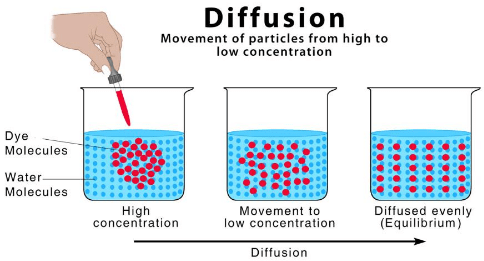
Q.4. What happens to the rate of diffusion if the temperature is increased?
Ans. With an increase in temperature, the rate of diffusion increases because particles gain more kinetic energy, move faster and mix more quickly.
Q.5. Name the state of matter that has the tendency to maintain its shape when subjected to outside force.
Ans. A solid tends to maintain its shape when subjected to an external force. Examples include a pen, a book or a wooden stick.
Q.6. Define melting point.
Ans. The melting point is the temperature at which a solid turns into a liquid at the normal atmospheric pressure.
Q.7. Define boiling point.
Ans. The boiling point is the temperature at which a liquid changes into vapour (gas) at the normal atmospheric pressure.
Q.8. Define latent heat of vaporization.
Ans. Latent heat of vaporisation is the heat energy required to convert 1 kg of a liquid into its vapour at its boiling point, at atmospheric pressure.
Q.9. Define latent heat of fusion.
Ans. Latent heat of fusion is the amount of heat energy required to change 1 kg of a solid into a liquid at its melting point, without any change in temperature.
Q.10. Define sublimation.
Ans. Sublimation is the process in which a solid changes directly into a gas without passing through the liquid state.
The reverse process, in which a gas changes directly into a solid, is called deposition.
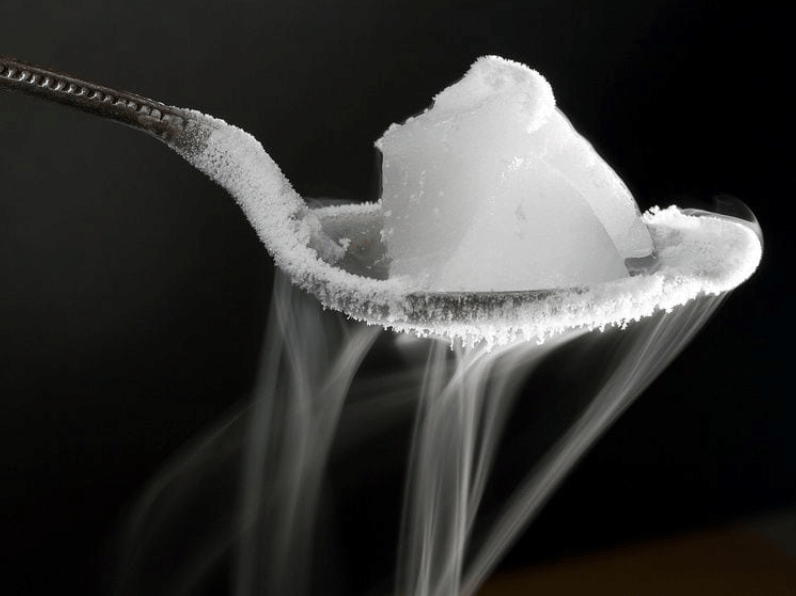 Sublimation
Q.11. What is dry ice?
Ans. Dry ice is the solid form of carbon dioxide (CO2). It does not melt at atmospheric pressure but sublimates directly to carbon dioxide gas. Its temperature is about -78.5°C.
Q.12. What is humidity?
Ans. Humidity is the amount of water vapour present in the air. When the air contains a large quantity of water vapour, it feels humid.
Q.13. Give two properties of a solid.
Ans.
(i) Solids have a fixed shape and are rigid.
(ii) Solids cannot be easily compressed because their particles are closely packed.
Q.14. What will happen if the pressure is reduced on solid carbon dioxide (dry ice)?
Ans. If the pressure on solid carbon dioxide is reduced, it will sublimate – that is, it will change directly from solid to gas without melting into a liquid.
Q.15. Name any three substances that show sublimation.
Ans. Ammonium chloride, camphor and naphthalene are examples of substances that undergo sublimation.
Q.16. Sponge is solid, but we can still compress it. Why?
Ans. A sponge is a solid with many tiny pores that trap air. When compressed, the air in these pores is pushed out and the sponge’s volume decreases, which makes it appear compressible even though the material is solid.
Q.17. What is normal atmospheric pressure?
Ans. Normal atmospheric pressure at sea level is defined as:
- 1 atmosphere (1 atm)
- which is equal to 1.013 × 10⁵ Pa.
Thus, standard atmospheric pressure is 1 atm at sea level.
Q.18. What is Kelvin?
Ans. Kelvin is the SI unit of temperature.
- 0°C is equivalent to 273.15 K.
- To convert from Kelvin to Celsius, subtract 273.15.
°C = K − 273 - To convert from Celsius to Kelvin, add 273.15.
K = °C + 273
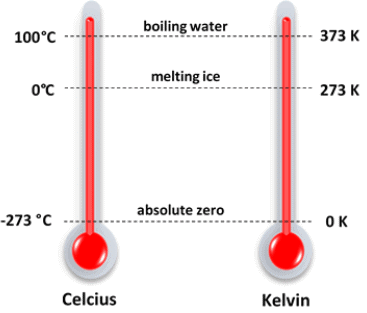 Temperature Scale in Degree and Kelvin
Q.19. Give two examples of diffusion.
Ans. Examples of diffusion:
- Milk drops spreading in water.
- Perfume sprayed in a room spreading its smell.
Q.20. Give the temperature at which water exists in two different phases/states.
Ans.
(i) At 0°C (273.15 K), water can exist as ice (solid) or as liquid water.
(ii) At 100°C (373.15 K) at 1 atm pressure, water can exist as liquid or as vapour (gas).
Short Answer Type Questions
Q.1. Why do we see water droplets collected on the outer surface of a glass container containing ice?
Ans. Water vapour in the air comes into contact with the cold outer surface of the glass, loses heat and changes into tiny liquid droplets. This process is called condensation.
Q.2. Explain why solids have a fixed shape but liquids and gases do not have a fixed shape.
Ans.Solids have particles held tightly in fixed positions by strong intermolecular forces, so they keep a definite shape. Liquids have weaker forces, allowing particles to move past each other; therefore liquids take the shape of their container. Gases have very weak forces and particles are far apart and move freely, so gases expand to fill any available space.
Q.3. Liquids and gases can be compressed but it is difficult to compress solids. Why?
Ans. Liquids and gases have noticeable space between their molecules, so applying pressure can push these molecules closer together – this makes them compressible. Solids have particles closely packed with very little space between them, so they cannot be easily compressed.
Q.4. A balloon, when kept in the sun, bursts after some time. Why?
Ans. The air inside the balloon heats up in sunlight. As temperature rises, air molecules gain kinetic energy and the gas expands, increasing the internal pressure on the balloon’s walls. If the pressure exceeds the elastic strength of the balloon, it bursts.
Q.5. Why do people perspire a lot on a hot, humid day?
Ans. The body sweats to cool down by evaporation of sweat. On a humid day the air already contains a lot of water vapour, so sweat evaporates more slowly and cooling is less effective; consequently, more sweat accumulates and we appear to perspire more.
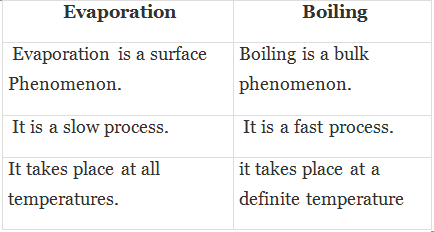
Q.6. Distinguish between evaporation and boiling.
Ans. Evaporation is the slow vapourisation of a liquid from its surface at any temperature below its boiling point. Boiling is rapid vapourisation that occurs throughout the liquid at a specific temperature called the boiling point. Evaporation occurs at the surface and causes cooling; boiling occurs throughout the liquid and produces bubbles of vapour.
Q.7. Why is it advisable to use a pressure cooker at higher altitudes?
Ans. At higher altitudes, atmospheric pressure is low, so the boiling point of water decreases. As a result, food cooks slowly. A pressure cooker increases pressure and raises the boiling point, allowing faster cooking.
Q.8. What are fluids?
Ans. Fluids are substances that can flow and take the shape of their container. They include:
- Liquids – definite volume but no fixed shape.
- Gases – neither definite volume nor definite shape.
Q.9. One kg cotton and one kg sand, which is more denser? Why?
Ans. One kilogram of sand is denser than one kilogram of cotton because density = mass/volume. Both masses are equal, but cotton occupies a much larger volume (because of trapped air), so its density is lower than that of sand.
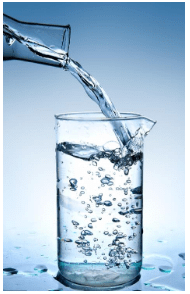
Q.10. Why is water liquid at room temperature?
Ans. At room temperature the intermolecular forces in water are not fully overcome by thermal energy, so water molecules remain close enough to form a liquid phase. The available thermal energy at room temperature is insufficient for water to become gas.
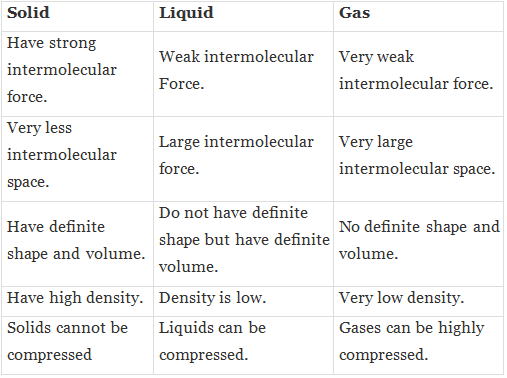
Q.11. State the differences between solid, liquid and gas.
Ans.
Q.12. Cotton is solid but it floats on water. Why?
Ans. Cotton contains many pores filled with air, which greatly increases its volume and reduces its average density. Because its density is lower than that of water, cotton floats. If the pores fill with water, the cotton becomes heavier and may sink.
Q.13. Why are solids generally denser than liquids and gases?
Ans. Density = mass/volume. In solids particles are packed closely, so a given mass occupies a small volume, producing higher density. Liquids and gases have larger intermolecular spaces, so for the same mass their volume is larger and density is lower.
Q.14. On a hot sunny day, why do people sprinkle water on the roof or open ground?
Ans. When water evaporates, it absorbs latent heat of vapourisation from the surrounding surface, causing cooling. Sprinkling water increases evaporation and thereby cools the roof or ground.
Q.15. On a hot sunny day, why do we feel pleasant sitting under a tree?
Ans. Leaves lose water by transpiration. The evaporating water cools the air nearby, making the shaded area under the tree feel cooler and more pleasant.
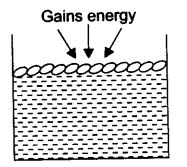
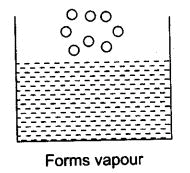
Q.16. The temperature at which liquids change into vapours is very high, for example, if water evaporates at 100°C, then how is water to evaporate at room temperature or at other temperatures?
Ans. Although the boiling point of water is 100°C, surface molecules of a liquid can gain enough energy from surroundings to escape into the vapour state at lower temperatures. This surface vapourisation at temperatures below the boiling point is evaporation. Examples: uncovered water drying and wet clothes drying at room temperature.
Q.17. Name the factors that affect evaporation.
Ans. The rate of evaporation depends on:
- Surface area: Larger area → faster evaporation.
- Temperature: Higher temperature → faster evaporation.
- Humidity: Lower humidity → faster evaporation.
- Wind speed: Higher wind speed removes vapour from the surface → faster evaporation.
Q.18. The melting point of ice is 273.16 K. What does this mean? Explain in detail.
Ans. The given value 273.16 K is essentially equivalent to 273.15 K (commonly used). This means:
- 273.15 K = 0°C, the temperature at which pure ice and water coexist in equilibrium at 1 atm pressure.
- When ice at 0°C is heated, it absorbs heat but its temperature stays constant until all ice melts; the absorbed heat is used to overcome attractive forces between molecules (latent heat of fusion).
- After all ice melts, further heating raises the temperature of the water.
Q.19. How is the high compressibility property of gas useful to us?
Ans. High compressibility allows large volumes of gas to be stored in small cylinders for transport and use. Examples include LPG and CNG for cooking and vehicles, and medical oxygen cylinders. Compressibility saves space and makes handling easier.
Q.20. With the help of an example, explain how diffusion of gases in water is essential.
Ans. Diffusion of gases into water is essential for aquatic life. For example:
- Oxygen from air dissolves into pond water and diffuses to fish and other organisms for respiration.
- Carbon dioxide dissolves and is used by aquatic plants for photosynthesis.
Long Answer Type Questions
Q.1. Pressure and temperature determine the state of a substance. Explain this in detail.
Ans.
(a) Increasing temperature gives particles more energy. For example, heating ice causes its temperature to rise until it reaches its melting point. At that temperature the solid melts to a liquid; further heating converts the liquid to vapour.

(b) Decreasing temperature removes energy from particles. For example, cooling steam causes it to condense into water, and further cooling of water leads to freezing into ice.

(c) Changing pressure can also change the state. Increasing pressure can liquefy gases (as in LPG cylinders where gas is stored as liquid under pressure). Reducing pressure can cause solids like dry ice (solid CO2) to sublimate directly into gas. Thus the combination of temperature and pressure determines whether a substance is solid, liquid or gas.
Q.2. Explain, giving examples, the various factors on which the rate of evaporation depends.
Ans. The rate of evaporation depends on:
- Surface area: A larger surface area exposes more molecules to escape into the vapour and so increases evaporation. For example, spreading wet clothes or placing tea in a saucer helps them cool and dry faster.
- Temperature: Higher temperature supplies more energy to surface molecules so more of them escape as vapour. Water evaporates quicker in sunlight than in the shade.
- Humidity: If the air already contains a lot of water vapour (high humidity) its capacity to take more vapour is reduced and evaporation slows down. This is why wet clothes dry slowly on humid days.
- Wind speed: Air movement carries away the vapour near the surface, lowering local humidity and increasing evaporation. A breeze speeds up drying.
Value-Based Answer Type Questions
Q.1. Adil parked his bicycle on a sunny day in a parking stand on his school campus. When the school got over, Adil saw his burst cycle type. Thereafter, he kept less air in his cycle types and did not inflate them fully.
(a) Why did the tyre burst?
(b) Why is air compressible?
(c) What value of Adil is reflected in the above act?
Ans.
(a) The tyre burst because the air inside it heated up in the sun, expanded and exerted extra pressure on the tyre walls. If this pressure exceeded the tyre’s strength, it caused the tyre to burst.
(b) Air is compressible because its molecules are far apart with significant space between them, so they can be pushed closer together under pressure.
(c) Adil showed the values of prudence and responsibility by deciding to keep less air to avoid future bursts. He demonstrated awareness of safety.
Q.2. Akshay’s friend visited his house in Mumbai and he was surprised to see air conditioners installed in all of his rooms. His friend advised Akshay to use water coolers and save electricity. On this, Akshay told him that the water-cooler is not at all effective in coastal areas.
(a) Why are water-coolers not effective in coastal areas?
(b) What are the other two factors on which evaporation of water depends?
(c) What value of Akshay’s friend is seen in this act?
Ans.
(a) Water coolers work by evaporative cooling. In coastal areas the humidity is already high, so the air cannot accept much more moisture and evaporation (and hence cooling) is reduced.
(b) Two other factors affecting evaporation are temperature and surface area.
(c) Akshay’s friend showed the values of environmental concern and thoughtfulness by suggesting an energy-saving alternative.
Q.3. Sita lived in a village and could not afford a refrigerator in her house. She knew how to keep water cold and preserve all perishable items in her house. She kept an ivet cloth surrounding the earthen pot to keep water cool. She also kept vegetables fresh by keeping them in wet gunny bags and sprinkled water over them in a timely manner.
(a) Why did Sita keep wet cloth surrounding the earthen pot?
(b) Suggest one more method of keeping the house cool in summer.
(c) What value of Sita is reflected in the above case?
Ans.
(a) The wet cloth surrounding the earthen pot keeps water cool because the water in the cloth evaporates, and evaporation absorbs heat from the pot, producing a cooling effect.
(b) Sprinkling water on the courtyard or veranda or keeping windows shaded with curtains are simple methods to keep the house cooler in summer.
(c) Sita showed practical wisdom, resourcefulness and a responsible attitude towards using simple, low-cost methods for cooling and preservation.
Q.4. Shreya commutes in a CNG-fitted van to school every day along with many other students. She told the van driver to get the CNG connection certified and timely check it for any leakage or loose connection of pipes. She told the driver to be more careful during summer.
(a) What is CNG?
(b) Why should one be more careful with CNG cylinders during summer?
(c) What value of Shreya is seen in the above act?
Ans.
(a) CNG stands for Compressed Natural Gas, a fuel stored at high pressure in cylinders.
(b) In summer the temperature rises and gas inside cylinders expands, increasing pressure. Any leakage or faulty connection can lead to fire or explosion, so regular checks and certification are necessary for safety.
(c) Shreya demonstrated responsibility, care for others’ safety and civic-minded behaviour by ensuring regular checks and safe use of fuel systems.