Q1. How did the chance discovery of a paper book leave Margie and Tommy stunned?
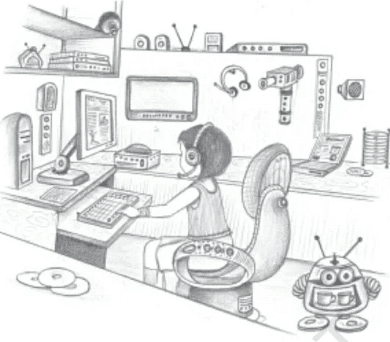
Mergie studying in her room
Ans: In the year 2157, Margie and Tommy are friends living in a world dominated by automation and technology. Instead of attending traditional schools, children learn from a mechanical teacher that customises lessons based on their individual needs.
One day, Tommy discovers an old, dusty paper book in his attic. He excitedly shares this find with Margie, and they are both amazed, as they have never seen a book without a screen. They find it fascinating that:
- The book has fixed text on pages that must be flipped manually.
- Ancient schools were large buildings where many children studied together.
- Students learned the same subjects and participated in the same activities.
- Real human teachers taught them using actual books.
Margie reflects on how much fun it must have been for children in the past to learn together, which contrasts sharply with her own experience of studying alone with a mechanical teacher.
Q2. What are the main features of the mechanical teachers and the schoolrooms that Margie and Tommy have in the story?
Ans: In the year 2157, Margie and Tommy attend a unique form of education featuring:
- Home-based schoolrooms: Their classrooms are located in their own homes, eliminating the need for a separate school building.
- Mechanical teachers: Each student learns with a mechanical teacher that provides lessons and assessments.
- Individualised learning: Students study alone, with the mechanical teacher adjusting the pace based on their age and progress.
- Assessment process: Homework is submitted through a slot in the mechanical teacher for grading.
- Technical support: If the mechanical teacher breaks down, engineers are available for repairs, although this can take time.
This system represents a significant shift from traditional education, focusing on technology and individual learning.
Q3. Why did Margie hate school? Why did she think the old kind of school must have been fun?
Ans: Margie hated school because it lacked fun and excitement. Her daily schedule was strict, requiring her to study at set times throughout the week, except on weekends. She had no classmates to interact with or seek help from, which made learning feel isolating. Additionally, her mechanical teacher sometimes malfunctioned, leading to challenging tests that she often struggled to pass. This constant disappointment made her wish for a break, but the advanced technology of 2157 offered her no respite.
Margie believed that the old kind of school must have been enjoyable because it was a lively environment. In those schools, children from the neighbourhood gathered together, laughing and playing. They learned in the same room, taught by human teachers, which allowed them to support one another with homework and share experiences. This sense of community and camaraderie in the old schools contrasted sharply with her own solitary learning experience.
Q4. Suppose you are Margie. Write a diary entry dated 17th May 2157 about Tommy’s real book that he found in his attic.
Ans: Tuesday, 17th May 2157, 10.00 p.m.
Dear Diary,
Today has been amazing! I saw a real, hard-bound printed book for the first time. Tommy discovered it while cleaning his grandfather’s attic. Here are some details:
- The book has around 200 pages that are yellow and crinkly from age.
- Reading it is different; the words are fixed on the pages, unlike my telebooks that scroll.
- It tells about a school from two centuries ago, which was a dedicated building for teaching.
- Students of the same age learned together in a classroom.
- Teachers were real people, not machines!
It’s fascinating to think about how much fun it must have been for children back then—playing, laughing, and helping each other with lessons. I wish I could travel back in time and experience one of those schools!
Q5. Do you agree with Margie that schools today are more fun than the school in the story? Give reasons for your answer.
Ans: There is no doubt that today’s schools are more fun than the schools discussed in the story.
- In the story, Margie has a mechanical teacher that lacks emotions and understanding.
- This robot-like teacher teaches based on fixed instructions, ignoring each child’s unique needs.
- Modern schools, in contrast, focus on the overall development of children.
- They provide training in areas such as leadership, sports, politics, and science.
- Students learn to adapt, meet new people, and thrive in diverse environments.
- Today’s classrooms promote unity and inclusion, bringing together students of all backgrounds.
- These activities foster a sense of belonging, helping to prevent feelings of loneliness or exclusion.
Q6. Will the existing schools and teachers become totally irrelevant in future ‘schools’? Give a reasoned answer.
Ans: Schools will undoubtedly change over the centuries. The future of education will be:
- Highly computerized and mechanical.
- Without a separate building for schools.
- Utilising mechanical teachers, like large screens capable of accessing vast amounts of information.
- Personalised to each student’s age and ability.
However, it is an exaggeration to claim that traditional schools and teachers will become completely irrelevant. Key points include:
- Future schools will still require a human element.
- The institution of schools and the role of teachers may persist.
- Human involvement in education is essential and cannot be entirely replaced.
Q7. Describe the characteristics of old schools. How did they arouse so much interest in Margie and Tommy?
Ans: The characteristics of old schools were quite different from those of Margie and Tommy’s mechanical school:
- Each school had its own unique buildings.
- Students from the entire town attended, creating a sense of community.
- Everyone learned the same subjects and had similar homework, making it easier to help each other.
- Teachers were real people, and students used paper books.
This sense of excitement and adventure in old schools intrigued Margie. She learned about them from Tommy, and compared to her mechanical teacher, these schools seemed almost magical. The idea of children learning together and supporting one another fascinated her.