Q.1. Which of the following is an irrational number?
(a) 
(b) √3(c) 1/2
(d) 
Ans.An irrational number is a number that cannot be expressed as a fraction of two integers and has an infinite non-repeating decimal representation.
Let’s evaluate the options:
(a) √49/64: This is a rational number because both the numerator and denominator are perfect squares, and their square root can be expressed as a fraction of integers. √49/64 = 7/8.
(b) √3: This is an irrational number because the square root of 3 cannot be expressed as a fraction of integers, and its decimal representation goes on infinitely without repeating.
(c) 1/2: This is a rational number because it can be expressed as a fraction of integers.
(d) -√1/4: This is a rational number because √1/4 = 1/2, and the negative sign only changes the sign of the rational number.
So, the irrational number among the given options is: (b) √3
Q.2. The number in p/q form is
(a) 267/1000
(b) 26/10
(c) 241/900
(d) 241/999
Ans. (c)
Solution:let x be the p/q form, x =
multiply both side by 100,
100 x =  …(i)
…(i)
multiply both side by 10
1000 x =  ….(ii)
Subtract (ii) – (i)
1000 x – 100 x = 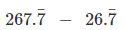
900 x = 241
⇒ x = 241/900
Hence, option (c) is correct
Try yourself:
Q3: Every point on the number line represents, which of the following numbers?
A.Natural numbers
B.Irrational number
C.Rational number
D.Real numberExplanation
Ans. Every point on the number line represents
a: Real number as the number line represents all real numbers, which includes natural numbers, whole numbers, integers, rational numbers, and irrational numbers, but not imaginary numbers.
Q.4. The decimal representation of a rational number is either:(a) Terminating or repeating
(b) Non-terminating and non-repeating
(c) Only terminating
(d) Only repeating
Ans: (a) Terminating or repeating
A rational number is any number that can be expressed as a fraction , where p and q are integers and
A terminating decimal is one that has a finite number of digits after the decimal point.
A repeating decimal is one where a block of digits repeats infinitely.
Q.5. Insert 3 irrational number between 2.6 and 3.8
Ans. 2.6 and 3.8
Irrational numbers are non repeating non – terminating
2.61010010001…..
2.802002000200002……
3.604004000400004…….
Q.6. What is the decimal form of the following no’s.
(a) 18/11
(b) 3/26
(c) 1/17
(d) 2/13
Ans.(a) 18/11 = 1.63636363…
(b) 3/26 = 0.11538461538
(c) 1/17 = 0.05882352941
(d) 2/13 = 0.15384615384
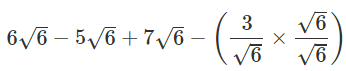
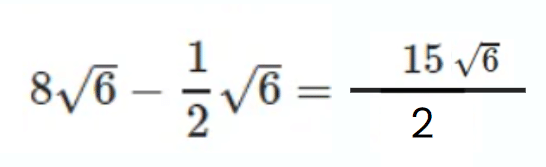
Q.8. Simplify: 
Ans.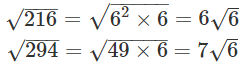
Q.9. Rationalise: 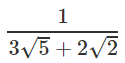
Ans.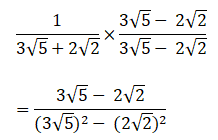
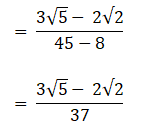
Q.10. Find the value of 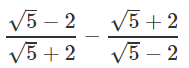
Ans.
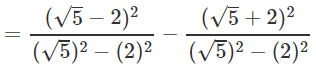
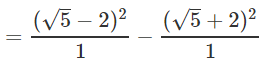 = 5+4 – 4√5 – 5 – 4 – 4√5 = -8√5
Q.11. If 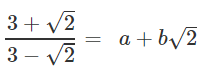 ,find the value of a & b.
Ans.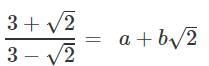 Rationalising LHS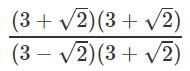
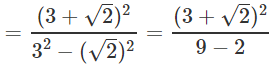
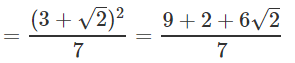
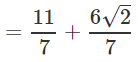
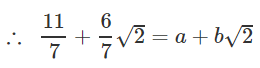 ∴ a = 11/7 and b = 6/7
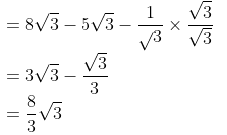
Q.12. Evaluate: 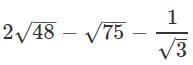
Ans.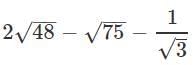
Q.13. Write the value of 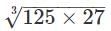
Ans.
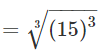 = 15
= 15
Q.14. Express  in p/q form.
Ans.let x be the p/q form,so, x =  10x =
10x =  1000x =
  1000x – 10x =
  –
–  990x = 15555x= 15555/990= 1037/66
Q.15. Insert five rational no’s between 3/5 and 4/5.
Ans.3/5 and 4/5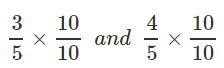 30/50 and 40/50∴ pick any five number between 30 and 4031/50, 32/50, 36/50, 37/50, 39/50