Reflect and Respond
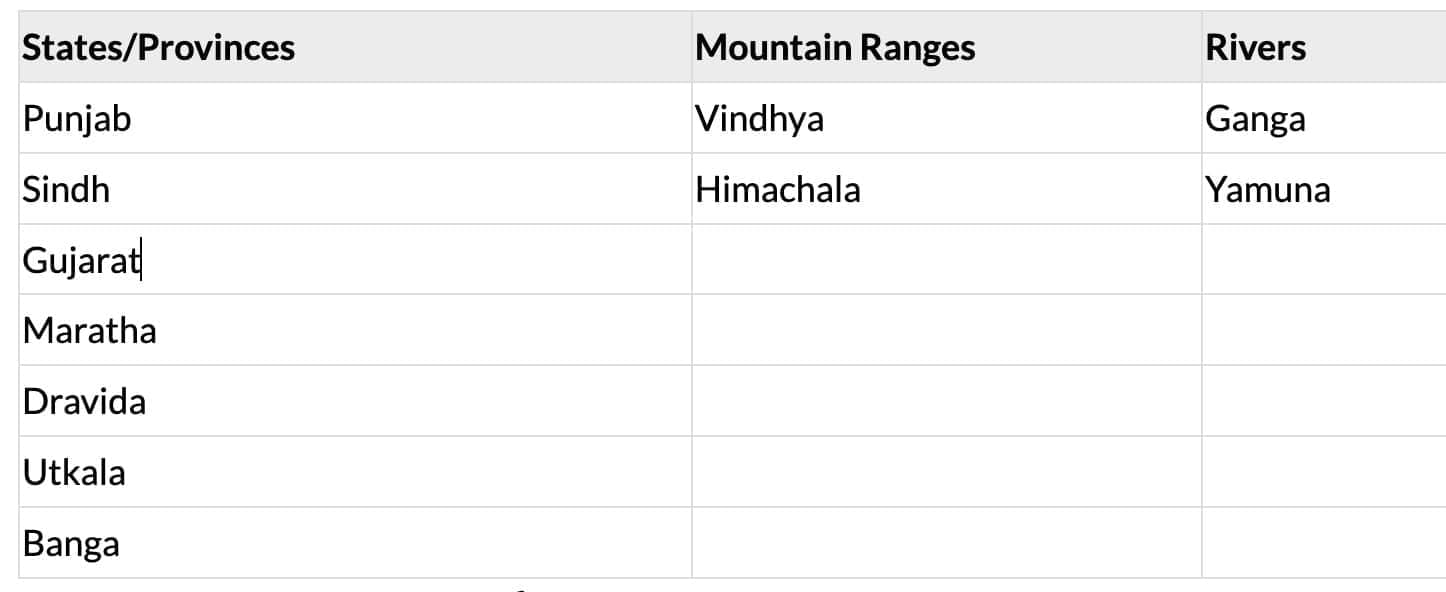
I. Recall the lines of the National Anthem and complete the table with the names of the states, mountain ranges, and rivers mentioned in it.
II. Discuss what the words ‘जय हे’ (Jaya he) in the last two lines of the National Anthem convey.
Ans: “Jaya he” means “Victory to you” or “May you be victorious.” Its repetition in the National Anthem expresses a heartfelt prayer for India’s glory, unity, and prosperity, reflecting patriotism, hope, and devotion to the nation.
III. Read the underlined words in the given lines of the poem. Choose the odd one out that does not correspond with the meaning of the underlined word.
- 1. She’s peerless, let’s praise her!
Options: valuable, incomparable, unmatched
Ans: valuable — “Peerless” means having no equal; incomparable and unmatched fit, but valuable does not. - 2. Many a sage has sanctified this land.
Options: blessed, purified, applauded
Ans: applauded — “Sanctified” means blessed or purified; applauded is unrelated. - 3. And here all auspicious things are found.
Options: fortunate, fantastic, favourable
Ans: fantastic — “Auspicious” means favourable or fortunate; fantastic does not match. - 4. Of hoary antiquity is Bharat,
Options: ancient times, recent past, time immemorial
Ans: recent past — It means very ancient; recent past is the opposite.
Check Your Understanding
I. Fill in the blanks by choosing appropriate words from the box to complete the summary of the poem.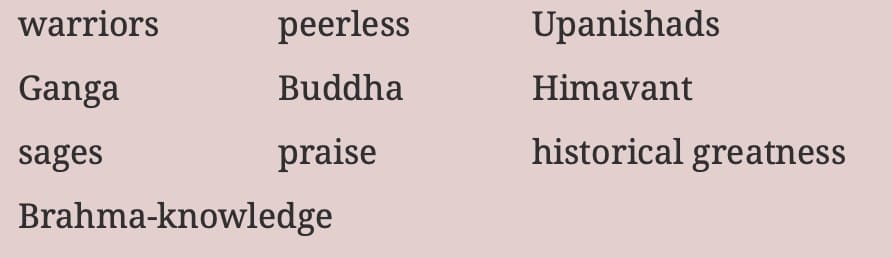
The poem is a tribute to India, celebrating its natural beauty, spiritual heritage, and 1. _______. The poet praises the 2. _______, describing it as mighty and unparalleled. The 3. _______ is depicted as generous and graceful, while the 4. _______ are honoured as sacred and unmatched. The poem highlights the contributions of 5. _______ and 6. _______ who have enriched the land with their bravery and wisdom. It also acknowledges the presence of 7. _______ and the teachings of8. _______, highlighting India’s deep-rooted spiritual and philosophical traditions. The poet repeatedly asserts that India is 9. _______, urging everyone to10. ________ her
Ans The poem is a tribute to India, celebrating its natural beauty, spiritual heritage, and 1. historical greatness. The poet praises the 2. Himavant, describing it as mighty and unparalleled. The 3. Ganga is depicted as generous and graceful, while the 4. Upanishads are honoured as sacred and unmatched. The poem highlights the contributions of 5. warriors and 6. sages who have enriched the land with their bravery and wisdom. It also acknowledges the presence of 7. Brahma-knowledge and the teachings of 8. Buddha, highlighting India’s deep-rooted spiritual and philosophical traditions. The poet repeatedly asserts that India is 9. peerless, urging everyone to 10. praise her.
II. Complete the following features about the poem.
1. The impact on the readers (mood): The poem creates a mood of pride, admiration, reverence, and patriotism. Its celebratory tone and repeated refrain inspire joy and a deep emotional connection with India’s heritage.
2. The poet’s attitude (tone): The tone is reverential, celebratory, and patriotic, expressing pride, devotion, and awe for India’s natural, spiritual, and cultural richness.
3. The rhyme scheme: The poem does not follow a strict rhyme scheme. It has a loose pattern with occasional rhymes and a chant-like, free verse rhythm.
4. Examples of personification:
- The Ganga is described as “generous” — a human quality attributed to a river.
- India (Bharat) is referred to as “she” and “her” throughout, personifying the land as a woman deserving of praise.
III. What is the impact of the refrain, ‘she’s peerless, let’s praise her!’?
Ans:
- It acts as a rallying cry, urging readers to celebrate India.
- Its repetition reinforces the idea that India is unmatched and worthy of honour.
- It gives the poem a chant-like, hymn-like quality.
- The word “let’s” makes it inclusive, creating a sense of collective pride.
- It builds an emotional crescendo, ending each stanza with a shared declaration.
IV. Complete the following sentence appropriately.
India is metaphorically described as ‘this sunny golden land,’ suggesting that it is ________.
Ans: India is metaphorically described as ‘this sunny golden land,’ suggesting that it is a land of warmth, radiance, and abundant richness — both materially and spiritually — glowing with light, life, and unmatched splendour.
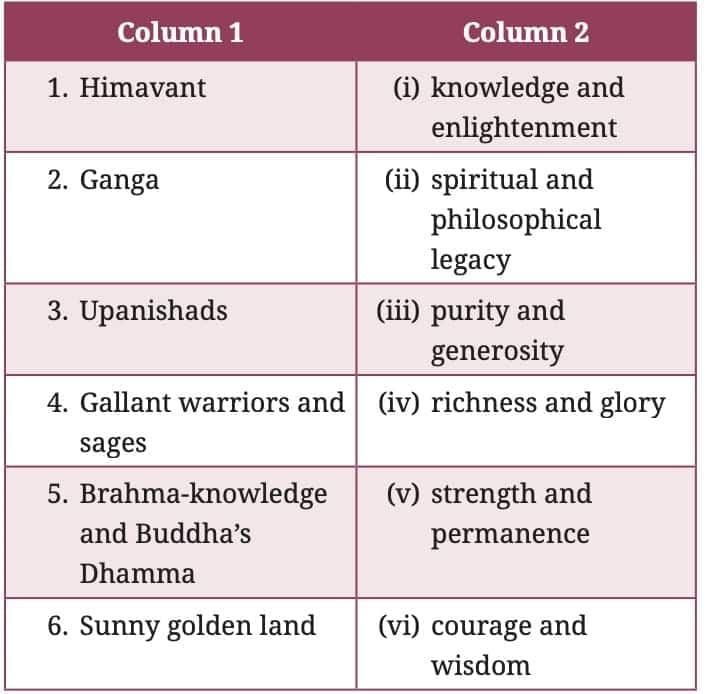
V. The poet uses symbolism. Match the symbols in Column 1 to what they suggest in Column 2.
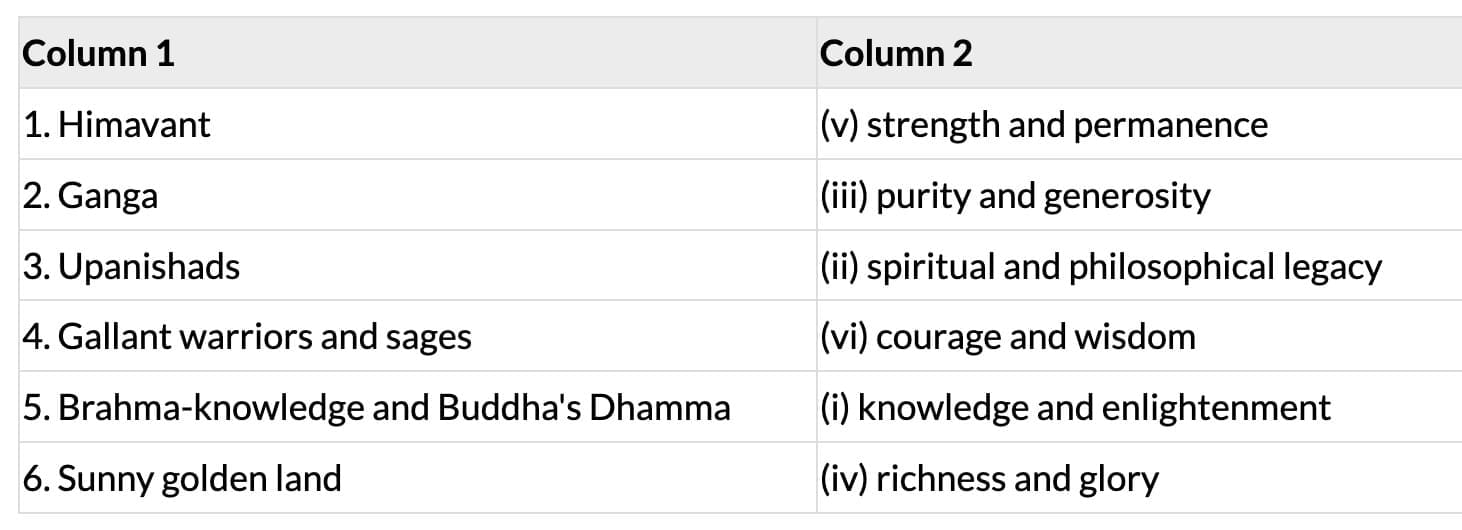
Ans
VI. The poet uses imagery. Give any two examples from the poem.
Ans:
- Example 1 — Visual Imagery: “The mighty Himavant is ours — there’s no equal anywhere on earth.” The word mighty creates a vivid picture of the grand, majestic Himalayas, evoking awe and grandeur.
- Example 2 — Auditory Imagery: “The divinest music has been heard here” creates an auditory image of melodious chants, appealing to the sense of hearing and giving a feeling of spiritual elevation.
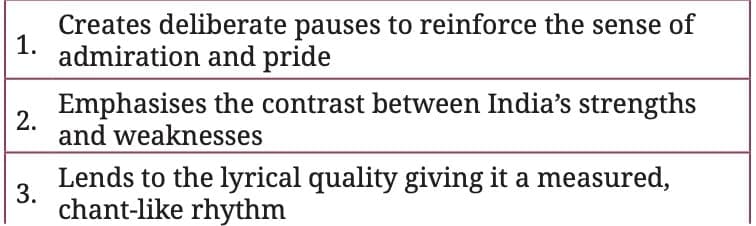
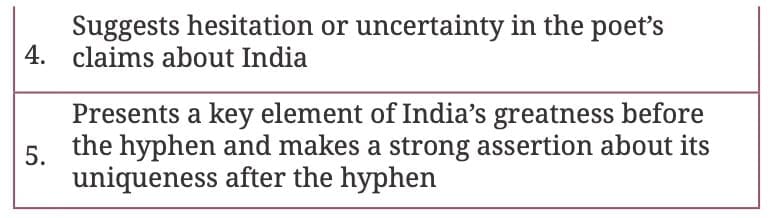
VII. What is the impact of the use of hyphens in the first stanza? Select the options that are true.
Ans: The options that are true are:
- 1. Creates deliberate pauses to reinforce the sense of admiration and pride.
- 3. Lends a lyrical, measured, chant-like rhythm to the poem.
- 5. Presents a key element of India’s greatness before the hyphen and makes a strong assertion about its uniqueness after it (e.g., “The mighty Himavant is ours–” followed by “there’s no equal anywhere on earth”).
The options that are false are:
- 2. FALSE — The poem does not discuss India’s weaknesses; it is purely celebratory.
- 4. FALSE — The poet’s tone is confident and assured, not hesitant.
VIII. The poet uses hyperbole in the poem. Identify examples and explain.
Ans: Hyperbole is the use of extreme exaggeration to emphasise a point.
- “The mighty Himavant is ours — there’s no equal anywhere on earth.” — While the Himalayas are the world’s highest range, claiming “no equal anywhere on earth” is an exaggeration to emphasise India’s pride in this natural wonder.
- “The generous Ganga is ours — which other river can match her grace?” — The rhetorical question implies no river can compare to the Ganga, exaggerating her supremacy to highlight her spiritual and cultural significance.
- “The sacred Upanishads are ours — what scriptures else to name with them?” — This implies no other scripture deserves comparison, exaggerating to elevate India’s philosophical heritage.
IX. The poem is an ode. Identify examples from the poem that correspond to it being an ode.
Ans: An ode is a lyrical poem expressing deep admiration for its subject in an elevated style.
- Deep admiration: Every stanza praises India — its mountains, rivers, scriptures, warriors, sages, music, and philosophies (e.g., “The mighty Himavant is ours,” “The generous Ganga is ours”).
- Elevated language: Words like “mighty,” “peerless,” “divine,” “sacred,” “gallant,” and “auspicious” give the poem a grand, formal tone.
- Emotional intensity: The repeated refrain “she’s peerless, let’s praise her!” is charged with enthusiasm, typical of an ode.
- Reverence for the subject: The poet treats India almost as a deity — referring to her as “she,” calling her peerless, and urging collective praise — hallmarks of an ode’s reverential attitude.
X. The poet uses allusion in the poem. Identify the matching allusions for the following.
Ans:
- An allusion to ancient Indian scriptures symbolising deep wisdom and enlightenment:
→ “The sacred Upanishads are ours” — The Upanishads are ancient philosophical texts forming the basis of Hindu thought, dealing with the nature of the self and ultimate reality. - An allusion to spiritual knowledge associated with self-realisation and ultimate truth:
→ “Here Brahma-knowledge has taken root” — Brahma-vidya is the highest spiritual knowledge in Indian philosophy, concerned with understanding ultimate reality (Brahman) and achieving self-realisation. - An allusion to Gautama Buddha’s teachings of compassion, non-violence, and enlightenment:
→ “and the Buddha preached his dhamma here” — A direct allusion to Gautama Buddha, who attained enlightenment and preached his dhamma at Bodh Gaya and Sarnath on Indian soil.
Critical Reflection
I. Read the extract given below and answer the questions that follow.
The mighty Himavant is ours–
there’s no equal anywhere on earth.
The generous Ganga is ours–
which other river can match her grace?
The sacred Upanishads are ours–
what scriptures else to name with them?
1. Complete the sentence.
The word ‘mighty’ refers to the ________ of the Himavant.
Ans: The word ‘mighty’ refers to the immense size, power, strength, and towering grandeur of the Himavant (the Himalayas), suggesting it is not just physically enormous but also commands awe and reverence.
2. Choose the correct option to complete the sentence given below.
The question mark at the end of the fourth and sixth line of the extract is used to __________.
(i) show doubt and uncertainty
(ii) emphasise a point
(iii) highlight confusion and hesitation
(iv) reveal inquiry and curiosity
Ans: (ii) emphasise a point.
These are rhetorical questions, not genuine queries. “Which other river can match her grace?” and “What scriptures else to name with them?” both assert emphatically that nothing can compare — the question marks emphasise the peerless greatness of the Ganga and the Upanishads.
3. The poet uses the word ‘generous’ to describe the Ganga. Why?
Ans: The poet uses ‘generous’ because the Ganga has freely given water, sustenance, and spiritual purification to millions across India for thousands of years. It nourishes the vast Indo-Gangetic plain and is believed to cleanse the souls of those who bathe in it — giving freely without asking anything in return. The word also personifies the river as a benevolent, motherly figure.
4. Why has the movement of the river been described as graceful?
Ans: The Ganga flows with a serene, majestic, and dignified quality — unhurried and composed as it moves through the plains. The word “grace” also has a spiritual dimension: the Ganga is revered as a goddess (Ganga Devi) believed to have descended from heaven, making her flow divine and elegant. Personifying her movement as graceful elevates her from a mere river to a symbol of divinity and benevolence.
5. Fill in the blank with the correct option from the words given in the brackets.
The poet is implying that the Upanishads are _________ (unmatched/abundant) in their wisdom and spiritual depth.
Ans: The poet is implying that the Upanishads are unmatched in their wisdom and spiritual depth. The rhetorical question “What scriptures else to name with them?” asserts that no other scripture can be placed alongside them — they stand supreme in philosophical and spiritual insight.
II. Answer the following questions.
1. How does the poem reflect a strong connection to cultural identity and heritage?
Ans: The poem reflects cultural identity through references to India’s defining elements:
- The Himavant represents India’s geographical identity.
- The Ganga represents its cultural and spiritual identity — a sacred river around which civilisations have grown.
- The Upanishads represent India’s intellectual and philosophical heritage.
- Gallant warriors and sages reflect India’s historical identity — brave defenders and wise thinkers who shaped its destiny.
- Brahma-knowledge and the Buddha’s dhamma represent India’s dual spiritual heritage — Vedic and Buddhist — both born on Indian soil.
- “The divinest music” alludes to India’s rich classical musical tradition. Together, these create a composite portrait of India’s ancient, deep-rooted, and unmatched civilisation.
2. What can you infer about the poet’s attitude towards India from the repeated phrase ‘she’s peerless, let’s praise her!’?
Ans:
- Deep patriotism and devotion: The poet treats India as a beloved mother figure deserving the highest honour.
- Unwavering pride: The word “peerless” reveals the poet’s absolute conviction that India is unequalled — stated with total confidence.
- A desire to inspire others: “Let’s praise her” is a collective call to action, mobilising every Indian to celebrate their homeland — reflecting his role as a nationalist using poetry to awaken pride and unity.
- Reverence bordering on worship: The repetition of the refrain gives the poem a devotional, hymn-like quality, suggesting the poet views India almost as a divine entity.
3. What does the line ‘many a sage has sanctified this land’ suggest about India’s spiritual heritage?
Ans:
- India has been home to countless sages and saints — like Vyasa, Valmiki, Adi Shankaracharya, and Kabir — who left a deep spiritual imprint on the land.
- “Sanctified” means to make holy — their tapas (penance), wisdom, and teachings have consecrated the very soil of India.
- “Many a sage” implies an unbroken line of spiritual masters across centuries, reflecting the continuity and depth of India’s spiritual tradition.
4. How does the poet connect warriors and music to India’s greatness?
Ans:
- “Gallant warriors have lived here” — acknowledges India’s martial heritage, representing strength, courage, and sacrifice alongside its spiritual greatness.
- “The divinest music has been heard here” — elevates India’s classical music traditions (Carnatic and Hindustani) to a divine level, presenting them as vehicles of devotion and beauty.
- By placing warriors and music together, the poet presents India as a complete civilisation — powerful in arms, exquisite in art, and rich in spirit.
5. How does this poem foster a sense of national pride?
Ans:
- Celebrating natural wonders: References to the Himalayas and the Ganga remind Indians of their incomparable geographical heritage.
- Honouring intellectual wealth: References to the Upanishads, Brahma-knowledge, and the Buddha’s dhamma highlight India’s profound philosophical contributions to the world.
- Recognising heroes: Mention of gallant warriors and sages honours those who built and protected the nation.
- Repeated use of “ours”: “The mighty Himavant is ours,” “The generous Ganga is ours” — this inclusive language creates a sense of collective ownership and belonging.
- The refrain: “She’s peerless, let’s praise her!” acts as a rallying cry, uniting all Indians in a shared celebration of their homeland.
Vocabulary in Context
I. Complete the table by choosing words from the poem.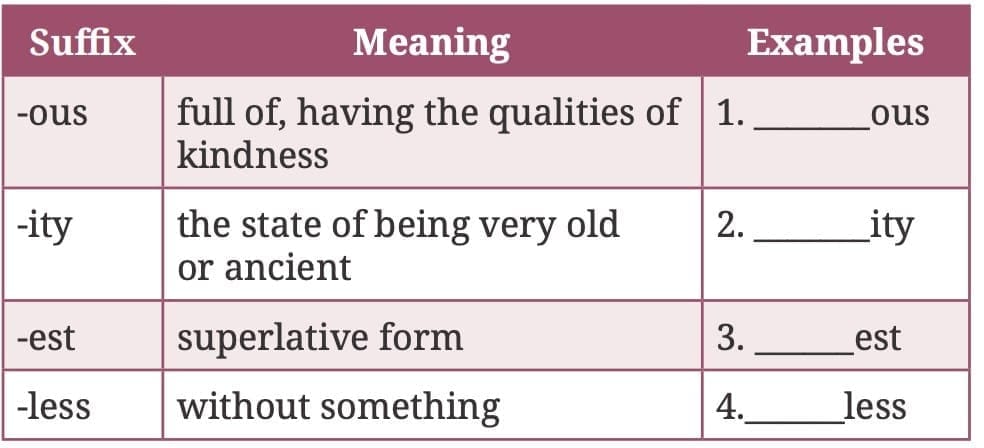
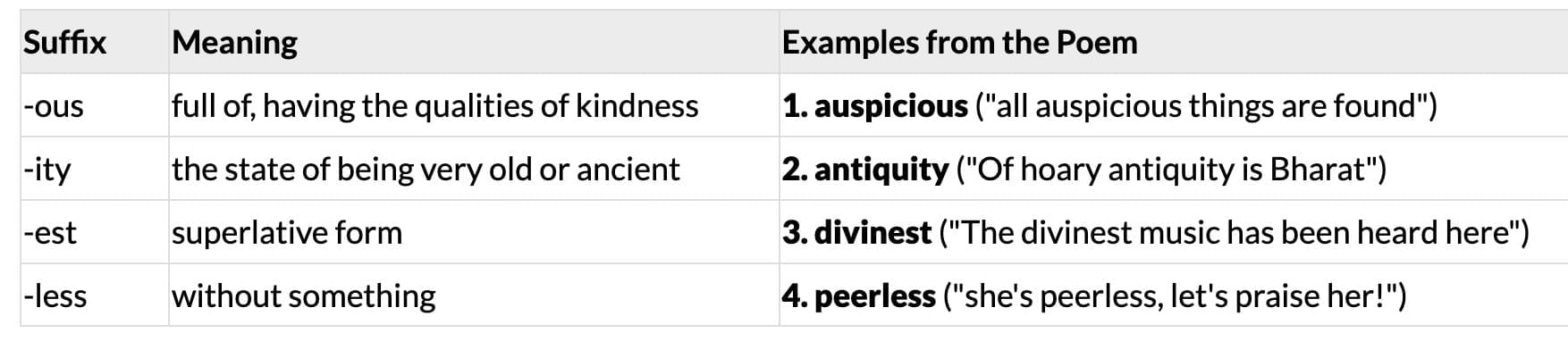
Ans:
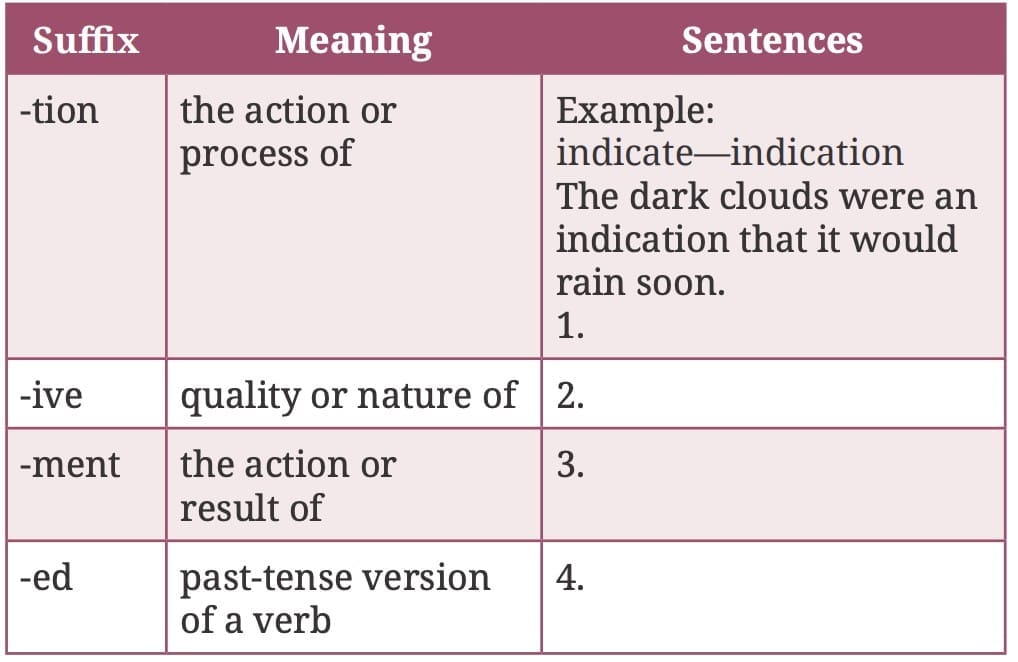
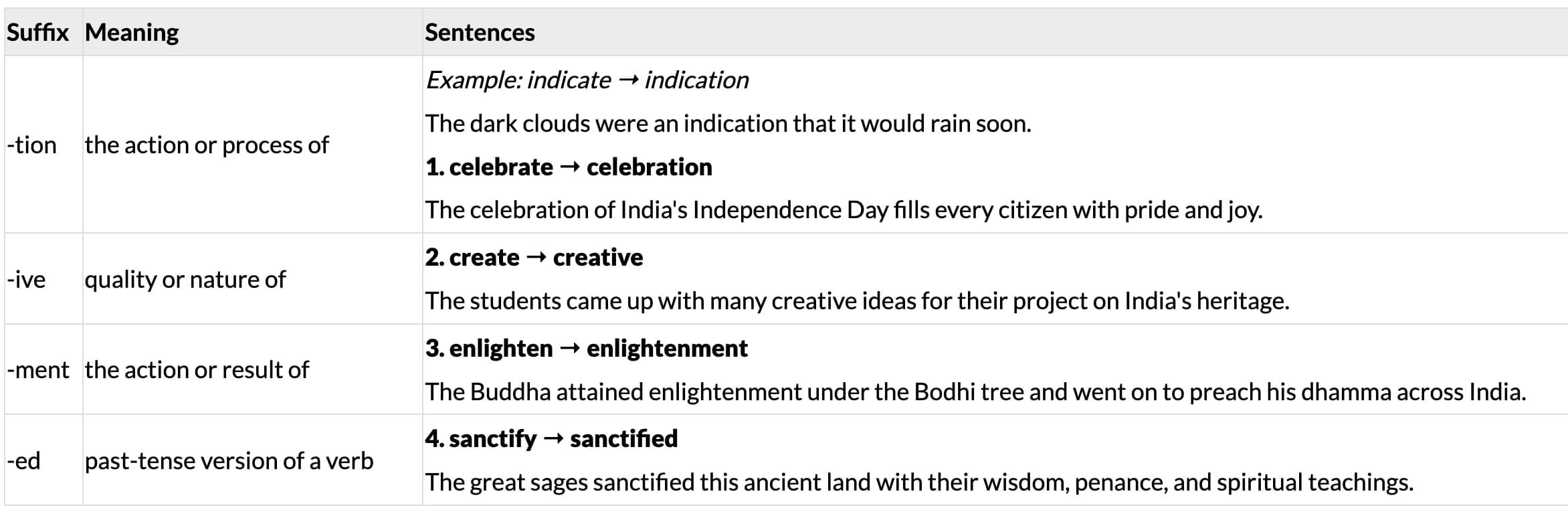
II. Complete the following table by adding a different suffix to form new words. Also, create a sentence using the created word.Ans:
Speaking Activity
I. In pairs, take turns to speak about the aspects of your village/town/city that you feel are an asset. It could be about geographical, cultural, traditional features, or even its history.
Use these cues to express your praise and admiration.
- One thing that I find truly wonderful about my village/town/city is…
- If I had to describe my village/town/city in one word, it would be…
- I have always been fascinated by the way the people of my village/town/city…
- What I want other people to know about my village/town/city is…
- When it comes to the scenery, my village/town/city truly shines because…
- I feel a deep sense of pride when I think about my village/town/city…
Note: These are sample answers for the city of Chandigarh. Students may adapt these for their own city, town, or village.
Sample Response 1:
One thing that I find truly wonderful about my city, Chandigarh, is its urban planning. It is one of the few cities in India — and indeed in Asia — that was planned from scratch as a modern city. Designed by the famous Swiss-French architect Le Corbusier, the city is laid out in neat sectors, each with its own market, school, and parks. The wide roads, green belts, and absence of traffic congestion make it one of the most liveable cities in the country.
Sample Response 2:
If I had to describe my city in one word, it would be — green. Chandigarh has an extraordinary number of parks and open spaces for a city of its size. The Rock Garden, Sukhna Lake, the Rose Garden — the largest rose garden in Asia — and the numerous sector parks make the city feel like a garden in itself. I have always been fascinated by the way the people of Chandigarh take pride in keeping their city clean and well-maintained.
Sample Response 3:
What I want other people to know about my city is its deep cultural richness. Being the shared capital of Punjab and Haryana, it sits at the confluence of two vibrant cultures. The food — from the buttery parathas to the rich dals and the famous Punjabi lassi — is a cultural experience in itself. When it comes to the scenery, my city truly shines because of its proximity to the Shivalik hills, which form a stunning backdrop and offer trekking, nature walks, and a refreshing escape from city life. I feel a deep sense of pride when I think about Chandigarh — it is a city that has managed to be both modern and rooted in its cultural traditions at the same time.
Writing Task
I. Write a paragraph about a place that you have visited which has stayed in your memory.
One of the most unforgettable places I have ever visited is the town of Mcleod Ganj in Himachal Pradesh. My family and I travelled there during the summer holidays, primarily to escape the heat of the plains and to experience the mountains for the first time. Before the trip, we researched the place thoroughly — reading about its Tibetan culture, its monasteries, and its trekking trails — and packed warm clothes, sturdy shoes, and a camera. We stayed at a small guesthouse with a balcony that looked directly at the Dhauladhar range, and every morning I woke up to the breathtaking sight of snow-capped peaks emerging from the clouds. During our stay, we visited the Namgyal Monastery, walked through the lively Tibetan market, tasted momos and thukpa at a small café, and trekked to Triund — a high meadow from which the view of the mountains was so vast and glorious that I stood speechless for several minutes. The fresh mountain air, the sound of prayer flags fluttering in the wind, and the gentle chanting from the monastery have stayed with me long after the trip ended. It was a place that made me feel both very small and very alive at the same time, and I hope to return one day.