Q1. Multiple choice questions
(i) Which of the following conservation strategies do not directly involve community participation?
(a) Joint forest management
(b) Beej Bachao Andolan
(c) Chipko Movement
(d) Demarcation of Wildlife sanctuaries
Ans: (d) Demarcation of Wildlife sanctuaries
Wildlife sanctuaries are established and maintained by the government, while all other options are examples of community participation.
Q2. Match the following.
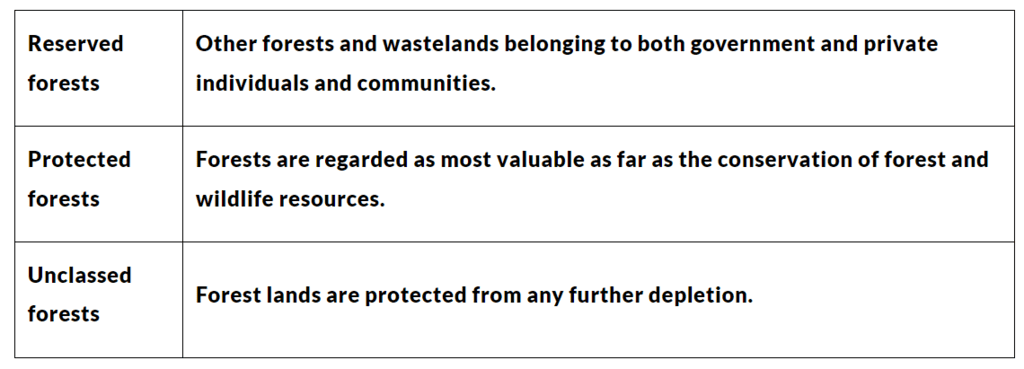
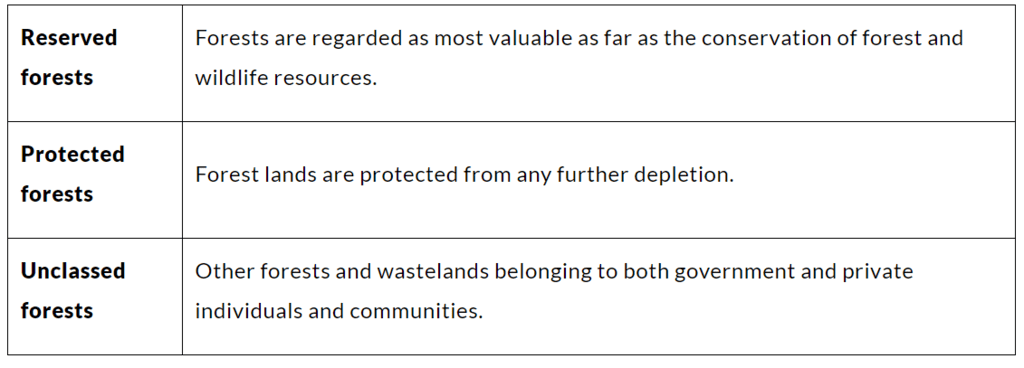
Ans:
Q3. Answer the following questions in about 30 words.
(i) What is biodiversity? Why is biodiversity important for human lives?
(ii) How have human activities affected the depletion of flora and fauna? Explain.
Ans:
(i) Biodiversity refers to the variety and variability of life on earth. Biodiversity is typically a measure of variation at the genetic, species and ecosystem levels. Biodiversity is abundant in tropical areas, which cover about 10 per cent of the earth’s surface but host about 90 per cent of the world’s species.
(ii) Habitat destruction, hunting, poaching, overexploitation, environmental pollution, poisoning and forest fires are factors that led to the decline of biodiversity.
Q4. Answer the following questions in about 120 words.
(i) Describe how communities have conserved and protected forests and wildlife in India.
(ii) Write a note on good practices towards conserving forests and wildlife.
Ans:
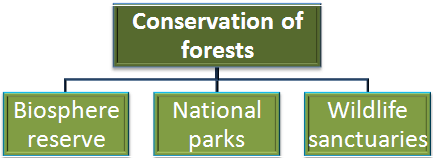
Conservation of Forest
(i)
- In the Sariska Tiger Reserve in Rajasthan, villagers have fought against mining by citing the Wildlife Protection Act.
- The inhabitants of five villages in the Alwar district have declared 1,200 hectares of forest as Bhairodev Dakav ‘Sonchuri’, declaring their own set of rules and regulations disallowing hunting and protecting the wildlife against outside encroachments.
- The Mundas and Santhals of the Chota Nagpur region worship Mahua and Kadamba trees.
- Tribals of Odisha and Bihar worship the tamarind and mango trees during weddings.
- Langurs and macaques around temples are fed daily and treated as part of the temple devotees.
- In and around Bishnoi villages in Rajasthan, herds of blackbuck, nilgai and peacocks can be seen as an integral part of the community, and nobody can harm them.
(ii)
- In the conservation of forests and wildlife, many good practices have evolved over the years, which are socio-cultural on one hand and legal on the other hand, such as the making of National Parks, Wildlife Sanctuaries and Bio-Reserves to protect endangered species of plants and animals.
- Mundas and the Santhals of the Chota Nagpur region worship Mahua and Kadamba.
- Bishnoi people protect blackbuck, nilgai and peacocks, and no one can harm them.
- Attempts to revive the traditional conservation methods or develop new methods of ecological farming are widespread.
- Beej Bachao Andolan in Tehri and Navdanya have shown that adequate levels of diversified crop production without the use of synthetic chemicals are possible and economically viable.
- Programmes such as Van Mahotsav are for creating awareness among people.