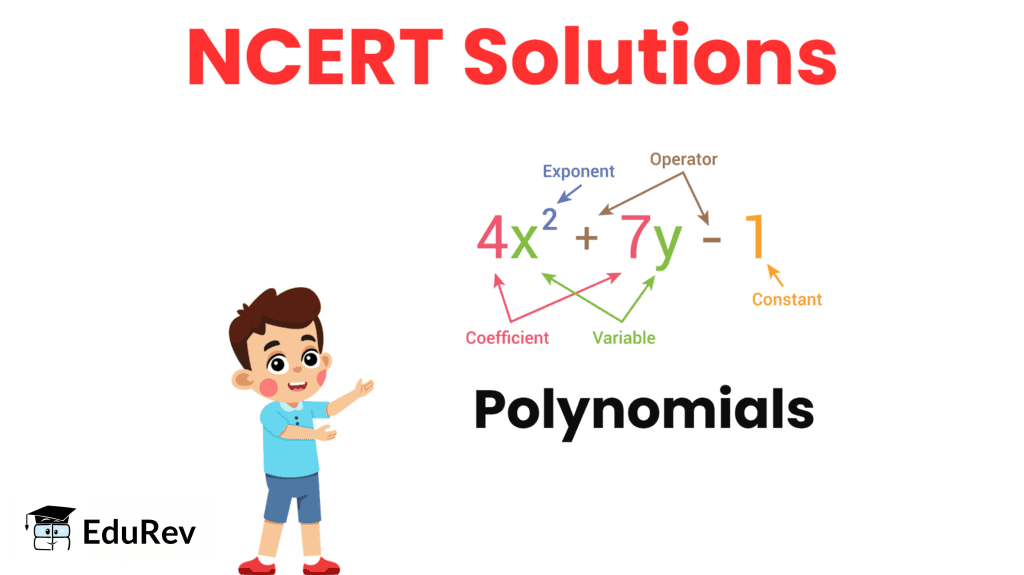
Q1. Which of the following expressions are polynomials in one variable and which are not? State reasons for your answer.
(i) 4x2–3x+7
Ans: The equation 4x2–3x+7 can be written as 4x2 – 3x1 + 7x0
Since x is the only variable in the given equation and the powers of x (i.e., 2, 1 and 0) are whole numbers, we can say that the expression 4x2 – 3x + 7 is a polynomial in one variable.
(ii) y2+√2
Ans: The equation y2 + √2 can be written as y2 + √2y0
Since y is the only variable in the given equation and the powers of y (i.e., 2 and 0) are whole numbers, we can say that the expression y2 + √2 is a polynomial in one variable.
(iii) 3√t + t√2
Ans: The equation 3√t + t√2 can be written as 3t1/2 + √2t
Though t is the only variable in the given equation, the powers of t (i.e.,1/2) is not a whole number. Hence, we can say that the expression 3√t + t√2 is not a polynomial in one variable.
(iv) y + 2/y
Ans: The equation y + 2/y can be written as y + 2y-1
Though y is the only variable in the given equation, the powers of y (i.e.,-1) is not a whole number. Hence, we can say that the expression y + 2/y is not a polynomial in one variable.
(v) x10 + y3 + t50
Ans: Here, in the equation x10 + y3 + t50
Though the powers, 10, 3, 50, are whole numbers, there are 3 variables used in the expression
x10 + y3 + t50.
Hence, it is not a polynomial in one variable.
Q2. Write the coefficients of x2 in each of the following:
(i) 2 + x2 + x
Ans: The equation 2 + x2+x can be written as 2 + (1)x2 + x
We know that, coefficient is the number which multiplies the variable.
Here, the number that multiplies the variable x2 is 1
the coefficients of x2 in 2 + x2 + x is 1.
(ii) 2 – x2 + x3
Ans: The equation 2 – x2 + x3 can be written as 2 + (–1)x2 + x3
We know that, coefficient is the number (along with its sign, i.e., – or +) which multiplies the variable.
Here, the number that multiplies the variable x2 is -1 the coefficients of x2 in 2 – x2 + x3 is -1.
(iii) (π/2)x2 + x
Ans: The equation (π/2)x2 + x can be written as (π/2)x2 + x
We know that, coefficient is the number (along with its sign, i.e., – or +) which multiplies the variable.
Here, the number that multiplies the variable x2 is π/2.
the coefficients of x2 in (π/2)x2 +x is π/2.
(iv)√2x – 1
Ans: The equation √2x – 1 can be written as 0x2+√2x-1 [Since 0x2 is 0]
We know that, coefficient is the number (along with its sign, i.e., – or +) which multiplies the variable.
Here, the number that multiplies the variable x2 is 0, the coefficients of x2 in √2x – 1 is 0.
Q3. Give one example each of a binomial of degree 35, and of a monomial of degree 100.
Ans: The degree of a polynomial is the highest power of the variable in the polynomial. It represents the highest exponent of the variable within the algebraic expression.
Therefore,
- Binomial of degree 35: A polynomial having two terms and the highest degree 35 is called a binomial of degree 35
Example: 3x35+5 - Monomial of degree 100: A polynomial having one term and the highest degree 100 is called a monomial of degree 100
Example: 4x100
Q4. Write the degree of each of the following polynomials:
(i) 5x3 + 4x2 + 7x
Ans: The highest power of the variable in a polynomial is the degree of the polynomial.
Here, 5x3 + 4x2 + 7x = 5x3 + 4x2 + 7x1
The powers of the variable x are: 3, 2, 1
The degree of 5x3 + 4x2 + 7x is 3 as 3 is the highest power of x in the equation.
(ii) 4 – y2
Ans: The highest power of the variable in a polynomial is the degree of the polynomial.
Here, in 4–y2,
The power of the variable y is 2
The degree of 4 – y2 is 2 as 2 is the highest power of y in the equation.
(iii) 5t – √7
Ans: The highest power of the variable in a polynomial is the degree of the polynomial.
Here, in 5t–√7,
The power of the variable t is 1.
The degree of 5t–√7 is 1 as 1 is the highest power of y in the equation.
(iv) 3
Ans: The highest power of the variable in a polynomial is the degree of the polynomial.
Here, 3 = 3 × 1 = 3 × x0
The power of the variable here is: 0
The degree of 3 is 0.
Q5. Classify the following as linear, quadratic and cubic polynomials:
Ans: We know that,
Linear polynomial: A polynomial of degree one is called a linear polynomial.
Quadratic polynomial: A polynomial of degree two is called a quadratic polynomial.
Cubic polynomial: A polynomial of degree three is called a cubic polynomial.
(i) x2 + x
Ans: The highest power of x2 + x is 2
The degree is 2
Hence, x2 + x is a quadratic polynomial
(ii) x – x3
Ans: The highest power of x–x3 is 3
The degree is 3
Hence, x–x3 is a cubic polynomial
(iii) y + y2 + 4
Ans: The highest power of y+y2+4 is 2
The degree is 2
Hence, y+y2+4is a quadratic polynomial
(iv) 1 + x
Ans: The highest power of 1 + x is 1
The degree is 1
Hence, 1 + x is a linear polynomial.
(v) 3t
Ans: The highest power of 3t is 1
The degree is 1
Hence, 3t is a linear polynomial.
(vi) r2
Ans: The highest power of r2 is 2
The degree is 2
Hence, r2 is a quadratic polynomial.
(vii) 7x3
Ans: The highest power of 7x3 is 3
The degree is 3
Hence, 7x3 is a cubic polynomial.