Short Answer Type Questions
Ques 1: What is the limit of resolution of the human eye? How does a microscope help overcome this limitation?
Ans: The limit of resolution of the human eye is 0.1 mm, which means two points separated by less than 0.1 mm appear as a single point when viewed from about 25 cm. Since most cells are too small to be seen by the unaided eye, a microscope is used to overcome this limitation. A microscope uses a combination of an objective lens and an eyepiece to magnify an object and make it appear larger, allowing fine cell structures to be observed clearly.
Ques 2: What is osmosis? How is it different from diffusion?
Ans: Osmosis is the movement of water through a selectively permeable membrane from an area of more water and less solute (dilute solution) to an area of less water and more solute (concentrated solution), until concentrations become equal. Diffusion, on the other hand, is the net movement of particles from a higher to a lower concentration and occurs even without a membrane. Therefore, osmosis is specifically the diffusion of water across a selectively permeable membrane.
Ques 3: What is the fluid-mosaic model of the cell membrane?
Ans: The fluid-mosaic model explains the structure of the cell membrane. According to this model, the membrane has a lipid bilayer – two layers of special fat molecules with water-attracting heads facing outwards and water-repelling tails facing inwards – with proteins embedded in them. The molecules can move sideways, flip, and rotate within the membrane making it fluid, and since the protein molecules are arranged like tiles in a mosaic pattern, it is called the mosaic model.
Ques 4: Why do plant cells have a cell wall? What is it made of?
Ans: Plants cannot move from place to place, so they need a rigid structure to withstand environmental stresses like wind and rain. Therefore, plant cells have an additional covering outside the cell membrane called the cell wall, which helps leaves and flowers remain firm, maintains their shapes, and helps plants stay upright. The plant cell wall is primarily made of cellulose, a type of carbohydrate formed by many glucose units linked together.
Ques 5: What is the nucleoid? How is it different from the nucleus of a eukaryotic cell?
Ans: In prokaryotic cells, the DNA is present as a single circular molecule associated with specific proteins, and the region containing this genetic material is called the nucleoid. The nucleoid does not have a membrane around it – the genetic material simply exists freely in the cytoplasm without any enclosing boundary. In contrast, eukaryotic cells have a well-defined nucleus enclosed by a double-layered nuclear membrane with pores that allow the transfer of material between the nucleus and the cytoplasm.
Ques 6: What are lysosomes? Why are they important for the cell?
Ans: Lysosomes are single membrane-bound sacs filled with enzymes that can break down unwanted proteins, carbohydrates, fats, and damaged parts of the cell, keeping it clean and healthy. The products formed by this breakdown are released into the cytoplasm where they may be reused in other cellular processes. They act as the cell’s clean-up system and are very important in preventing waste materials from accumulating inside the cell.
Ques 7: What is the function of the Golgi apparatus in a cell?
Ans: The Golgi apparatus acts like the cell’s post office – it modifies, sorts, and packages proteins and lipids received from the endoplasmic reticulum into vesicles for transport, secretion, or lysosome formation. It is functionally linked to the endoplasmic reticulum and is made up of stacks of flattened, sac-like structures. It is thus responsible for the packaging and shipping of cellular products to various destinations inside and outside the cell.
Ques 8: What are chromoplasts and leucoplasts? How do they differ in function?
Ans: Chromoplasts are plastids found in flower petals and fruits that contain pigments other than chlorophyll, such as yellow, orange, or red pigments, which give bright colours to flowers and fruits and help attract pollinators and seed-dispersing animals. Leucoplasts, on the other hand, lack pigments and are colourless – they store food material such as starch, oils, or proteins. For example, some leucoplasts in potato and taro cells store starch.
Ques 9: What is cell division? Name its two major types and state the importance of each.
Ans: Cell division is the process by which new cells are formed from pre-existing cells. It allows living organisms to grow, repair damaged tissues, and reproduce. The two major types are mitosis and meiosis. Mitosis is important for normal growth, repair, maintenance, and asexual reproduction, producing two genetically identical daughter cells. Meiosis is important for sexual reproduction and creates genetic diversity by producing four daughter cells, each with half the number of chromosomes of the parent cell.
Ques 10: Why do mature Red Blood Cells (RBCs) in humans not have a nucleus?
Ans: Mature Red Blood Cells in humans do not have a nucleus because the absence of a nucleus provides more space for haemoglobin, which is the molecule that carries oxygen. This allows RBCs to transport a larger amount of oxygen to all cells of the body. However, since they lack a nucleus, they cannot repair or divide themselves, which is why their lifespan is short – they survive for approximately 120 days.
Ques 11: What is cell culture? What conditions are required to maintain it?
Ans: Cell culture is a method developed by scientists to grow plant and animal cells outside the body in special conditions. In this process, cells are taken from an organism and placed in a nutrient-rich medium that allows them to grow and multiply. To keep the culture safe, the right temperature, acidic or alkaline conditions, and moisture must be maintained under sterile conditions. Cell culture is crucial for studying how cells work and for the production of biochemicals, food, medicines, and vaccines.
Ques 12: What is the function of vacuoles in plant cells and animal cells? Why are plant vacuoles larger than animal vacuoles?
Ans: In a mature plant cell, there is usually one large central vacuole surrounded by a single selectively permeable membrane, filled with a watery fluid called cell sap. The vacuole stores water, minerals, sugars, and waste material, and by storing large amounts of water it helps maintain pressure inside the cell, which keeps the plant cell firm. When a plant does not get enough water, the vacuole loses water and the plant gets wilted. In animal cells, vacuoles are sometimes present but are not as large as plant vacuoles – they only help in the temporary storage of materials. Plant vacuoles are larger because plants need to maintain firmness and store greater amounts of water and nutrients for their survival.
Long Answer Type Questions
Ques 1: Describe the structure and function of the cell membrane. Explain what happens to a cell when it is placed in hypotonic, hypertonic, and isotonic solutions.
Ans: The cell membrane, also called the plasma membrane, is a thin boundary that surrounds a cell and protects its contents. It defines the individuality of a cell and is the universal feature present in all living cells.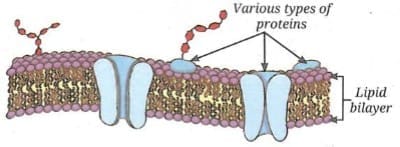 Structure of a cell membrane
(i) Structure: The cell membrane is extremely thin, about 7 to 10 nanometres thick. It is made up of lipids and proteins. According to the fluid-mosaic model, the membrane has a lipid bilayer – two layers of fat molecules with water-attracting heads facing outwards and water-repelling tails facing inwards – with proteins embedded in them. The molecules can move sideways, flip, and rotate, making the membrane fluid. Proteins in the membrane act like gatekeepers, helping substances pass through. Since the protein molecules are arranged like tiles in a mosaic, it is called the mosaic model.
(ii) Function: The cell membrane is selectively permeable, which means it allows some substances to pass through while blocking others. All living cells communicate with their surroundings and neighbouring cells through the cell membrane. It controls the exchange of materials between the cell and its external environment.
(iii) Effect of Different Solutions: When placed in an isotonic solution, where the solute concentration outside equals that inside the cell, there is no net movement of water and the cell remains unchanged. When placed in a hypotonic solution, where the solute concentration outside is less than inside the cell, water moves into the cell by osmosis, causing the cell to swell. When placed in a hypertonic solution, where the solute concentration outside is greater than inside the cell, water moves out of the cell by osmosis, causing the cell to shrink.
Ques 2: Compare the structure and functions of the Rough Endoplasmic Reticulum (RER), Smooth Endoplasmic Reticulum (SER), and Golgi apparatus. How are these organelles functionally connected?
Ans: The Endoplasmic Reticulum (ER) is a large organelle that spreads like a network within the cytoplasm of the cell and is continuous with the outer membrane of the nuclear envelope. It plays a key role in the synthesis and transport of proteins, fats, and some hormones.
(i) Rough Endoplasmic Reticulum (RER): It looks rough under an electron microscope because ribosomes are attached to its surface. It is mainly involved in protein synthesis and protein secretion. For example, in gland cells such as pancreatic cells, RER is highly active in producing and secreting proteins.
(ii) Smooth Endoplasmic Reticulum (SER): It does not have ribosomes on its surface and therefore looks smooth. It is involved in the synthesis and storage of fats (lipids) and hormones. It is found in greater amounts in cells that are specialised for lipid production.
(iii) Golgi Apparatus: It is made up of stacks of flattened, sac-like structures. It acts like the cell’s post office – it modifies, sorts, and packages proteins and lipids received from the ER into vesicles for transport, secretion, or lysosome formation. It was first observed in 1898 by Italian scientist Camillo Golgi in the nerve cells of a barn owl.
(iv) Functional Connection: These three organelles are functionally linked and work as a coordinated pathway. Proteins are first synthesised on ribosomes attached to the RER, then processed and transported through the ER to the Golgi apparatus, where they are further modified, packaged into vesicles, and dispatched to their destinations inside or outside the cell. This ensures efficient production, processing, and delivery of cellular products.
Ques 3: What are plastids? Describe the structure and function of chloroplasts. How are mitochondria and chloroplasts similar to certain bacteria?
Ans: Plastids are special organelles found only in plant cells, used for food synthesis and storage. There are three main types – chloroplasts containing the green pigment chlorophyll, chromoplasts containing coloured pigments for attracting pollinators, and leucoplasts which are colourless plastids for storing food materials like starch, oils, or proteins.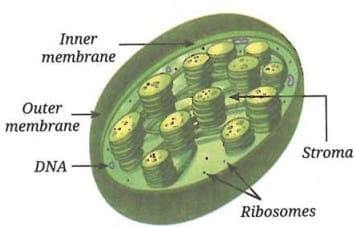
(i) Structure of Chloroplast: Chloroplasts are double-membrane-bound organelles, similar to mitochondria. Inside the chloroplast there is a semi-fluid substance called the stroma. Within the stroma are disc-shaped membrane structures that contain chlorophyll. These structures absorb light energy during photosynthesis. The sugars synthesised in this process are stored in the stroma along with starch granules.
(ii) Function of Chloroplast: Chloroplasts are the sites of photosynthesis. The green pigment chlorophyll absorbs sunlight, which is used to synthesise food for the plant. This makes chloroplasts the primary source of energy production in plant cells through the conversion of light energy into chemical energy stored in sugars.
(iii) Similarity of Mitochondria and Chloroplasts to Bacteria: Mitochondria and plastids share several features that are similar to certain bacteria. Both have their own DNA and ribosomes, which allows them to make some of their own proteins independently. This is unusual because most organelles depend entirely on the cell’s genetic machinery. These characteristics strongly suggest that both mitochondria and plastids share an evolutionary history with ancient single-celled organisms, supporting the idea that they were once free-living bacteria that were incorporated into larger cells.
Ques 4: Describe the process of mitosis and meiosis. How do errors in these processes affect the body?
Ans: Cell division is the process by which new cells are formed from pre-existing cells, allowing organisms to grow, repair tissues, and reproduce. Both prokaryotic and eukaryotic cells divide, but eukaryotic cells divide in a more controlled and orderly manner by a process called the cell cycle.
(i) Mitosis: Mitosis is the most common type of cell division. One parent cell divides to produce two genetically identical daughter cells. Each new cell gets the same DNA and the same number of chromosomes as the parent cell. This ensures that genetic information is largely maintained across body cells. Every human begins life as a single fertilised egg, and this one cell divides repeatedly by mitosis to form trillions of cells in the body. Mitosis is important for normal growth, repair, maintenance, and asexual reproduction.
(ii) Meiosis: Meiosis is a type of cell division that produces gametes and occurs only in the cells of reproductive organs. It is a two-step process – the parent cell divides twice to form four daughter cells, each having half the number of chromosomes of the parent cell. During the first division, the chromosome number in each daughter cell is reduced to half. The second division is similar to mitosis. In animals, meiosis occurs in the testes of males to produce sperm and in the ovaries of females to produce eggs. During fertilisation, when gametes from two individuals combine, the original chromosome number is restored. Meiosis is important for sexual reproduction and creates genetic diversity, which is why children resemble their parents but are not exactly the same.
(iii) Errors in Cell Division: The processes of mitosis and meiosis must occur in a proper and controlled manner. Errors in mitosis lead to uncontrolled cell divisions, which can result in the formation of tumours and an abnormal number of chromosomes in body cells. Errors in meiosis may result in genetic disorders, which may be associated with developmental problems or distinctive physical features. Faulty meiosis may also cause early pregnancy loss or reduced fertility.
Ques 5: What is the Cell Theory? Explain its three statements. How do cells maintain a balance between growth and death, and what happens when this balance is disturbed?
Ans: The Cell Theory is the unifying principle of biology because it applies to all living organisms, from the simplest bacterium to the most complex plant or animal.
(i) The Three Statements of Cell Theory: All living organisms are made up of one or more cells. The cell is the basic unit of structure and function in living beings. All cells arise from pre-existing cells. This theory unifies all of biology and explains life’s continuity through cell division. It was formulated through the contributions of Schleiden, Schwann, and Rudolf Virchow.
(ii) How Cells Maintain Balance – Controlled Growth: Cells grow and divide in a controlled way, stay in the right place, carry out their functions, and eventually die when they are no longer needed. Dead cells are replaced by new cells that carry out the same function. Thus, every cell has a definite life span. In many animal cells, cell division usually stops when cells come in contact with neighbouring cells – this process is called contact inhibition.
(iii) Programmed Cell Death (PCD): Cells also have natural ways of dying to maintain a balance. Programmed Cell Death is a genetically regulated and organised process of selective cell destruction. It is essential for normal development, cellular quality control, and immune function. For example, when an embryo develops, PCD helps form fingers by eliminating cells between digits – without it, we would have webbed hands.
(iv) When Balance is Disturbed – Cancer and Genetic Disorders: If cells do not die when they should, or if they die too early, problems arise. Cancer cells lose contact inhibition and keep dividing uncontrollably, leading to the formation of tumours. Cancerous tumours can invade nearby tissues and even spread to other parts of the body. Errors in mitosis can lead to an abnormal number of chromosomes and tumour formation. Errors in meiosis may result in genetic disorders associated with developmental problems, distinctive physical features, early pregnancy loss, or reduced fertility.
(v) Plant Cells and Contact Inhibition: Plant cells grow differently. Due to their rigid cell walls, plant cells do not show contact inhibition and follow a different pattern of growth compared to animal cells.