Ans: The law of conservation of mass states that in a chemical reaction mass can neither be created nor destroyed. This means the total mass of the reactants equals the total mass of the products. For example: 2Na + Cl2 —> 2NaCl Mass of reactants = 2 × 23 + 2 × 35.5 = 46 + 71 = 117 u Mass of products = 2 × (23 + 35.5) = 2 × 58.5 = 117 u Thus, mass is conserved before and after the reaction.
Q2. Explain the law of constant proportion.
Ans: The law of constant proportion (law of definite proportions) states that a chemical compound always contains the same elements in the same fixed proportion by mass, irrespective of its source or method of preparation. Example: For example, in water (H₂O), the ratio of hydrogen to oxygen by mass is always 1 : 8.
Q3. Who coined the term atom?
Ans: The word “atom” comes from the ancient Greek word atomos and was used by early Greek philosophers such as Democritus. John Dalton, however, proposed the modern atomic theory and gave a scientific basis to the idea of atoms.
Q4. Define atom.
Ans: An atom is the smallest particle of an element that can take part in a chemical reaction and retain the chemical properties of that element.
Q5. Define molecule.
Ans: A molecule is the smallest particle of an element or compound that can exist independently and show all the chemical properties of that substance. Examples: O2 is a molecule of oxygen; H2O is a molecule of water.
Q6. Define atomicity.
Ans: Atomicity is the number of atoms present in one molecule of an element. Example: Atomicity of O2 is 2; atomicity of O3 is 3.
Q7. What is an atomic mass unit?
Ans: An atomic mass unit (amu), also written as unified atomic mass unit (u), is defined as one twelfth (1/12) of the mass of a carbon-12 atom. It is the standard unit for expressing atomic and molecular masses. Example: Molecular mass of H2O = (2 × 1) + 16 = 18 u.
Q8. Give one example of cation and anion.
Ans: Cation => Na+ Anion => Cl–
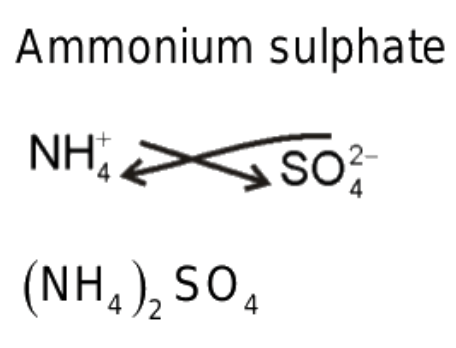
Q9. Give the chemical formula for ammonium sulphate.
Ans: Ammonium ion = NH4+ Sulphate ion = SO42- Chemical formula: (NH4)2SO4.
Q10. Find the molecular mass of H2O.
Ans: Molecular mass of H2O = (2 × 1) + 16 = 2 + 16 = 18 u
Short Answer Type Questions
Q1. Give the unit to measure the size of an atom and give the size of a hydrogen atom.
Ans: Atomic size is measured in nanometres (nm). The size of a hydrogen atom is about 10⁻¹⁰ m.
Q2. What is IUPAC, give its one function?
Ans: IUPAC is the International Union for Pure and Applied Chemistry. One of its functions is to set standard rules for naming chemical elements and compounds and to approve official chemical names, symbols and units.
Q3. Give the Latin name for sodium, potassium, and iron.
Q4. What is the ratio by mass of combining elements in H2O, CO2and NH3?
Ans: Mass ratios of combining elements are: H2O: H : O = 2 : 16 → simplest mass ratio H : O = 1 : 8 CO2: C : O = 12 : 32 → simplest mass ratio C : O = 3 : 8 NH3: N : H = 14 : 3 → simplest mass ratio N : H = 14 : 3
Q5. What is a polyatomic ion? Give one example.
Ans: A polyatomic ion is a group of two or more atoms bonded together that carry an overall electrical charge and act as a single charged species. Examples: Ammonium – NH4+; Nitrate – NO3–.
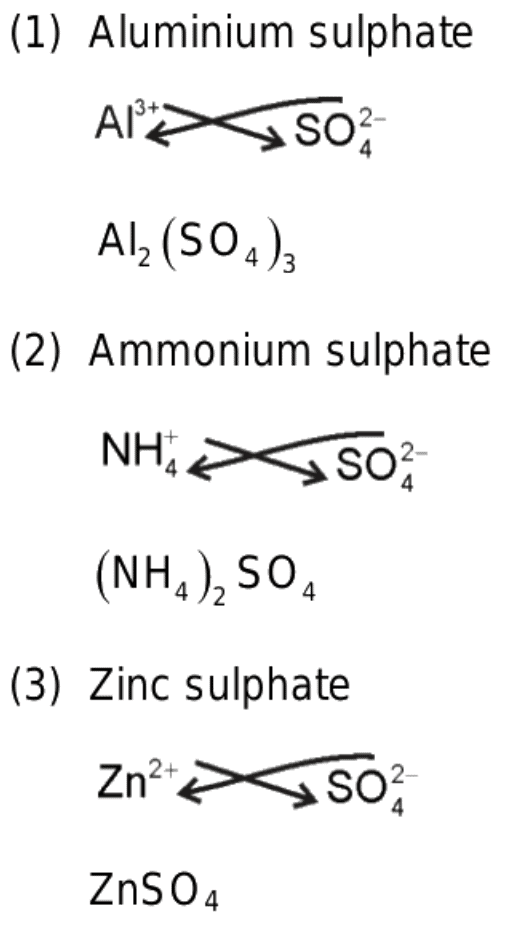
Q6. Write down the formula for: Copper nitrate, calcium sulphate and aluminium hydroxide.
Q7. What is formula unit mass? How is it different from molecular mass?
Ans: The formula unit mass of an ionic compound is the sum of the atomic masses of all atoms present in its simplest formula unit. Formula unit mass applies to ionic substances whose smallest repeating unit is a formula unit (made of ions). Molecular mass is the sum of the atomic masses of all atoms in a molecule and applies to molecular (covalent) substances. In short, formula unit mass = ionic compounds; molecular mass = molecular compounds.
Q8. What are the rules for writing the symbol of an element?
Ans: IUPAC approves the symbols of elements. Rules for writing symbols: – Symbols are one or two letters, usually taken from the element’s English name. – The first letter is always a capital (upper case) and, if there is a second letter, it is lower case. Examples: Hydrogen – H; Helium – He. – Some symbols come from Latin, e.g., Iron – Fe (Ferrum); Sodium – Na (Natrium).
Q9. Explain relative atomic mass and relative molecular mass.
Ans: Relative atomic mass of an element is the ratio of the average mass of atoms of the element to 1/12th of the mass of a carbon-12 atom. Relative molecular mass is the sum of the relative atomic masses of all atoms in a molecule; it gives how many times a molecule is heavier than 1/12th of a carbon-12 atom.
Q10. The formula of carbon dioxide is CO2. What information do you get from this formula?
Ans: The chemical formula CO₂ gives the following information:
CO₂ represents carbon dioxide, which is a compound.
One molecule of carbon dioxide contains one atom of carbon and two atoms of oxygen.
The ratio by number of atoms of carbon to oxygen in CO₂ is 1 : 2.
The formula shows that carbon and oxygen are chemically combined in a fixed proportion, which is characteristic of a compound.
Q11. State 3 points of difference between an atom and an ion.
Ans:
Atom
Ion
Is electrically neutral (no net charge).
Has a net electrical charge (positive or negative).
Number of electrons = number of protons.
Number of electrons ≠ number of protons (formed by loss or gain of electrons).
May be chemically reactive depending on element.
Usually formed to achieve greater stability (by gaining or losing electrons).
Q12. Calculate the formula unit mass of NaCl and CaCl2. (Na = 23, Cl = 35.5, Ca = 40)
Ans: Formula unit mass of NaCl = 23 + 35.5 = 58.5 u Formula unit mass of CaCl2 = 40 + (2 × 35.5) = 40 + 71 = 111 u
Q13.The ratio by mass for hydrogen and oxygen in water is given as 1 : 8 respectively. Calculate the ratio by number of atoms for a water molecule.
Ans: To convert mass ratio to number of atoms, divide the mass ratio by the atomic masses: Mass ratio H : O = 1 : 8 Atomic masses H = 1, O = 16 Divide each by its atomic mass: H → 1/1 = 1; O → 8/16 = 0.5 Make whole numbers by multiplying by 2: H → 1 × 2 = 2; O → 0.5 × 2 = 1 Thus, the ratio by number of atoms in water is H : O = 2 : 1.
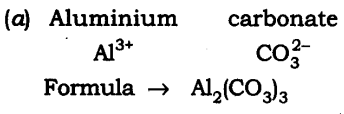
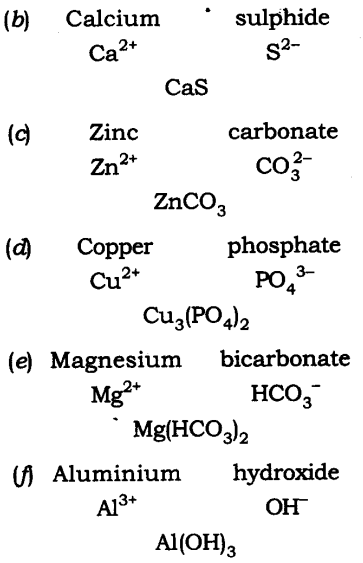
Q14. Write down the chemical formula for the following compounds: (a) Aluminium carbonate (b) Calcium sulphide (c) Zinc carbonate (d) Copper phosphate (e) Magnesium bicarbonate (f) Aluminium hydroxide.
Q15. Explain the difference between 2[O] , O2and O3.
Ans: 2[O] -> Represents two separate oxygen atoms (these single atoms cannot exist freely under normal conditions). O2 -> Represents one oxygen molecule made of two oxygen atoms; this diatomic molecule exists freely and is the common form of oxygen in air. O3 -> Represents one molecule of ozone made of three oxygen atoms; ozone is a distinct triatomic form of oxygen with different properties.
Long Answer Type Questions
Q1. (a) How do atoms exist? (b) What is atomicity? (c) What are polyatomic ions?
(a) Atoms of some elements cannot exist independently under normal conditions and combine to form molecules or ions. For example, non-metals like oxygen form O2 molecules. Noble gases can exist independently; most other elements exist as molecules or ions.
(b) The number of atoms constituting a molecule is known as its atomicity. Examples: O3 -> atomicity is 3; O2 -> atomicity is 2. (c) Polyatomic ions: When more than one atom combine and together carry a net charge, they form a polyatomic ion which behaves as a single charged particle. Examples: OH–, NO3–, NH4+.
Q2. Which are the six postulates of Dalton’s atomic theory?
Ans: Postulates of Dalton’s atomic theory: 1. Matter is made of indivisible particles called atoms. 2. Atoms of the same element are similar in mass and properties, but differ from atoms of other elements. 3. Atoms are indivisible particles, which cannot be created or destroyed in a chemical reaction. 4. Atoms of different elements combine in fixed, simple whole-number ratios to form compounds. 5. Atoms of the same element can combine in different ratios to form different compounds. 6. The atom is the smallest unit of matter that can take part in a chemical reaction.
Q3. What is an atomic mass unit’? How is it linked with relative atomic mass?
Ans: An atomic mass unit (amu or u) is defined as one twelfth of the mass of a carbon-12 atom. The relative atomic mass of an element states how many times an atom of that element is heavier than 1/12th the mass of a carbon-12 atom. Thus, relative atomic mass is a dimensionless number comparing an atom’s mass to the standard amu.
Q4. Write the formulae for the following and calculate the molecular mass for each of them. (a) Caustic potash (b) Baking powder (c) Limestone (d) Caustic soda (e) Ethanol (f) Common salt
Ans:
(a) Caustic potash: KOH. Molecular mass = 39 + 16 + 1 = 56 u.