PageNo. 42
Think

Q. Have you ever had an upset stomach? Do you know what could have caused it? What could happen if spoiled food is eaten by mistake? If yes, what did you do to get well?
Answer: Yes, I have had an upset stomach before. It can be caused by eating spoiled or dirty food, or by not washing hands before eating. If spoiled food is eaten by mistake, it can cause stomach pain, vomiting, or loose motions. When I had an upset stomach, I rested, drank plenty of water, and my parents gave me curd or buttermilk. If it was very bad, we went to the doctor.
Write
Q. Why do you think food gets spoiled?
Answer: Food gets spoiled because tiny living things called microbes grow on it. Microbes need water, air, and the right temperature to grow. Spoiled food may look or smell bad and is not safe to eat.
Page No. 44
Write
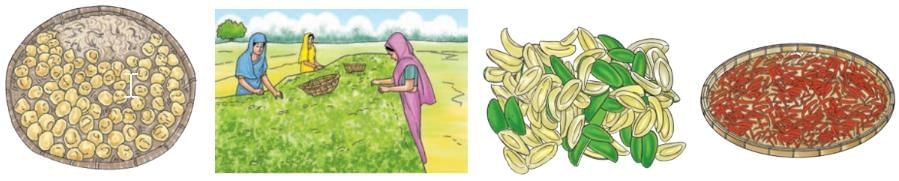
Q. What other things are dried so that they remain unspoilt throughout the year?
Answer: Items that are dried to keep them unspoilt include:
- Grains (rice, wheat)
- Lentils (dal)
- Dry fruits (raisins, dates)
- Spices (red chillies, turmeric)
- Fish and meat (in some places)
Activity 1
Page No. 45
Activity 2
Discuss
Q. What would happen to this pickle if no oil had been added?
Answer: If no oil had been added, air would get inside the jar. Microbes would grow quickly, and the pickle would spoil fast. Oil makes a layer that keeps air out and protects the pickle.
Page No. 46
Activity 3
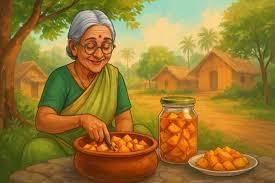
Q. Find out about food preservation practices in your family by asking the elders at home. Write at least one such practice.
Answer: My grandmother makes lemon pickle and covers it with oil so it lasts for many months. We also dry coriander leaves or mint to use them later. Sometimes, my mother keeps extra cooked food in the fridge to protect it from spoiling.
Page No. 48
Think
Q. Did you ever have an upset stomach, vomiting or indigestion? Did you use any home remedies? Write about the home remedy given to you. Have your parents given you curd or some product like buttermilk made from it, for an upset stomach?
Answer: Yes, when I had indigestion, my mother gave me curd and asked me to drink buttermilk. It helped my stomach feel better. Eating plain rice with curd also helps.
Page 49
Activity 4
Q. Do you ever accompany your elders for buying vegetables and fruits? During such visits, observe how elders select fruits and vegetables in the market. Write one thing that you learnt from your shopping trip and write it as a Finding #9, the way Disha would write.
Answer: Finding #9: My grandmother gently presses the fruit to see if it is fresh and firm. She checks the colour and smell. She does not buy very soft fruits or those that have spots or look dull.
Page No. 50
Write
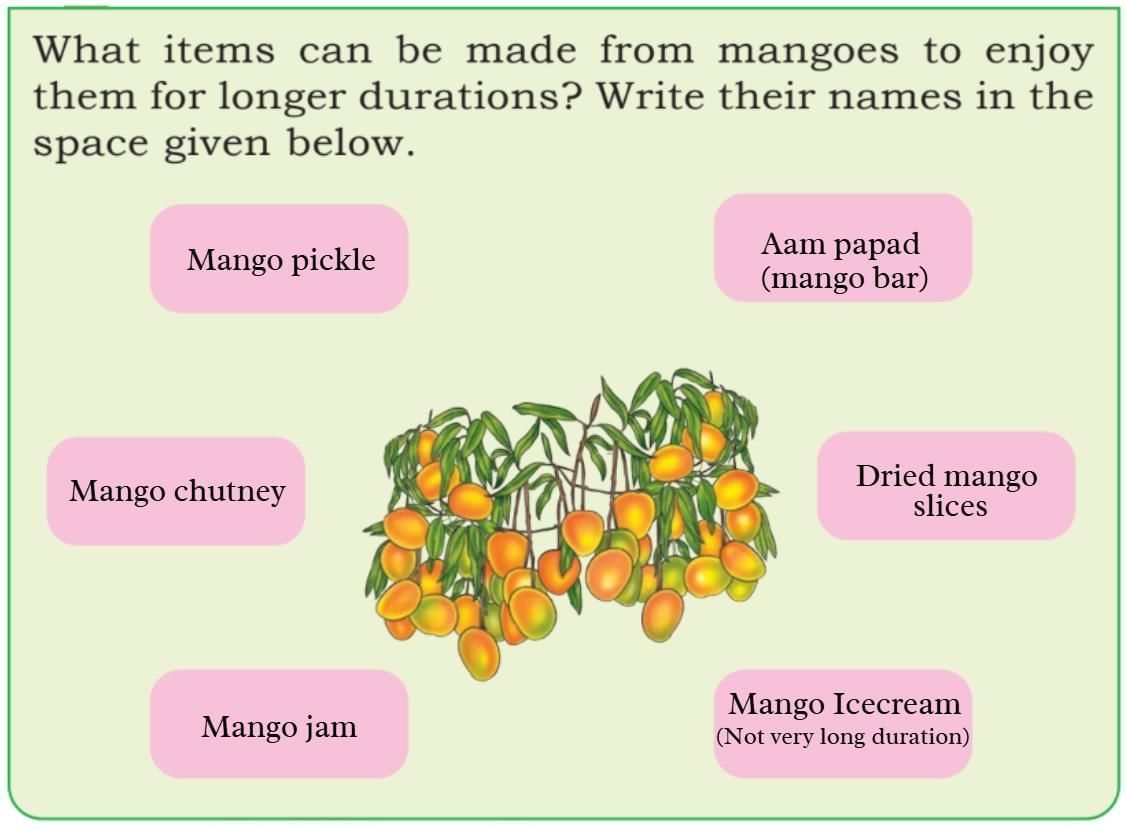
Q. Name three seasonal fruits or vegetables of your region. For example, amla in winter and jamun in summer.
Answer: (Any three are enough; the answer depends on your region)
- Watermelon (Summer)
- Orange (Winter)
- Mango (Summer)
- Peas (Winter)
- Litchi (Summer)
- Grapes (Winter)
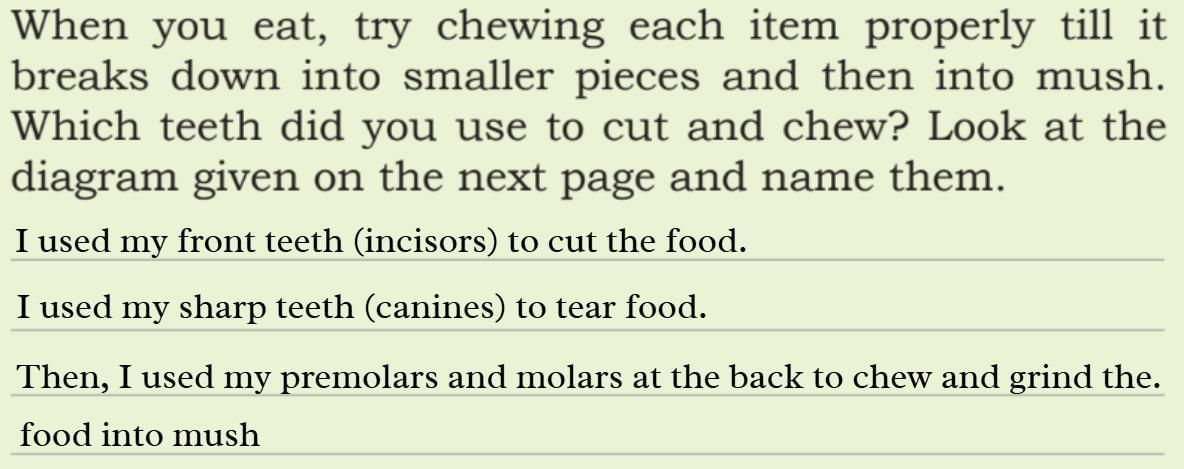
Activity 5
Page No. 53
Write
Q. How can you avoid choking?
Answer: To avoid choking, we should:
- Take small bites
- Chew food properly before swallowing
- Do not talk or laugh when eating
- Eat slowly and do not be in a hurry
Page No. 53-54
Let us reflect
1. Why do some food items last for weeks and others spoil in just a few days?
Answer:
- Some foods last longer because they lack moisture or are kept in ways that prevent air and moisture from reaching microbes.
- For instance, pickles in oil, dried foods, and foods stored in the refrigerator tend to have a longer shelf life.
- Foods that contain water, are kept in warm temperatures, and are exposed to air spoil quickly.
- This is because microbes grow rapidly in conditions that are warm and moist.
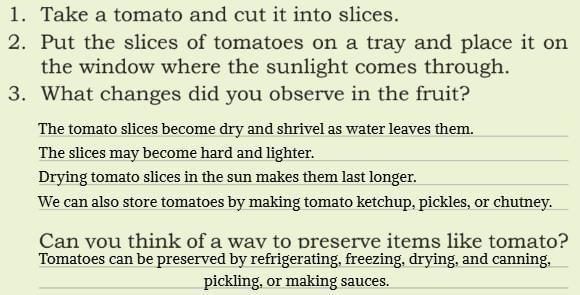
2. You are going on a field trip for two days. List five food items you will carry. How will you keep them from getting spoiled?
Answer: If I am going on a trip, I will carry these food items:
- Dry snacks like biscuits and nuts (packed in airtight containers to keep air and moisture away).
- Dried fruits or chips (because they have less water).
- Fresh fruits that last longer, such as apples or bananas (keep them in a cool place).
- A sandwich wrapped in cling film or kept in a lunchbox.
- Bottled water or juice (sealed to avoid contamination)
To keep them from spoiling, I will keep them in airtight containers and avoid keeping them in the sun or warm places.
3. What if food cannot be preserved? Imagine a world without food preservation and discuss the consequences.
Answer: If food cannot be preserved, it will spoil quickly and go to waste. The consequences of a world without food preservation:
- People would have to eat food immediately after it is harvested or cooked.
- There would be a shortage of food, especially during off-seasons, and long-distance transport of food would be difficult.
- This would cause hunger and malnutrition since fresh food will not be available throughout the year.
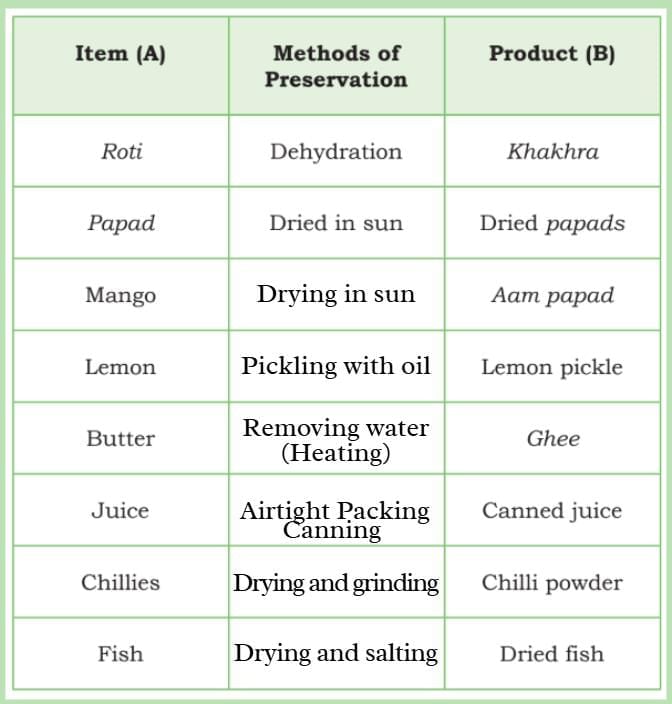
4. Match the following: Which method is used to preserve the following food items (A) to make the final product (B).
Answer: