Reflect and Respond
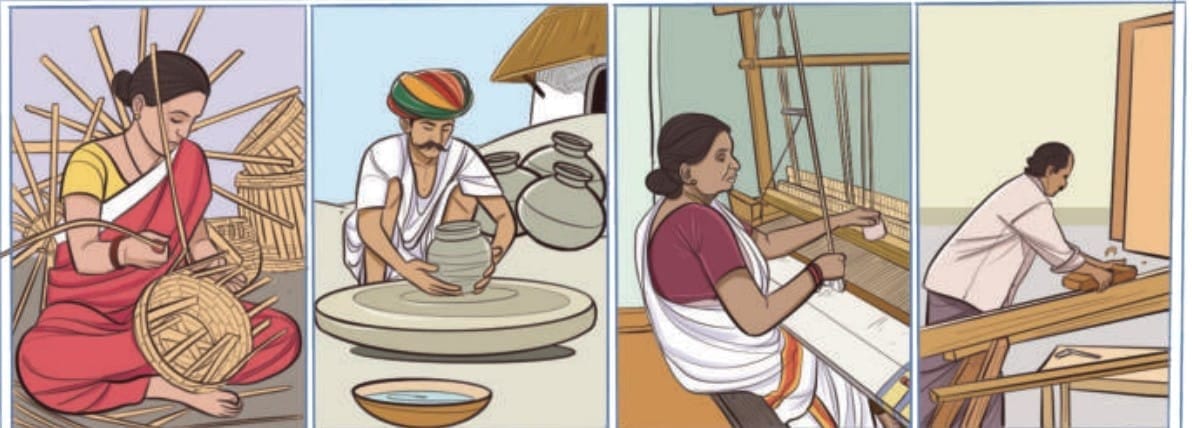
I. Look at the pictures and identify the vocations. List at least five more vocations.
Ans: The pictures show: basket weaving, pottery (pot making), weaving/loom work, and carpentry/woodwork.
Five more vocations: blacksmithing, embroidery/needlework, stone carving, leather work (cobbling), and block printing.
II. Work in pairs. Discuss the following questions.
1. What is common among these pictures?
Ans: All pictures show people engaged in traditional, skill-based, handmade crafts requiring manual skill and expertise passed down from generation to generation. Workers create useful products using their hands and simple tools rather than machines.
2. We refer to such skill-based work as v__ __ a __ __ o __ s.
Ans: The word is vocations — a skill-based occupation or calling that a person is specially trained for, often involving manual dexterity and craftsmanship.

3. Mention a few differences between handmade and machine-made products.
Ans:
Check Your Understanding (Part I)
I. Do you think pot making is easy? If yes, why? If no, why not?
Ans: No, pot making is not easy. The story shows it is extremely laborious:
- Grey and red clay is found at a riverbank sixteen kilometres away — one must climb down a sheer drop and carry the heavy load uphill all the way back.
- The clay must then be pounded inside bamboo cylinders for a long time — Arenla mentions dropping the mould out of sheer exhaustion many times.
- Shaping the pot requires great skill and coordination. Even Sentila, despite years of watching, could not master it immediately.
- After shaping, pots are dried, loaded onto a kiln, and fired — with constant attention, as over or under-firing ruins the entire batch.
- The whole process takes months and earns only a few rupees — making it physically demanding with very little financial reward.
II. Would Sentila be able to fulfil her dream of becoming a pot maker? Explain.
Ans: Yes, it is very likely that Sentila will fulfil her dream:
- Her passion is deep and long-standing — it began in childhood and never wavered despite her mother’s disapproval.
- She secretly visits expert potters to learn, showing initiative and perseverance.
- Her father Mesoba has already told the village council that Sentila will soon be “making the best pots in the village.”
- The village council has affirmed that pot making skills must be passed on, putting social pressure on Arenla to teach her daughter.
- Arenla, despite initial reluctance, has not actively stopped Sentila’s visits — she pretends ignorance, suggesting her opposition is softening.
III. Do you think Mesoba and Arenla would support Sentila? Give a reason.
Ans: Yes, both will likely support Sentila, though perhaps reluctantly at first.
- Mesoba has already shown implicit support — he told the village council that Sentila would soon be “making the best pots in the village,” suggesting he accepts her wish.
- Arenla opposes pot making from her own bitter experience of its hardships and poor earnings. However, pressured by the village council and Mesoba, and aware of Sentila’s sincere dedication, she ultimately agrees to teach her — as seen in Part II when she takes Sentila to the riverbank.
Check Your Understanding (Part II)
I. Do you think Onula’s support helped Sentila? If yes, why? If no, why not?
Ans: Yes, Onula’s support was crucial to Sentila’s development:
- Onula identified the real problem — Sentila was too tense while working with her mother and could not relax into the work.
- She gave Sentila encouragement her mother never did: “Don’t worry, little one, I shall teach you how to make a perfect pot.” This immediately changed Sentila’s emotional state.
- After Onula’s demonstration, Sentila — “with a confidence she had never felt before” — successfully made a beautiful pot for the first time.
- Onula also wisely directed Sentila to observe her mother’s technique for shaping the rim, ensuring she continued learning from Arenla as well.
- The result: Sentila eventually makes nearly as many pots as her mother in a single session — Onula’s role as the emotional catalyst made this possible.
II. Sentila observes her mother making pots. What does this tell us about her?
Ans: Sentila’s sustained observation reveals several qualities:
- Intense passion and dedication: Even when formal training was failing, she continued to watch and internalise the craft — noting her mother’s hand positions, rhythm, and rim technique.
- Patience and perseverance: Rather than giving up after repeated failures, she kept observing, convinced she would eventually master the skill.
- Intelligence: After Onula’s guidance, her observation became focused and purposeful, leading directly to her breakthrough.
- Humility: She accepted she still had things to learn and continued watching her mother with respect and curiosity.
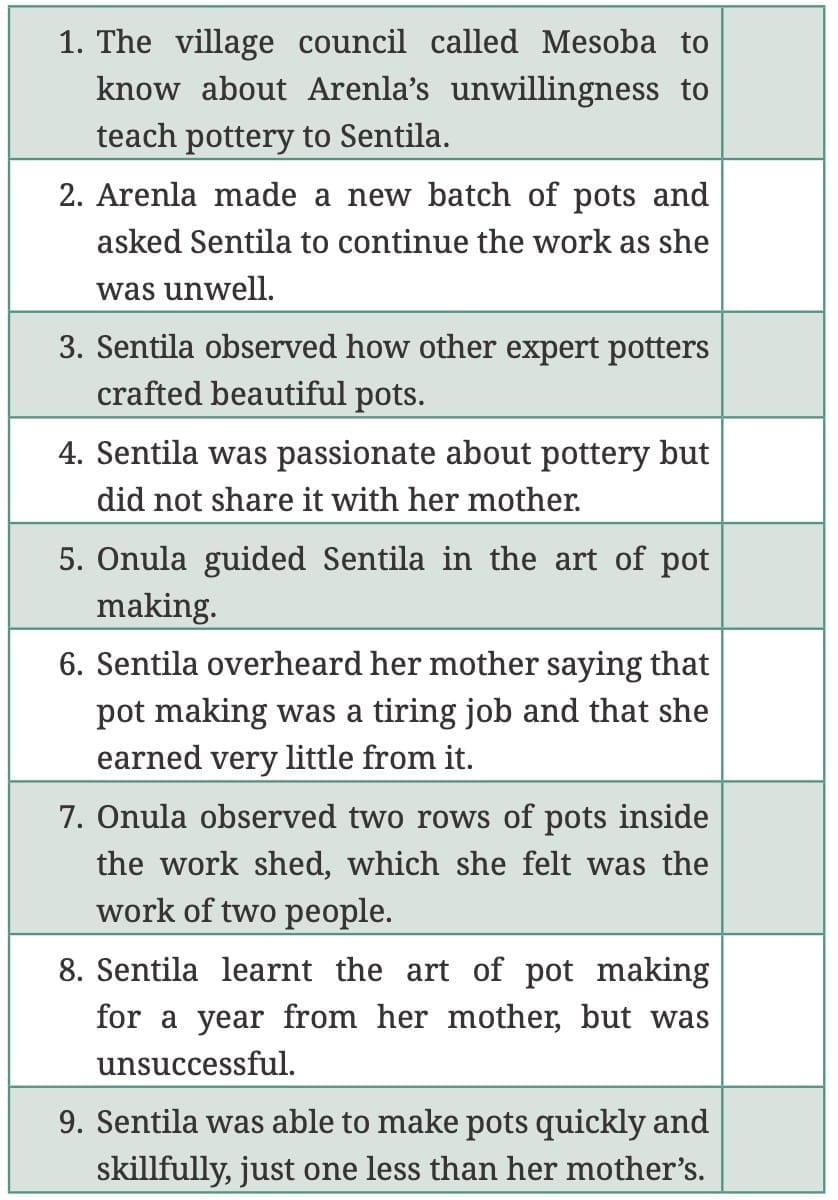
III. Arrange the following events of the story in the correct sequence.
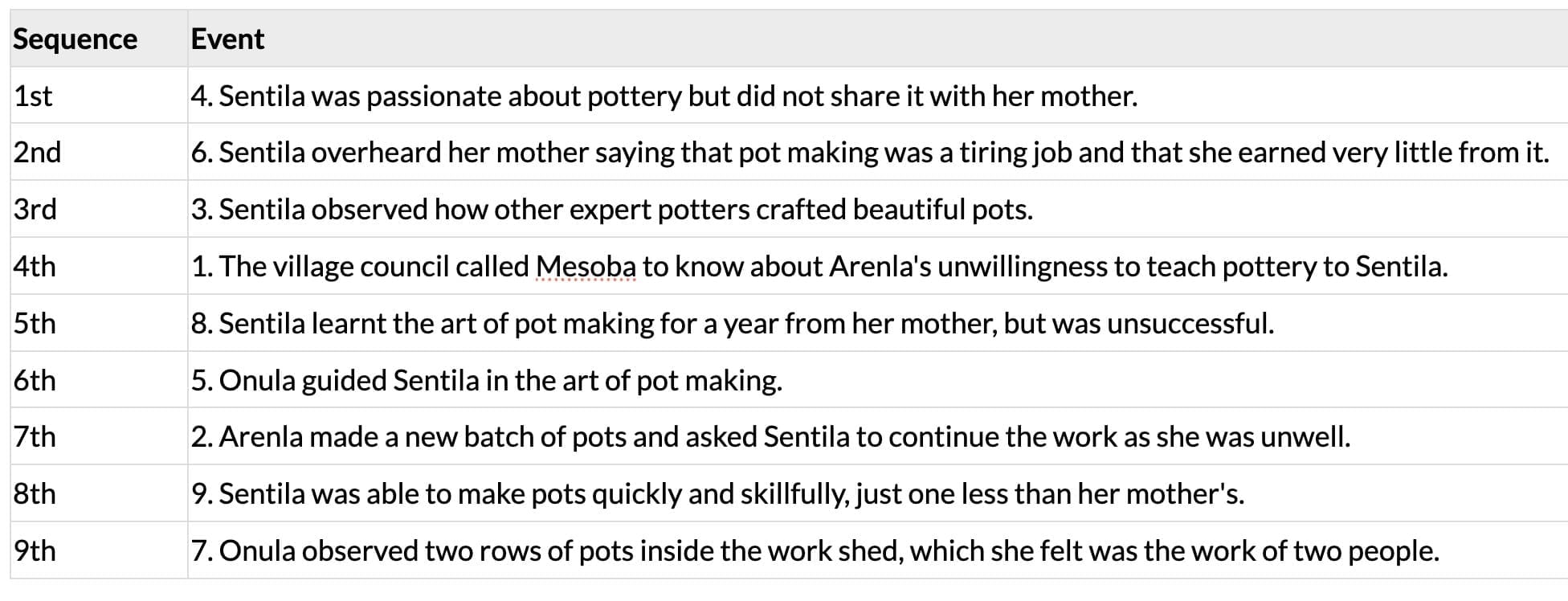
Ans:
Critical Reflection
I. Read the extracts given below and answer the questions that follow.
Extract 1:
Pounding the stubborn clay inside bamboo cylinders to soften it, is also tedious. So many times I’ve dropped the mould out of sheer exhaustion and have had to start all over again. It takes months to bring out a batch of pots after so much labour. And the reward? A few rupees. But if Sentila learns weaving, she can make much more money besides providing enough cloth for the family. Weaving is not messy like pot making and can be done indoors in all seasons. Also, the time spent on weaving one shawl is much less and the return is handsome.
(i) Choose the correct reason for the given assertion.
(A): The effort in making pots is far greater than the returns.
A. The process of pot making is quite tiresome and long, and one hardly earns much.
B. The process of pot making is exhausting, takes a long time, yet gives a sense of satisfaction.
Ans: A. Arenla confirms that months of physically punishing labour yields only “a few rupees” — there is no mention of satisfaction, only exhaustion and frustration at the poor return.
(ii) Why does Arenla want Sentila to learn weaving?
Ans: Arenla wants Sentila to learn weaving because:
- Weaving earns significantly more money — the return is “handsome.”
- A weaver can also produce cloth for the family’s own use.
- Weaving can be done indoors in all seasons, unlike pot making which depends on outdoor clay sources and sunshine.
- The time to make one shawl is far less than the months needed for a batch of pots.
- Weaving is not messy, unlike the heavy, dirty clay work of pot making. Having suffered pot making’s hardships all her life, Arenla wants a better future for Sentila.
(iii) State one advantage that weaving has over pot making, as per the extract.
Ans: Weaving can be done indoors in all seasons, whereas pot making requires outdoor access for clay collection and drying in the sun, making weaving a more consistent and reliable occupation throughout the year.
(iv) Choose the sentence that uses the word ‘handsome’ in the same way as in the extract.
A. My father is a handsome man.
B. They will make a handsome profit selling this property.
Ans: B. In the extract, “handsome” means a generous or substantial financial return — not physical appearance. Option B uses it in the same sense.
(v) ‘And the reward?’ What is the author’s purpose of using a question mark here?
Ans: The question mark is used for rhetorical emphasis. It creates a dramatic pause before the bitter answer (“A few rupees”), making the reader anticipate the contrast between enormous labour and tiny reward. It also conveys Arenla’s deep frustration and disillusionment — she is essentially asking, sarcastically and painfully, “After all that effort, what do I get?”
Extract 2:
Onula saw her taking out some clay and the implements from her basket quietly. She watched Sentila’s clumsy efforts to make a pot and noticed that Sentila was too tense. As a result, the clay seemed unable or unwilling to yield the right shape. When Sentila wearily let the misshapen lump fall flat on the ground, Onula went to her and said, “Don’t worry, little one, I shall teach you how to make a perfect pot.” Sentila watched in amazement as Onula fashioned a beautiful pot and asked her to try again.
(i) Complete the sentence with an appropriate reason.
Onula feels Sentila’s effort at making a pot is clumsy because ______________.
Ans: Onula feels Sentila’s effort is clumsy because Sentila is far too tense and anxious while working, which prevents her from moving her hands with the relaxed, rhythmic confidence that pot making requires, causing the clay to fail to yield the right shape.
(ii) Choose the correct option to complete the following sentence.
‘Don’t worry, little one, I shall teach you how to make a perfect pot.’
This shows that Onula was _____________.
A. sincere and generous
B. forgiving and thoughtful
C. thoughtful and generous
D. forgiving and sincere
Ans: C. thoughtful and generous. Onula is thoughtful because she observed Sentila’s problem carefully and understood it was tension — not lack of ability — holding her back. She is generous because she willingly offered her time and skill to teach a girl who was not her own child. “Forgiving” does not apply as there is nothing to forgive.
(iii) Which among the following is the effect of a cause?
A. As a result, the clay seemed unable or unwilling to yield the right shape.
B. Onula saw her taking out some clay and the implements from her basket quietly.
Ans: A. The phrase “as a result” signals this is the effect. The cause is Sentila being too tense; the effect is the clay not yielding the proper shape. Option B is simply an observation, not an effect.
(iv) ‘Onula fashioned a beautiful pot.’ Here, the word ‘fashioned’ means ______________. (created/styled)
Ans: ‘fashioned’ means created — Onula shaped and made a pot from clay using her skill. “Styled” relates to appearance and does not fit this context.
(v) How might Sentila have felt when she saw ‘the misshapen lump fall flat on the ground’?
Ans: Sentila likely felt deep disappointment, shame, and helpless frustration. The text tells us she “hung her head in shame and frustration” in an earlier session. The word “wearily” before the lump falls also tells us she was already exhausted and demoralised. Having dreamed of this craft for years, each visible failure intensified her sense of inadequacy — she may have begun to doubt whether she would ever master the skill.
II. Answer the following questions.
1. Describe the process of pot making followed by expert pot makers, as observed by Sentila.
Ans:
- Collecting the clay: Grey and red clay is dug from the riverbank sixteen kilometres away, loaded into carrying baskets, and brought uphill to the village.
- Preparing the clay: The clay is soaked in a trough, stuffed into bamboo cylinders, and pounded repeatedly to soften it into a malleable, dough-like consistency.
- Shaping the pot: The potter pushes the left hand into the softened clay, rotates it, and uses a spatula in the right hand to shape it. The regular tap, tap of the spatula gradually forms the pot — requiring perfect coordination and relaxed confidence.
- The mouth and rim: The rhythm is slackened when shaping the mouth, and a strip of elongated dough is added to form the rim.
- Drying: After two or three days, pots are given a final touch-up and taken out to dry in the sun.
- Firing: Dried pots are loaded onto a kiln on a bed of hay and dried bamboo, covered, and carefully fired — over or under-firing ruins the entire batch.
2. What warning was given to Mesoba by the village council?
Ans: The village council warned Mesoba on two counts:
- It was Arenla’s duty to teach her daughter pot making — a skill passed down through generations — and refusing to do so was a dereliction of that duty.
- Skills like pot making did not “belong” to any individual — they were the collective heritage of the entire community, and experts were obliged to pass them on to anyone who wished to learn, not just their own family. If all pot makers refused to teach, the tradition would die out — a serious loss for the community.
3. How did Sentila feel when she failed at pot making even after a year of training with her mother?
Ans: After a year of training with no progress, Sentila felt deeply ashamed and frustrated — the text states she “hung her head in shame and frustration.” This was especially painful because she had harboured this dream for so long. Watching her mother effortlessly shape the same clay into a beautiful pot intensified her sense of inadequacy. Despite these feelings, she did not abandon her dream, which speaks to her commitment and perseverance.
4. ‘Onula stood there for a long time as if trying to absorb a new phenomenon’. Explain.
Ans: When Onula entered the work shed after Arenla’s death, she found two neat rows of pots — identical in quality and finish — and realised it was not the work of one person. She was overwhelmed by the realisation that Sentila, who had struggled for years to shape a single pot, had in one session produced a batch indistinguishable from her master-potter mother’s work. For Onula, this was almost miraculous. She was trying to absorb both Sentila’s achievement and the profound coincidence — a new pot maker had been born on the very day her mother died, as if the craft had passed from one to the other at the moment of transition.
5. ‘The tradition and history of the people did not belong to any individual.’ What does this symbolise?
Ans:
- It symbolises that cultural heritage is a collective treasure — a skill built and refined across generations belongs to the entire community, not any one family.
- It symbolises communal responsibility — those who possess a skill have a duty to share and preserve it for the benefit of all.
- It warns against cultural extinction — if skilled individuals refuse to pass on their knowledge, entire traditions can die with them.
- It reflects an indigenous value system where individual ownership is secondary to communal wellbeing, and cultural practices are a shared identity to be protected.
6. What is the significance of the concluding line of the story, ‘A new pot maker was born’?
Ans:
- Literally, it marks Sentila’s transformation — from a passionate but struggling learner to a skilled, independent potter who has produced a batch nearly equal to her mother’s.
- Symbolically, “was born” echoes the language of new beginnings — Sentila’s life as a pot maker begins on the same day her mother (her teacher) dies, as if the craft passed from one to the other at the moment of transition.
- It symbolises the continuity of tradition — the village council’s fear that the skill would die with Arenla is answered. The craft will live on through Sentila.
- Its brevity and simplicity give it understated power, allowing the enormity of the moment to resonate quietly with the reader.
7. What is the role of perseverance in pursuing one’s dreams? Elaborate with reference to Sentila.
Ans:
- Despite family opposition: Her mother actively discouraged pot making. Sentila neither confronted her nor abandoned her dream — she quietly continued learning from expert potters whenever she could.
- Despite repeated failure: A full year of training with her mother yielded no progress. Many would have given up. Sentila did not.
- Despite shame and frustration: She hung her head in shame many times but always came back to try again — emotional resilience as important as technical skill.
- Through patient observation: Even when her hands failed her, her eyes and mind kept learning. Her sustained observation of her mother’s technique eventually led to her breakthrough.
- The story affirms that perseverance is not passive waiting but active, ongoing effort — and that it is this quality, more than talent alone, that makes dreams a reality.
Vocabulary and Structures in Context
I. Classify the words/phrases as Tools/Implements, Raw Materials, or Process.
- She taught Sentila how to dig the clay with a dao, load it on to her carrying basket…
- Sentila was a quick learner and turned the clay into malleable dough. Pounding the stubborn clay inside bamboo cylinders to soften it…
The highlighted words describe the tools and materials required in the process of pot making.
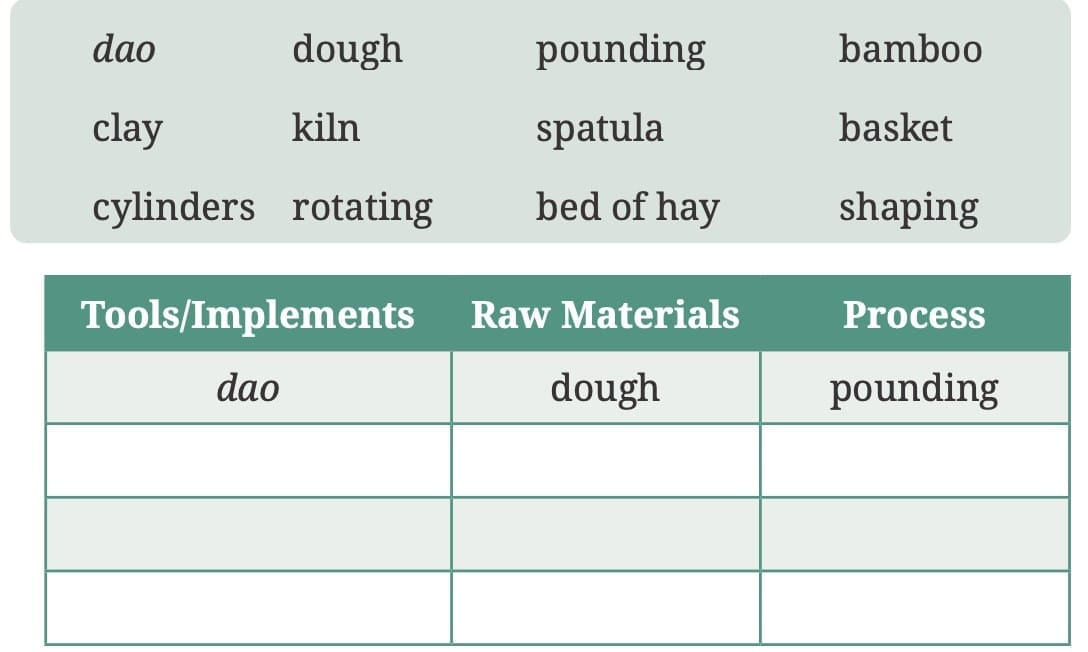
Now, classify the words/phrases given in the box as shown in the table below. One example for each category has been done for you.
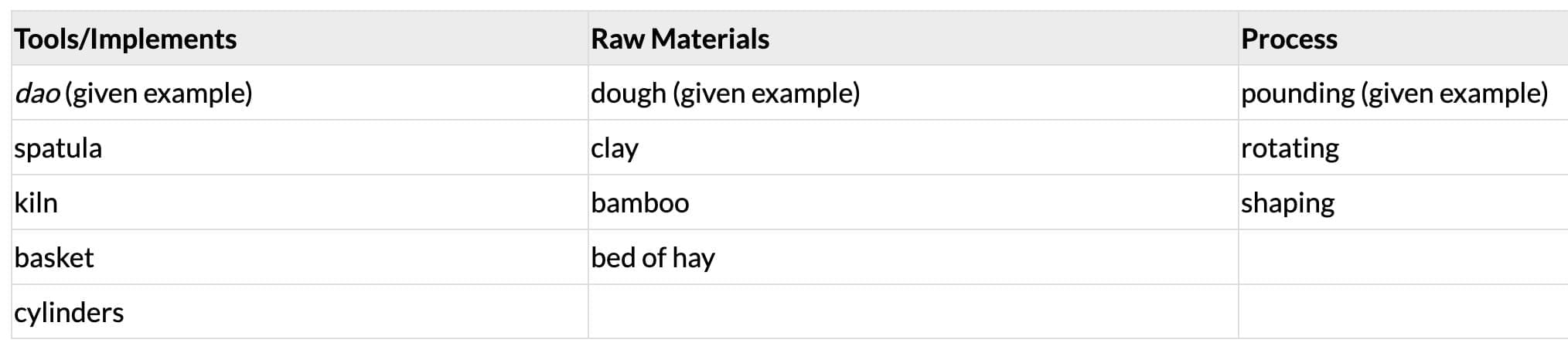
Ans:


II. Economic words — meanings and sentences.These words relate to livelihood and economic aspects that are crucial for any enterprise/business/vocation. Work in pairs and find the meanings of the following words related to economy. You may refer to a dictionary.Now, frame sentences using each word.
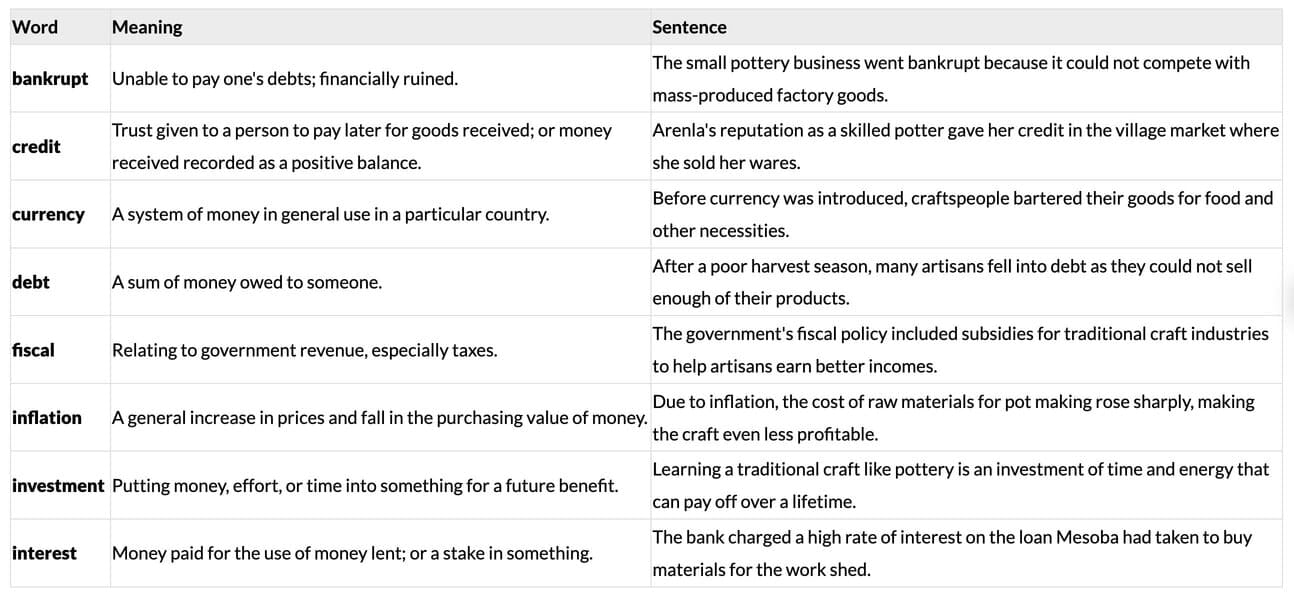
Ans:
III.1. Complete the following sentences with suitable noun clauses.
- (i) The elders emphasised that pot making was the community’s heritage and must be passed on from generation to generation, not withheld from those who wished to learn it.
- (ii) Mesoba explained why Arenla had not yet taught Sentila the craft, saying that they had wanted the girl to grow stronger after her illness before taking on the demanding work.
- (iii) Onula’s promise was that she would teach Sentila how to make a perfect pot and help her gain the confidence and technique she was lacking.
- (iv) Sentila observed her mother carefully when she was shaping the mouth of the pot, which helped her finally understand how the rhythm was slackened and how the rim of elongated dough was added to complete the pot.
- (v) The kiln, where the dried pots were loaded in a uniform pattern on a bed of hay and dried bamboo and then fired with great care, required careful attention to prevent over or under-firing.
III.2. Underline the main clause and circle the subordinate clause.
- (i) Arenla took Sentila to the riverbank (where the grey and red clay was found).
- (ii) She started on the next one, and like a sprinter (who had suddenly found momentum)…
- (iii) … skills such as pot making, (which not only catered to the needs of the people) did not belong to any individual…
III.3. Complete the following sentences with suitable relative clauses.
- (i) Sentila, whose passion for pot making had burned since childhood and who had secretly visited expert potters to learn the skill, practised the craft diligently.
- (ii) The village council, where the elders gathered to discuss matters of community importance and tradition, sought an explanation for Arenla’s reluctance.
- (iii) The potter’s hands, which moved with the practised ease of years of experience, coordinating left hand and spatula in perfect rhythm, shaped the clay into beautiful creations.
- (iv) Arenla, her mother, wanted her to learn weaving, which was cleaner, could be done indoors in all seasons, took less time, and earned a much better income than pot making.
- (v) Mesoba went home and discussed the matter with Arenla, who had been aware of her daughter’s visits to the potters all along but had chosen to pretend ignorance.
III.4. Read the highlighted words in the following lines from the text.
- Onula saw her taking out some clay…
- … make as many pots as they could.
- … did not belong to any individual.
- Slowly she walked away from this place of wonder.
- … they would not have enough days of sunshine …
(i) Find some more determiners from the text.
Ans: Additional determiners found in the text:
- her (possessive) — “her mother,” “her daughter,” “her basket”
- the (article) — “the clay,” “the kiln,” “the village”
- a (article) — “a lump,” “a beautiful pot,” “a batch”
- another (indefinite) — “another lump of clay”
- every (distributive) — “every possible way”
- next (ordinal) — “the next one”
- no (indefinite) — “no expert potters”
- one (numeral) — “just one short of her mother’s tally”
III.4.(ii) Fill in the blanks with suitable determiners.
A. The florist arranged five bouquets for her clients, that were displayed in an elegant floral shop.
B. The carpenter crafted several unique tables, and one became the centrepiece in his furniture collection.
C. Each of the apprentices in the culinary class demonstrated their knife skills during the intense cooking session.
D. Many of the sculptures were displayed at the art exhibition, showcasing their diverse artistic skills.
Speaking Activity
Work in pairs and choose two characters from the story—Sentila and one other character (Arenla, Mesoba, Onula, or a village elder).
Prepare to speak from the chosen character’s perspective based on information from the story and the understanding of the intentions of the characters.
Prepare a role-play between Sentila and the chosen character. The conversation between the characters should cover the following points:
- Sentila’s desire to learn pot making
- The challenges she faces
- The advice or perspective the other character offers
Students can use direct quotes from the story and creatively expand on the characters’ thoughts and feelings.
You may use the following sentence prompts:
- I feel/felt ________ because…
- I wish/wished ________ because…
- When you said/did ________, it made me feel/think ________ because…
Ans: Sample Role-Play: Sentila and Onula
The following is a sample role-play script covering Sentila’s desire to learn pot making, the challenges she faces, and the advice and perspective offered by Onula. Students may adapt and expand on this using direct references from the story and sentence prompts provided.
Sentila: Onula Aunty… I feel so ashamed. I have been trying for over a year, and I still cannot shape a single pot properly. I wish I had never tried — maybe Mother was right. Maybe I am not meant for this.
Onula: Don’t say that, little one. When I watched you just now, I did not see someone without talent. I saw someone who was trying so hard that the clay could feel the tension in your hands. You are fighting it, when you should be trusting it.
Sentila: But when you said that I should just relax and try again, I didn’t believe it would work. And then I made a pot! A real one! I felt something I had never felt before — like the clay was finally listening to me. But then you said the mouth was all wrong, and I felt that terrible frustration again.
Onula: I understand. But I said that to give you direction, not to discourage you. When you work with your mother next time, don’t just sit there feeling nervous — watch her hands when she shapes the mouth. See how she slackens the rhythm. Watch where she adds the rim. You are a quick learner. You will do well. I have seen it.
Sentila: I wish I could tell Mother that I want this more than anything. I feel frustrated because she sees pot making only as a burden — the aching back, the heavy clay, the long walk to the riverbank. But when I watch the pot taking shape, Aunty, it is like watching something come alive. That feeling — I cannot give it up.
Onula: Then don’t. When you said “I feel” just now — that is your answer. Your mother carries the weight of years of hard work in her words. She is not wrong about the hardship. But she cannot feel what you feel. That passion — it is your greatest tool. Carry it with you every time you sit down at the wheel, and the clay will know.
Sentila: Thank you, Aunty. I think I finally understand. I will go back, I will watch, and I will try again. One day I will make pots that even Mother cannot tell apart from her own.
Onula: (smiling) I believe you already will. Go, Sentila. The clay is waiting.
Writing Task
Reflective Writing – Sample Write-up: Identifying Skills and Passion
Reflective writing encourages introspection and thoughtful exploration of personal experiences, skills, and aspirations. It helps individuals gain deeper insights into themselves and their goals through structured reflection.
I. Follow the steps given below to create a write-up about your skills and passions.
Step 1: Introduction
Reflect on your passions and the skills you currently possess or are developing. Consider why these activities or interests are meaningful and enjoyable to you.
Step 2: Describing skills
Describe specific activities or practices you engage in to nurture your skills. This could include hobbies, classes (art, music, coding, etc.), workshops, or personal projects.
Step 3: Passion into profession
Identify which of these skills you believe have the potential to turn your passion into a profession. Explain why you think these skills are crucial or advantageous in your chosen field.
Step 4: Examples and reflection
Provide examples or anecdotes that illustrate how your skills and passions complement each other. Reflect on how these experiences have shaped your career aspirations and personal growth.
Step 5: Conclusion
Summarise your reflections. Discuss any insights gained about yourself, your skills, and your career ambitions through this exercise.
Ans
Step 1 — Introduction:
For as long as I can remember, I have been drawn to the world of words. Reading, writing, storytelling — these have never felt like work to me. While other children at school would groan when assigned an essay, I would find myself excited by the blank page and what I could fill it with. My passion is writing, and over the years I have realised that it is not just something I enjoy — it is something I need. It is how I make sense of the world around me.
Step 2 — Describing Skills:
To nurture this passion, I read widely across genres — novels, short stories, poems, journalism, and non-fiction. I keep a journal where I write every evening, recording not just events but thoughts, observations, and emotions. I have participated in school creative writing competitions and have recently started a blog where I write short stories and book reviews. I also attend a writing workshop once a month where I receive feedback from experienced writers and fellow enthusiasts. Each of these activities has sharpened a different aspect of my writing — the journal builds my habit of observation, the workshop builds my ability to accept criticism and revise, and the blog teaches me to write for an audience.
Step 3 — Passion into Profession:
I believe writing has genuine professional potential for me. The skills I am developing — communication, research, storytelling, editing — are valuable in a wide range of careers including journalism, content creation, publishing, teaching, and even law or public policy (where clear, persuasive writing is essential). I believe my ability to express complex ideas clearly and my commitment to practising every day will be my greatest advantages in any field that involves communication.
Step 4 — Examples and Reflection:
One experience that shaped my understanding of writing as a skill was when my story was rejected in a competition I had worked very hard for. I was devastated at first — but when I revisited the story months later, I could see its weaknesses clearly. I rewrote it entirely, and the revised version was published in our school magazine. That experience taught me that passion alone is not enough — perseverance, a willingness to fail, and the humility to improve are what turn passion into skill. Just like Sentila in the story, I learned that the breakthrough comes not from giving up, but from continuing to try, observe, and grow.
Step 5 — Conclusion:
This exercise of reflection has made me see that I am not just “someone who likes writing” — I am someone who is actively building a craft. I have learned that the gap between loving something and being truly good at it is filled by consistent effort, honest self-criticism, and the courage to keep going when it gets difficult. My goal is to one day write stories that matter to people — stories like the ones I have read that have stayed with me long after the last page. That is the pot maker in me: not content to simply admire the craft, but determined to master it.