Let us Think (Page 2).
A. Answer the following
Q1: Explain the meaning of the word ‘bow’ used in the poem.
Ans: The word ‘bow’ in the poem refers to a rainbow, which looks like a curved arc in the sky.
Q2: Which bridge does the poet like more and why?
Ans: The poet likes the rainbow more than river bridges because it is prettier and builds a road from earth to sky.
Q3: The word ‘these’ is used for different things in stanzas one and two. What are the things for which ‘these’ has been used in each stanza?
Ans: In stanza one, ‘these’ refers to boats and ships. In stanza two, ‘these’ refers to bridges on the rivers.
Q4: State whether the following are True or False.
Ans:
a. Ships sail on the river. – False (Ships sail on the seas, not rivers.)
b. Boats sail on the sea. – False (Boats sail on the rivers, not seas.)
c. Bridges are built on the river. – True (Bridges are built on rivers.)
d. A road is built from earth to the sky. – False (The rainbow is described as a road, but it’s not actually built.)B. Think and discuss
Q5: What are the ways in which you can cross a river?
Ans: You can cross a river by using a bridge, a boat, a ferry, or by swimming if it’s safe.
Q6: Have you ever seen a rainbow in real life or in pictures? How did you feel?
Ans: I saw a rainbow in the sky after rain. I felt happy and excited because it was colourful and beautiful.
Q7: If you could walk on a rainbow, where do you think it would take you?
Ans: Walking on a rainbow might take me to a magical place with bright colours, happy animals, and shiny clouds.
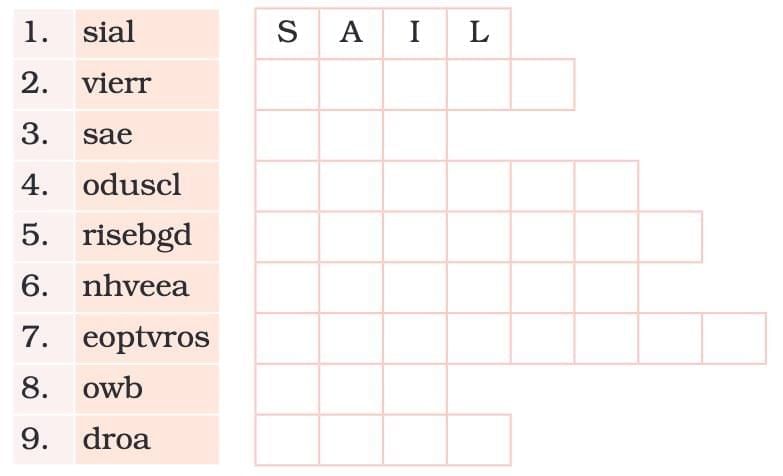
Let us Learn (Page 3)A. Rearrange the letters of each word to form a meaningful word from the poem
Q: Rearrange the letters of each word to form a meaningful word from the poem.
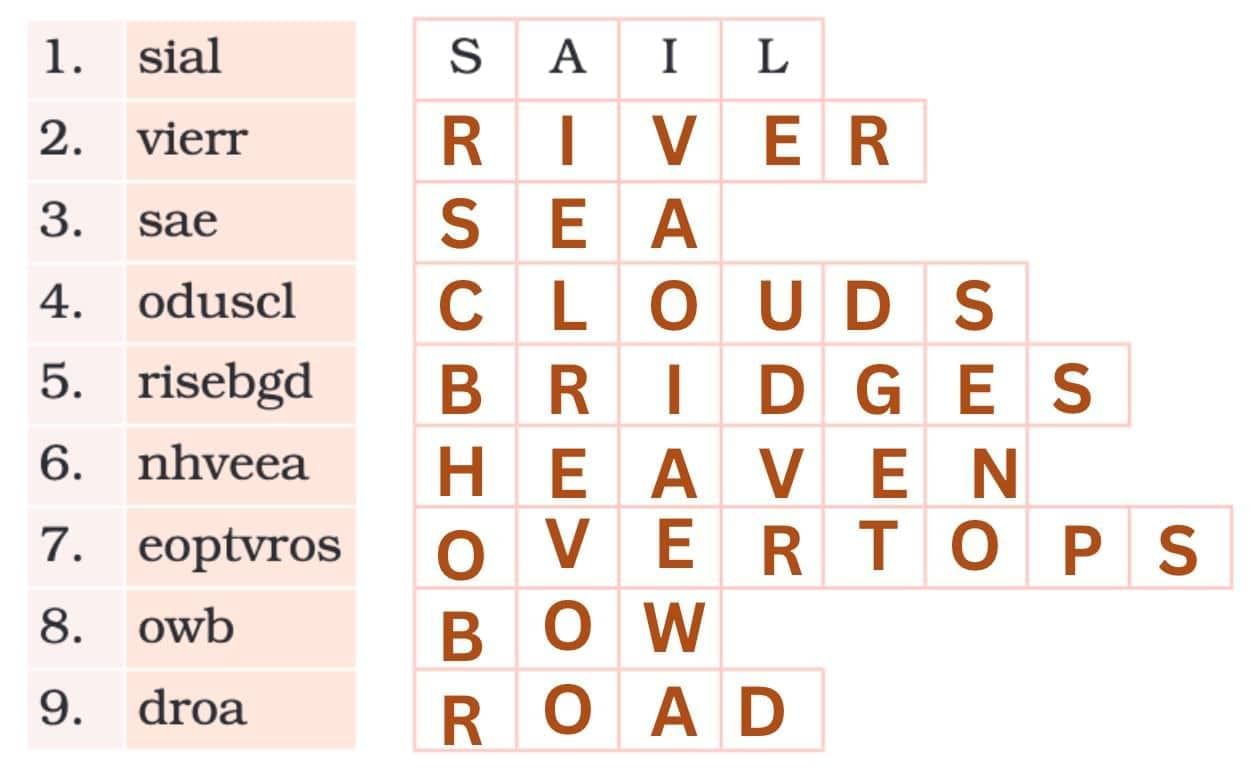
Ans:B. Work in pairs
Q: Work in pairs. One of you moves a finger around in the circle. When your partner says ‘Stop’, perform the action indicated by the segment that the finger lands on.
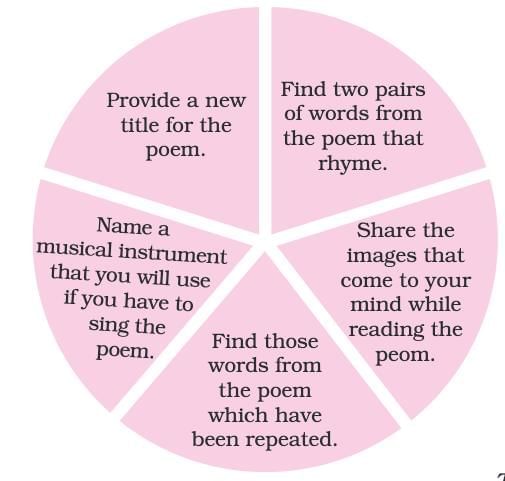
Ans: This is a classroom activity. Work with a partner, move your finger in a circle, and perform the action when your partner says ‘Stop’.
Let us Listen (Page 4)
Q: Sit in a circle and listen to the words read aloud by your teacher. Give five rhyming words for each word as indicated.
Ans:
- Ship: chip, trip, dip, slip, grip
- Tree: free, see, bee, knee, tea
- Bow: show, glow, know, flow, snow
- Rain: pain, gain, main, chain, lane
- Sun: fun, run, gun, bun, none
- Sea: tea, key, bee, free, see
- Sail: mail, tail, fail, rail, jail
- And: hand, land, band, sand, stand
- Sky: high, fly, buy, try, cry
- Far: car, star, jar, bar, tar
Let us Speak (Page 5)
Q: Recite the poem given below in three ways:
a. In a happy voice,
b. In an angry voice,
c. In a surprised voice.
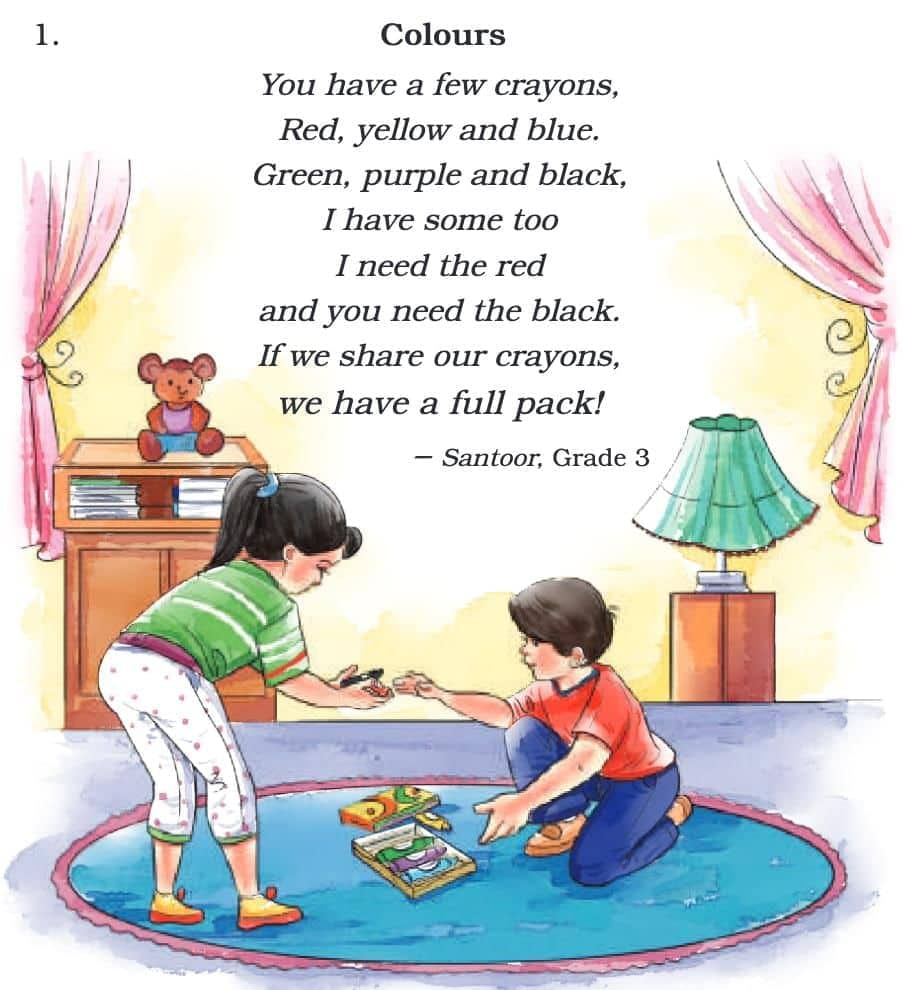
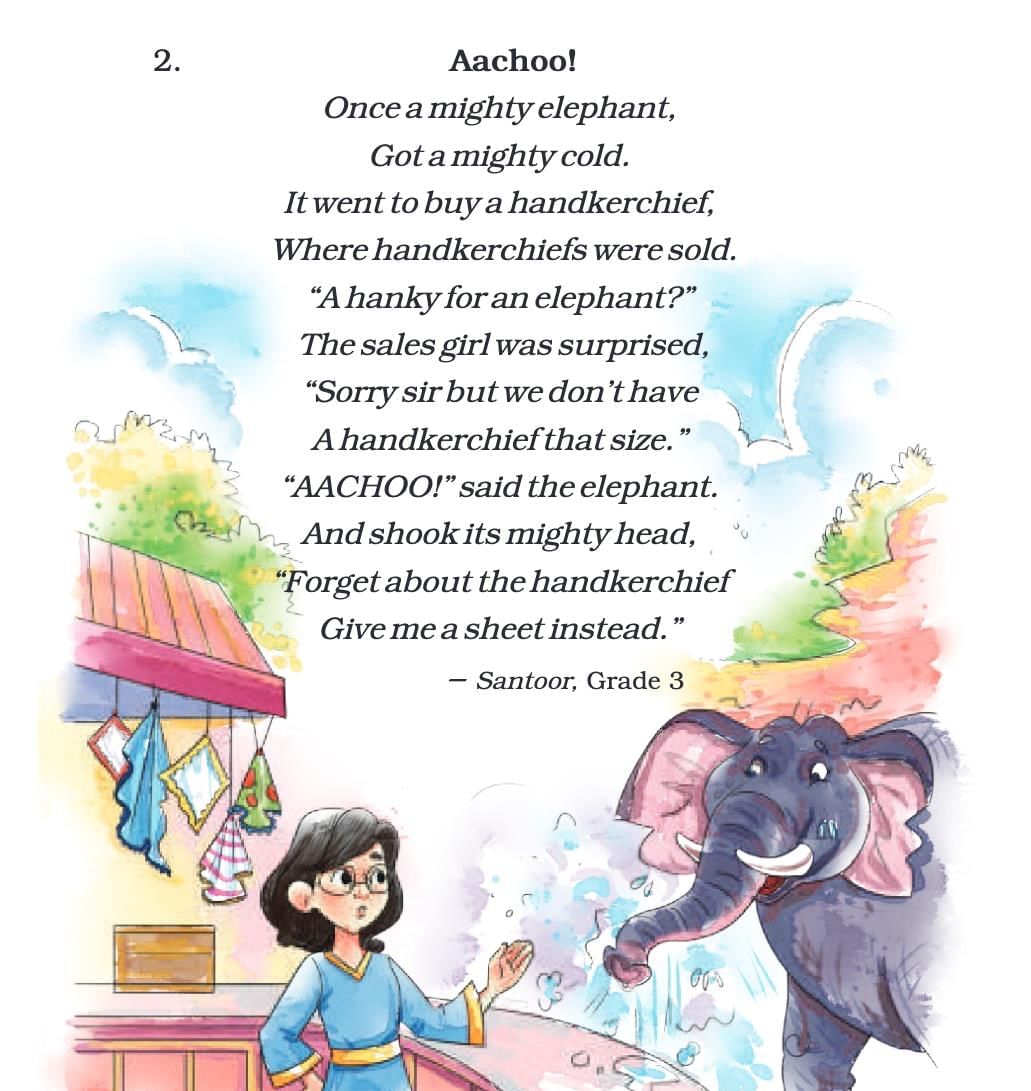
Ans: This is a classroom activity. Recite the poem “Colours” in a happy voice, an angry voice, and a surprised voice as instructed by the teacher.
Let us Write (Page 7)A. The poem The Rainbow mentions boats and ships and their journey across the water bodies. You too may have travelled to different places. Share your experience of travelling to any one place with your class.
Write a short paragraph of 80–100 words about your journey to a place you visited recently. You may include the following points in your paragraph:
• Time of journey and destination
• Purpose of travel
• Whom you travelled with
• Things you liked or disliked during your travel
• Local dishes and snacks
• Monument, landmark or scenery
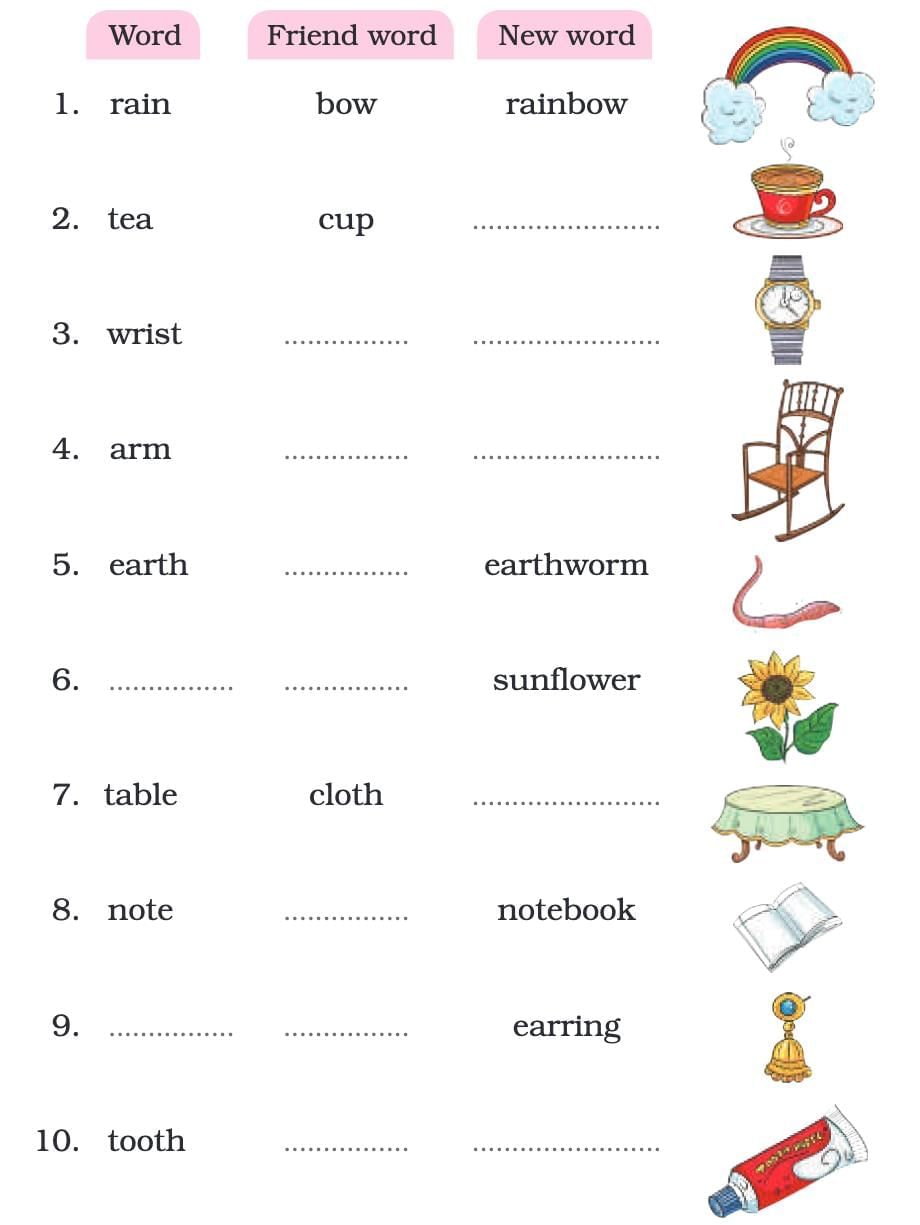
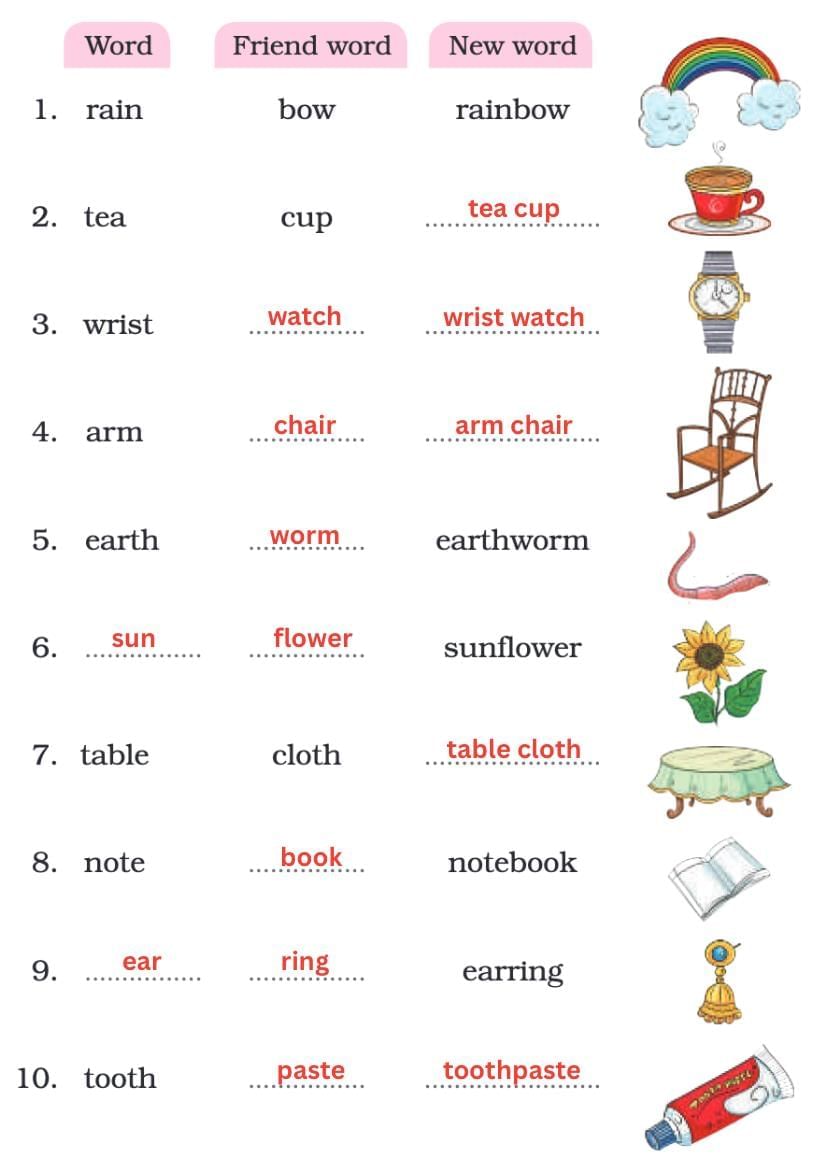
Ans: Last month, I traveled to my grandmother’s village for a family visit. I went with my parents and sister by car. The journey was fun because we played games and sang songs, but the road was bumpy sometimes, which I didn’t like. I loved the green fields and the river we saw on the way. We ate homemade parathas and mangoes from the village. The old temple near the river was beautiful. I felt happy spending time with my family and seeing new places.B. A word joins a ‘friend word’ to make new words
Q: Complete the table.
Ans:C. Create two sentences for each word, once as a noun and then as a verb
Q: The following words are both nouns and verbs. Create two sentences for each word, once as a noun and then as a verb.
Ans:
1. Cut
Noun: The cut on my finger hurts.
Verb: I cut the paper with scissors.
2. Bat
Noun: The cricket bat is new.
Verb: Bats fly at night.
3. Picture
Noun: The picture on the wall is colourful.
Verb: I picture a beautiful rainbow in my mind.
4. Cry
Noun: Her cry was loud.
Verb: Babies cry when they are hungry.
5. Filter
Noun: The water filter is in the kitchen.
Verb: We filter the water before drinking.
6. Dance
Noun: The dance at the party was fun.
Verb: We dance to music every evening.
7. Plant
Noun: The plant needs water.
Verb: I plant flowers in the garden.
8. Paint
Noun: The paint on the wall is blue.
Verb: We paint the house every year.
9. Fly
Noun: The fly is on the food.
Verb: Birds fly in the sky.
10. Face
Noun: Her face was happy.
Verb: We face challenges bravely.D. Write the opposites of the following words
Q1: Write the opposites of the following words in the space provided. All your answers must begin with an ‘S’.
Ans:
a. large → small
b. weak → strong
c. fast → slow
d. rough → smooth
e. dull → shiny
f. curved → straight
g. finish → start
h. addition → subtraction
i. complicated → simple
j. mild → spicy
k. blunt → sharp
Q2: Now, make sentences using the words that you have written in the blanks.
Ans:
1. The small cat slept quietly.
2. The strong boy lifted the box.
3. The slow turtle crossed the road.
4. The smooth stone felt nice to touch.
5. The shiny star sparkled in the sky.
6. The straight line was easy to draw.
7. We start the game in the morning.
8. Subtraction is harder than addition.
9. The simple puzzle was fun to solve.
10. The spicy food was tasty.
11. The sharp knife cut the fruit easily.
Q3: In small groups, choose a letter of the English alphabet and create an exercise similar to the one above.
Ans: Example Response:
Choose the letter ‘B’. Find opposites starting with ‘B’:
1. small → big
2. dark → bright
3. sad → blissful
4. old → brand-new
5. dull → brilliantE. VIBGYOR – The colours of the rainbow
Q: VIBGYOR is an easy way to remember the seven colours of the rainbow in order.
Ans:The seven colours of the rainbow are:
- Violet
- Indigo
- Blue
- Green
- Yellow
- Orange
- Red
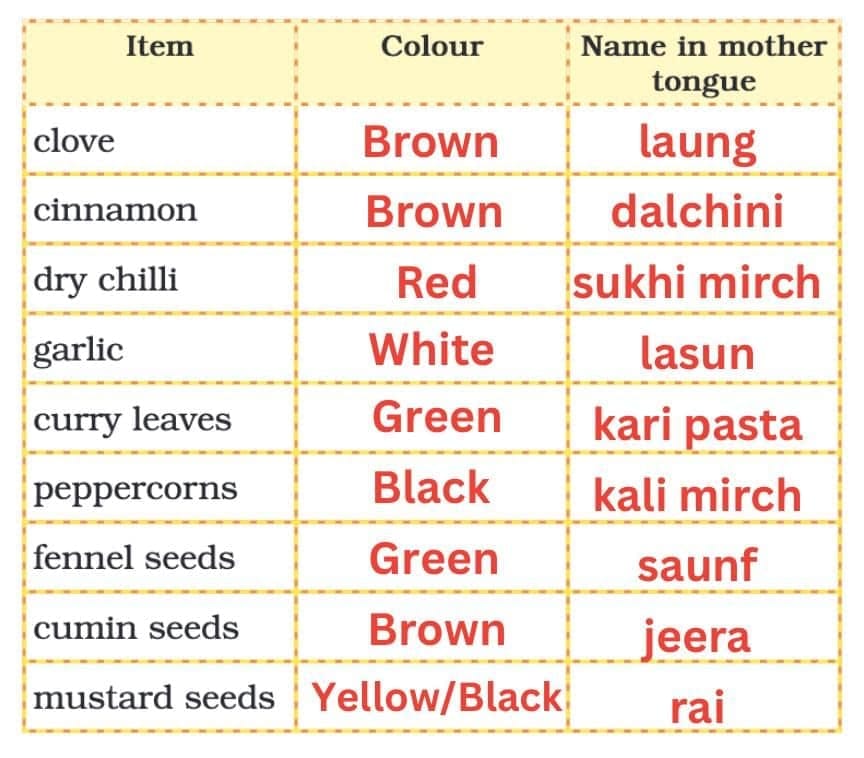
F. The following items, generally found in kitchens, add colour and taste to the food
Q: What colours are they? Write them in the column. What do you call them in your mother tongue?
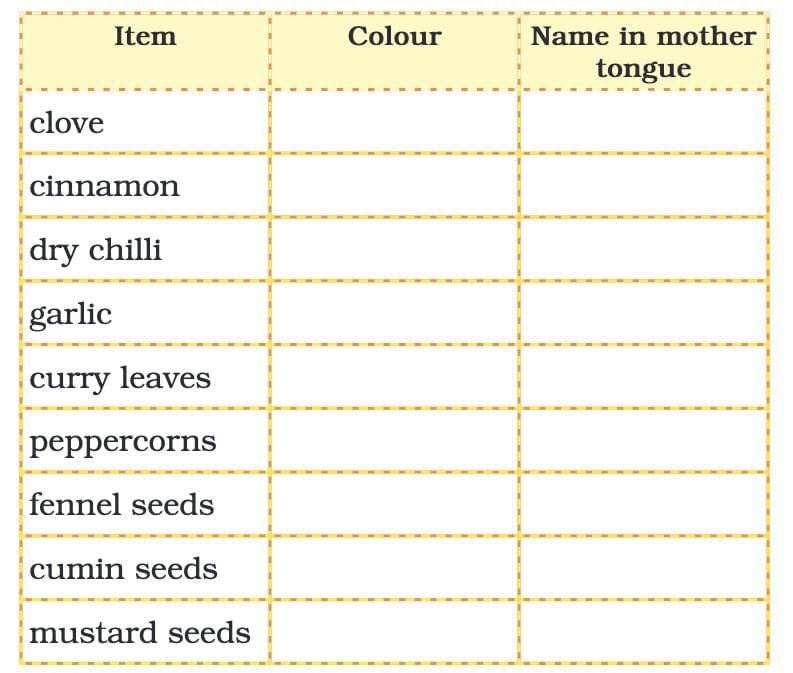
Ans: