Reflect and Respond
I. Given below are four riddles. Read and identify who these people are.
- “In furrows deep, secrets I sow,
As time passes, I watch them grow.”
Ans: A Farmer. The riddle refers to sowing seeds in ploughed soil and watching crops grow — the primary work of a farmer. - “From wheel to kiln, my skill is born,
Step by step, an art takes form.”
Ans: A Potter (Pot Maker). The riddle describes working with clay on a potter’s wheel and firing pots in a kiln — the hallmarks of the potter’s craft. - “I lay foundations, brick by brick,
To build a house, it’s me you pick.”
Ans: A Mason / Construction Worker. The riddle describes laying bricks and building foundations — the work of a mason or builder. - “I work with pots, pans, and spice,
Creating dishes that taste so nice.”
Ans: A Cook / Chef. The riddle refers to someone who works in a kitchen using pots, pans, and spices to create food.
II. What is the role and relevance of the people you identified in the riddles? How do they contribute to society?
Ans:
- The Farmer is the foundation of civilisation — growing the food that sustains entire populations and ensuring national food security.
- The Potter is a keeper of cultural tradition — creating functional vessels for daily use and decorative objects that carry a community’s artistic heritage across generations.
- The Mason builds the physical infrastructure of society — from homes and schools to hospitals and bridges.
- The Cook nourishes communities and preserves regional food culture and culinary traditions.
All four vocations address the most basic human needs of food, water, shelter, and nourishment. Society cannot function without their skilled work, yet they are often taken for granted.
Check Your Understanding
I. State whether the following statements are true or false. Also, rectify the false statements.
II. Let us appreciate the poem.
1. Rhyme Scheme and Lineation
(i) Does the poem strictly adhere to a rhyme scheme, or is it in free verse?
Ans: The poem is written in free verse — it does not follow a strict, regular rhyme scheme. While some lines have a loose musicality, there is no consistent ABAB, AABB, or any other fixed pattern. This suits the poem’s inclusive nature — just as the vocations celebrated are many and varied, the poem’s form is also open and unconfined.
(ii) What is the impact of the varying length of lines in the poem?
Ans:
- It mirrors the diversity of vocations — just as no two crafts are alike, no two lines are identical in length.
- Longer lines describe a vocation in detail; shorter lines create emphasis and punch.
- It gives the poem a conversational, spoken-word quality, as if someone is genuinely reporting on the sounds and sights of India’s working world.
- It prevents monotony, keeping the reader engaged as each line arrives with a slightly different rhythm.
(iii) What is the pattern in the structure of most lines of the poem?
Ans: Most lines follow a pattern of naming a vocation, followed by a description of what they do or how they do it (e.g., “The carpenters celebrating; they create anything out of wood with mathematical precision”). This creates a cumulative, catalogue-like effect building an ever-expanding portrait of India’s working people, with a processional quality — as if different workers are passing by one by one and being acknowledged.
2. Speaker
(i) Who appears to be the speaker and what is her/his role here?
Ans: The speaker appears to be an attentive, appreciative observer — perhaps a poet or thoughtful citizen — who stands amid India’s vibrant working life and celebrates everything they witness. Their role is that of a witness, celebrant, and chronicler who gives voice and dignity to every vocation. By saying “I hear Bharat celebrating,” the speaker becomes the voice of collective recognition — ensuring no worker goes unseen or uncelebrated.
3. Tone and Mood

(i) Fill in the blanks with suitable options from the box.
A. The tone is celebratory and reverential, depicting a sense of admiration and respect for the artisans and craftspersons.
B. There is a joyful mood throughout the poem, capturing the vibrancy and richness of cultural traditions and skills.
4. Imagery
(i) Select any two descriptions from the poem that evoke visual images.
Ans:
- Visual Image 1: “The boatmen gathering their nets from the shore, sailing, and singing while at work, return to tell the tales of life at sea” — evokes a vivid picture of boatmen at the shoreline, pulling nets from the water, their silhouettes against the horizon as they head home.
- Visual Image 2: “Those of craftsperson, each one celebrating their craft, woven with colours and myriad hues” — evokes the colourful spectacle of craftspeople at work, their creations bursting with colour.
(ii) Fill in the blanks with suitable phrases.
The poem includes auditory imagery through mentions of artisans with lutes, _____________, and _____________, emphasising the sounds associated with each vocation.
Ans: The poem includes auditory imagery through mentions of artisans with lutes, electricians humming, and the delicious singing of the cook, emphasising the sounds associated with each vocation.
5. Metaphor
(i) State whether the following sentence is true or false:
The mention of ‘delicious singing’ of the cook is a metaphor because it implies that the quality of the singing is so enjoyable or pleasing that it can be equated to the experience of tasting something delicious.
Ans: True. ‘Delicious singing’ is an example of synesthesia — a figure of speech in which one sense (taste: ‘delicious’) is used to describe an experience of another sense (hearing: ‘singing’). Synesthesia is a special type of metaphor. The cook’s singing is compared to something delicious, suggesting it is warm, pleasurable, and full of life.
6. Personification
(i) Select the line that tells us that the poet personifies vocations by attributing human-like qualities to them.
Ans: The line is: “The voice of their vocation is the voice of their identity.”
Here, a vocation — an abstract concept — is given a human quality: a voice. This personifies it as something that can speak and express, treating it as a living entity that carries and communicates the worker’s entire identity, elevating work from a mere economic activity to something that speaks on behalf of the worker’s whole being.
7. Repetition
(i) Why might the poet have begun and ended with the same line — ‘I hear Bharat celebrating, the varied vocations I hear!’?
Ans:
- Structural unity: Creates a circular structure, suggesting India’s vocational richness is continuous and unending.
- Emphasis: Repetition hammers home that Bharat celebrates ALL vocations together.
- Musical quality: Gives the poem a rhythmic, hymn-like quality — like a joyful chorus the entire nation joins.
- Ongoing act: Beginning and ending with “I hear” suggests that celebrating India’s vocations is a permanent, continuous act, not a one-time event.
8. Alliteration
(i) Identify two examples of alliteration from the poem.
Ans:
- Example 1: “celebrating their craft” — repetition of the ‘c’ sound in “celebrating” and “craft.”
- Example 2: “sailing, and singing” — repetition of the ‘s’ sound, creating a smooth, flowing effect that mimics the gentle motion of a boat on water.
9. Symbolism
(i) Each vocation in the poem symbolises something more than just a job. What does it symbolise?
Ans:
- Identity and selfhood: “The voice of their vocation is the voice of their identity” — a person’s craft is not just what they do, it is who they are.
- Cultural heritage: Craftspersons and artisans keep alive traditions going back centuries, carrying the knowledge and values of their communities across generations.
- Dignity of labour: By celebrating every craft equally, the poem challenges social hierarchies — the electrician is as celebrated as the designer; the shoemaker as the architect.
- The living soul of Bharat: All vocations together symbolise the everyday, working India — of hands, voices, and skills that keep the nation flourishing.
Critical Reflection
I. Read the extract given below and answer the questions that follow.
The shoemakers affirming the quality of their work, for the feet that walk, dance, run, jump, return home.
The delicious singing of the cook, or the rhythm of designer, mason, each celebrating what belongs to them and to none else,
1. The poet says that the shoemakers ‘affirm’ the quality of their work. What does ‘affirm’ refer to here?
(i) to make adjustments in
(ii) to declare with confidence
(iii) to label the goods
(iv) to justify the efforts
Ans: (ii) to declare with confidence. The shoemakers are making a proud, dignified declaration of the excellence of what they produce — not adjusting, labelling, or merely justifying. This reflects their self-respect and pride in their craft.
2. What do quality shoes help with, according to the poet?
Ans: Quality shoes help the human feet carry out all the activities of life — to walk, dance, run, jump, and return home. This covers every kind of human movement: the ordinary (walking, returning home), the joyful and artistic (dancing), and the energetic (running and jumping) — enabling people to live fully, from labour to leisure.
3. What does ‘return home’ symbolise besides the literal act of returning?
Ans:
- It symbolises safety and completion — the shoemaker’s craft enables safe journeys through all of life’s activities.
- It symbolises the full circle of life — from going out into the world to returning to one’s roots and relationships.
- It symbolises belonging and identity — “home” is not just a physical place but an emotional and spiritual anchor. The shoemaker who enables people to “return home” helps them remain connected to who they are.
4. Identify the phrase that tells us that every worker’s contribution is distinct.
Ans: The phrase is: “each celebrating what belongs to them and to none else.” The words “to none else” emphasise that every worker possesses a unique skill and identity that cannot be replicated — each person’s craft is their individual, irreplaceable contribution to the world.
5. Complete the following with suitable words:
…for the feet that walk, dance, run, jump, return home refers to ___________.
Ans: …refers to all the varied activities and journeys of human life — from daily labour and joyful celebration to physical exertion and the safe return home — made possible and comfortable by the shoemaker’s quality craftsmanship.
II. Answer the following questions.
1. Why does the poet say, ‘I hear Bharat celebrating, the varied vocations I hear’?
Ans: The poet uses this line to assert that India’s true identity lies in the living work of its people. The sounds of people working — the tap of a carpenter’s tool, the electrician’s hum, the boatman’s song — are themselves a form of celebration. India celebrates its vocations not just in festivals but through the act of work itself, every day. The repeated “I hear” reinforces that the speaker is actively listening and honouring what most overlook, urging the reader to recognise that India’s workers constitute the real music and identity of the nation.
2. What does the electrician ‘humming’ while getting ready for work suggest?
Ans:
- It suggests the electrician approaches work with contentment and purpose — humming signals a relaxed, positive inner state.
- It humanises the electrician — showing a person at ease in their vocation, not merely burdened by it.
- It creates an auditory image — the hum poetically mirrors the low hum of electricity through a wire.
- It reflects the poem’s central theme of dignity of labour — the electrician who brightens our lives hums cheerfully, treating work as a calling.
3. Explain the significance of the line, ‘The voice of their vocation is the voice of their identity.’
Ans:
- Vocation as self-expression: What a person does is inseparable from who they are — the potter’s identity is woven into the clay they shape; the boatman’s into the sea they sail.
- Work as voice: Each craftsperson speaks through their work — the carpenter through furniture, the weaver through cloth — carrying their personality, culture, and values.
- Dignity and respect: All vocations deserve equal respect because each is the unique voice of a unique human being. To dismiss any vocation is to silence that person’s identity.
- Cultural continuity: Since many vocations are passed down through generations, the “voice of their vocation” is also the accumulated voice of their ancestors — a living bridge between past and present.
4. Do you think the role of all the people belonging to different vocations is important in our daily lives? Support your answer with a reason.
Ans: Yes, absolutely. Even a single ordinary day depends on dozens of different workers: the food on our plate comes from the farmer; the pot it is cooked in from the potter; our building from the mason and carpenter; electricity from the electrician; shoes from the shoemaker; and fish from the boatman. If any one vocation were to disappear, an entire dimension of daily life would collapse. Society functions because of the interdependent network of all vocations — each contributing what uniquely belongs to them. To respect and value every vocation is to recognise the practical truth of how human civilisation is sustained.
5. Why is the poet celebrating all the vocations in the poem? Explain by giving examples from your context.
Ans: The poet celebrates all vocations because they form the foundation of society — yet most workers are invisible and their contributions taken for granted. The poem corrects this by shining a light of recognition on each one, asserting that no vocation is minor or unworthy.
From our own context:
- The raddi-wallah (scrap collector) ensures recycling of paper, metal, and plastic — an environmental worker rarely acknowledged.
- The dhobi or launderer ensures hygiene and dignity for those who cannot wash their own clothes.
- The auto-rickshaw driver ferries students, workers, and patients daily — a vital connector of urban life.
- The safai karamchari (sanitation worker) cleans streets and drains before dawn — performing one of the most essential public health services.
The poet urges society to extend the same recognition to these workers that we extend to doctors, engineers, and teachers.
6. How does the poet use sensory imagery to bring out the beauty of everyday work?
Ans:
- Auditory imagery: “The artisans with lutes, each hailing varied emotions”; “The electricians humming”; “The boatmen sailing, and singing while at work”; “The delicious singing of the cook” — making the poem feel alive with the sounds of India working.
- Visual imagery: “Craftspersons celebrating their craft, woven with colours and myriad hues” and “The boatmen gathering their nets from the shore” — painting vivid pictures of skilled people in action.
- Synesthetic imagery: “The delicious singing of the cook” blends taste (delicious) with sound (singing), creating a pleasurable mix that captures the cook’s joyful essence.
- Kinetic imagery: References to carpenters working with “mathematical precision,” the rhythm of the designer and mason, and feet that “walk, dance, run, jump” evoke the physical sensation of movement and craft.
Together, these images transform what could be a dry list of professions into a living, breathing celebration of human work in all its colour, sound, and vitality.
Vocabulary in Context
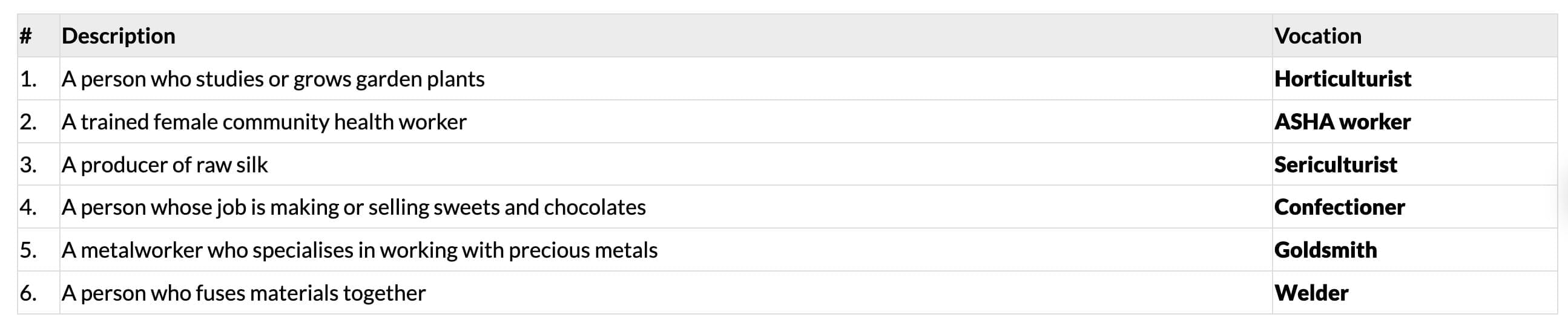
I. Match the vocations with the descriptions that follow.
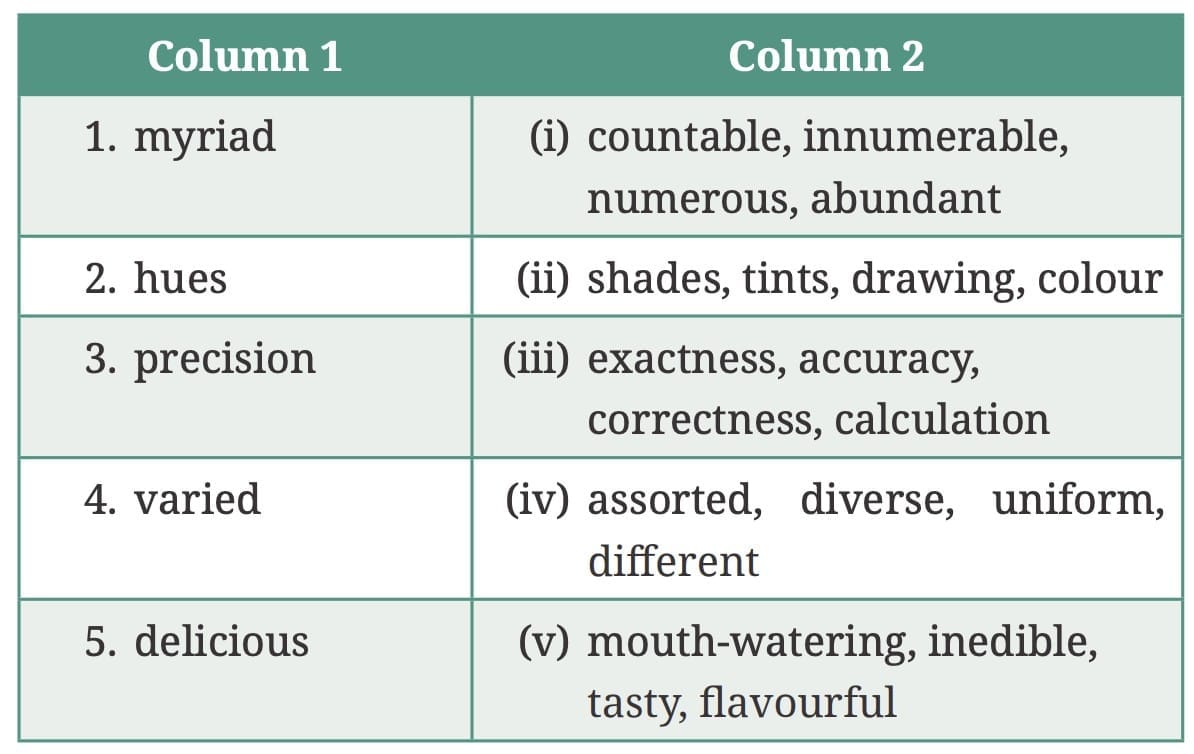
II. Identify the word from Column 2 that is NOT a synonym of the word in Column 1.
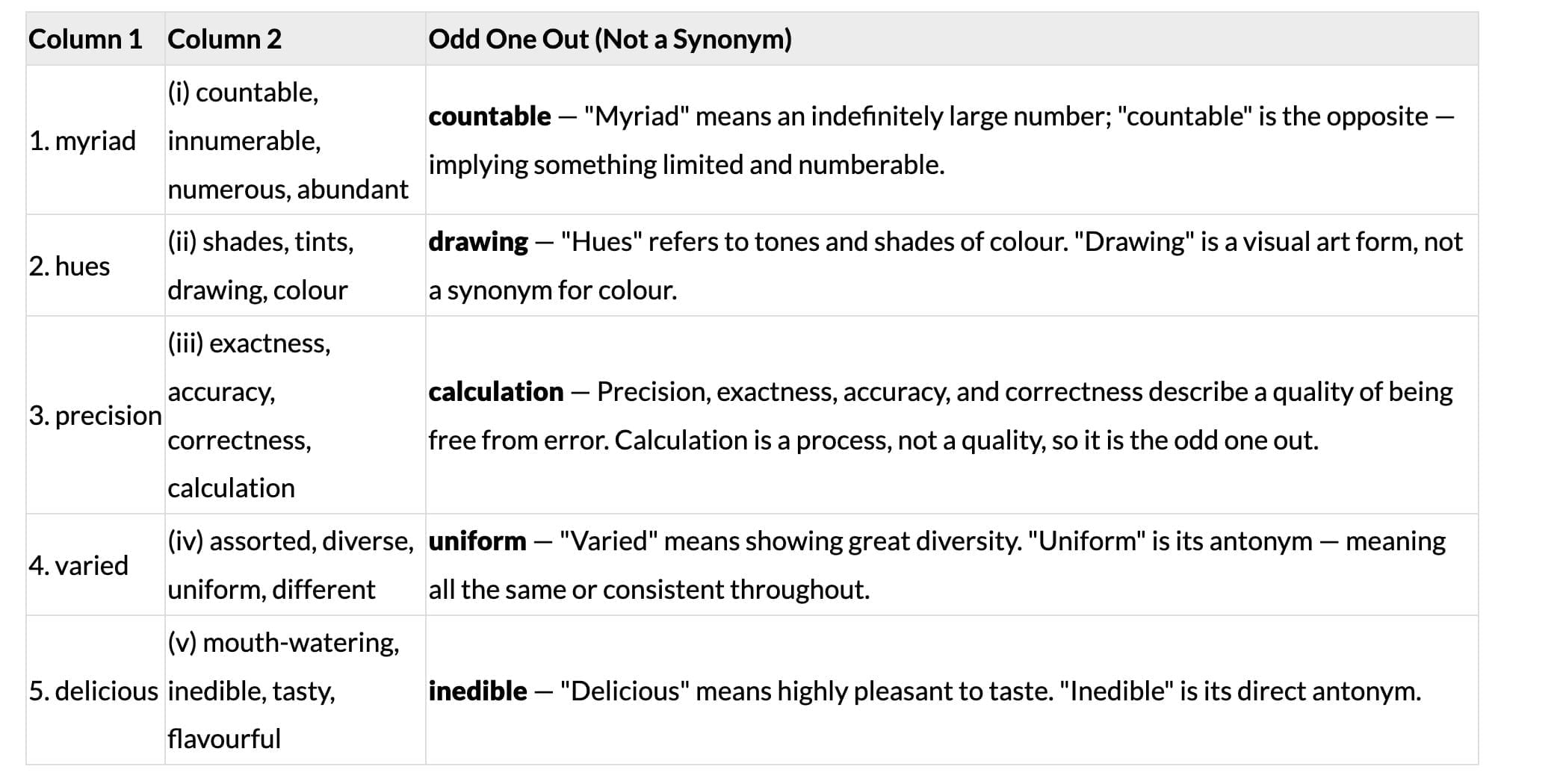
Ans:
Speaking Activity
The poet speaks of several occupations in the poem. Create groups of five. Allot the role of any five vocations that the poet talks about. Each student in the group will represent one vocation. Each student speaks for 1–2 minutes about their vocation—who they are, what they do, where they work, what kind of experiences they have at work, what problems they face, and a message for all.
Ans: The following are sample 1–2 minute monologues for five vocations mentioned in the poem. Each covers who the speaker is, what they do, where they work, their experiences, the problems they face, and a message for all. Students may adapt these for their own context.
1. The Craftsperson (Weaver)
My name is Ramavva, and I am a weaver from a small village in Karnataka. Every morning, before the sun is fully up, I sit at my loom. The threads — red, green, gold, blue — are my language. I speak through colours and patterns that my grandmother taught me and her grandmother taught her. My work is not fast. One saree can take a week. But when a bride wears it on her wedding day, I feel as though I have added something beautiful and lasting to the world. The challenges I face are real — power looms in the cities produce sarees in hours that take me days, and they cost half the price. Many buyers choose the cheaper option, and I understand why. But I want to tell you: when you buy a handwoven cloth, you are not just buying fabric. You are buying the story of a life, a tradition, and a family that has kept this art alive for generations. Please value what human hands can make. It is a gift that no machine can truly replicate.
2. The Carpenter
I am Suresh, a carpenter from Rajasthan. My workshop smells of sawdust and linseed oil — it is the most honest smell in the world. I work with teak, sheesham, and mango wood. Every piece of furniture I make begins as a rough plank and ends as something that will last fifty years. I measure twice and cut once — mathematical precision, as they say. I have made beds for newborns and chairs for grandmothers. I have built temple doors and school desks. My challenges? People often think carpentry is unskilled labour, and they bargain hard on my wages. But every joint I make, every curve I carve, carries years of training. My message to you: next time you sit on a chair or open a wooden door, think for a moment about the hands that made it. A good carpenter does not just shape wood — we shape the spaces where people live their lives.
3. The Electrician
Good morning. I am Priya, an electrician, and I have been working with cables and wires for twelve years. People call me when there is no light, no power, no heat. I come with my tools, my multimeter, and my training, and I restore the electricity that makes modern life possible. I work in homes, hospitals, factories, and schools. The problems I face? People often underestimate the danger of electrical work — I have to work carefully with live wires every day, and mistakes can be fatal. I have seen colleagues injured because safety protocols were ignored. I also hum while I work — yes, that is true — because I love what I do. My message: electricity lights your home, runs your hospital, charges your phone, and keeps your food cold. Respect the people who keep that power flowing safely. And please never attempt electrical repairs without training — call a professional. It could save your life.
4. The Boatman
My name is Murugan, and I am a boatman from the coast of Tamil Nadu. I go out to sea before dawn and return by mid-morning with nets full of fish. The sea is my office, and it is both generous and dangerous. On good days, the nets come up heavy and the market pays well. On bad days — cyclones, rough waters, empty nets — we come home with nothing and still have boat loans to repay. My family worries every time I sail out. But I cannot imagine any other life. The sea is where I feel most alive. When I sing while I sail, it is not just to pass the time — it is to honour the water that gives us everything. My message: the fish on your plate did not come from a shop. It came from someone who risked their life in open waters before sunrise. Remember us when you eat. And support sustainable fishing — so that the sea can keep giving, and boatmen like me can keep returning home.
5. The Shoemaker / Cobbler
I am Rajan, and I repair and make shoes at a small stall outside the market in our town. I have been here for twenty-two years. I know every kind of sole, every kind of leather, every kind of stitch. I have repaired the school shoes of children who came back to show me their report cards. I have re-soled the sandals of old women who could not afford new ones. Every pair of shoes that leaves my hands, I stand behind fully. Some people look down on my work because I sit on the ground with my tools. But those same people cannot walk comfortably without the shoes I fix. The problems I face are rising costs of materials and the flood of cheap imported footwear that people throw away instead of repair. My message: learn to value repair over replacement. A good cobbler can make your favourite shoes last five more years. And a good pair of shoes lets you walk, run, dance, and return home safely. I am proud of that. Every single day.
Writing Task
I. Your school will be organising a ‘Career Mela’ in which students are to be made familiar with the different career options. Complete the poster for the event given below.
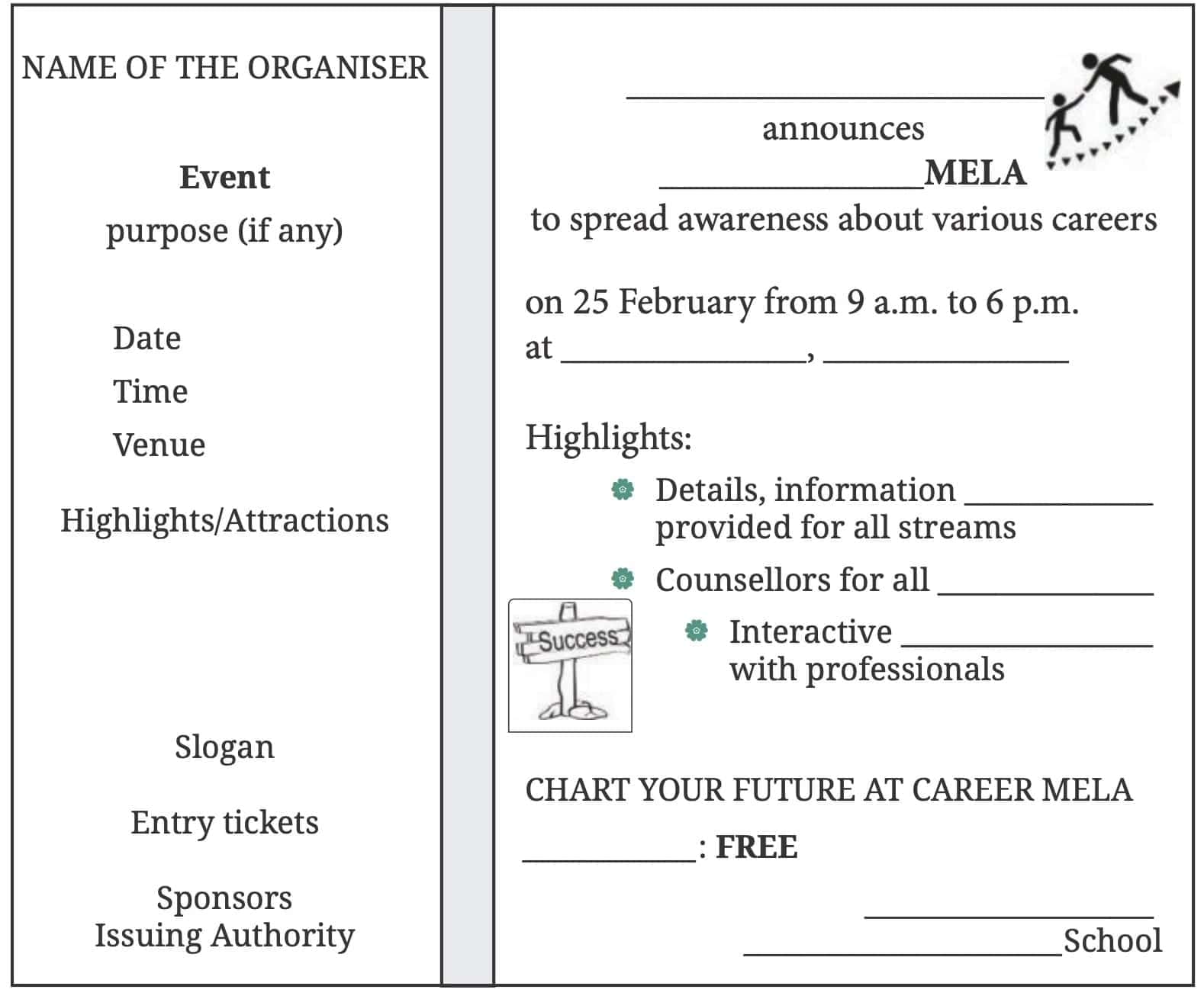
Sample Completed Poster for Career Mela
GREEN VALLEY PUBLIC SCHOOL
Sector 12, Chandigarh
announces
CAREER MELA
To spread awareness about various career opportunities
Date: 25 February
Time: 9:00 a.m. to 6:00 p.m.
Venue: School Auditorium, Green Valley Public School, Sector 12, Chandigarh
Highlights:
- Details and information booklets and brochures provided for all streams (Science, Commerce, Humanities, Vocational)
- Counsellors for all career streams and entrance examinations
- Interactive sessions and Q&A panels with professionals from industry, arts, medicine, law, and skilled trades
- Live demonstrations by vocational experts and artisans
- Stalls by leading colleges, coaching centres, and skill development organisations
CHART YOUR FUTURE AT CAREER MELA
Entry: FREE | Open to all students of Classes 8–12 and their parents
Supported by: District Education Office, Chandigarh
Issued by: The Principal, Green Valley Public School