Q1: Give difference between hypotonic solution, isotonic solution and hypertonic solution.
Ans: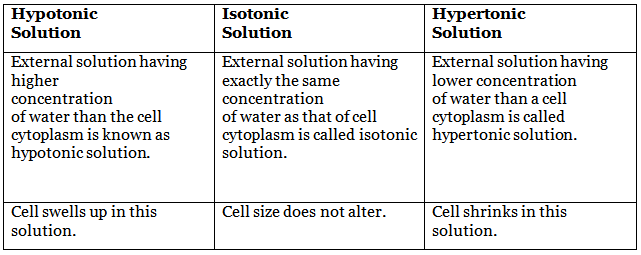
Q2: (a) Name the organelle which provides turgidity and rigidity to the plant cell. Name any two substances which are present in it.
(b) How are they useful in unicellular organisms?
Ans:
(a) Plant cells have big vacuoles that provide them turgidity and rigidity. Plant vacuoles store amino acids, sugars, various organic acids and some proteins.
(b) I n unicellular organism they can serve the following works :
- Forming food vacuoles : In single celled organisms like amoeba, the food vacuole contains the food items that the amoeba has engulfed. After that the food items are digested by the enzymes.
- Removal of excess water and wastes : In some unicellular organisms, vacuoles play important roles in egesting excess water and some wastes from the cell.
Q3: Write a note on the structure of cell.
Ans :
(a) Cell is the basic unit of all living organisms. It is surrounded by an outer selectively permeable Plasma Membrane. Plant cells have an additional covering called “cell wall” outer to the Plasma Membrane.
(b) Inside the plasma membrane there is a translucent viscous substance the cytoplasm in which the organelles are embedded. The control centre of the cell is the nucleus; it contains all the information necessary for the cell to function and to reproduce. Surrounding the nucleus is the endoplasmic reticulum (ER) on which ribosomes may be embedded. Ribosomes are granular structures which are the site of protein synthesis.
(c) The powerhouse of cell is the mitochondria. It helps in releasing energy by the oxidation of food in cell. There are flat membranous secretory structures in the cell called the Golgi bodies. In plant cells, an additional structure located near the nucleus called the chloroplast, is also present. They are the site of photosynthesis.
(d) Cells also contain lysosomes which are also called suicide bags. They digest and remove the unwanted debris of the cell. Centriole (present in animal cells) located near the nucleus helps in cell division. Cytoplasm also contains vacuoles filled with the cell sap. In plant cells, vacuole is large and centrally placed.
Q4: Give the difference between plant cell and animal cell.
Ans:
| No. | Plant Cell | Animal Cell |
|---|---|---|
| 1. | Usually larger in size. | Comparatively smaller in size. |
| 2. | Enclosed by a rigid cellulose cell wall in addition to plasma membrane. | Enclosed by a plasma membrane only. |
| 3. | Has a fixed shape. | Shape is usually variable. |
| 4. | Plastids present (chloroplasts in photosynthetic cells). | Plastids absent. |
| 5. | A mature plant cell has a large central vacuole. | Vacuoles are small, temporary or absent. |
| 6. | Nucleus usually lies at the periphery due to large vacuole. | Nucleus usually lies in the centre. |
| 7. | Centrioles usually absent. | Centrioles present. |
| 8. | Lysosomes rare. | Lysosomes common. |
| 9. | Plasmodesmata present. | Plasmodesmata absent. |
| 10. | Reserve food is starch. | Reserve food is glycogen. |
| 11. | Can synthesize all amino acids, vitamins and coenzymes required. | Cannot synthesize all amino acids, vitamins and coenzymes. |
| 12. | Does not burst in hypotonic solution due to rigid cell wall (becomes turgid). | May burst in hypotonic solution due to absence of cell wall. |
Q5: Draw a neat labelled diagram of plant cell.
Ans: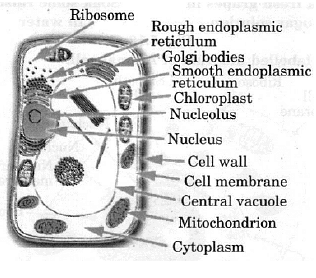 Plant cell
Q6: (i) Name the organelle which provides turgidity and rigidity to the plant cell. Name any two substances which are present in it.
(ii) How are they useful in unicellular organisms?
Ans :
(i) Plant cells have big vacuoles full of cell sap that provide them turgidity and rigidity. Plant vacuoles store amino acids, sugars, various organic acids and some proteins.
(ii) I n unicellular organism they may serve the following purposes :
- Forming food vacuoles: In single celled organisms like amoeba, the food vacuole contains the food items that the amoeba has ingested. The food items are digested by the enzymes later on.
- Removal of excess water and wastes: In some unicellular organisms, specialized vacuoles play important roles in expelling excess water and some wastes from the cell.
Q7: Describe the role played by the lysosomes. Why are these termed as suicidal bags? How do they perform their functions?
Ans :
Functions of lysosomes :
- Extracellular digestion. Sometimes lysosome enzymes are released outside the cell to break down extracellular material.
- Digestion of foreign material. Lysosome also destroys any foreign material which enters inside the cell such as bacteria.
- Cellular digestion. In damaged cells, ageing cells or dead cells lysosomes get ruptured and enzymes are released. These enzymes digest their own cell.
Lysosomes contain about 40 hydrolytic enzymes. When the cell gets damaged, lysosomes burst and their enzymes digest their own cell. So, lysosomes are called ‘suicide bags’.
Q8: Describe an activity to demonstrate endosmosis and exosmosis. Draw a diagram also.
Ans:
1. Endosmosis : The movement of water in the cell or a body through a semipermeable membrane is called endosmosis. It can be demonstrated as follows :
(i) Take some raisins with stalks and put them in plain water in a beaker.
(ii) Observation : Raisins absorb water and swell. Raisins have high concentration of sugar than surrounding plain water. Because of this, water from the outside passing through semipermeable membrane enters into the cell. This is endosmosis.
2. Exosmosis : The movement of water out from a cell or a body through a semipermeable membrane is called exosmosis. This can be demonstrated as follows :
(i) We place the swollen raisins (from above activity) into a beaker containing a concentrated solution of sugar or salt.
(ii) Observation : When swollen raisins are placed in concentrated sugar or salt solution, they shrink because the solution surrounding the raisins is having low water concentration. Thus, raisins loose water by osmosis, this process is called exosmosis.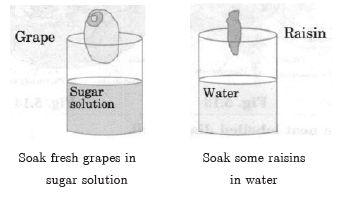
Q9: Draw a neat labelled diagram of Animal cell.
Ans: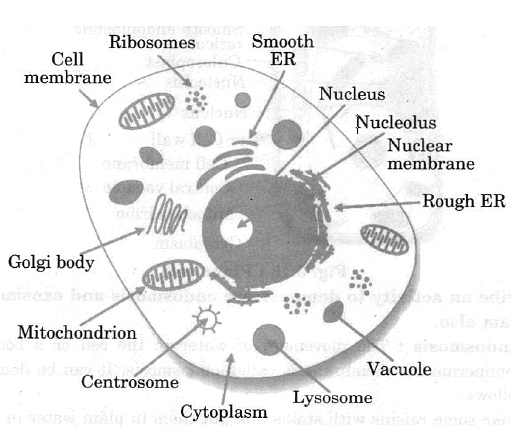 Animal Cell
Q10: Explain the structure and function of Golgi bodies.
Ans: Golgi bodies consist of a system of membrane-bound vesicles arranged in stacks parallel to each other called cisterns. These membranes are connected with the membrane of endoplasmic reticulum (ER).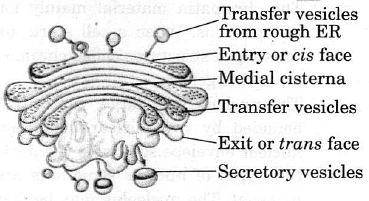 Golgi apparatus
Functions of Golgi apparatus :
(i) Golgi apparatus packages and dispatches the material synthesized in the cell.
(ii) Golgi complex is also involved in the formation of lysosomes.
(iii) Golgi apparatus is also involved in the synthesis of many substances such as polysaccharides, glycoprotein, etc.
Q11: Give difference between plasma membrane and cell wall.
Ans:
| Feature | Plasma Membrane | Cell Wall |
|---|---|---|
| Composition | Made up of lipids and proteins | Made up of cellulose (in plants) |
| Nature | Living | Dead / non-living |
| Presence | Present in both plant and animal cells | Present in plant cells only (absent in animal cells) |
| Permeability | Semi-permeable | Freely permeable |
| Physical nature | Soft and flexible | Hard and rigid |
| Function | Regulates entry and exit of substances | Provides shape, support, and protection |
Q12: Explain the structure of nucleus. Give a neat labelled diagram of a nucleus of cell. Give brief information about nucleus.
Ans: Nucleus is the control centre of the cell. It is covered by a double layered envelope called nuclear membrane. The nuclear membrane has some pores which allow the transfer of material from inside the nucleus to cytoplasm. Inside the nuclear membrane some thread like structures are present. This is known as chromatin material.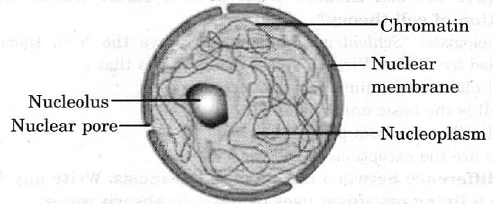 Structure of a nucleus
The chromatin material mainly formed through DNA (deoxyribonucleic acid) and proteins. When a cell starts to divide, chromatin material condenses into rod-shaped structures called chromosomes. The chromosomes contain DNA which are called genes.
The nucleus is a large, centrally located spherical cellular component. It is bounded by two nuclear membranes, both forming a nuclear envelope. The nuclear envelope separates the nucleus from the cytoplasm. Within nucleoplasm two types of nuclear structures are embedded : the nucleolus and chromatin material. The nucleolus may be one or more in number and is not bounded by any membrane. It is rich in protein and RNA molecules and acts as the site for ribosome formation.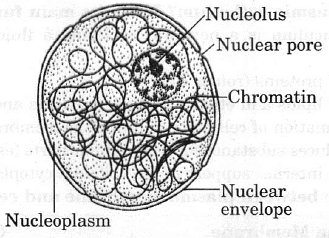 Nucleus
Q13: Explain the following terms : (a) Plasma membrane, (b) Cytoplasm, (c) Nucleus.
Ans:
(a) Plasma membrane: It is a thin membrane which controls the passage of materials in and out of the cell. It is also called selectively permeable membrane. It makes the outer boundary of the cell and is made up of lipids and proteins (phospholipid bilayer).
(b) Cytoplasm: It is transparent jelly-like thick substance present in the cell. It makes the ground of the cell in which all the cell organelles are suspended.
(c) Nucleus: It is a double-layered membrane structure which contains chromosomes required for the inheritance of characteristics from one generation to the other.
Q14: Give difference between diffusion and osmosis. Write any two examples where a living organism uses osmosis to absorb water.
Ans: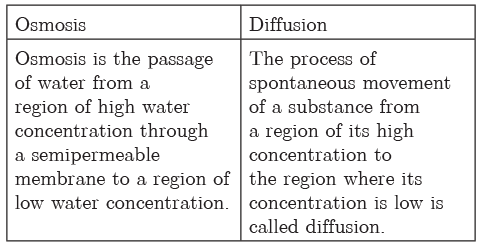
Example of Osmosis :
(i) Plant roots absorb water.
(ii) Unicellular organisms such as amoeba absorb water from freshwater.
Q15: What would happen if when we put an animal cell into a solution of sugar or salt in water?
Ans:
The following three things could happen :
- If the solution surrounding the cell is very dilute than cytoplasm, the water will move into the cell, i.e., the cell will gain water.
- I f the solution has exactly similar water concentration as that of cytoplasm of cell, there will be no net movement of water across the cell membrane, i.e., no gain or loss of water from the cell.
- If the medium (solution) has a lower concentration of water than the cell, i.e., the solution is concentrated, the cell will lose water by osmosis. How do all cells look alike in terms of shape and size?
- Cells vary in shapes and sizes according to the fusion. Generally, cells are spherical but they may be long and branched as in nerve cell, Kidney shaped as guard cell in plant’s leaves, discoid as RBC, spindle shaped as muscle cell, etc. Size of cell varies from 0.2 mm to 18 cm in diameter. Some are microscopic while some are visible with naked eyes.
For example :
(i) Size of a typical cell in a multicellular organism ranges from 20-30 mn.
(ii) The largest cell is ostrich egg (15 cm in diameter with shell and 8 cm in diameter without shell).
(iii) The longest cell is nerve cell (up to 1 m. or more) and red blood cells are the smallest cell in our body.
(iv) Smallest cells so far known are PPLOs, e.g. mycoplasma (0.1 µm in diameter).
(v) Human egg is 0.1 mm in diameter.
- Cells vary in shapes and sizes according to the fusion. Generally, cells are spherical but they may be long and branched as in nerve cell, Kidney shaped as guard cell in plant’s leaves, discoid as RBC, spindle shaped as muscle cell, etc. Size of cell varies from 0.2 mm to 18 cm in diameter. Some are microscopic while some are visible with naked eyes.
Q16: How do lysosomes perform their function?
Ans:
Functions of lysosomes:
(i) Extracellular digestion: Sometimes lysosome enzymes are released outside the cell to break down extracellular material.
(ii) Destruction of foreign material: Lysosome also destroys any foreign material which enters inside the cell such as bacteria.
(iii) Cellular digestion : Enzymes are released in damaged cells, ageing cells or dead cells. These enzymes digest their own cell.
Lysosomes contain about 40 hydrolytic enzymes. Lysosomes burst and their enzymes digest their own cell when the cell gets damaged. So, lysosomes are called ‘suicide bags’.
Foreign materials entering the cell, such as bacteria or food, as well as dead old organelles in the lysosomes break up into small pieces.
Q17: What types of enzymes are present in the lysosomes? What is their function? Which organelle membranes manufacture these enzymes?
Ans: Lysosomes contain powerful digestive enzymes capable of breaking down all organic material.
Lysosomes help to keep the cell clean by digesting worn out cell organelles and foreign material such as bacteria or food.
RER (Rough Endoplasmic Reticulum) makes the digestive enzymes present in the lysosomes.
Q18: Give brief information about the mitochondria. Describe the structure of mitochondria.
Ans: The mitochondria are tiny bodies of varying shapes and size. Each mitochondria is bounded by a double membrane envelope. Outer membrane is porous. The inner membrane is thrown into folds. These folds are called cristae and are studded with small rounded bodies known as oxysomes. The interior cavity of the mitochondria is filled with a protein matrix which contains a few small-sized ribosomes, a circular DNA molecule and phosphate granules. Mitochondria are sites of cellular respiration.
Mitochondria are membrane bound cell organelle found in the cytoplasm. Each mitochondria is a double membrane bounded structure. The outer membrane of mitochondrion is smooth. But, the inner membrane of the mitochondrion is folded inwardly, into the matrix of mitochondrion forming finger like projections. The inward finger like projections of inner membrane is called cristae. Cristae greatly increase the surface area of inner membrane. Mitochondria contain extra nuclear DNA.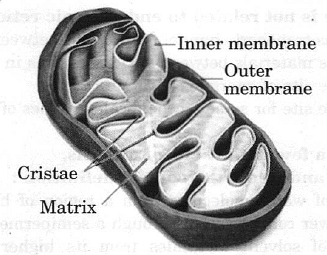 Mitochondria