Previous Year Questions 2025
Q1: Read the following extract and answer the questions:
“He stalks in his vivid stripes
The few steps of his cage,
On pads of velvet quiet,
In his quiet rage.
He should be lurking in shadow,
Sliding through long grass”
(i) Identify and name any one figure of speech in the above extract. (2 Marks)
Ans: The figure of speech used here is Oxymoron — “quiet rage”.
It combines two opposite ideas — quiet and rage — to express the tiger’s suppressed anger while being confined in the cage.
(ii) Fill in the blank with one word.
The tiger’s stalking on ‘pads of velvet’ suggests a movement that is ______. (1 Mark)
Ans: Silent
(The phrase “pads of velvet quiet” shows the noiseless, smooth movement of the tiger.)
(iii) Based on the given lines from the poem, which words would best describe the feelings of the tiger? (1 Mark)
(a) Calm and content
(b) Both subdued and angry
(c) Both frustrated and happy
(d) Both angry and famished
Ans: (b) Both subdued and angry
(The tiger is full of rage but remains quiet and helpless in the cage.)
(iv) Select the option that applies the same rhyme scheme as the first four lines of the given extract. (1 Mark)
(A) The people along the sand
All turn and look one way
They turn their back on the land
They look at the sea all day
(B) Along the sand, the people
All turn and look one way
They turn back on the sand
They look at the sea all day
(C) The people along the sand
Look one way and all turn
Their backs on the land
They look at the sea all day
(D) The people along the sand
They turn their back on the land
They look one way
At the sea all day.
Ans: (A)
The people along the sand / All turn and look one way / They turn their back on the land / They look at the sea all day.
(Rhyme scheme: ABAB, same as the given extract — “stripes/cage/quiet/rage.”)
Q2: Why does the tiger in the zoo ignore the visitors? (Answer in 40-50 words) (3 Marks)
Ans: The tiger in the zoo ignores the visitors because he feels helpless and trapped behind the bars of his cage. His strength and freedom are confined, and he knows he cannot attack or frighten anyone. Instead of showing aggression, he quietly walks inside the cage, suppressing his anger and frustration.
Q3: How does the poem show that the tiger had lost its natural instinct? (Answer in about 30-40 words, 3 marks)
Ans: The poem shows that the tiger has lost its natural instinct because, instead of hunting or roaming freely in the jungle, he now walks silently inside his cage. His wild strength and ferocity are suppressed, and he has become helpless and subdued in captivity.
Q4: Draw a comparison between the tiger in the zoo and in the forest. (Answer in about 30-40 words, 3 marks)
Ans: The tiger in the zoo is imprisoned, helpless, and full of silent anger as he walks within the narrow limits of his cage. In contrast, the tiger in the forest is free, powerful, and majestic — lurking in the shadows, hunting deer, and roaming fearlessly in his natural habitat.
Q5: The tiger in the zoo is denied its natural habitat. Describe its behaviour and routine as a captive in the concrete cell. (Answer in about 40-50 words, 3 marks)
Ans: In the zoo, the tiger lives a dull and confined life inside a concrete cell. He moves silently up and down the limited space of his cage, suppressing his anger and strength. He ignores the visitors, listens to the patrolling sounds at night, and stares helplessly at the shining stars, longing for freedom.
Q6: Explore the contrasting images of the tiger in ‘A Tiger in the Zoo’ and the tiger in ‘How to Tell Wild Animals’. (Answer in 100-120 words) (6 Marks)
Ans: In ‘A Tiger in the Zoo’, the tiger is shown as a helpless and confined creature. Leslie Norris presents the tiger as majestic yet powerless, pacing silently in a small cage. His strength and rage are suppressed, and he feels trapped and frustrated, yearning for freedom. The poem highlights the cruelty of captivity and evokes sympathy for the animal.
In contrast, in ‘How to Tell Wild Animals’ by Carolyn Wells, the tiger is portrayed as fierce, powerful, and free in its natural habitat. The poet humorously describes how one can identify wild animals, and the tiger is shown as a symbol of terror that leaps upon its prey. Thus, one poem shows the tiger’s captivity and helplessness, while the other shows its freedom and ferocity.
Q7: The inherent instinct for freedom is a fundamental trait in all living creatures. Justify this statement with reference to ‘Mijbil the Otter’ and ‘A Tiger in the Zoo’. (100-120 words) (6 marks)
Ans: Both ‘Mijbil the Otter’ and ‘A Tiger in the Zoo’ highlight the deep desire for freedom found in all living beings. In ‘Mijbil the Otter’, Mij initially struggles when confined indoors but becomes joyful and lively once he experiences the open water, his natural habitat. His playful and curious nature blossoms only when he is free. Similarly, in ‘A Tiger in the Zoo’, the tiger is depicted as restless and frustrated in his cage, his strength and spirit subdued by captivity. The poet contrasts this with the tiger’s true life in the wild, where he roams proudly and hunts freely. Both works show that freedom brings life and happiness, while captivity causes pain and helplessness.
 | Get additional INR 200 off today with EDUREV200 coupon. |
Previous Year Questions 2024
Q1. Read the extract given below and answer the questions that follow: [2024]
He stalks in his vivid stripes
The few steps of his cage,
On pads of velvet quiet,
In his quiet rage.
He should be lurking in the shadows,
Sliding through long grass
Near the water pole
Where plump deer pass.
He should be snarling around houses.
At the jungle’s edge,
Baring his white fangs, his claws,
Terrorising the village!
(i) State any one point of contrast between the tiger in the zoo and its natural habitat.
Ans. He is confined in the zoo, whereas he experiences freedom in the jungle.
(ii) When the speaker suggests that the tiger should be “Snarling around houses at the jungle’s edge”, What does he insinuate about the tiger’s natural behaviour and habitat?
Ans. By nature, the tiger is fierce, roaring to frighten the villagers residing near the jungle’s edge.
(iii) The poet’s skilful use of imagery effectively depicts the confinement and frustration of the tiger. Elaborate in about 40 words.
Ans. The poet talks about the tiger in the zoo, locked in a small cage. It walks quietly in the tiny space and doesn’t roar. Its soft paws, like velvet, make no noise as it moves.
(iv) Which phrase would correctly substitute ‘quiet rage’ in the given sentence from the extract?
Ans. Suppressed anger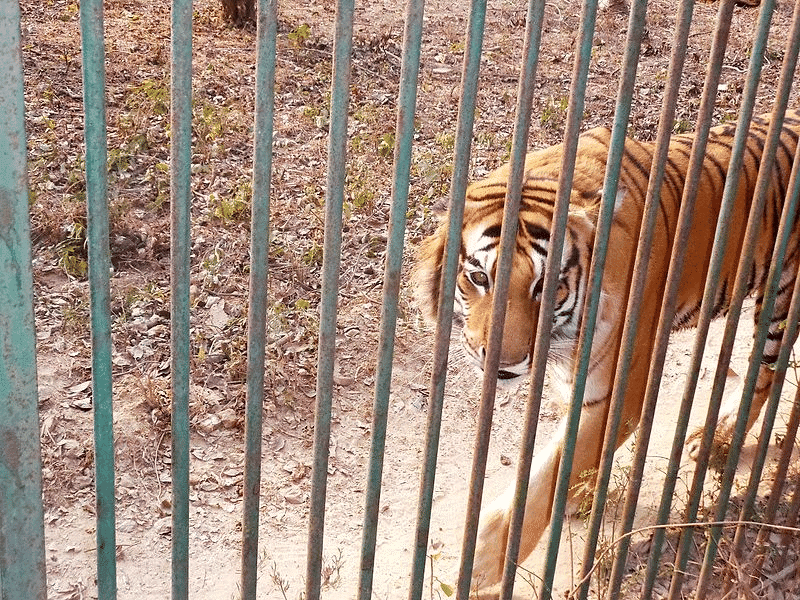
Q2. Read the extract given below and answer the questions that follow: [2024]
He stalks in his vivid stripes
The few steps of his cage,
On pads of velvet quiet,
In his quiet rage
(i) Explain the contrast created by the words, ‘stalks’ and ‘few steps of his cage’.
Ans. The word ‘stalks’ suggests walking with majesty, reflecting the tiger’s natural elegance and strength. In contrast, ‘the few steps of the cage’ highlight the tiger’s restricted movement and lack of freedom.
(ii) Which of the following best describes the tiger’s feelings in the context?
(A) anger (B) conflicted
(C) pessimism (D) apprehension
Ans. (D)
(iii) Comment in about 40 words on the poet’s use of imagery in the above extract.
Ans. The poet describes the tiger’s bright stripes and its quiet movement in a small cage. Unable to roar or show its strength, the tiger walks silently on its soft, velvety paws, reflecting its sadness and helplessness in confinement.
(iv) Which word in the stanza means the same as ‘clear and bright’?
Ans. The word “vivid” in the stanza means ‘clear and bright’ and is used to describe the tiger’s stripes.
| Also read: 4-Days Study Plan: Poem – A Tiger in the Zoo |
Previous Year Questions 2023
Q3: Read the following extract and answer the questions that follow: (2023)
He hears the last voice at night.
The patrolling cars,
And stares with his brilliant eyes
At the brilliant stars.
He stalks in his vivid stripes
A few steps of his cage.
(i) Whose is the last voice heard by the tiger?
(a) police jeep
(b) patrolling cars
(c) watchmen
(d) roar of lion
Ans: (b)
The tiger hears the sound of patrolling cars at night, which is the last voice it hears before solitude takes over.
(ii) Complete the sentence appropriately
It is clear that ‘Repetition’ is the poetic device used for ’his brilliant eyes at the brilliant stars’ because ___ (Clue: explain how repetition applies here)
Ans: because there is a repetition of word ‘brilliant’.
The word “brilliant” is repeated to emphasize the contrast between the tiger’s vivid eyes and the distant stars.
(iii) The main contrasting ideas in this extract are
(a) tiger and deer
(b) cruelty and sympathy
(c) confinement and freedom
(d) master and slave
Ans: (c)
The extract contrasts the tiger’s confinement within the cage with its yearning for freedom, symbolized by the stars.
(iv) The use of the word ‘stalks’ creates an image of
(a) cowardice
(b) frustration
(c) lethargy
(d) purposefulness
Ans: (b)
The word “stalks” suggests the tiger’s restless movement, indicating frustration due to its confinement.
(v) State whether the following statement is true or False
The poem uses ‘staring at the sky’ to symbolize the freedom ‘he’ yearns for.
Ans: true
The act of staring at the stars symbolizes the tiger’s longing for freedom and a life beyond the bars of its cage.
Q4: Read the following extract given below and answer the questions that follow: (2023)
He stalks in his vivid stripes
The few steps of his cage,
On pads of velvet quiet, In his quiet rage.
He should be lurking in the shadows,
Sliding through long grass Near the water hole Where plump deer pass.
(i) ‘Quiet rage’ refers to the tiger’s ______.
(a) helplessness
(b) has has not been able to hunt
(c) his prey has not come to the water hole
(d) he is not free
Ans: (a)
“Quiet rage” indicates the tiger’s frustration and helplessness due to its confinement, where it cannot express its anger openly.
(ii) He is lurking in shadows because____.
Ans: he is waiting for his prey
The tiger is depicted as lurking in the shadows near a water hole, where it waits quietly for its prey, such as deer, to pass by.
(iii) Complete the sentence appropriately. It is clear that metaphor is the poetic device used for ‘pads of velvet’ because___ (clue – explain how metaphor applies here).
Ans: softness of the velvet is used to describe the softness of tiger’s feet.
The term “pads of velvet” is a metaphor, comparing the softness of the tiger’s paws to velvet, emphasizing their quiet and gentle touch.
(iv) Find a word from the extract that means – to walk with measured, stiff or haughty strides:
(a) steps
(b) lurking
(c) pads
(d) stalk
Ans: (d)
“Stalk” means to walk in a controlled and calculated manner, often indicating a sense of purpose or restraint, as the tiger does in its cage.
(v) State whether the following statement is True or False: The tiger is stealthily waiting for the deer to come to the water hole.
Ans: True
The extract describes the tiger as lurking in the shadows near a water hole, implying it is waiting stealthily for prey, such as deer, to approach.
Previous Year Questions 2021
Q5: Read the following extract given below and answer the questions that follow: (Term I, 2021-22)
He stalks in his vivid stripes
The few steps of his cage,
On pads of velvet quiet,
In his quiet rage.
He should be lurking in the shadows,
Sliding through long grass
Near the water hole
Where plump deer pass.
I. How does the tiger show his helplessness?
(a) Through his beautiful stripes
(b) Through his brief walk
(c) Through his controlled anger
(d) By walking quietly
Ans: (c)
The phrase “quiet rage” reflects the tiger’s controlled anger, showing his helplessness as he cannot express his full power due to confinement.
II. Study the following statements :
(i) Even in the zoo the tiger has retained his majesty.
(ii) He is walking softly in the cage as he is looking for his prey.
Choose the correct option :
(a) (i) is right and (ii) is wrong.
(b) (ii) is right and (i) is wrong.
(c) (i) and (ii) are both right.
(d) (i) and (ii) are both wrong.
Ans: (a)
Statement (i) is correct because the tiger maintains his majestic appearance even in captivity, while statement (ii) is incorrect as the tiger is not looking for prey in the zoo.
III. Looking at the caged tiger we :
(a) admire his majestic looks.
(b) get scared of him.
(c) feel sympathetic towards him.
(d) feel safe that he is caged.
Ans: (c)
Observing the tiger’s confinement evokes sympathy for his loss of freedom and natural habitat.
IV. The tiger in the zoo does not have to hunt for his food :
(a) so he feels happy.
(b) yet he is angry.
(c) so he feels secure.
(d) yet he feels lonely.
Ans: (b)
Despite not needing to hunt, the tiger feels anger and frustration due to his restricted life in the cage.
V. He likes the water hole as :
(a) the deer visits it
(b) there is tall grass around it
(c) it is a shady place
(d) he can hide behind the grass.
Ans: (a)
The tiger is drawn to the water hole as it attracts deer, his natural prey, allowing him to wait in ambush in the wild.
| Also read: 4-Days Study Plan: Poem – A Tiger in the Zoo |
Previous Year Questions 2015
Q6: How does the tiger create terror among the villagers? (CBSE 2015)
Ans: The tiger terrorises the villagers by baring his big white fangs and revealing his sharp claws. He makes terrifying snarls while moving around the houses of the villagers that are situated at the edge of the forest. His mighty presence and roars scare the villagers.