Have you ever shared a chocolate with your friend? Or divided a pizza among family members?
When we share things equally, we are actually using the concept of fractions!
In this chapter, we will learn about sharing and measuring things by dividing them into equal parts. We will explore how to identify and create halves, quarters, and other fractions, and understand how these concepts apply in our daily lives.
Parts and Wholes
Let’s begin with a story about two sisters, Ikra and Samina, who needed to share a drawing sheet.
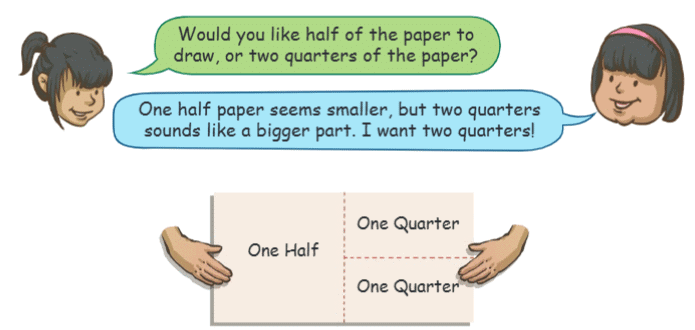
Ikra and her little sister, Samina, decide to make a drawing, but they are left with a single drawing sheet. Ikra wants to share the paper by dividing it in half, but Samina insists on having a bigger part of the paper. Ikra thought for a moment and proposed a solution.
What Samina didn’t realize was that one half and two quarters are actually the same amount!
This is one of the fascinating things about fractions that we’ll learn in this chapter.
So let’s dive into the world of fractions and discover how sharing and measuring help us understand the parts that make up a whole!
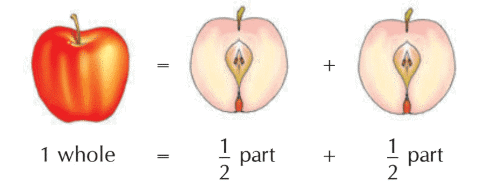
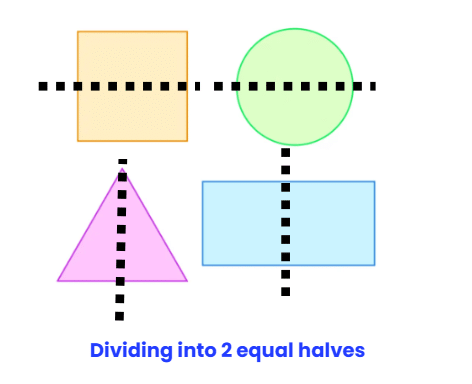
When an object is divided into two equal parts, each part is called a half. We write half as 1/2. Some are divided into halves correctly, and some are not. Can you identify in below image which ones are divided into halves correctly?
For a shape to be divided into halves correctly, the two parts must be exactly equal in size and shape.
When you fold one part over the other, they should match perfectly.
Yes, all shapes can be correctly halved.
Understanding Quarters
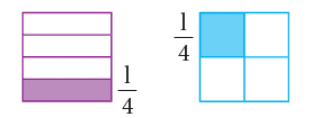
When an object is divided into four equal parts, each part is called aquarter. We write quarter as 1/4.
Each shape, given alongside, is divided into 4 equal parts. One out of the 4 equal parts is shaded. Each shaded part of the shape is one-fourth of the whole.
Try yourself:
What is each part called when an object is divided into two equal parts?
A.Third
B.Whole
C.Half
D.Quarter
View Solution
Many Ways to Make Halves and Quarters
Making Halves
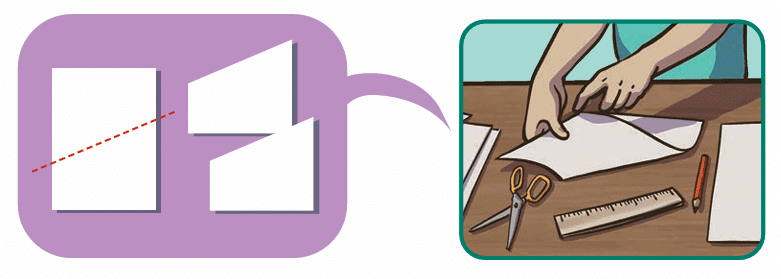
Students are asked to fold or cut a rectangular paper into two equal parts — called halves. This helps children understand that:
A half means dividing a shape into 2 equal parts.
There is more than one way to do it — horizontally, vertically, or even diagonally.
No matter how it’s folded, the goal is always to get two equal parts of the whole.
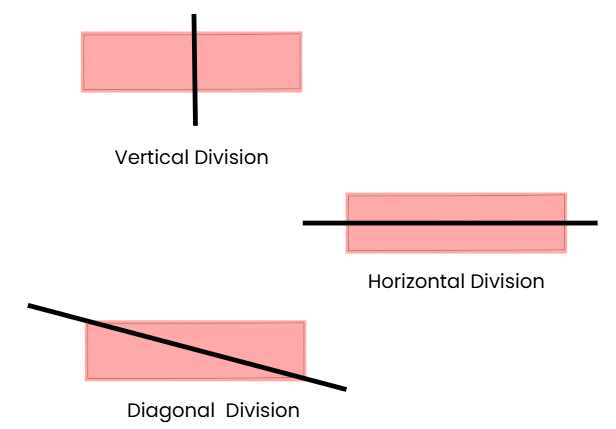
A rectangular paper can be divided into two equal parts (halves) in several different ways:
Vertical Division: Drawing a vertical line down the middle
Horizontal Division: Drawing a horizontal line across the middle
Diagonal Division: Drawing a diagonal line from one corner to the opposite corner
All these methods create two equal parts, so they all correctly divide the rectangle into halves.
Making Quarters
Students are asked to draw or fold the paper in five different ways to get ¼ (one-fourth) parts. See that the same rectangle can be split in many ways, yet all parts must be equal.
This introduces students to the fraction ¼, helping them understand that a quarter means one out of four equal parts.
DING DONG BELL!!
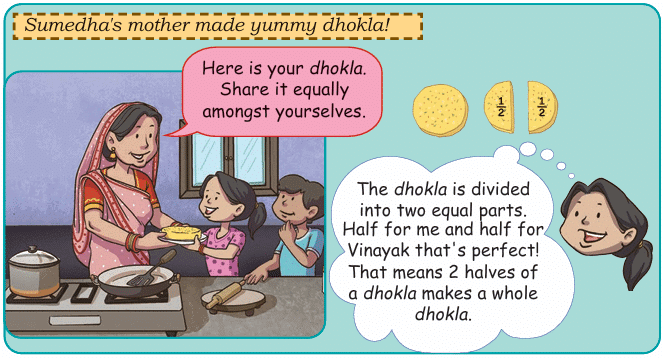
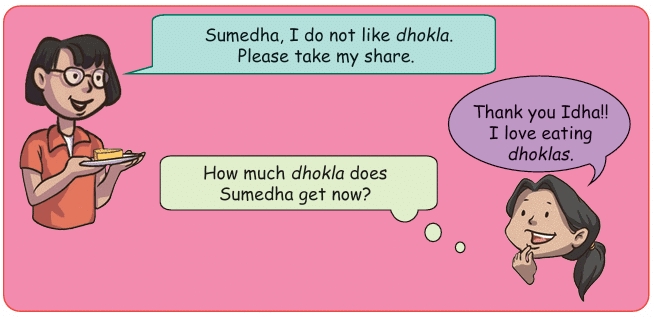
Sumedha’s mother gives her and Vinayak one dhokla (a yummy snack) and says to share it.
They cut it into 2 equal parts. Each one gets ½ (one-half) of the dhokla. 2 halves make one whole dhokla.
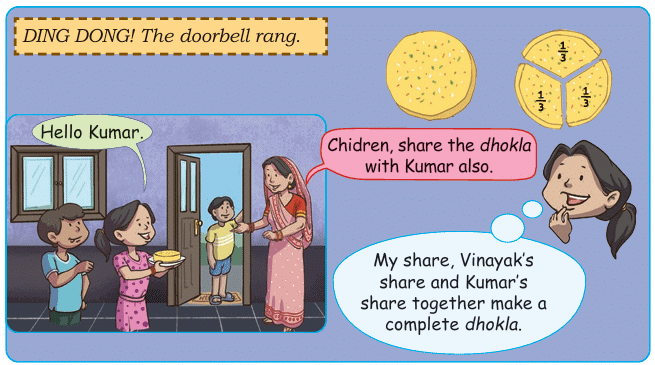
Now Kumar arrives, so they need to share again.
They divide the dhokla into 3 equal parts. Each one gets ⅓ (one-third) of the dhokla. 3 one-thirds make one whole dhokla.
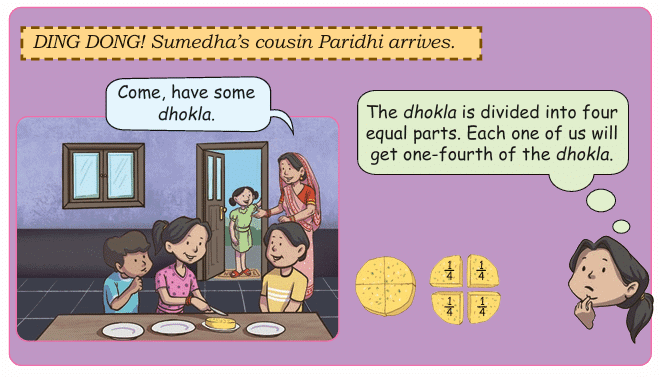
Sumedha’s cousin Paridhi comes. Time to share again!
They cut the dhokla into 4 equal parts. Each one gets ¼ (one-fourth) of the dhokla. 4 one-fourths make one whole dhokla.
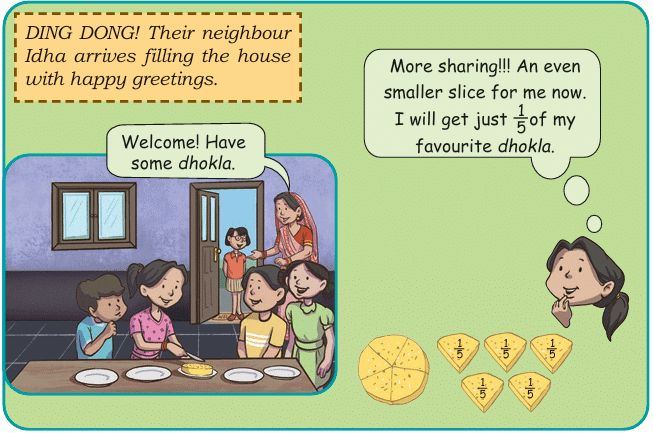
Now Idha joins! More friends, smaller pieces.
They divide the dhokla into 5 equal parts. Each one gets ⅕ (one-fifth) of the dhokla. 5 one-fifths make one whole dhokla.
Idha says she doesn’t want her piece and gives it to Sumedha!
Sumedha had ⅕ and got one more ⅕ from Idha. So now she has ⅕ + ⅕ = 2⁄5 of the dhokla.
This story teaches us about fractions through sharing dhokla. As more friends join, the dhokla is divided into more equal parts—like halves, thirds, fourths, and fifths. We learn that:
A fraction is a part of a whole.
More people means smaller pieces.
Fractions can be added.
Try yourself:
What do we call each part when an object is divided into four equal parts?
A.Fifth
B.Half
C.Quarter
D.Third
View Solution
My Flower Garden
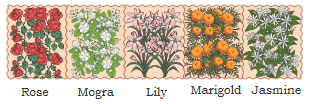
Idha has seeds of 5 different flowering plants—Rose, Mogra, Lily, Marigold, and Jasmine. She decides to plant them equally in her garden. That means each flower will take up 1 out of 5 parts, or 1/5 of the total garden space.
Initial Plan:
Each of the 5 plants gets 1/5 of the garden:
Rose = 1/5
Mogra = 1/5
Lily = 1/5
Marigold = 1/5
Jasmine = 1/5
Revised Plan:
Idha has very few Lily seeds, so she decides not to plant Lily and instead uses that space to plant Roses again.
Now, the garden looks like this:
Rose = 2 parts → 2/5 of the garden
Mogra = 1/5
Marigold = 1/5
Jasmine = 1/5
Lily is no longer planted.
From the final layout:
Mogra = 1/5
Marigold = 1/5
Jasmine = 1/5
Rose = 1/5 + 1/5 = 2/5
So, each part of the garden represents a fraction of 1/5, and combining parts gives larger fractions like 2/5.
Comparing Fractions
Sometimes we need to compare fractions to determine which one is larger or smaller.
Let’s learn how to compare fractions.
When comparing fractions, we use symbols like:
“>” means “greater than”
“<” means “less than”
“=” means “equal to”
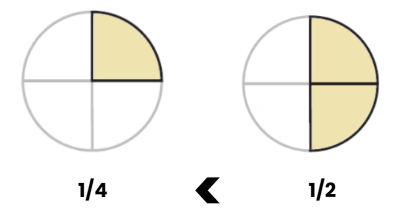
Let’s look at an example comparing 1/4 and 1/2:
We can see that 1/2 covers more area than 1/4, so 1/2 > 1/4.
Answer: 1/2, 1/3, 1/4
Note: When comparing fractions with the same numerator (the top number), the fraction with the smaller denominator (the bottom number) is larger.
Let Us Find Fractions in Our Surroundings
Fractions are everywhere around us! Let’s explore some everyday situations where we can find and use fractions.
Kadamba is excited to know where we use fractions in daily life. She found some examples below. Help her find more examples and try to draw the images of the same in your notebook.
Examples of Fractions in Daily Life:
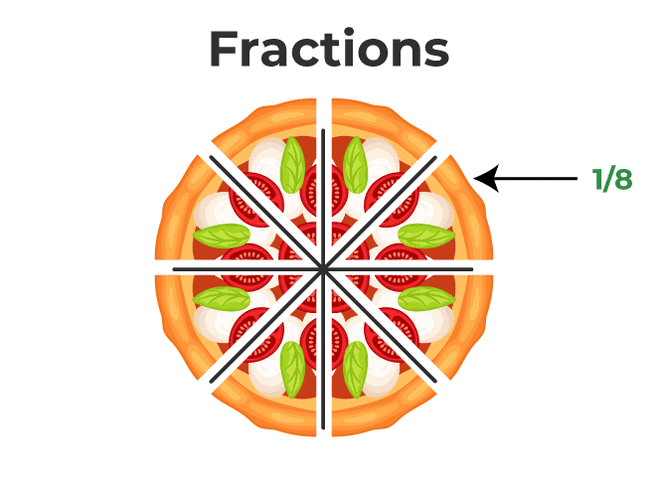
Food: When we divide a pizza into 8 slices, each slice is 1/8 of the whole pizza.
Time: Half an hour is 1/2 of an hour, and 15 minutes is 1/4 of an hour.
Money: 50 paise is 1/2 of one rupee, and 25 paise is 1/4 of one rupee.
Measurements: Half a meter is 1/2 of a meter, and 250 ml is 1/4 of a liter.
Some Solved Examples
Example 1:There are 12 cookies. What fraction of cookies will each child get if there are 3 children?
Sol: Total number of cookies = 12
Number of children = 3
Number of cookies each child will get = 12 ÷ 3 = 4
Fraction of the total cookies each child will get = 4/12 = 1/3 (after simplifying)
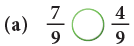
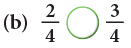
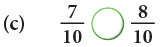
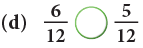
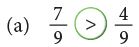
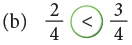
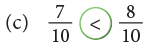
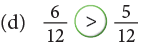
Example 2: Fill in the with < or >.
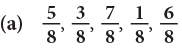
Example 3: Arrange the following fractions in ascending order.
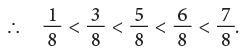
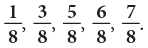
(a) Since, 1 < 3 < 5 < 6 < 7. The fraction with the smaller numerator names the smaller fraction.
Here, the fractions in ascending order are
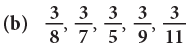
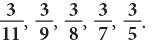
(b)The fraction with the greater denominator names the smaller fraction.
Here, the fractions in ascending order are
Example 4: A chocolate bar is cut into 5 equal parts. Arjun eats 2 parts and then eats 1 more. What fraction of the bar did he eat?
Sol: First he ate = 2/5
Then he ate = 1/5
Total eaten = 2/5 + 1/5 = 3/5
Example 5: Raj got 6 out of 12 questions correct in a quiz. What fraction of questions did he get right? Simplify the answer.

 Diagonal Division: Drawing a diagonal line from one corner to the opposite corner