Page No. 36
Think About It
Q1. Why do the courtiers call the prince ‘the Happy Prince’? Is he really happy? What does he see all around him?
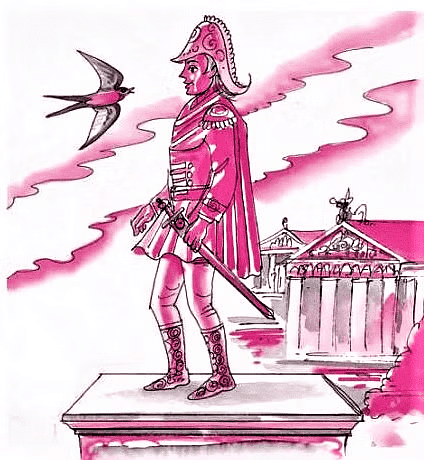
Ans: The courtiers referred to the prince as ‘the Happy Prince’ because he always appeared joyful. During his life, he was unaware of tears as he lived in a palace where sorrow was forbidden. However, after his death, when he became a statue, he was no longer happy. He wept for the suffering he observed in the city around him.
- As a statue, he could see the misery and ugliness of his city.
- His heart, though made of lead, could not help but weep for the pain of others.
- His tears flowed down his golden cheeks, revealing his true sorrow.
Q2. Why does the Happy Prince send a ruby for the seamstress? What does the swallow do in the seamstress’ house?
Ans: The Happy Prince sent a ruby to the seamstress because she was very poor and unable to feed her sick child, who had a fever. The swallow, convinced by the Prince, flew to her house.
- Upon arrival, the seamstress was asleep.
- The swallow placed the ruby on her work table.
- He then circled the bed, using his wings to fan the boy’s forehead.
- This action helped soothe the boy, allowing him to sleep peacefully.
Q3. For whom does the prince send the sapphires and why?
Ans: The Happy Prince sent sapphires to assist two individuals in need:
- Young Writer: He was too cold and hungry to finish his play. The Prince sent a sapphire, which the writer sold for firewood and food. This act lifted his spirits, motivating him to complete his work.
- Little Matchgirl: She had dropped her matches in the gutter, ruining them. Knowing she would be punished for not bringing home money, the Prince sent her a sapphire as well. When the swallow delivered it, she joyfully ran home, relieved and laughing.
Q4. What does the swallow see when it flies over the city?
Ans: When the swallow flew over the city, it noticed a stark contrast between wealth and poverty:
- The rich were enjoying themselves in their beautiful homes.
- Poor beggars sat at the gates, struggling for survival.
- In dark alleys, starving children looked out with white faces.
- Two boys huddled together under a bridge, trying to keep warm.
- A watchman shouted at them to move along.
- Near the cathedral, he saw marble angels and heard music from a palace.
- A girl on a balcony complained about her dress not being ready for the state ball.
- He observed lanterns hanging from ships as he flew over the river.
- Finally, he reached a poor woman’s house, where her sick boy lay feverish.
The swallow dropped a ruby from the Prince, cooling the boy’s forehead with his wings. The boy felt better and fell into a peaceful sleep.
Upon returning to the Happy Prince, the swallow shared his experiences. The Prince remarked that doing good made him feel warm, despite the cold.
Q5. Why did the swallow not leave the prince and go to Egypt?
Ans: After the Prince gave away the sapphires from his eyes, he became blind. The swallow, moved by the Prince’s kindness, chose to stay with him instead of flying to Egypt.
This decision highlights the swallow’s deep loyalty and affection for the Prince, demonstrating that he valued their bond over returning to his friends.
Q6. What are the precious things mentioned in the story? Why are they precious?
Ans: In the story, the two precious things are the Prince’s leaden heart and the dead swallow. They are valued for their:
- Kindness: The Prince, though dead, was saddened by the suffering in his city. He gave away his riches to help the poor, prioritising their well-being over his own.
- Selflessness: The swallow showed kindness by delivering the Prince’s messages and chose to stay with him, even knowing he would struggle in winter.
- Emotional significance: When the swallow died at the Prince’s feet, the Prince’s heart broke from sorrow.
When God asked for the most precious things in the city, an angel brought the leaden heart and the dead bird. God promised that the swallow would sing in His garden of Paradise, while the Happy Prince would praise Him in his city of gold.