Reflect and Respond
I. Discuss what you see in a garden — the colours and where you see them.
Ans (Sample): In a garden, green dominates everywhere — from deep pine green of hedges to lighter apple green of grass and new leaves. Flowers introduce red, yellow, orange, pink, and violet. The sky shows shades of blue through gaps in the foliage, and dew drops create silver-white sparkles in morning light — making a garden a natural, living painting.
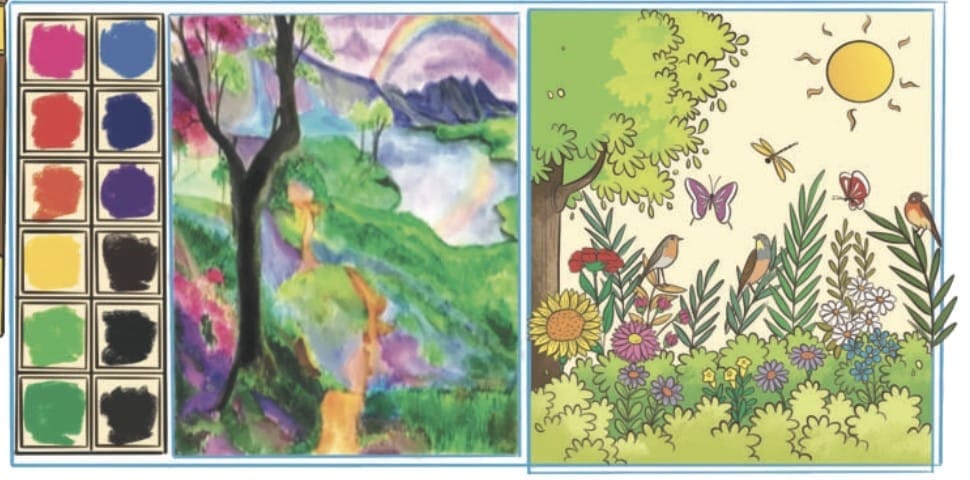
II. Speak about similarities between the garden and the painting using the given sentence prompts.
Ans (Sample):
- Just as a garden is filled with colours arranged naturally by plants, similarly, a painting is filled with colours arranged deliberately by an artist.
- A garden and a painting, both use colour, contrast, and arrangement to create a harmonious whole that evokes emotion.
- Creativity is common to both a garden and a painting — the gardener and painter both make deliberate aesthetic choices.
- Like a garden, a painting too tells a story through colours, textures, and forms placed with intention.
III. Identify palette, canvas, and a hue from the painting described.
Ans:
- Palette — The earth serves as the palette: the surface on which the colours of flowers, grass, and plants are held. In a painting, it is the board where the artist mixes colours.
- Canvas — Each garden plot is the canvas — the broad surface on which the gardener “paints” with plants and blooms.
- A hue — The vibrant red of spring blossoms or the varied green of leaves.
Check Your Understanding

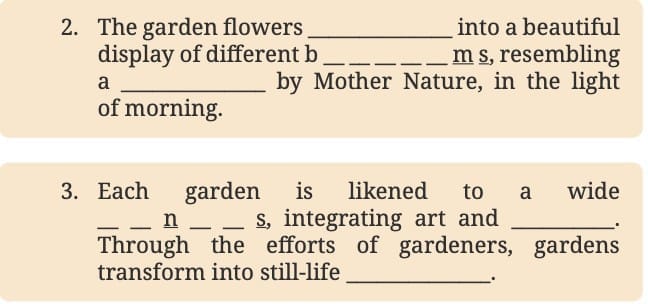
I. Complete the summary of each stanza by filling in the blanks.
- The earth / soil is portrayed as a rich palette where gardeners’ dreams flourish in the form of seeds (brushstrokes of seeds), awaiting spring.
- The garden flowers bloom into a beautiful display of different blossoms, resembling a painted artwork by Mother Nature, in the light of morning.
- Each garden is likened to a wide canvas, integrating art and life. Through the efforts of gardeners, gardens transform into still-life paintings.
II. Select the appropriate title for each stanza. (Two titles are extra.)
- Nature’s Work of Art
- Sweet-smelling Blossoms
- Gardens as Living Canvases
- Earth and Possibilities
- The Painter’s Canvas
Ans:
- Stanza 1 → Earth and Possibilities — the earth is described as a rich palette and seeds as brushstrokes, full of potential awaiting spring.
- Stanza 2 → Nature’s Work of Art — celebrates the blooming garden as Nature’s own masterpiece with shades of green, red, and blue.
- Stanza 3 → Gardens as Living Canvases — every plot is likened to a canvas where art and life coincide.
- Extra (unused) titles: Sweet-smelling Blossoms | The Painter’s Canvas
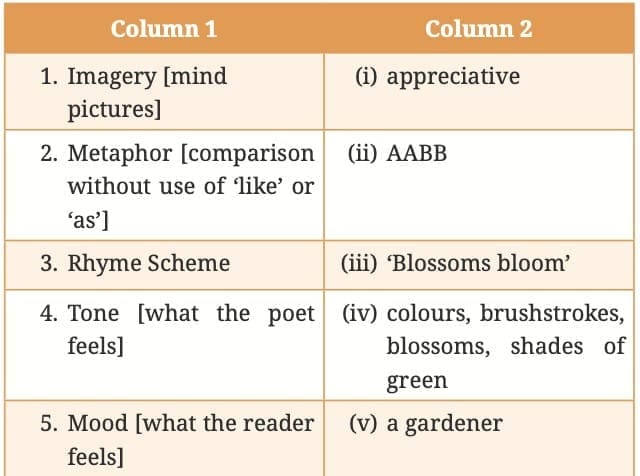
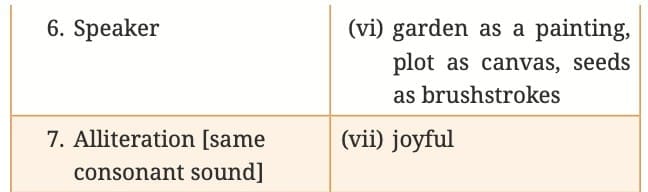
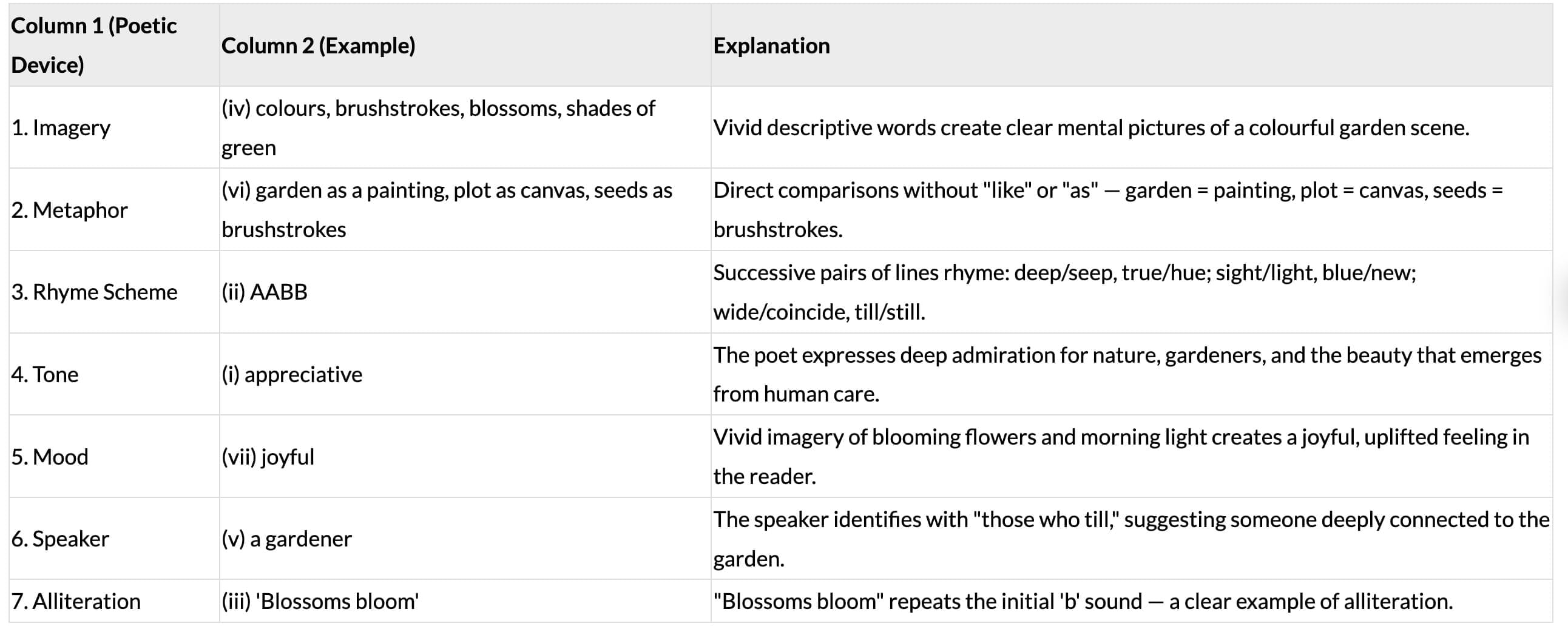
III. Match the poetic devices in Column 1 to the examples in Column 2.
Critical Reflection
I. Read the given extracts from the poem and answer the questions that follow.
Extract 1:
Brushstrokes of seeds, planted true,
Awaiting spring’s vibrant hue.
(i) The poet has used a metaphor in ‘Brushstrokes of seeds’. Which option from those given below uses a metaphor?
A. Her mother’s heart heard her heartfelt request with kindness.
B. She has a heart of gold.
C. Her heart did a dance of joy on seeing the new doll.
D. She has a very kind heart.
Ans: B. She has a heart of gold. “Heart of gold” directly compares the heart to gold without using “like” or “as.” Option A uses “heartfelt” (an adjective), option C is personification, and option D is a factual statement.
(ii) Complete the sentence appropriately.
The phrase ‘planted true’ is significant because it implies __________.
Ans: …that seeds are sown with care, intention, and sincerity — not carelessly but with genuine purpose, just as a painter’s brushstrokes are deliberate and precise.
(iii) Why has the poet used the word ‘hue’ instead of ‘colours’ in the extract?
Ans:
- Rhyme: ‘Hue’ rhymes with ‘true,’ maintaining the AABB scheme. ‘Colours’ would break it.
- Precision: ‘Hue’ is a more refined, painterly term — a specific shade or tint — reinforcing the garden-as-painting metaphor.
- Rhythm: ‘Hue’ is a single syllable that fits the line’s rhythm better than the two-syllable ‘colours.’
(iv) Complete the following analogy correctly with a word from the extract.
Summer: hot :: Spring : _________
Ans: vibrant. Just as summer is characterised by heat, spring is characterised by vibrancy — the extract itself uses the phrase “spring’s vibrant hue.”
(v) Read the Assertion (A) and the Reason (R) and select the option that is correctly suited.
(A): Gardeners wait for Spring.
(R): Gardens are worth painting in Spring.
A. Both (A) and (R) are true and (R) is the correct explanation of (A).
B. Both (A) and (R) are true but (R) is not the correct explanation of (A).
C. (A) is true but (R) is false.
D. (A) is false but (R) is true.
Ans: B. Gardeners wait for spring because it provides conditions for growth and blooming. Gardens are also worth painting in spring — but this is not the reason gardeners wait.
Extract 2:
Each plot, a canvas wide,
Where art and life coincide.
(i) What does ‘Each plot’ refer to in this extract?
Ans: ‘Each plot’ refers to each individual patch of garden land set aside for growing plants. Just as a painter works on a specific canvas, a gardener works on a specific plot — each separately tended plot is like a unique canvas.
(ii) Select which option imitates the rhyme scheme of the extract.
A. beautiful and clear / laughter and cheer
B. beautiful and clear / laughter and tears
Ans: A. The extract uses an AA rhyme scheme — “wide” and “coincide” rhyme. “Clear” and “cheer” in option A replicate this. In option B, “clear” and “tears” do not rhyme.
(iii) Select the line from the extract that conveys that gardening blends aesthetic beauty with natural growth.
Ans: “Where art and life coincide.” This line directly states that art (the creative dimension) and life (biological growth) exist simultaneously in the same garden space — “coincide” meaning they occur at the same place and time.
(iv) Complete the following sentence appropriately.
The plot is likened to a canvas suggesting that _____________.
Ans: …just as a blank canvas is a space of infinite creative potential filled by an artist with colour and form, a garden plot is a space of infinite natural potential filled by a gardener with plants, colours, and life — both transformed through skill and care.
(v) Why has the poet most likely used the word ‘wide’ instead of ‘long’ in ‘canvas wide’?
Ans:
- Rhyme: ‘Wide’ rhymes with ‘coincide’; ‘long’ would break the AABB scheme.
- Visual suggestion: ‘Wide’ suggests expansiveness and breadth — a garden spreading outward in all directions — more apt than ‘long,’ which implies only one dimension.
- Artistic connotation: A painter’s canvas is conventionally described by width, not length — making ‘wide canvas’ the more natural artistic expression.
II. Give reasons for the comparisons made by the poet in the poem.
- A painter is compared to a gardener because both are creative individuals who use their medium — paint on canvas, or plants in soil — to produce a carefully arranged composition. Both must plan, select materials, apply them with skill and intention, and wait patiently for the result.
- A palette is like earth as both are foundational surfaces from which colour and beauty emerge. Just as a painter mixes colours on a palette, the earth holds nutrients and seeds from which plants and their colours spring forth.
- Brushstrokes are like seeds because both are deliberate, precise acts of creation that set the foundation for what will eventually become a full, beautiful work — small initial gestures that lead to large, colourful outcomes.
- A canvas is similar to a garden plot as both are defined spaces within which creative work happens — bounded areas transformed from bare surfaces into works of art through skill and care.
III. Answer the following questions.
1. How does the metaphor ‘Brushstrokes of seeds’ enhance the understanding of gardening as an art form?
Ans:
- It elevates planting to a deliberate creative gesture — the gardener makes intentional aesthetic decisions about placement, spacing, and colour, like an artist making considered brushstrokes.
- It highlights the precision and skill of gardening — a brushstroke is controlled and purposeful, suggesting gardeners plant with the same exactness as skilled painters.
- It introduces patience and anticipation — just as brushstrokes build slowly into a finished painting, seeds take time to bloom. Both require quiet nurturing before the full picture emerges.
2. What can you infer about the poet’s perspective on the relationship between nature and creativity from the following lines?
‘Each plot, a canvas wide, / Where art and life coincide.’
Ans:
- The poet views nature and creativity as two aspects of the same reality — “coincide” suggests art and life are fundamentally inseparable in the garden.
- The poet believes nature itself is creative — the growth of plants and arrangement of colours constitute a form of artistry rivalling any human painting.
- Human creativity is an expression of nature — gardeners participate in a creative process nature has always been engaged in, rather than imposing art upon it.
3. Do you think the imagery in the poem successfully paints a vivid picture in the reader’s mind? If yes, why? If no, why not?
Ans: Yes, the imagery is very successful:
- Colour imagery: “Shades of green, red, and blue” and “vibrant hue” conjure a bright, specific garden scene.
- Kinetic imagery: “Blossoms bloom” and “dancing in the morning light” give the garden movement — the reader can almost see flowers swaying in early sunlight.
- Sensory richness: “Morning light” introduces a specific quality — soft, warm, gentle — adding depth and atmosphere.
- Extended metaphor as imagery: The garden-as-painting comparison layers a visual metaphor over a visual scene, creating a rich, double-layered picture.
4. Support the view that the poet’s mention of the colour yellow, besides red, blue and green, would have lent effectively to the imagery.
Ans:
- Yellow is most associated with spring — sunflowers, marigolds, and daffodils are iconic spring blooms. Without it, the poem’s garden feels slightly incomplete.
- Yellow captures morning light — the poem mentions “dancing in the morning light,” and morning light is warm and golden-yellow, creating a thematic connection.
- Yellow creates contrast and brightness — the most luminous colour in the spectrum, it would add warmth and radiance to the colour scheme.
- Yellow symbolises hope and joy — deeply aligned with the poem’s celebratory, appreciative tone.
5. Considering the line ‘Gardens become paintings still’, what can you interpret about the poet’s view on the timelessness of nature’s beauty?
Ans: The line carries two complementary meanings:
- ‘Still’ as ‘even now’ (adverb): Gardens continue to become paintings today — nature’s creative cycle is unchanged even in the modern world.
- ‘Still’ as ‘motionless’ (adjective): Gardens become still-life paintings — so perfectly composed at any moment that they are already finished works of art.
Together, these convey that nature’s beauty is both eternal and instantaneous — a self-renewing masterpiece that has always already been art.
6. Justify the title of the poem, ‘Canvas of Soil’.
Ans:
- ‘Canvas’ is the artist’s surface — blank ground ready to be filled with colour and meaning, signalling the poem will treat the garden as art.
- ‘Soil’ is the gardener’s surface — humble, organic, and life-giving, sustaining everything in a garden.
- The combination declares from the title that soil is the canvas — the earth is the surface on which nature paints its masterpieces and gardeners exercise their creative art.
- It captures the poem’s deeper meaning: boundaries between art and nature dissolve in the garden — soil is not mere land but a creative medium of infinite possibility.
Vocabulary in Context
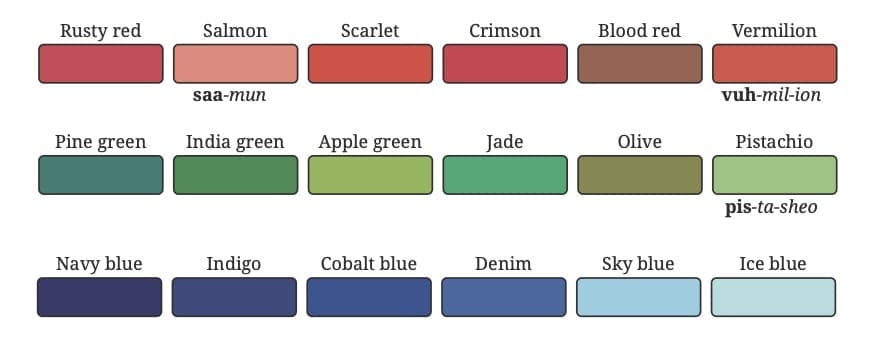
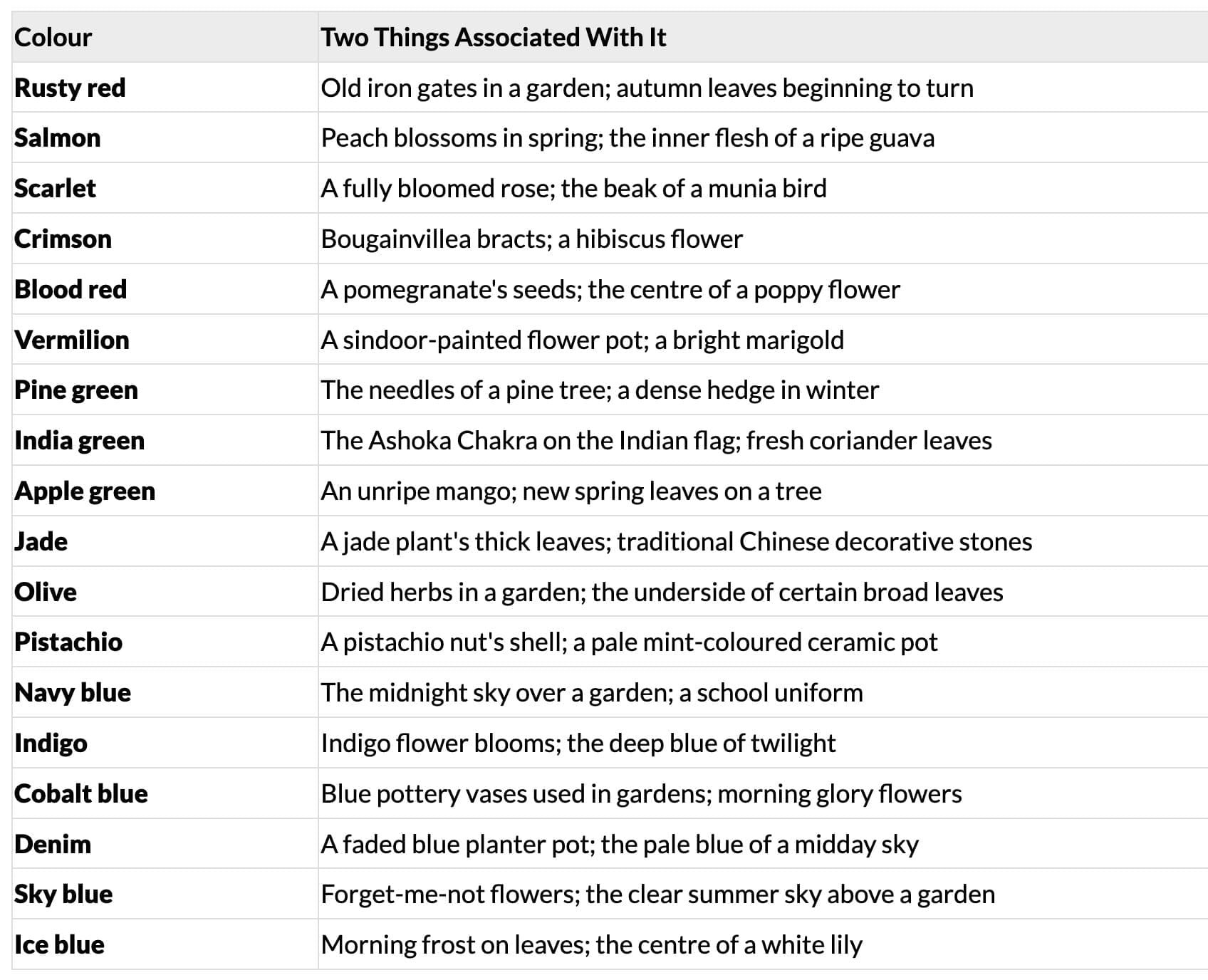
I. Discuss two things you can associate with each colour shade.
II. Discuss the meanings of the underlined painting-related words in the paragraph.
You have studied painting-related words like palette, brushstrokes, shades, hue, colours, and canvas. Now, read the following paragraph and discuss in pairs what the underlined painting-related words might mean. Discuss this way:
I think __________ means __________ because the passage talks about __________.
Example: I think portrait means a picture of someone’s face because the passage talks about capturing a friend’s features.
In the art studio, young painters eagerly approached their easels, each framing a canvas that they had to work on. The teacher encouraged them to experiment with a diverse tonal range, playing with shades and hues to bring their paintings to life. One student focused on a detailed portrait, capturing his friend’s features, first with careful underpainting and then filling the final colours. Another student worked on a mural, depicting a Spring Day on the right wall of the classroom. The room continued to buzz with artistic energy.
Ans:
- Easels: I think easels means stands that hold a canvas upright while a painter works because the passage talks about painters approaching their easels and framing a canvas — the easel is what supports the painting surface.
- Tonal range: I think tonal range means the variety of light and dark shades of colour used in a painting because the teacher encourages students to experiment with it by playing with shades and hues — the spectrum of colour values from light to dark.
- Portrait: I think portrait means a painting of a specific person’s face because a student is capturing his friend’s features — a realistic depiction of a particular person.
- Underpainting: I think underpainting means a preliminary layer of paint applied before the final colours because the student completes it first and then fills in the final colours — a foundation layer.
- Mural: I think mural means a large painting done directly on a wall because the student works on a mural on the right wall of the classroom — applied to a physical wall, not a canvas.
Speaking Activity

I. Advantages of a Flower Garden vs. a Vegetable Garden at Home
II. Sample responses expressing preference with reasons.
Would you like to have a flower garden or a vegetable garden at home? Why?
Take turns with your partner and speak your points aloud, one by one, by using the given sentence prompts to express your preference, with reasons.
- I prefer ________ to ________ because …
- For me, it is a ________ instead of a ________ due to …
- If I had a choice I’d rather have a ________ than a ________ as …
- I would prefer ________ rather than ________ since …
Sample 1 (preferring a flower garden):
I prefer a flower garden to a vegetable garden because I believe beauty has its own kind of nourishment. For me, it is a joy instead of a chore due to the fact that flowers are relatively low-maintenance and reward you with colour and fragrance every morning. If I had a choice, I’d rather have a flower garden than a vegetable garden as stepping into a blooming garden after a long school day restores my peace of mind in a way that harvesting vegetables simply cannot. I would prefer a flower garden rather than a vegetable garden since flowers attract bees and butterflies and make the entire neighbourhood more beautiful — they are a gift not just to me but to everyone around.
Sample 2 (preferring a vegetable garden):
I prefer a vegetable garden to a flower garden because it gives me something I can eat — the satisfaction of growing my own tomatoes or spinach is extraordinary. For me, it is a practical investment instead of a purely aesthetic pleasure due to the fact that fresh, homegrown vegetables are healthier and more sustainable than what we buy in the market. If I had a choice, I’d rather have a vegetable garden than a flower garden as it teaches me about patience, soil, seasons, and the effort behind every meal. I would prefer a vegetable garden rather than a flower garden since it connects me directly to the food I eat and helps my family reduce its grocery bills — making beauty and usefulness go hand in hand.
Writing Task
I. Write a descriptive piece of two to three paragraphs describing the details and colours in the garden you have visited.
- Focus on how different shades of blue, red, and green interact, create contrast, and bring the garden to life.
- Pay attention to details like the texture of petals, the varying greens of leaves, and the way light affects the colours.
Ans: Sample Descriptive Piece: A Garden I Visited
The Pinjore Gardens in Haryana, which I visited last winter, remain one of the most vivid memories of colour and form I carry with me. The garden is arranged in a series of descending terraces, and as you walk down from one level to the next, the scene shifts like turning the pages of a richly illustrated book.
At the highest level, rows of marigolds bordered the path in bands of orange and rusty red, their petals catching the thin winter sunlight and glowing as if lit from within. Just beyond them, beds of salvias stood in deep crimson and blood red, punctuated by the soft ice blue of ageratum flowers nestled at their feet. The contrast between the warm reds and the cool blues created a tension that was almost musical — like two notes in a chord that are different yet perfectly suited to each other. Where the red blossoms ended, the eye was naturally drawn sideways to a row of marigolds in vivid yellow-orange, and then to a hedge of boxwood clipped smooth and flat in a rich pine green. The greens themselves were layered: the dark, almost black-green of the cypress trees at the periphery gave way to the medium India green of the lawn, which in turn brightened into the apple green of new growth wherever the sunlight fell most directly.
What struck me most was the way the light transformed everything as the morning progressed. In the early hours, the garden was cool and shadowed, the reds appearing almost maroon in the diffused light. But as the sun rose, each colour became its fullest, truest self — the scarlet roses blazing, the jade-green lily pads on the small pond shimmering, and the white jasmine on the boundary wall glowing with an almost silver intensity. The petals of the larger roses had a soft, almost suede-like texture, and the light caught the tiny hairs on their surface, making them look as though they had been dusted with gold. In that garden, I understood exactly what the poet Maya Anthony meant: every plot truly is a canvas wide, where art and life coincide.