Understanding Multiplication

Imagine you have a basket full of colourful marbles. You want to find out how many marbles are in the basket. You see that there are 4 rows of marbles as given in picture below, with each row containing 5 marbles:
- 5 marbles in the first row,
- 5 marbles in the second row,
- 5 marbles in the third row, and
- 5 marbles in the fourth row.
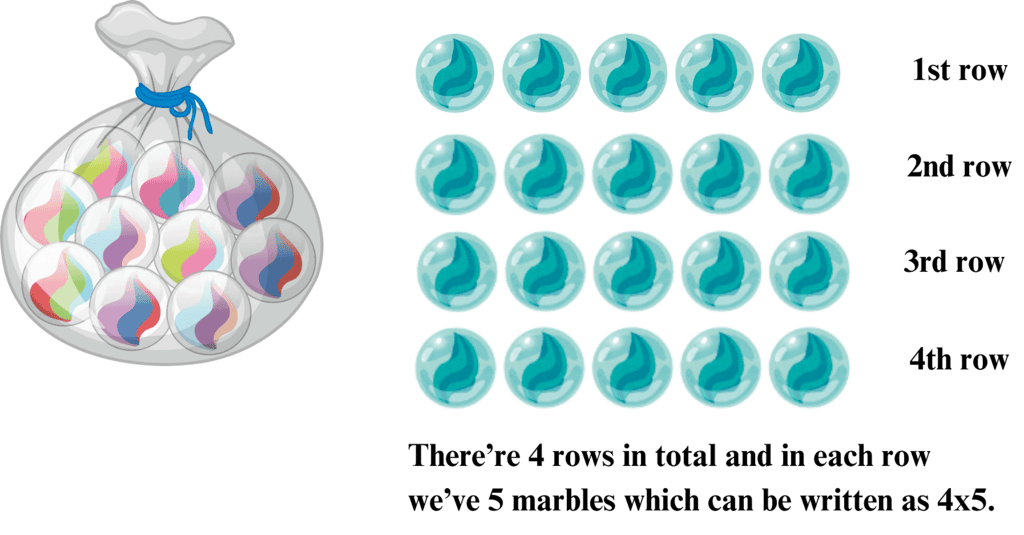
Instead of counting each row individually, you can use multiplication to find the total number of marbles. Multiply the number of rows (4) by the number of marbles in each row (5): 4 × 5, which equals 20.
So, there are 20 marbles in the basket!
Seeing Patterns in Multiplication Tables
Multiplication is not just about memorizing numbers—it’s also about spotting patterns.
Let’s take the 5-times table as an example:
- 1 × 5 = 5
- 2 × 5 = 10
- 3 × 5 = 15
- 4 × 5 = 20
- 5 × 5 = 25
What patterns do you see?
- The last digits keep repeating: 5, 0, 5, 0, 5, 0…
- All the answers end in either 0 or 5.
Now, can you guess the last digits of 11 × 5 and 12 × 5?
- 11 × 5 = 55 → ends in 5
- 12 × 5 = 60 → ends in 0
By noticing patterns, we can predict answers without fully calculating. This makes multiplication easier and more logical.
Try yourself:
What is the result of 6 multiplied by 3?
- A.12
- B.18
- C.15
- D.24
View SolutionUnderstanding Division
Division is a method of sharing things equally among a specific number of people. It also helps us find out how many times one number goes into another.
- Imagine you have a big box of delicious kaju katlis to share with your friends.
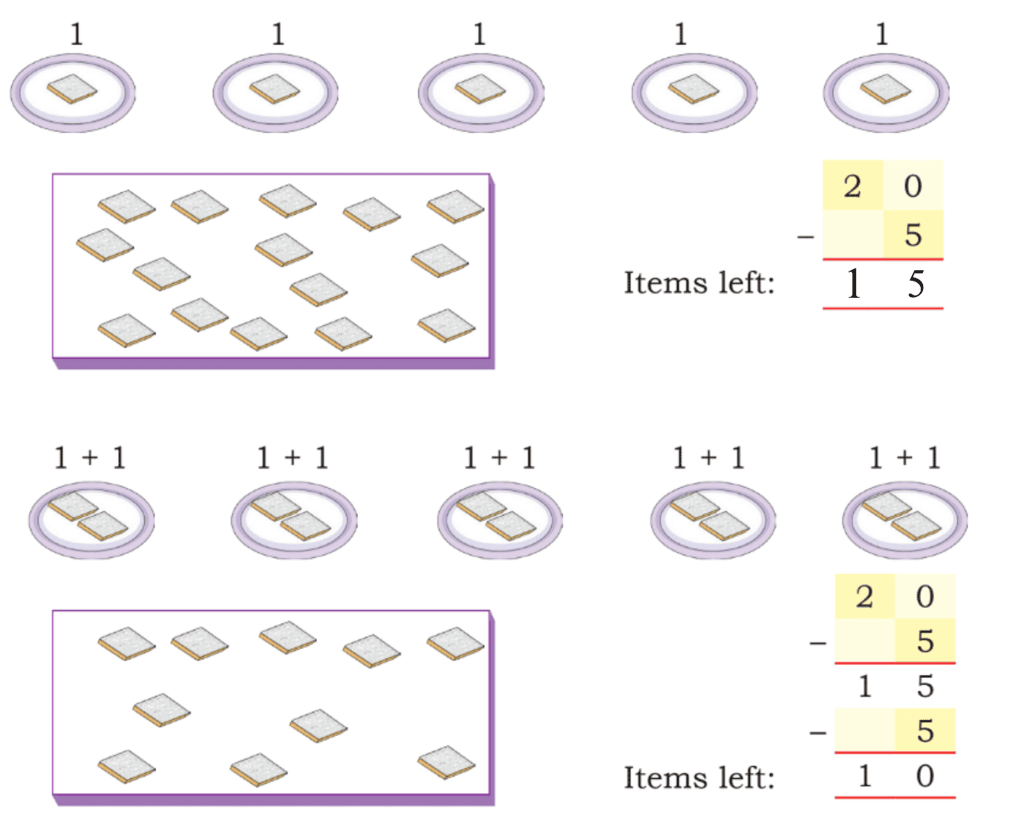
- Suppose you have 20 kaju katlis and 5 friends to share with.
- Instead of giving them out one by one, we can use division to see how many each friend gets.
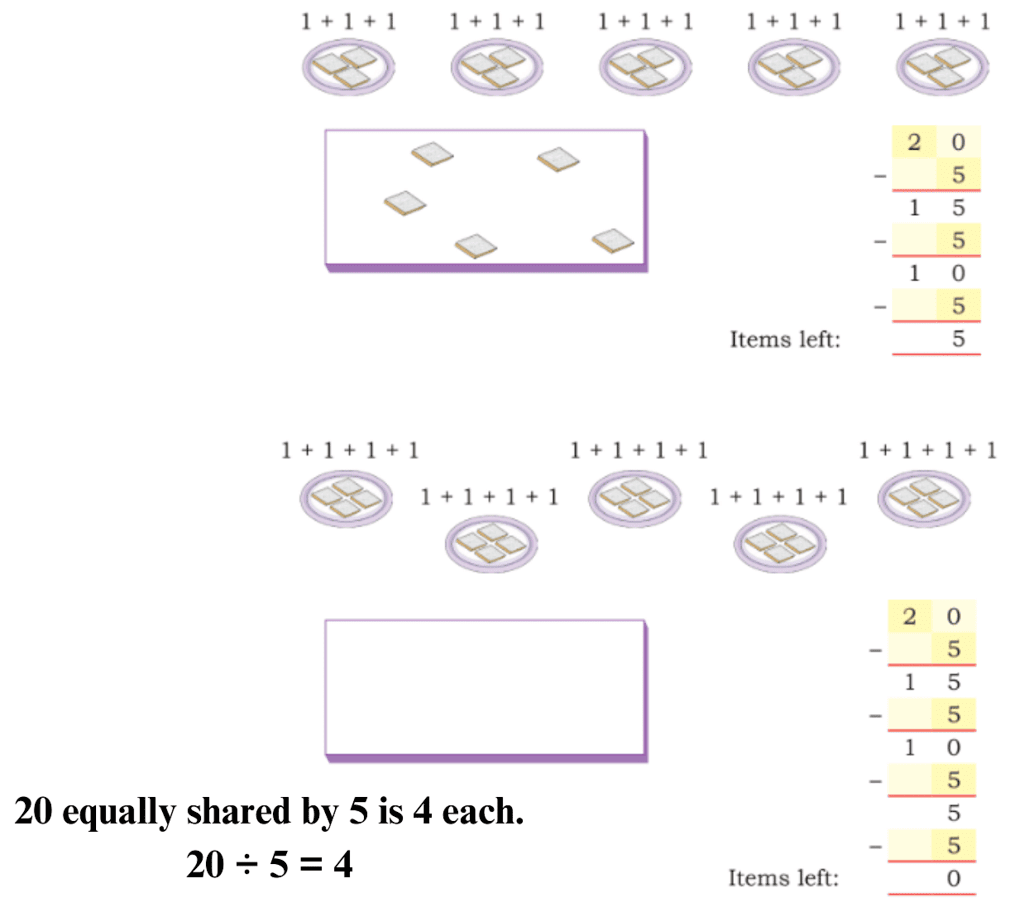
- We start with the total number of kaju katlis, which is 20, and divide it by the number of friends, which is 5, i.e., 20 ÷ 5 = 4.
- This division can also be seen as repeated subtraction. We subtract 5 kaju katlis each time until we have none left. After the first subtraction, we have 15 kaju katlis: 20 – 5 = 15. Then, subtracting another 5 leaves us with 10 kaju katlis: 15 – 5 = 10.
- This continues until we subtract the last 5 kaju katlis, resulting in 0 kaju katlis.
- Each time we subtract 5, we count it as one friend’s share. So, from 20 shared by 5, each person gets 4 kaju katlis.
Remainders in Division

- Sometimes, if the total doesn’t divide evenly, we might have a remainder. For instance, if you had 22 kaju katlis and 5 friends, each friend would still get 4, but there would be 2 kaju katlis left over.
This is how division helps us share items fairly among a group, ensuring everyone receives their fair portion.
Learning with Story: Raksha Bandhan
Once upon a time, during the festive occasion of Raksha Bandhan, in a cosy little house, there lived a girl named Sara. Sara loved her four cousins: Alex, Ben, Clara, and David. One sunny afternoon, their grandma gave Sara a bag of 12 toffees to share equally with her cousins. Sara wanted to make sure each cousin got the same number of toffees, so she needed to figure out how to do this.
Sara decided to use a method she learned in school called division. Division helps us find out how to split something into equal parts. Here’s how Sara did it:
- Count the Total Number of Toffees: Sara counted the toffees in the bag and found there were 12 toffees.
- Count the Number of Cousins: Sara counted her cousins: Alex, Ben, Clara, and David. There were 4 cousins.
Sara realised she needed to divide the total number of toffees (12) by the number of cousins (4) to ensure fairness in sharing. She remembered the division symbol (÷) and set up her problem:
12 ÷ 4 = ?
To figure this out, Sara thought about it like this: if she gives 1 toffee to each cousin, she would have given out 4 toffees in total (because there are 4 cousins). She kept giving each cousin 1 toffee until all the toffees were gone.
Here’s how she did it step-by-step:
- She gave 1 toffee to each cousin, so 4 toffees were given out (12 – 4 = 8).
- She gave another 1 toffee to each cousin, so another 4 toffees were given out (8 – 4 = 4).
- She gave 1 more toffee to each cousin, giving out the remaining 4 toffees (4 – 4 = 0).
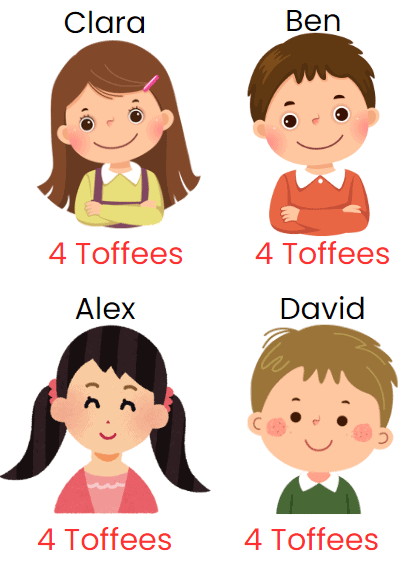
Sara saw that each cousin received 3 toffees. She checked her work: 3 toffees per cousin times 4 cousins equals 12 toffees.
So, the division was correct:
12 ÷ 4 = 3
Sara was happy that each of her cousins got an equal share of toffees, and they all enjoyed their sweet treat together.
Try yourself:What is the result of dividing 16 cookies equally among 4 friends?
- A.3
- B.4
- C.5
- D.6
View SolutionWays of Grouping
Let’s talk about a fun way to count things! Imagine you have a bunch of your favorite candies. How would you count them? There are many ways, and we’ll explore some exciting methods together!
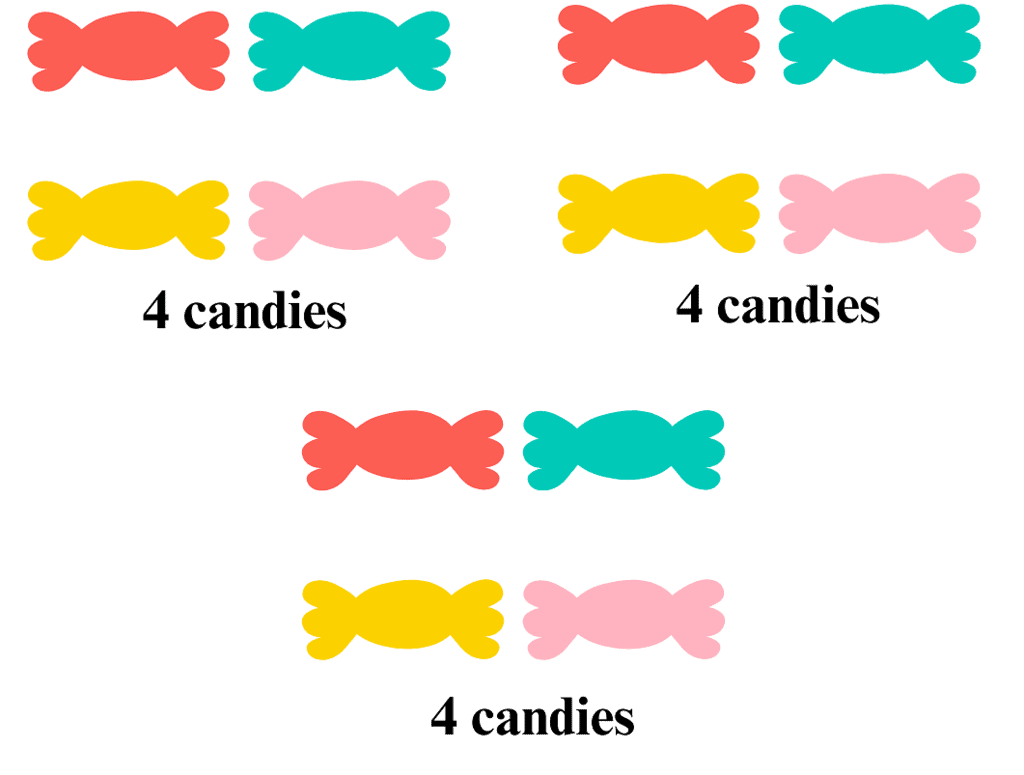
- Think about your candies . You can put them in groups to count them easily. For example, let’s say you have 12 toys. You can make 3 groups with 4 candies in each group. So, you have 3 groups of 4 candies each. That’s one way to count them!

- Now, let’s try another way. Instead of 3 groups, let’s make 4 groups, each with 3 candies. So, now you have 4 groups of 3 candies each. That’s another way to count them!
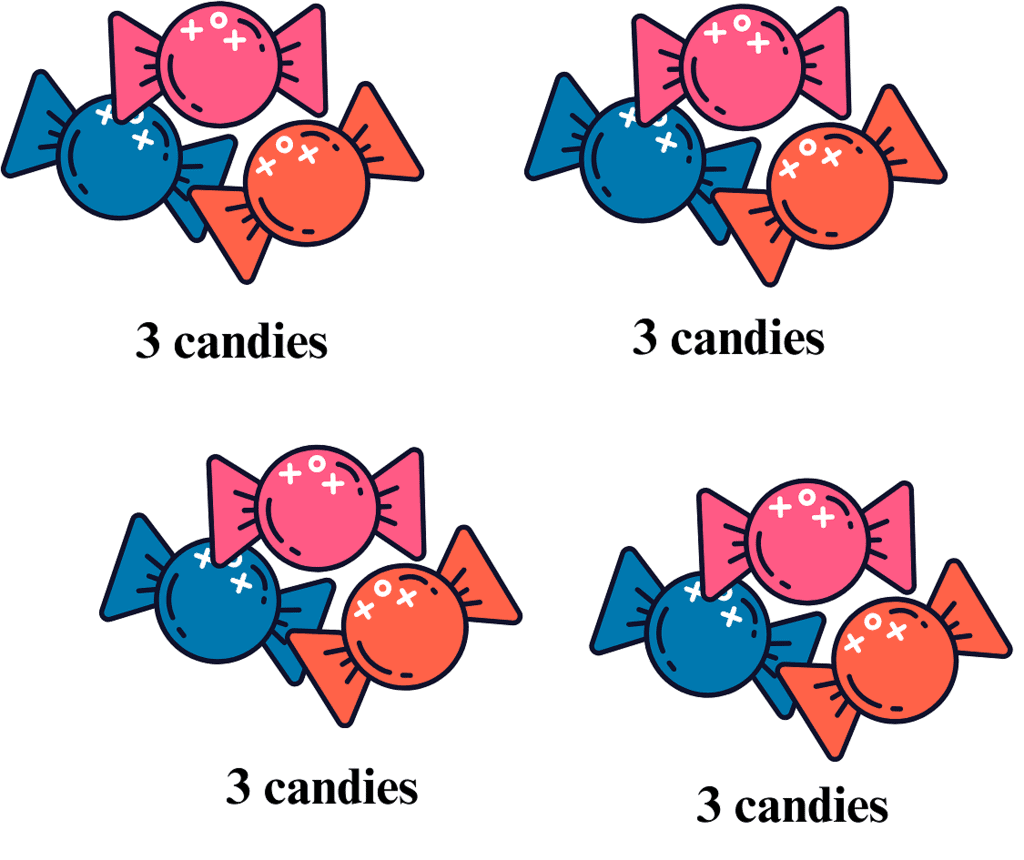

- Whether you make 3 groups of 4 candies or 4 groups of 3 candies, you still have the same total number of candies, which is 12.
This shows us that we can count things by grouping them in different ways, but the total remains the same! It makes counting even more fun!Number Line Skip
In the evening, the family visits the playing field. Maya and her mother discover an exciting game called “Number Line Skip.” Atya uses a stick to draw a winding number path on the ground. She asks Dhara to write the numbers starting from 0. Dhara is SKIP JUMPING BY 3.
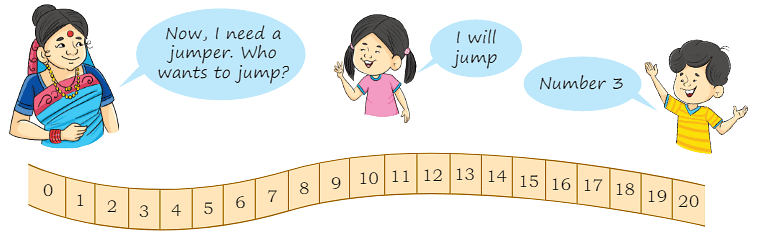
As they played, they noticed something amazing! Starting from 0, Dhara jumps to 3. From 3, she goes to 6. From 6, she continues to 9. They realised that by adding the same number, they could predict the next jump. Let’s look at Dhara’s jumps:
- 1 jump → 3
- 2 jumps → 3 + 3 = 6 = 2 x 3
- 3 jumps → 3 + 3 + 3 = 9 = 3 x 3
- 4 jumps → 3 + 3 + 3 + 3 = 12 = 4 x 3, and so on.

They also had a fun challenge: “Guess and write the next number she will jump to.” Atya places a flower on 12. “Skip jump with equal steps to reach the flower,” she instructs. No direct jumping to the flower is allowed.
Now, they hopped and laughed, discovering the wonders of numbers. The one who reaches the flower in the smallest number of jumps wins!Writing Tables
In the Fun Way of Writing Tables game, a little boy Aryan and his friends found a cool way to learn their times tables using sticks. They made a grid with sticks and counted where they crossed to figure out the answers.
Here’s how they did it:
- Aryan lined up sticks in rows and columns to make a big square grid.
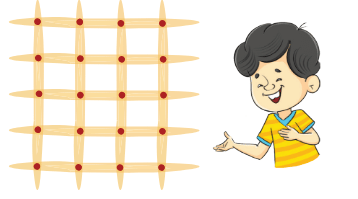
- Then, he counted where the sticks crossed to find the answer to different multiplication questions. For example, to find out what 5 times 3 is, she counted where the row labelled “3” and the column labelled “5” crossed.
- He noticed a pattern in the answers, like how the last numbers repeated in some of them. This helped her understand how numbers work together.
- Following the same pattern, they discovered some other tables as well,which are shown below:
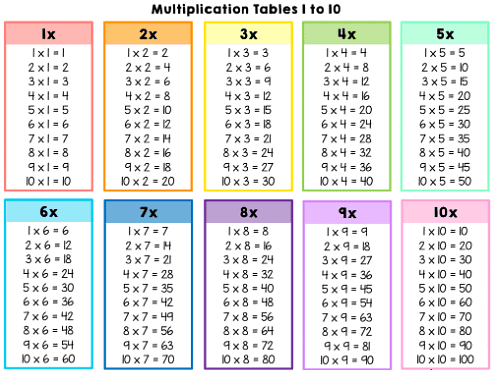
- Aryan and his friends also saw something cool when they looked at the tables for 2, 3, and 5. They noticed that some numbers had a special connection with others. This made them curious, and they wanted to explore more!
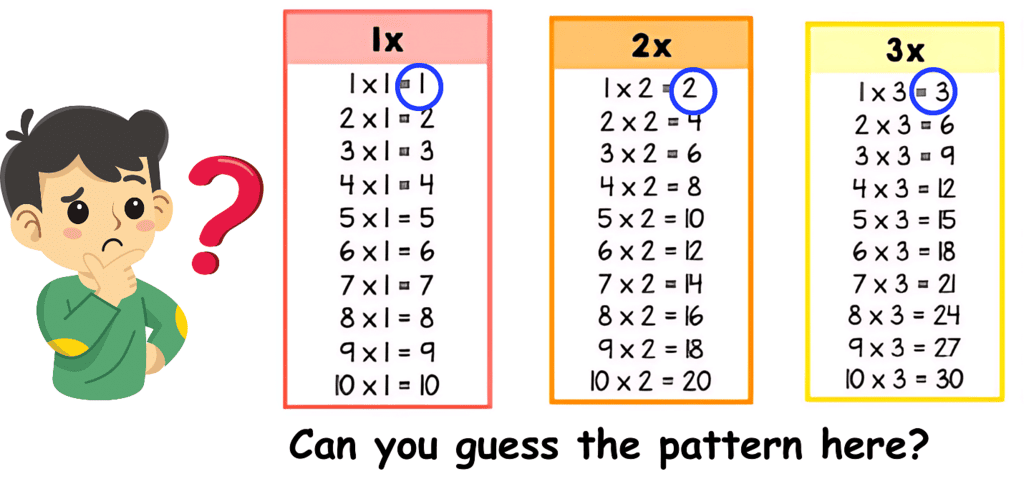
- As you can see, when we multiply 1 with 2, we get 2; when we multiply 1 with 3, we get 3 and when we multiply 1 with 5, we get 5.
- So, we can say that any number multiplied to 1 results in the same number.
By playing this game, Aryan and his friends had fun while learning about multiplication tables and discovering new patterns in numbers. Math became an exciting adventure for them!

Try yourself:
What is the result when 4 is multiplied by 7?
- A.24
- B.28
- C.30
- D.32
View SolutionWord Problems
Word problems play a crucial role in mathematics as they enable students to use their knowledge of basic arithmetic like addition, subtraction, multiplication, and division in everyday situations. Here are some examples of these types of problems.
Examples of Word Problems

1. There are 5 fruits in each basket. If there are 9 baskets filled with fruits, how many fruits are there in total?
Solution: Number of fruits in one basket = 5
Number of baskets = 9
Total fruits = Fruits per basket × Number of baskets = 5 × 9 = 45
Therefore, there are 45 fruits altogether.
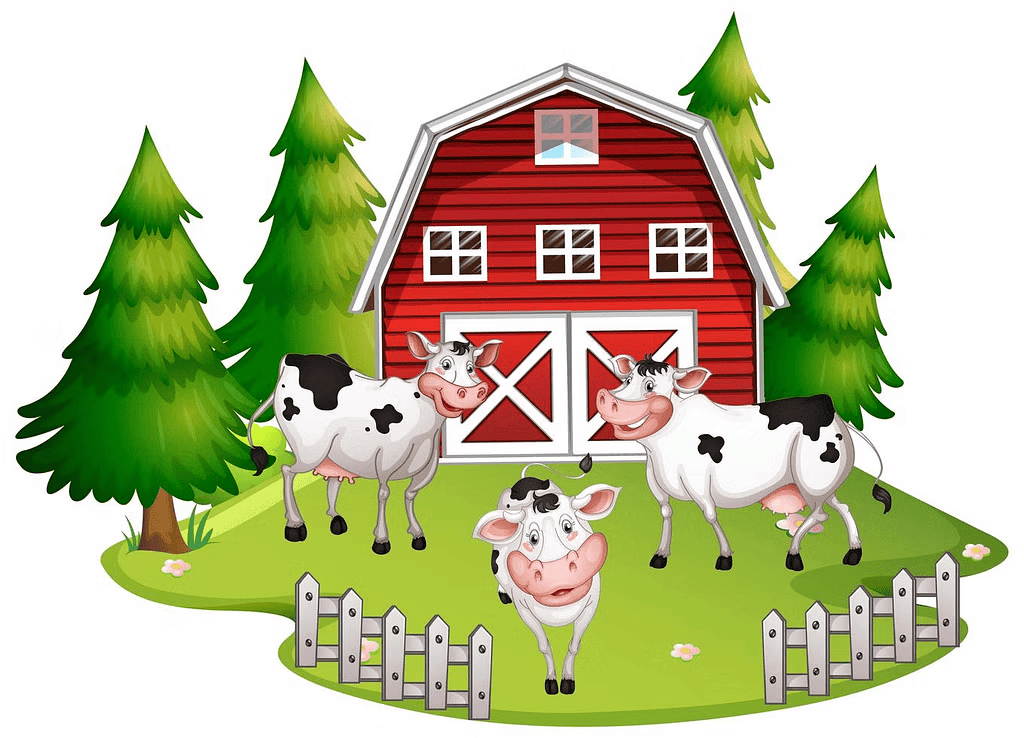
2. Donald, the duck can see 60 legs in a cow shed. How many cows are there in the shed?
Solution: Total number of legs = 60
Number of legs per cow = 4
Total number of cows in the shed = 60 / 4 = 15
So, there are 15 cows in the shed.
By working through these examples, you can become more comfortable with division and multiplication.
Let’s Practice
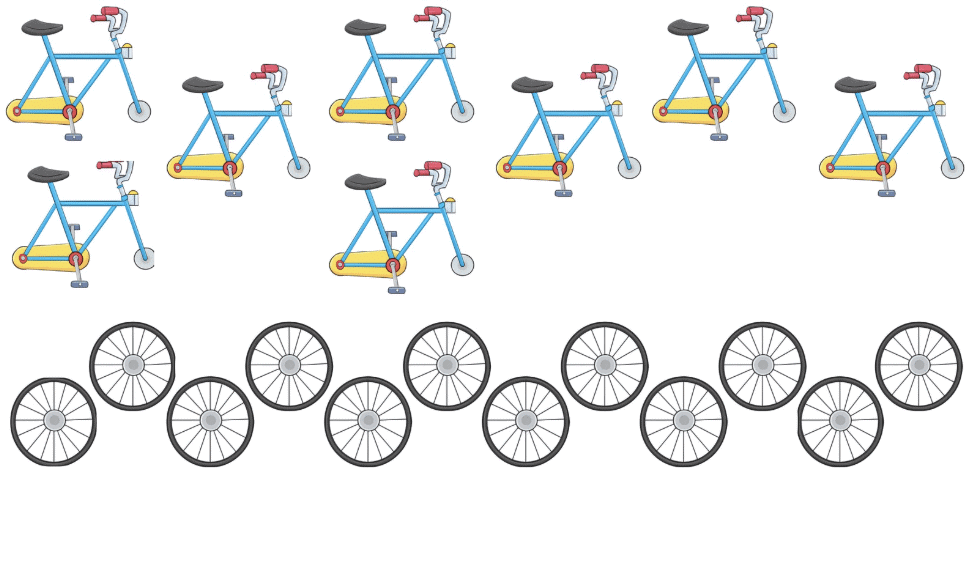
Question: Each cycle needs 2 wheels. How many cycles can be fitted with 12 wheels?
 View Answer