Q1: What period does the Gupta Era refer to?
Ans: The Gupta Era refers to the 3rd to 6th century CE.
Q2: What is the Gupta Empire known for?
Ans: The Gupta Empire is known for its achievements in art, literature, science, and governance.
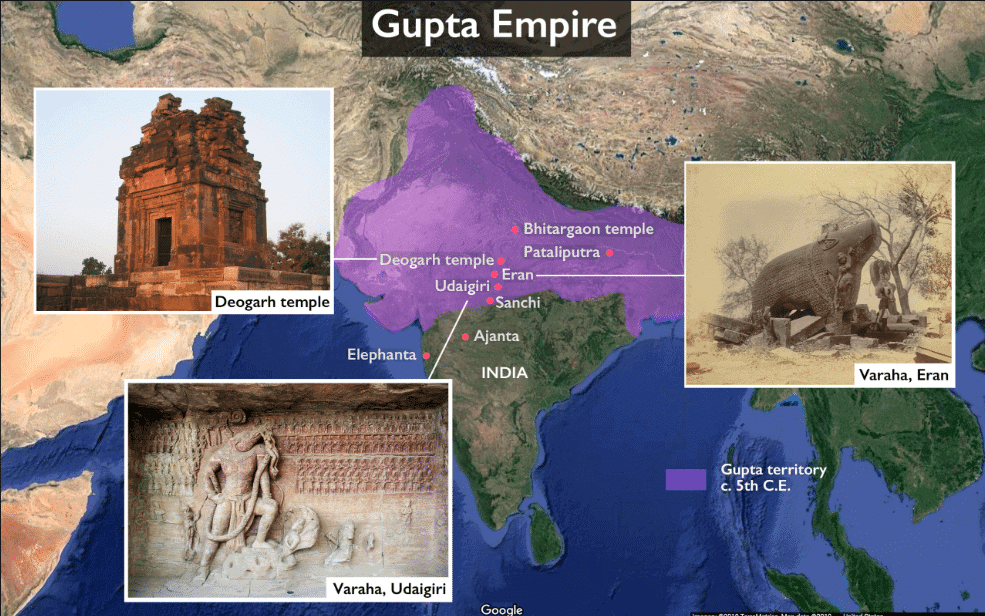
Gupta Empire
Q3: What title did Gupta rulers use to signify their supreme power?
Ans: Gupta rulers used titles like maharajadhiraja, samrat, and chakravartin.
Q4: What was the significance of the Iron Pillar in Delhi?
Ans: The Iron Pillar in Delhi is known for its advanced metallurgy and rust-resistant iron.
Q5: Who was Samudragupta and what was his contribution?
Ans: Samudragupta was a warrior king who expanded the Gupta Empire through military conquests.
Q6: What is the Prayaga Prashasti?
Ans: The Prayaga Prashasti is a pillar inscription praising Samudragupta’s achievements, written by his poet Harisena.
Q7: What did Faxian, a Chinese traveller, observe about Gupta society?
Ans: Faxian noted that people were content, cities were wealthy, and merchants built charity houses, but chandālas faced harsh treatment.
Q8: What was the main source of income for the Gupta Empire?
Ans: The main source of income for the Gupta Empire was land tax, along with other taxes on mines, irrigation, and trade.
Q9: What role did Prabhāvatī Gupta play in strengthening the Gupta-Vākāṭaka relations?
Ans: Prabhāvatī Gupta married a Vākāṭaka prince and later became a regent for her sons, strengthening the Gupta-Vākāṭaka ties.
Q10: What is the significance of Nālandā University during the Gupta period?
Ans: Nālandā University was a major center of learning, supported by the Gupta rulers, and attracted scholars from across the world.
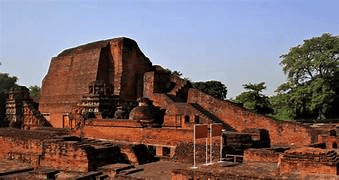
Nalanda University
Q11: What is the Iron Pillar a symbol of?
Ans: The Iron Pillar is a symbol of Gupta-era advancements in metallurgy, especially in rust-resistant iron.
Q12: What was the role of the Gupta dynasty in spreading Buddhism?
Ans: The Gupta dynasty supported Buddhism by funding Buddhist vihāras (monasteries) and promoting religious tolerance.
Q13: What kind of advancements did Āryabhaṭa make in science?
Ans: Āryabhaṭa made significant advancements in mathematics and astronomy, such as calculating the Earth’s size and explaining solar eclipses.
Q14: What did Varāhamihira contribute to science?
Ans: Varāhamihira wrote Brihat Samhita, which covered topics like astronomy, astrology, and weather forecasting.
Q15: What is Kālidāsa’s Meghadūtam about?
Ans: Kālidāsa’s Meghadūtam is a poem about a yaksha sending a message to his beloved via a cloud.

Kalidas
Q16.: What were the key features of Gupta-era art?
Ans: Gupta-era art is known for its beauty, detailed carvings, and sculptures, especially in sites like the Ajanta Caves.
Q17: What was the cultural impact of the Gupta Empire?
Ans: The Gupta Empire had a profound cultural impact, fostering Sanskrit literature, religious tolerance, and artistic achievements.
Q18: How did the Gupta Empire influence the development of mathematics?
Ans: The Gupta Empire contributed to mathematics through Āryabhaṭa’s work on calculations and solving equations, many of which are still in use today.
Q19: What was the role of trade during the Gupta period?
Ans: Trade was vital to the Gupta economy, as India traded textiles, spices, and gems with the Mediterranean, Southeast Asia, and China.
Q20: How did Gupta rulers support other religions?
Ans: Gupta rulers supported various religions, including Buddhism, Jainism, and Brahmanism, by providing patronage and building religious institutions.
Q21: What is the significance of the Ajanta Caves?
Ans: The Ajanta Caves are famous for their Buddhist paintings and sculptures, showcasing the Gupta Empire’s artistic achievements.

Ajanta Caves
Q22: What does the term “Classical Age” refer to in the context of the Gupta Empire?
Ans: The term “Classical Age” refers to the Gupta period’s cultural and intellectual achievements, including art, literature, and science.
Q23: What was the Gupta Empire’s approach to governance?
Ans: The Gupta Empire had a well-organized administration, with local rulers managing regions in exchange for tribute and loyalty.
Q24: How did the Gupta period contribute to the development of the Indian numeral system?
Ans: The Gupta period saw the development of numerals, including early forms of zero, which influenced modern mathematics.
Q25: What led to the decline of the Gupta Empire?
Ans: The decline of the Gupta Empire was caused by external invasions, internal conflicts, and the rise of regional powers.