Page No. 104
Check! Check!
Q: Anu has recorded the weights of the items in her house. Check if she has recorded them correctly by putting a tick against them if they look correct.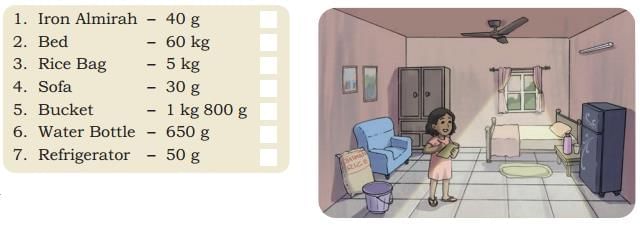 Ans:
Ans: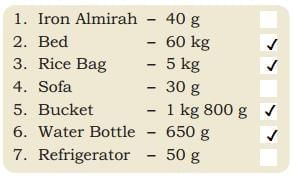
Let Us Do
Q: Read the scales. Write the correct weight in the space given below.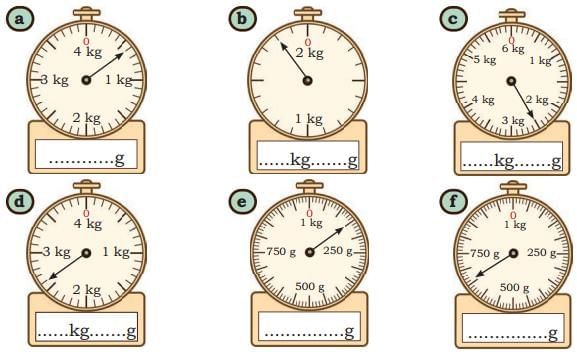 Ans:
Ans: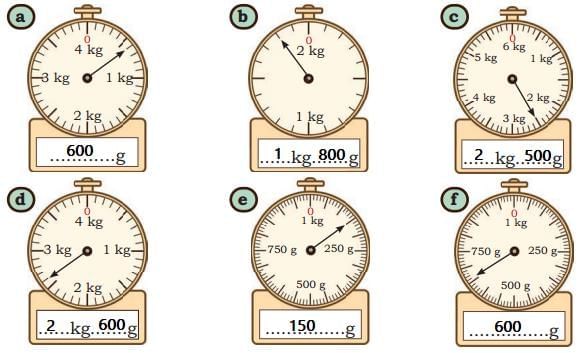 From parts (a) to (d), each small division on the scale represents 100 g, and in parts (e) and (f), each small division on the scale represents 10 g.
Page No. 105
Different Units but Same Measure
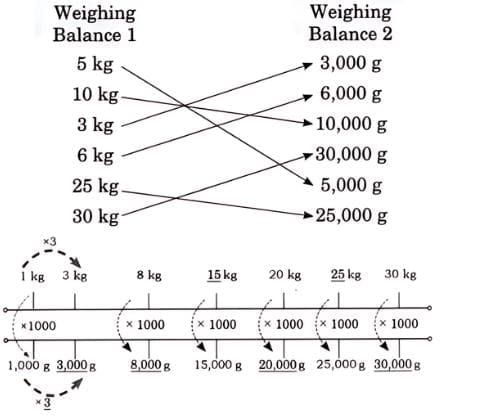
Q: Match the bags that have the same weights. You can use the double number line given below.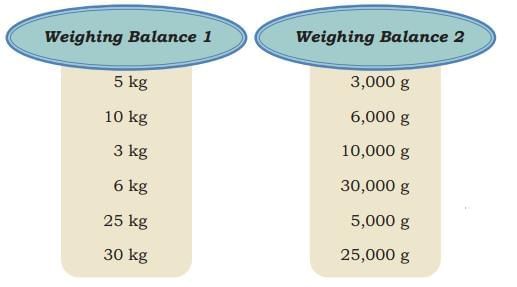
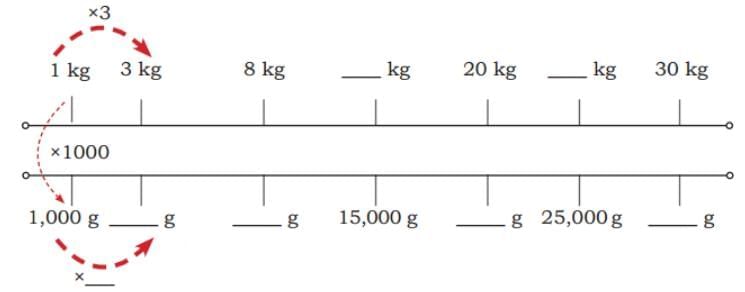
Ans:
Page No. 106
Let Us Find
Q1: Shamim and Rehan observed someone buying sugar weighing 5 kg 50 g. They thought of the quantity in grams. How much is it? Ans:
Ans:
1 Kg = 1000g
5 kg = 5,000 g
5 kg 50 g = 5,000 g + 50 g = 5050 g
So, Shamim is right.
Q2: Complete the conversions by filling in the blanks. You can use the double number line given below on which some numbers have been marked. 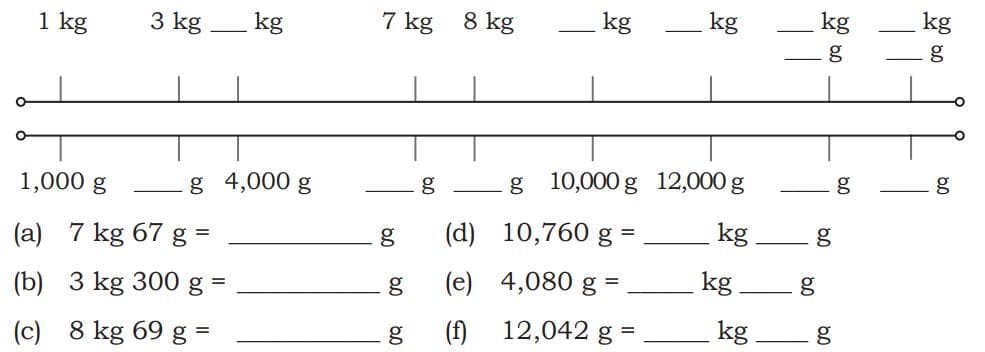
Ans:
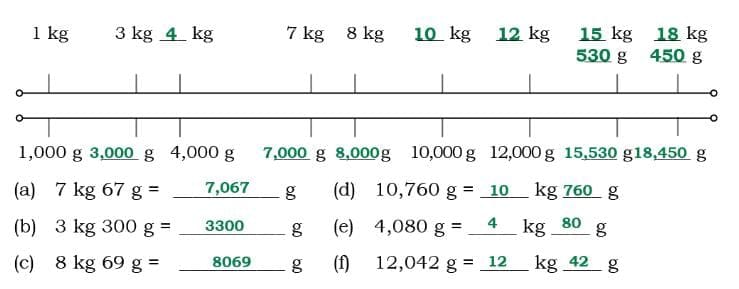
(a) 7 kg 67 g = ___________ g
Ans:
7 kg = 7,000 g
7 kg 67 g = 7,000 g + 67 g = 7,067g
7 kg 67g = 7,067 g
(b) 3 kg 300 g = ___________ g
Ans:
3 kg = 3,000 g
3 kg 300 g = 3,000 g + 300 g
= 3,300 g
3 kg 300 g = 3,300 g
(c) 8 kg 69 g = ___________ g
Ans:
8 kg = 8,000 g
8 kg 69 g = 8,000 g + 69 g
= 8,069 g
8 kg 69 g = 8,069 g
(d) 10,760 g = _____ kg ____ g
Ans:
10,760 g = 10,000 g + 760 g
= 10 kg + 760 g
10,760 g = 10 kg 760 g
(e) 4,080 g = _____ kg ____ g
Ans:
4,080 g = 4,000 g + 80 g
= 4 kg + 80 g
4,080 g = 4 kg 80 g
(f) 12,042 g = _____ kg ____ g
Ans:
12,042 g = 12,000 g + 42 g
= 12 kg + 42 g
12,042 g = 12 kg 42 g
Page No. 107
Comparison between Different Weights
Q1: Harpreet’s family planned a picnic over the weekend. Her mother and father packed different food items to take along. The following is the list of fruits they carried.
Among the fruits they carried, which one has the
(a) highest weight?
(b) least weight?
(c) Arrange the items in descending order of their weight.
Ans:
(a) Weight of the watermelon = 3 kg = 3,000 g
Weight of the pineapple = 1 kg 750 g
= 1,750 g
Weight of the apples = 1 kg 250 g
= 1,250 g
Weight of the mangoes = 2 kg = 2,000 g
Among these weights, 3,000g is the highest, which is the weight of the watermelon.
Therefore, among the fruits they carried, watermelon has the highest weight.
(b) Among the given weights, 1,250g is the least, which is the weight of the apples. Therefore, among the fruits they carried, apples have the least weight.
(c) The decreasing order of weights is:
3,000 g > 2,000 g > 1,750 g > 1,250 g
Therefore, the items in decreasing order of their weights are: Watermelon, Mangoes, Pineapple, Apples.
Q2: Compare the weights using <, =, > signs.
(a) 1 kg 600 g ____ 1,700 g
Ans:
1 kg 600 g = 1,600 g < 1,700 g
1 kg 600 g < 1,700 g
(b) 1 kg 600 g ____ 1 kg 60 g
Ans:
In 1 kg 600 g and 1 kg 60 g
1 kg = 1 kg but 600 g > 60 g
1 kg 600 g > 1 kg 60 g
(c) 10 kg 35 g ____ 10035 g
Ans:
10 kg 35 g = 10,035 g
(d) 1 kg 600 g ____ 2 kg 500 g
Ans:
In 1 kg 600 g and 2 kg 500 g 1 kg < 2 kg
1 kg 600 g < 2 kg 500 g
(e) 5 kg 50 g ____ 4 kg 500 g
Ans:
5 kg 50 g = 5,050 g
4 kg 500 g = 4,500 g
5,050 g > 4,500 g
So, 5 kg 50 g > 4 kg 500 g
(f) 900 g + 7,000 g ____ 7 kg + 900 g
Ans:
900 g + 7,000 g = 900 g + 7 kg
900 g + 7,000 g = 7 kg + 900 g
Page No. 108-109
Let Us Find
Q1: If a sugar sachet weighs 5 g, how much will it be in milligrams?
Ans:
1 g = 1,000 mg
5 g = 5 × 1,000 = 5,000 mg
Therefore, the sugar sachet weighs 5,000 milligrams.
Q2: Complete the double number line below appropriately.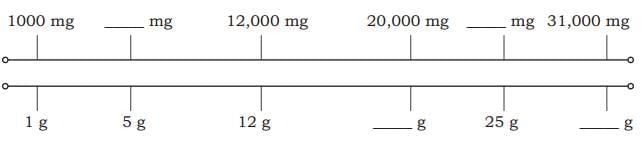 Ans:
Ans:
Q3: An ornament weighs 4 g 100 mg. What will be the weight in milligrams?
Ans: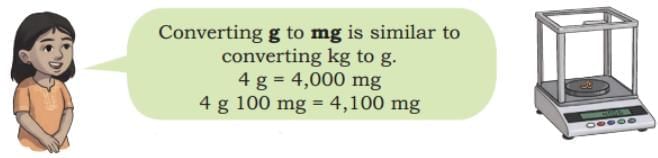
Q4: A goldsmith has made an ornament weighing 10 g 500 mg. What will its weight be in milligrams?
Ans:
1g = 1000 milligram
10 g = 10,000 mg
10 g 500 mg = 10,500 mg
Therefore, the weight of the ornament is 10,500 mg.
Q5: Compare the weights using <, =, > signs.
(a) 20 g ___________ 200 mg
Ans:
20 g = 20,000 mg
20,000 mg > 200 mg
20 g > 200 mg
(b) 16 g 50 mg ___________ 50 g 16 mg
Ans:
16 g < 50 g
16 g 50 mg < 50 g 16 mg
(c) 2,010 mg ___________ 2 g 100 mg
Ans:
2,010 mg = 2,000 mg + 10 mg
= 2 g 10 mg
Now, 2 g = 2 g but 10 mg < 100 mg
2,010 mg < 2 g 100 mg
(d) 9,000 mg ___________ 90 g
Ans:
9,000 mg = 9 g < 90 g
9,000 mg < 90 g
(e) 5,000 g ___________ 7,500 g
Ans:
5,000 g < 7,500 g
(f) 800 mg + 88 mg ___________ 880 mg + 8 mg
Ans:
800 mg + 88 mg = 888 mg,
880 mg + 8 mg = 888 mg
800 mg + 88 mg = 880 mg + 8 mg
Q6: Observe the pictures given below and fill in the blanks.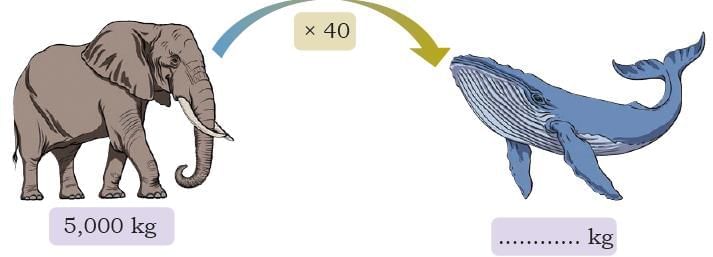 Ans:
Ans: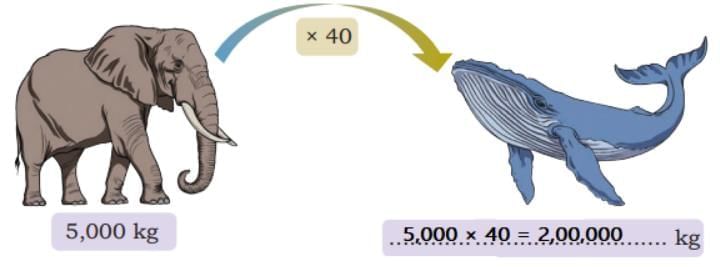
Q7: Answer the following questions.
(a) 5,000 kg = ____ quintals = ____ tonne
(b) 9,000 kg = ____ quintals
(c) ____ kg = 8 tonnes
Ans:
(a) 100 kg = 1 quintal
5,000 kg = 5,000/100 quintals
= 50 quintals
Also, 10 quintals = 1 tonne
50 quintal = 50/10 tonnes
= 5 tonne
Therefore, 5,000 kg = 50 quintals = 5 tonne
(b) 9,000 kg = 9,000/100 quintals
= 90 quintals
(c) 1 tonne = 1,000 kg
8 tonnes = 8 × 1,000 kg = 8,000 kg
Therefore, 8,000 kg = 8 tonnes.
King’s Weight
Q: In a kingdom, the king donates wheat grains equal to 10 times his weight on his birthday.
(a) If he donates 800 kg of wheat grain this birthday, what is his current weight?
Ans:
The king donates 800 kg of wheat grains on his birthday. It means 10 times the weight of the king this birthday is 800 kg. Therefore, 10 x king’s weight = 800 kg
So, king’s weight = 800/10 kg
= 80 kg
(b) If he had donated 780 kg of wheat grain on his last birthday, what was his weight last year?
Ans:
The king donated 780 kg of wheat grains on his last birthday. It means 10 times the king’s weight last year = 780 kg.
So king’s weight last year = 780/10 kg
= 78 kg
(c) How much weight did he gain in a year until this birthday?
Ans:
Weight gain = Weight of the king on this birthday – Weight of the king on last birthday
= 80 kg – 78 kg
= 2 kg
Page No. 111
Let Us Do
Q1: A restaurant owner uses 5 kg 200 g, 8 kg 900 g, and 12 kg 600 g of onions over 3 days. What is the total weight of onions used by the restaurant owner in 3 days?
Ans: Uses of onions on 1st day = 5 Kg 200 g
Uses of onions on 2nd day = 8 kg 900 g
Uses of onions on 3rd day = 12 kg 600 g
Total weight of the onions used in 3 days =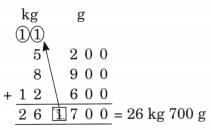
So, the total weight of the onions used by the restaurant owner in 3 days is 26 kg 700 g.
Q2: Aarav is helping his grandfather at the fruit stall. He lifts two baskets of apples weighing 2 kg 100 g and 3 kg 950 g. What is the total weight of apples he lifted?
Ans: First basket weight = 2 kg 100 g
Second basket weight = 3 kg 950 g
Total weight of two basket =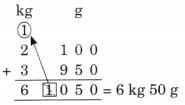
Therefore, the total weight of the apples Aarav lifted is 6 kg 50 g.
Q3: 4 kg 500 g of sand is used from a sack weighing 10 kg. How much sand is left in the sack?
Ans: Weight of the used sand = 4 kg 500 g
Total sand weight = 10 kg
Remaining sand weight =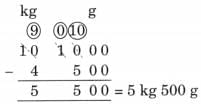
Therefore, 5 kg 500 g sand is left in the sack.
Q4: A rice sack weighs 9 kg 750 g. After some rice is used, it weighs 3 kg 700 g. How much rice was used?
Ans: Total weight of rice sack = 9 kg 750 g
Sack weight after used rice = 3 kg 700 g
Weight of used rice =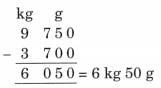
Therefore, 6 kg 50 g rice was used.
Q5: A delivery truck delivered 17 kg 900 g of supplies in the morning and 12 kg 700 g in the afternoon. How much total supplies did it deliver?
Ans: Weight of the delivered supplies in the morning = 17 kg 900 g
Weight of the delivered supplies in the afternoon = 12 kg 700 g
Weight of the total supplies delivered =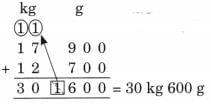
Therefore, the total supplies delivered by the delivery truck is 30 kg 600 g.
Q6: A box of books weighs 14 kg 750 g. After removing some books, the weight of the box is 10 kg 500 g. What is the weight of the books removed?
Ans: Weight of a box of books = 14 kg 750 g
Weight of a box after some books removed = 10 kg 500 g
Weight of the books removed =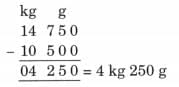
Therefore, the weight of the books removed is 4 kg 250 g.
Q7: In a community kitchen of a Gurdwara, 65 kg of flour was purchased on one day. Out of this, 42 kg 275 g flour was used for preparing langar. The next day, an additional 52 kg 500 g of flour was bought. What is the total quantity of flour now available in the kitchen store?
Ans: Weight of flour purchased = 65 kg
Weight of flour used in langar = 42 kg 275 g
Weight of flour purchased next day = 52 kg 500 g
Flour purchased + additional flour bought: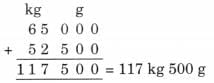
Flour now available in the kitchen store:
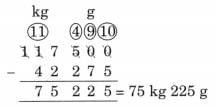
Therefore, the total flour available in the kitchen is 75 kg 225 g.
Page No. 112-114
Let Us Do
Q1: The cost of some grocery items is given in the following table. Find the total cost of each item.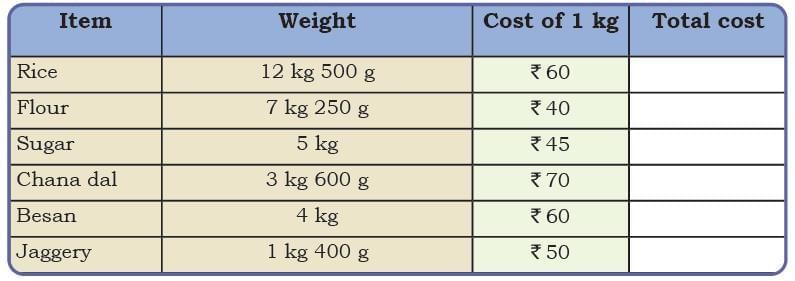 Ans:
Ans:
Rice: Cost of 12 kg = 12 × ₹ 60 = ₹ 720
Cost of lkg (1,000 g) = ₹ 60
Cost of 500 g = ₹ 30
Therefore, cost of 12 kg 500 g = ₹ 720 + ₹ 30
= ₹ 750
Flour: Cost of 7 kg = 7 × ₹ 40 = ₹ 280
Cost of 1 kg (250 g + 250 g + 250 g + 250 g)
= ₹ 40 (10 + 10 + 10 + 10)
Cost of 250 g = ₹ 10
Therefore, cost of 7 kg 250 g = ₹ 280 + ₹ 10
= ₹ 290
Sugar: Cost of 5 kg = 5 × ₹ 45 = ₹ 225
Chana dal: Cost of 3 kg = 3 × ₹ 70 = ₹ 210
Cost of 1 kg (1000 g) = ₹ 70
Cost of 100 g = ₹ 7
Cost of 600 g = 6 × ₹ 7 = ₹ 42
Therefore, cost of 3 kg 600 g = ₹ 210 + ₹ 42
= ₹ 252
Besan: Cost of 4 kg = 4 × ₹ 60 = ₹ 240
Jaggery: Cost of 1 kg (1000 g) = ₹ 50
Cost of 100 g = ₹ 5
Cost of 400 g = 4 ×₹ 5 = ₹ 20
Cost of 1 kg 400 g = ₹ 50 + ₹ 20 = ₹ 70
Hence, the complete table is: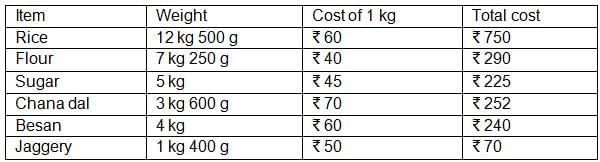
Q2: 4 people need 500 g rice for a meal. How much rice will be needed for 8 people if they eat similar quantity of rice?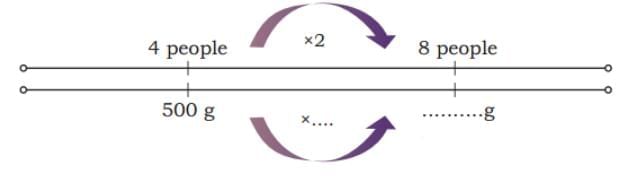 Ans:
Ans:
For 4 people, rice needed = 500 g
For 1 person, rice needed = 500/4 = 125 g
So, for 8 people, rice needed = 8 × 125 = 1000 g = 1 kg
Therefore, 8 people will need 1 kg of rice.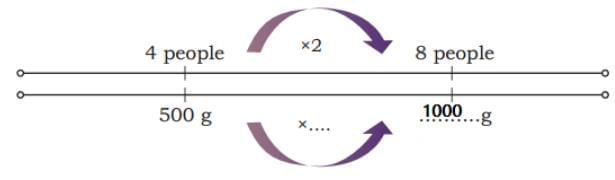
Q3: 5 kg of tomatoes cost ₹ 73. How much will 10 kg of tomatoes cost?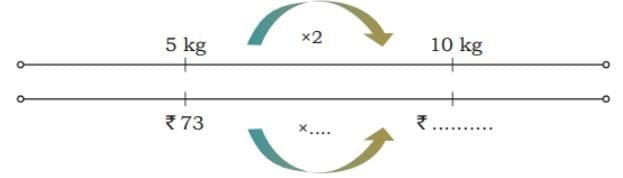 Ans:
Ans:
5 kg × 2 = 10 kg
₹ 73 × 2 = ₹ 146
10 kg of tomatoes will cost ₹ 146.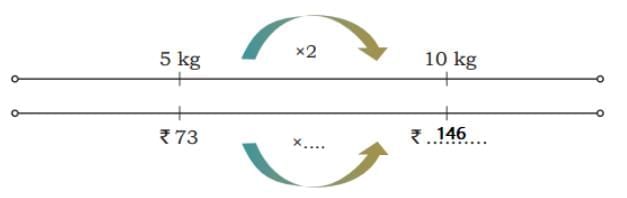
Q4: Nitesh is a scrap dealer. How much would he have paid for
(а) 16 kg of old newspaper, if he paid ₹ 8 for every 1 kg of newspaper?
Ans:
1 kg × 16 = 16 kg
₹ 8 × 16 = ₹ 128
Nitesh would have paid ₹ 128.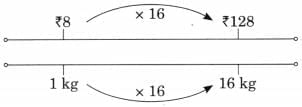
(b) 20 kg iron, if he paid ₹ 200 for every 10 kg of iron?
Ans:
10 kg × 2 = 20 kg
₹ 200 × 2 = ₹ 400
Nitesh would have paid ₹ 400.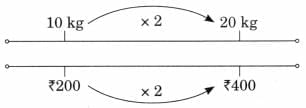
(c) 10 kg plastic, if he paid ₹ 30 for 5 kg of plastic?
Make double number lines for answering (b) and (c).
Ans:
5 kg × 2 = 10 kg
₹ 30 × 2 = ₹ 60
Nitesh would have paid ₹ 60.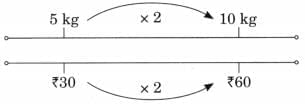
Measuring Capacity
Q1: You must have seen tea being prepared at your home. How much water and milk do we need to make 2 cups of tea?
Ans: We need 200 mL of water and 200 mL of milk to make 2 cups of tea.
Q: Do we need 1 litre of water to make 2 cups of tea?
Ans: No, we do not need 1L of water to make 2 cups of tea. It is too much.
Q: Is 500 mL of water enough for 2 cups of tea?
Ans: No, 500 mL of water is also too much for 2 cups of tea.
Q2: A bucket can hold a maximum of 20 mL of water. Is this statement correct? Which unit should be used in such a situation?
Ans:The statement is incorrect. We should use litres instead of mL in this situation because mL is a very small unit in the context of capacity of a bucket.
Big to Small, Small to Big
Q1: Ramiz brings a 500 mL water bottle to school. He drinks two bottles at school. How much water does he drink at school?
Ramiz drinks ____ mL + ____ mL = ____ mL.
Ramiz drinks ____ l of water in a day.
Ans: Capacity of 1 water bottle = 500 mL
So, the capacity of 2 water bottle = 500 mL + 500 mL = 1000 mL
Ramiz drinks 1000 mL/1 litre of water in a day.
Q2: Muskaan drinks 3 L of water in a day. How many times would she need to refill a 500 mL water bottle?
Ans: Capacity of water bottle = 500 mL
Total consumption of water in a day by Muskaan = 3 litres
Number of refills needed = 3,000 mL ÷ 500 mL = 6 times
Muskaan drinks 3,000 mL of water in a day.
Q3: Write the total capacity of the following containers in each blank.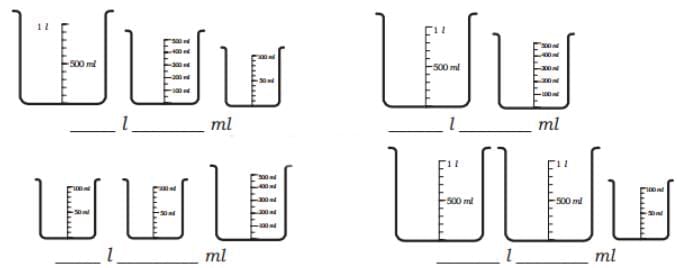 Ans: First Jug: 1 litre + 500 mL + 100 mL = 1 litre 600 mL
Second Jug: 1 litre + 500 mL = 1 litre 500 mL
Third Jug: 100 mL + 100 mL + 500 mL = 700 mL
Fourth Jug: 1 litre + 1 litre + 100 mL = 2 litres 100 mL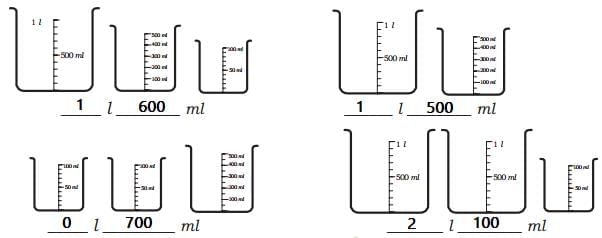
Different Units but Same Measure
The Milkman’s Delivery
Khayal chacha delivers fresh cow milk to homes. Bhalerao’s family orders 2 L of milk everyday. 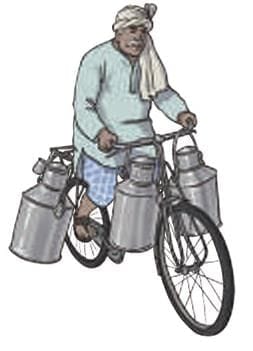
Q: This family has a vessel marked in mL only. What mark will you see in the vessel corresponding to 2 L?
Ans:
Q: Khayal chacha delivers the following amounts of milk each week to different families.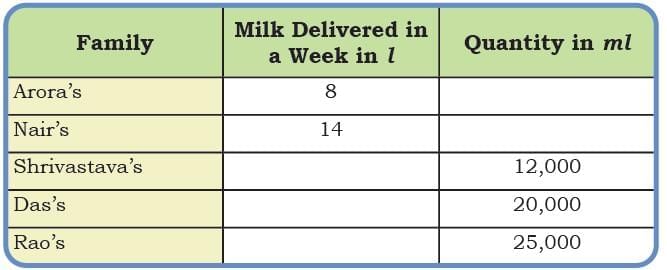 Ans:
Ans: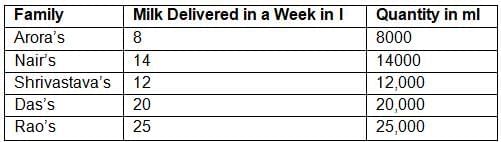
Page No. 115-116
Let Us Think
Q1: Mary and Daisy filled their bottle with 11 400 mL of water. They wondered about the capacity of the bottle in mL. How much is it?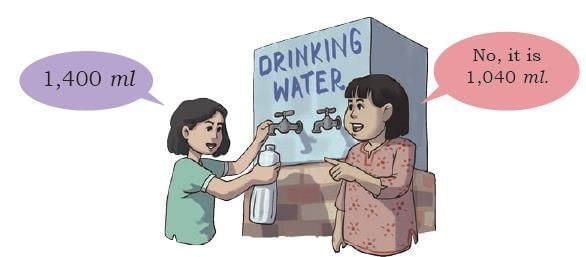 Who do you think is correct and why?
Ans:
1 L = 1000 mL
1L 400 mL = 1000 mL + 400 mL
= 1400 mL
Therefore, Mary is correct.
Q2: Convert and fill in the blanks appropriately. You can use the double number line given earlier.
(a) 3 L 8 mL = _____mL
(b) 9 L 90 mL = _____ mL
(c) 14,075 mL = ____L ____mL
(d) 8 L 86 mL = ____ mL
(e) 12,200 mL = ____L_____mL
(f) 18,350 mL = ____L ____mL
Ans:
(a) 3 L = 3,000 mL
3 L 8 mL = 3,008 mL
(b) 9 L = 9,000 mL
9 L 90 mL = 9,090 mL
(c) 14,075 mL = 14,000 mL + 75 mL
= 14L + 75 mL
14,075 mL = 14 L 75 mL
(d) 8L = 8,000 mL
8 L 86 mL = 8,086 mL
(e) 12,200 mL = 12,000 mL + 200 mL
= 12 L + 200 mL
12,200 mL = 12 L 200 mL
(f) 18,350 mL = 18,000 mL + 350 mL
= 18 L + 350 mL
18,350 mL = 18 L 350 mL
Let Us Compare
1. Kiran owns a petrol pump. She records the details of the sales of petrol in a day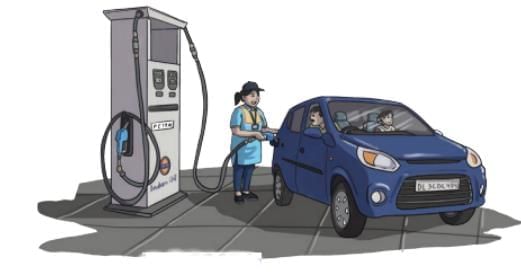
2.
(a) How much more fuel is bought for buses than for trucks?
(b) What is the total quantity of fuel filled from the petrol pump on that day?
Ans: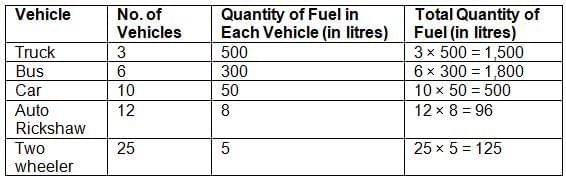
(a) Fuel bought for buses = 1,800 L
Fuel bought for trucks = 1,500L
Difference = 1,800 – 1,500 = 300
300 L more fuel is bought for buses than for trucks.
(b) The total quantity of fuel filled from the petrol pump on that day is:
1,500 L + 1800 L + 500 L + 96 L + 125 L
= 4,021 L
3. Compare the following quantities using the signs <, =, >.
(a) 5 L 600 mL ___________ 5,400 mL
Ans:
5 L 600 mL = 5000 mL + 600 mL
= 5,600 mL > 5,400 mL
5 L 600 mL > 5,400 mL
(b) 10 L 100 mL ___________ 1 L 600 mL
Ans:
10 L > 1 L
10 L 100 mL > 1 L 600 mL
(c) 190 mL + 800 mL ___________ 800 mL +109 mL
Ans:
800 mL = 800 mL and
190 mL > 109 mL
190 mL + 800 mL > 800 mL + 109 mL
(d) 3 l 600 mL ___________ 3,600 mL
Ans:
3 l 600 mL = 3000 mL + 600 mL
= 3600 mL
31 600 mL = 3600 mL
(e) 4 l 50 mL ___________ 4 l 500 mL
Ans:
4 L = 4L and 50 mL < 500 mL
4L 50 mL < 4L 500 mL
4. Sam and Tina fill petrol in their bikes. Tina bought 2 L 500 mL of petrol. Sam bought 2 L 800 mL more petrol than Tina. How much petrol did Sam buy?
Ans: Tina’s petrol = 2 L 500 mL = 2500 mL
Extra petrol Sam bought = 2 L 800 mL = 2800 mL
Sam’s petrol = 2500 mL + 2800 mL = 5300 mL
In litres: 5300 mL = 5L 300 mL
So, Sam bought 5L 300 mL of petrol.
Page No. 118
Let Us Solve
Q1: Riya is filling water bottles for a picnic. She fills one 2 L bottle and four 500 mL bottles. Her friend, Aarav fills three 750 mL bottles. Who filled more water, Riya or Aarav? How much more?
Ans:
Water filled in four 500 mL bottles is 4 × 500 mL = 2,000 mL = 2L
Total amount of water filled by Riya = 2L + 2L = 4L
Water filled by Aarav = 3 × 750 mL = 2,250 mL
= 2 L 250 mL
4L > 2L 250 mL
So, Riya filled more water.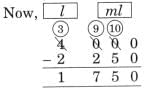
Therefore, Riya filled 1L 750 mL more water than Aarav.
Q2: A bottle of milk is poured equally into 8 glasses, leaving 120 mL of milk in the bottle.
(a) If each glass has a capacity of 360 mL, what is the total capacity of 8 glasses?
(b) How much milk was there in the bottle initially?
(c) If 1 l of milk costs ₹ 40, how much will 3 l milk cost?
Ans:
(a) Total capacity of 8 glasses
= 8 × 360 mL = 2,880 mL = 2L 880 mL
(b) The amount of milk in the bottle initially
= the total amount of milk poured in the glasses + the amount of milk left
= 2,880 mL + 120 mL
= 3,000 mL
= 3 L
(c) Cost of 1 l milk is = ₹ 40
Cost of 3 l milk = 40 × 3 = ₹120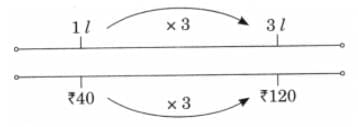
Q3: A juice vendor has a 5 l container of orange juice. Each glass has a capacity 250 mL.
(a) How many full glasses can he serve before the container becomes empty?
Ans:
1l = 1000 mL = 500 mL + 500 mL
= 250 mL + 250 mL + 250 mL + 250 mL
So, 4 full glasses can be served in 1L.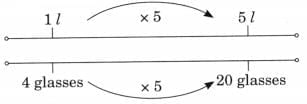
1 l × 5 = 5 l
4 glasses × 5 = 20 glasses
Therefore, he can serve 20 full glasses before the container becomes empty.
(b) If he has already served 10 glasses, how much juice is left?
Ans:
Total juice = 5000 mL
Juice in 10 glasses = 10 × 250 mL = 2500 mL
Juice left = 5000 mL – 2500 mL = 2L 500 mL
(c) If 250 mL of juice is sold at ₹25, how much will he earn by selling 5 L juice?
Ans:
We know that 20 × 250 mL = 5000 mL(5 l)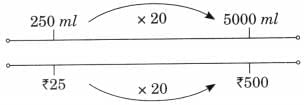
250 mL × 20 = 5000 mL
₹ 25 × 20 = ₹ 500
Therefore, he will earn ₹ 500 by selling 5 l juice.
Q4: In a factory, 8 L 400 mL of oil needs to be equally poured into 7 containers for storage. How much oil will each container hold?
Ans: Given:
- Total oil = 8 L 400 mL
- Number of containers = 7
We know that, 1 L = 1000 mL
So, 8 L = 8000 mL
⇒ 8 L 400 mL = 8000 + 400 = 8400 mL
8400 mL ÷ 7 = 1200 mL
Now, Convert back to litres and millilitres: 1200 mL = 1 L 200 mL
Q5: If one container can hold 1 L 75 mL of buttermilk, how much buttermilk will be there in 8 such containers?
Ans:
1 container x 8 = 8 containers
1L 75 mL × 8 = 1L × 8 + 75mL × 8
= 8 L + 600 mL = 8 L 600 mL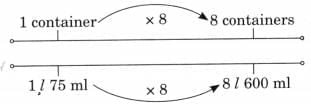
Therefore, 8 L 600 mL buttermilk will be there in 8 such containers.