Q1: ABCD is a parallelogram and AP and CQ are perpendiculars from vertices A and C on diagonal BD Which of the following is true based on given information (a) AP = CQ (b) QD = PB (c) DP = QB (d) ΔPAD ≅ ΔQCB Ans: (a, b, c, d)
Sol: All are correct In Triangle ΔPAD and ΔQCB AD = CB ∠P = ∠Q = 90º ∠CBQ = ∠ADP (Alternate interior angles of AB||CD) So AAS congruence Also as they are congruent, we get AP = CQ and DP = QB Now Let’s see the triangles ΔAPB and ΔCQD AB = CD ∠P = ∠Q = 90º (Alternate interior angles of AB||CD) So QD = PB
Q2: The angles of the quadrilateral are in the ratio 2 : 5 : 4 : 1? Which of the following is true? (a) Largest angle in the quadrilateral is 150º (b) Smallest angle is 30º (c) The second largest angle in the quadrilateral is 80º (d) None of these Ans: (a, b)
Sol: Angles are 2 x , 5 x , 4 x , x Now 2x + 5x + 4x + x = 360 Or x = 30 Angles are 30º, 60º, 120º, 150º
Q3: Two adjacent angles in a parallelogram are in the ratio 2 : 4. Find the values? (a) 80, 100 (b) 40, 140 (c) 60, 120 (d) None of the above Ans: (c)
Sol: Adjacent angles 2x + 4x = 180 x = 30 60, 120 are adjacent angles
Q4: ABCD is a trapezium with AB = 10cm, AD = 5 cm, BC = 4 cm and DC = 7 cm? Find the area of the ABCD (a) 34 cm2 (b) 28cm2 (c) 20 cm2 (d) None of these Ans: (a)
Sol: BC is the altitude between the two parallel sides AB and DC So Area of trapezium will be given by A = 1/2 BC (AB + DC) = 34cm2
Q5: ABCD is a trapezium where AB||DC. BD is the diagonal and E is the mid point of AD. A line is draw from point E parallel to AB intersecting BC at F. Which of these is true? (a) BF = FC (b) EA = FB (c) CF = DE (d) None of these Ans: (a)
Sol: Let’s call the point of intersection at diagonal as G Then in triangle DAB EG||AB and E is the mid point of DA, So by converse of Midpoint Theorem, G is the mid point of BD Now in triangle DBC GF||CD G is the mid point of DB So by converse of mid point theorem F is the mid point of BC
True or False
Q1: The diagonals of a parallelogram bisect each other. Ans: True. It is by definition
Q2: In a parallelogram, opposite sides and angle are equal. Ans: True. It is by definition
Q3: A diagonal of a parallelogram divides it into two congruent triangles. Ans: True. This can be proved easily using SSS congruence
Q4: The bisectors of the angles of parallelogram create a rectangle. Ans: True
Q5: Sum of all the internal angles is 360∘. Ans: True. This can easily proved by drawing one diagonal and summing all the angles based on triangle angle sum.
Q6: Sum of all the exterior angles is 180∘. Ans: False
Q7: Square, rectangle and rhombus are all parallelogram. Ans: True
Q8: Consecutive angles are supplementary. Ans: True
Answer the following Questions
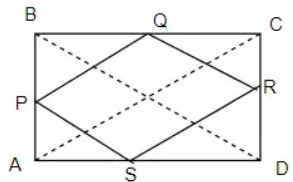
Q1: Show that the quadrilateral formed by joining the mid- points of adjacent sides of rectangle is a rhombus. Ans: The figure is shown as below
To Prove: quadrilateral PQRS is a rhombus Proof: In Δ ABC P and Q are mid points of sides AB and BC By Mid point theorem PQ = 1/2 AC and PQ || AC -(X) In Δ ACD S and R are mid points of sides AD and DC By Mid point theorem SR = 1/2 AC and SR || AC –(Y) From (X) and (Y), we have PQ = SR PQ ||SR Hence PQRS is a parallelogram Now in Δ BCD Q and R are mid points of sides BC and DC By Mid point theorem QR = 1/2 BD Nowe AC = BC Hence PQ = SR = QR Now a parallelogram whose adjacent sides are equal is a rhombus. Hence proved
Q2: P, Q, R and S are respectively the mid-point of sides AB, BC, CD and DA of a quadrilateral ABCD such that AC = BD. Prove that PQRS is a rhombus.
Ans: Given AC = BD Proof: In Δ ABC P and Q are mid points of sides AB and BC By Mid point theorem PQ = 1/2 AC and PQ || AC -(X) In Δ ACD S and R are mid points of sides AD and DC By Mid point theorem SR = 1/2 AC and SR || AC –(Y) From (X) and (Y), we have PQ = SR = 1/2 AC —-(1) Similarly in Δ BCD Q and R are mid point of BC and CD By Mid point theorem QR = 1/2 BD Similarly in Δ ADB S and P are mid point of AD and AB By Mid point theorem SP = 1/2 BD Therefore SP = QR = 1/2 BD —(2) AC = BD So from (1) and (2) PQ = SR = SP = QR Hence PQRS is a rhombus
Q3: l, m and n are three parallel lines intersected by transversal’s p and q such that l, m and n cut off equal intercepts AB and BC on p. Show that l, m and n cut off equal intercepts DE and EF on q also.
Ans: Given: AB = BC To Prove: DE = EF Proof: Let us join A to F intersecting m at G The trapezium ACFD is divided into two triangles namely Δ ACF and & Δ AFD In Δ ACF, it is given that B is the mid-point of AC (AB = BC) and BG || CF (since m || n). So, G is the mid-point of AF (by Mid Point Theorem) Now, in Δ AFD, we can apply the same argument as G is the mid-point of AF, GE || AD and so by by Mid Point Theorem, E is the mid-point of DF, i.e., DE = EF. In other words, l, m and n cut off equal intercepts on q also.
Q4. Find all the angles of a parallelogram if one angle is 80°.
Ans: For a parallelogram ABCD, opposite angles are equal.
So, the angles opposite to the given 80° angle will also be 80°.
It is also known that the sum of angles of any quadrilateral = 360°.
So, if ∠A = ∠C = 80° then,
∠A + ∠B + ∠C + ∠D = 360°
Also, ∠B = ∠D
Thus,
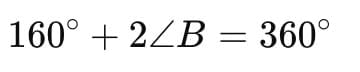
80° + ∠B + 80° + ∠D = 360°
Hence, 2∠B = ∠D = 200°/2
Now, all angles of the quadrilateral are found which are:
∠A = 80°
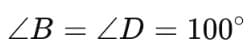
∠B = 100°
∠C = 80°
∠D = 100°
Q5: In a trapezium ABCD, AB//CD. Calculate ∠C and ∠D if ∠A = 55° and ∠B = 70°
Ans: In a trapezium ABCD, ∠A + ∠D = 180° and ∠B + ∠C = 180°
Given AC = BD
Given: