What is Gravitation?
The force responsible for objects falling towards Earth, the Moon orbiting Earth, and planets orbiting the Sun. Isaac Newton identified this as the universal gravitational force.
- Newton’s Insight: Newton hypothesised that the same force that causes an apple to fall also keeps the Moon in orbit around Earth. This force acts towards the centre, known as the centripetal force.
Centripetal Force
Centripetal force is what keeps objects moving in a circular path. It pulls objects towards the centre of the circle, helping them keep moving in that circular motion.
The Moon’s motion around Earth is due to the centripetal force provided by Earth’s gravitational attraction. Without this force, the Moon would move in a straight line.
Newton’s Third Law
- The Earth attracts an apple, and the apple attracts the Earth with an equal force (Newton’s Third Law).
- Due to the Earth’s significantly larger mass, its acceleration towards the apple is negligible, so we don’t observe the Earth moving towards the apple or the Moon.
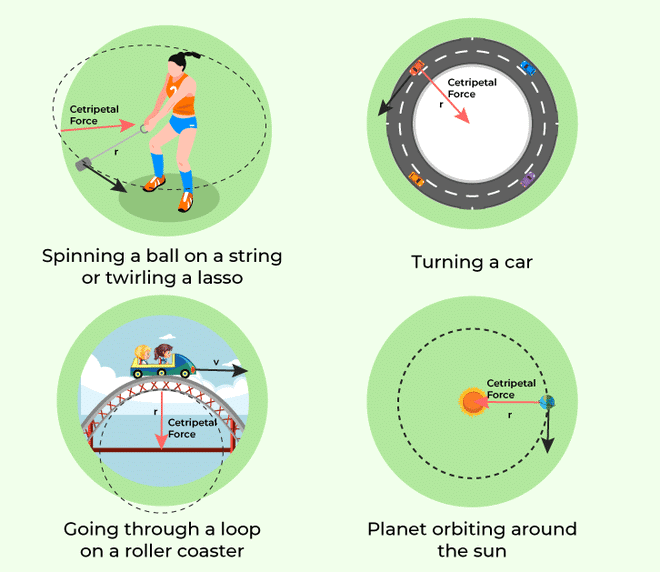 Examples of Centripetal Force
Universal Law of Gravitation
According to Newton’s law of gravitation, the force of gravitational attraction between two objects is directly proportional to the product of their masses and inversely proportional to the square of the distance between them.
This means:
- The gravitational force gets weaker as you go higher up.
- It also changes on the Earth’s surface, becoming weaker from the poles to the equator.
Formula: If M and m are the masses of two objects separated by a distance d, the gravitational force of attraction between them is given by:
F = G M m⁄d2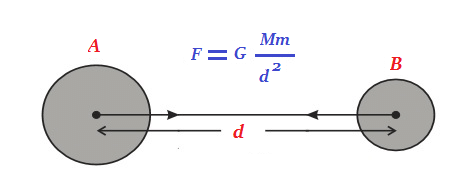
where G is a constant, known as the Universal constant of gravitation.
- The universal constant of gravitation G is numerically equal to the force of attraction between two objects of unit mass each separated by unit distance.
- The value of G is 6.673 x 10⁻¹¹ N m2 kg-2. This value was determined by Henry Cavendish (1731 – 1810) using a sensitive balance.
- G is called a universal constant because its value does not depend on the nature of the intervening medium or temperature, or other physical conditions
- As the value of G is extremely small, the gravitational force between regular objects is so small that it cannot be detected.
- However, the force of attraction acting on an object due to Earth, the force of attraction between Earth and the moon, and the force experienced by planets due to the gravitational attraction of the Sun can be easily felt and measured.
Try yourself:Which of the following statements is true according to the universal law of gravitation?
- A.The force of attraction between two objects depends on their masses and the distance between them.
- B.The value of the universal constant of gravitation depends on the nature of the intervening medium.
- C.The gravitational force between ordinary terrestrial objects is easily detected and measured.
- D.The value of the universal constant of gravitation is 9.8 m/s2.
Example 1: Suppose we have two objects: Object A with a mass of 5 kilograms and Object B with a mass of 10 kilograms. The distance between the centres of these objects is 2 meters. We’ll assume the gravitational constant, G, to be approximately 6.674 × 10⁻¹¹ N m2/kg2.
Solution:
Using the Universal Law of Gravitation, we can calculate the gravitational force between these objects:
F = (G * (m1 * m2)) / r2
F = (6.674 × 10⁻¹¹ N m2/kg2 * (5 kg * 10 kg)) / (2 m)2
F = (6.674 × 10⁻¹¹ N m2/kg2 * 50 kg2) / 4 m2
F ≈ 8.3425×10 −10N
Therefore, the gravitational force between Object A and Object B is approximately 8.3425×10 −10 Newtons.
Importance Of The Universal Law Of Gravitation
The universal law of gravitation explains various phenomena that were once thought to be unrelated:
- The force that keeps us grounded on Earth
- The moon’s orbit around the Earth
- This same force governs the planets’ movement around the Sun
- The tides caused by the moon and the Sun
Free Fall or Gravity
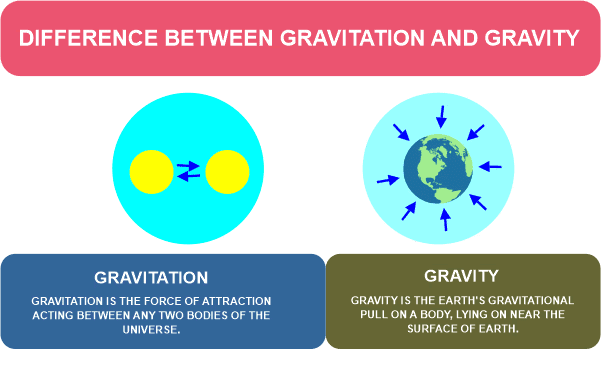
The force that pulls objects toward the Earth is known as the force of gravity.
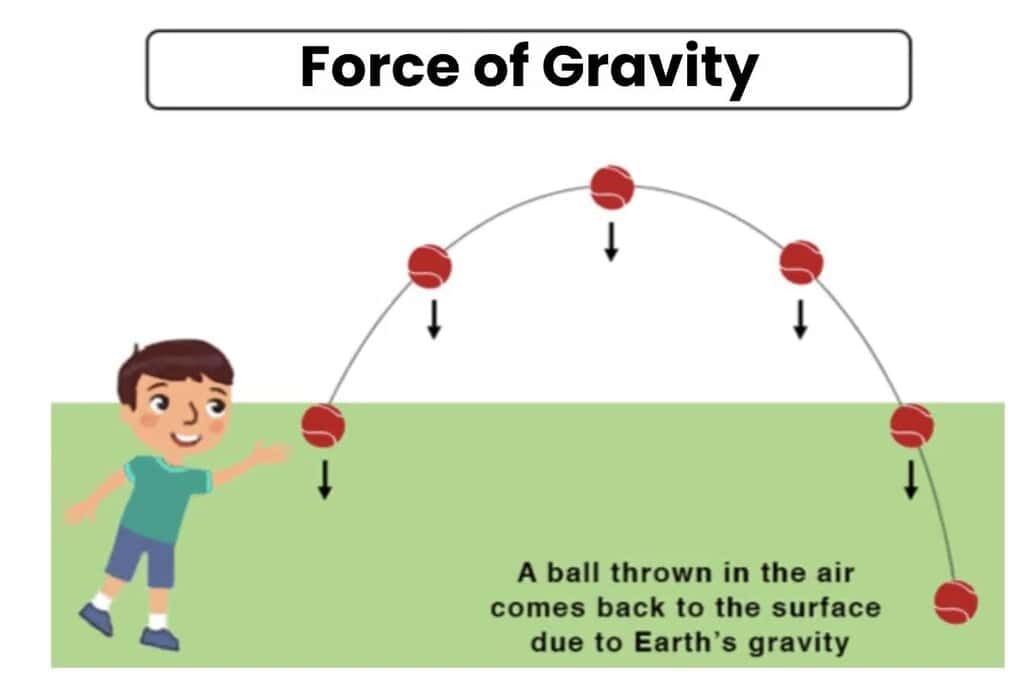
- For an object with mass m located on or near the Earth, this force can be calculated using the formula: F = GMm/R², where G is the universal gravitational constant, M is the mass of the Earth, and R is the radius of the Earth.
- The acceleration produced in a freely falling object on account of the force of gravity is known as the acceleration due to gravity. It is denoted by the symbol ‘g’.
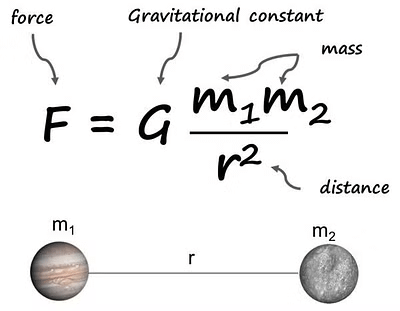 Gravitation Formula
To calculate the Value of g
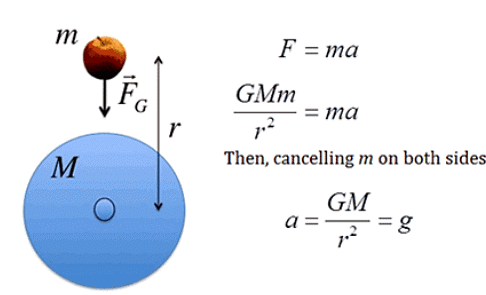
The acceleration due to gravity at Earth’s surface is given by the formula: g = GM/R². The average value of g on the surface of the Earth is about 9.8 m/s². To find g, we use these constants:
- G = 6.7 × 10⁻¹¹ N m²/kg² (Gravitational Constant)
- M = 6 × 10 24 kg (Mass of the Earth)
- R = 6.4 × 10⁶ m (Radius of the Earth)
- Here’s how the value of g is calculated.
Calculation of acceleration due to gravity

The motion of Objects under the influence of the Gravitational Force of the Earth
The value of g varies from place to place. On the surface of the earth value of g is more at the poles than at the equator. The value of g also decreases as one moves farther from the Earth.
 Free Fall Motion
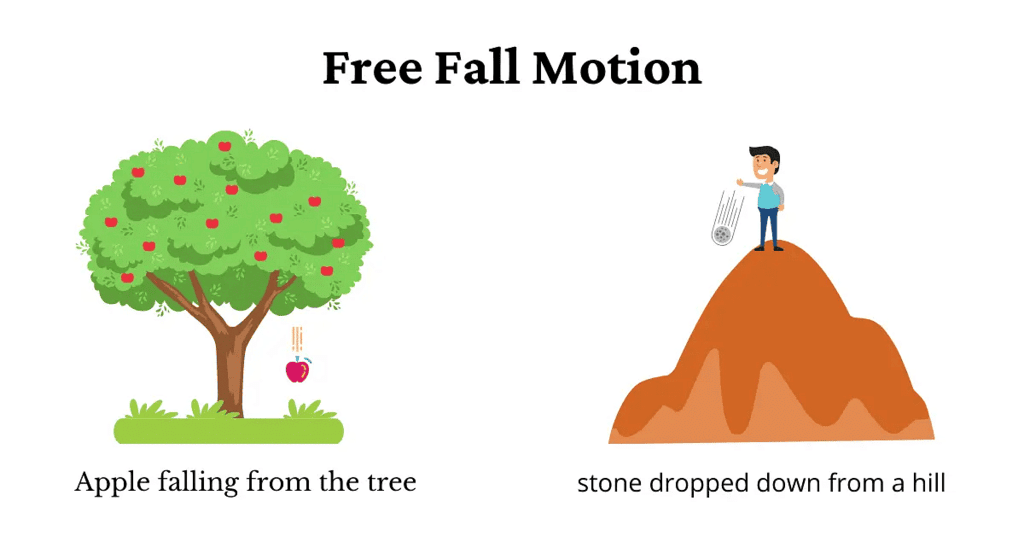
- When an object falls towards the Earth under the force of gravity alone, we say that the object is in free fall. A freely falling object experiences a constant acceleration of g (=9.8ms-2) during its downward motion.
- However, if an object is projected vertically upward with a certain velocity, its velocity goes on decreasing due to gravity, till it comes to rest and then starts falling vertically downward under gravity.
- To demonstrate the impact of air resistance on falling objects, try this activity:Activity: Drop a piece of paper and a stone from the same height at the same time. Check if both hit the ground together. You will notice that the paper takes longer to fall because of air resistance. In a vacuum, both would fall at the same speed.
- The three equations of motion, viz, (i) v = u + at, (ii) s = ut + 1/2 at2, and (iii) v2 – u2 = 2as, are true for the motion of objects under gravity. For free fall, the value of acceleration a = g = 9.8ms-2.
- If an object is just let fall from a height, then in that case u = 0 and a = +g = +9.8ms–2.
- If an object is projected vertically upwards with an initial velocity u, then a = -g = -9.8ms-2 and the object will go to a maximum height h where its final velocity becomes zero (i.e. v = 0). In such a case

Examples for the Three Equations of Motion Under Gravity
1. Using v = u+at:

2. Using s = ut + 1/2at2

2. Using v2−u2=2as:

Mass
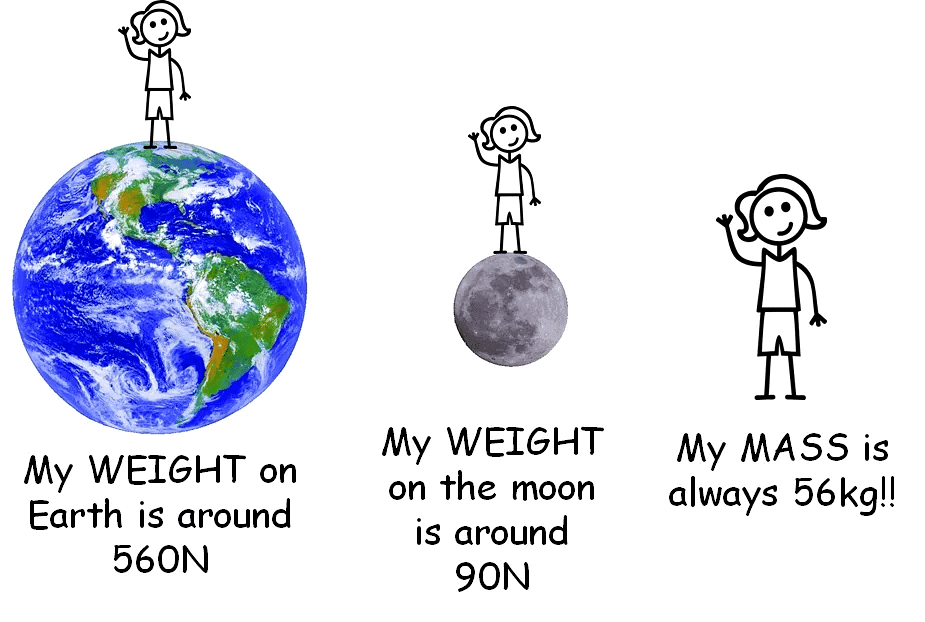
The mass of an object is a measure of its inertia. The mass of an object is constant and does not change from place to place. Greater mass means greater inertia, resisting changes in motion.
 Mass and Weight
Weight
- The weight of an object is the force with which it is attracted towards the Earth. The weight W of an object of mass m will be W = mg. Weight is a force acting vertically downwards. It means that it is a vector.
- As the weight of an object is a force, its SI unit is Newton (N).
An object of mass m = 1 kg has thus a weight of W = 1 x 9.8 = 9.8 N. - At a given place weight of an object is directly proportional to its mass, i.e,
 (at a given place). For this reason, at a given place, we may use the weight of an object as a measure of its mass.
Weight of Object on the Moon
- The mass of an object stays the same no matter where it is. This is important for understanding the difference between mass and weight. Weight is the force that pulls an object towards the Earth or the Moon.
- The force of gravity due to the moon is 1/6th of the force of gravity due to Earth.
Hence
Due to this very reason weight of an object on the moon will be 1/6th of its weight on Earth.
Try yourself:Question: Which of the following statements about weight is true?
- A.Weight is a measure of the amount of matter in an object.
- B.Weight is the force of gravity acting on an object.
- C.Weight is a constant property of an object and does not change.
- D.Weight is the same as mass.
Thrust and Pressure
The normal force acting on a surface, due to the weight of an object placed on the surface, is called ‘thrust’. As thrust is a sort of force hence its SI unit is “a newton” (N).
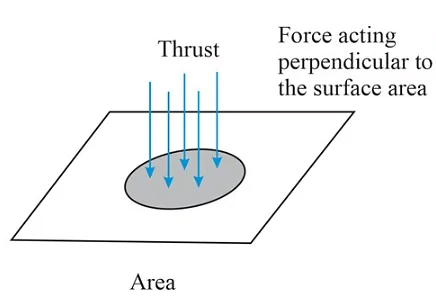 Thrust
- The thrust on unit surface area is called pressure.
Pressure
Thus, pressure on a given object is the normal force acting on its surface per unit surface area.
SI unit of pressure is N m-2, but it is also called pascal and denoted by the symbol Pa.
∴ 1 pascal (1 Pa) = 1 N m-2 - The same force acting on a smaller area exerts a larger pressure. It is due to this reason that a nail or a pin has a pointed tip, and knives have sharp edges.
- Given force acting on a larger area exerts a smaller pressure. It is due to this reason that the foundations of houses are made broad, the base of dams is made broad, sleepers are laid below the railway line and so on.
Pressure in Fluids
Fluid is that state of matter which can flow. All liquids and gases are fluids.
- Fluids have weight and exert pressure on the base and walls of their container.
- Any pressure in a confined fluid is transmitted equally in all directions.
- The SI unit of pressure is the pascal, abbreviated as Pa.
| Also read: Short & Long Answer Questions- Gravitation |
Buoyancy
- When an object is placed in a fluid, it feels a force pushing it upwards, known as upthrust or buoyant force. All objects experience this force when submerged in a fluid.
- The strength of the buoyant force depends on the fluid’s density, causing the object to rise when released.
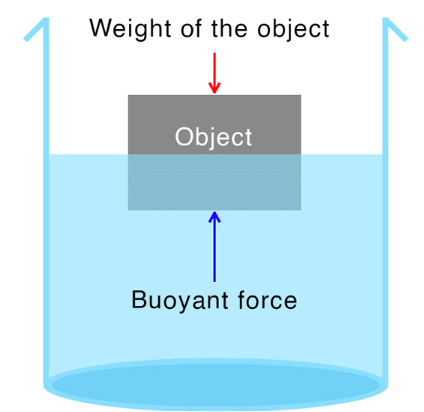 Buoyancy
Try yourself:What is the SI unit of weight?
- A.Newton (N)
- B.Kilogram (kg)
- C.Pascal (Pa)
- D.Meter (m)
Why Objects Float Or Sink When Placed On The Surface Of Water?
The ability of an object to float or sink in water depends on its density compared to the water’s density and the buoyant force acting on it. Density measures how much mass is in a certain volume.
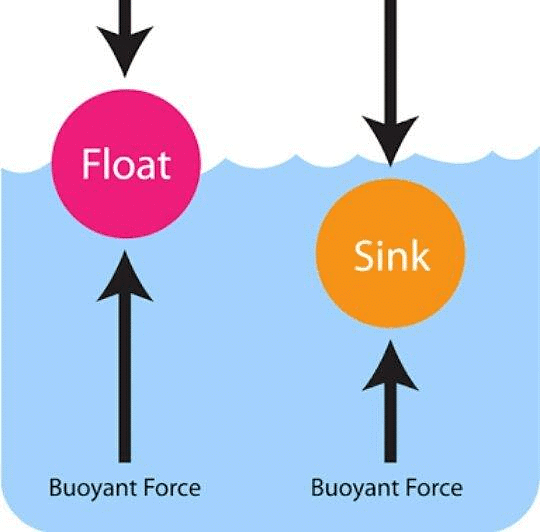
Floating and Sinking on Surface of Water
When an object is placed in water, it experiences two main forces: buoyancy and gravity.
- Buoyancy is the upward force on an object in a fluid, like water. This force arises from the pressure difference on the object’s top and bottom. According to Archimedes’ principle, the upward buoyant force equals the weight of the water displaced by the object. The more water the object displaces, the greater the buoyant force. If the object’s weight exceeds the buoyant force, it will sink; if the buoyant force is greater, it will float.
- The weight of an object is the result of its mass multiplied by the acceleration due to gravity. While weight can change depending on location, the mass remains constant.
In summary, whether an object floats or sinks in water depends on the comparison between its weight and the buoyant force exerted by the water. If the object’s weight is greater, it will sink. If the buoyant force is greater, it will float.
Archimedes’ Principle
A Greek scientist Archimedes found a principle about buoyant force, which is the reduction in weight of an object when it is placed in a fluid. He realised this after he saw water spill from a bathtub when he got in. He ran through the streets shouting “Eureka!”, which means “I have found it”.
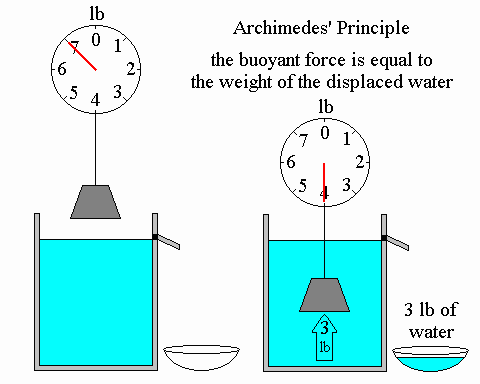
Archimedes’ Principle
- According to Archimedes’ principle, “when an object is fully or partially placed in a fluid, it feels an upward force equal to the weight of the fluid it displaces.”
- This principle has many uses, like in designing ships and submarines. It is also the basis for lactometers, which check the purity of milk, and hydrometers, which measure the density of liquids.
Try yourself:Archimedes’ principle states that:
- A.The buoyant force on an object is equal to the weight of the fluid displaced by the object
- B.The buoyant force on an object is equal to the volume of the fluid displaced by the object
- C.The buoyant force on an object is equal to the mass of the fluid displaced by the object
- D.The buoyant force on an object is equal to the density of the fluid displaced by the object