Multiple Choice Questions (MCQs)
Instruction: Select the correct option for each question.
 Which mirror makes objects appear smaller but gives a wider field of view?
a) Plane mirror
b) Concave mirror
c) Convex mirror
d) Two-way mirror
Answer: c) Convex mirror
Convex mirrors always form erect, diminished images and cover a wider area—used as side-view mirrors.- Looking at the inner (curved inward) side of a shiny spoon, your face appears:
a) Erect and diminished
b) Inverted (upside down)
c) Erect and same size
d) Erect and magnified at all distances
Answer: b) Inverted (upside down)
The inner side behaves like a concave mirror, forming inverted images when the object is farther. - The warning “Objects in mirror are closer than they appear” is written because a convex mirror:
a) Inverts images
b) Forms enlarged images
c) Forms diminished images
d) Does not follow reflection laws
Answer: c) Forms diminished images
Diminished (smaller) images make objects seem farther than they are. - Which statement about a concave mirror is correct?
a) Always forms erect images
b) Always forms diminished images
c) Can form enlarged erect images when object is close
d) Never focuses light
Answer: c) Can form enlarged erect images when object is close
Concave mirrors give enlarged erect images at small distances; inverted images when farther. - First law of reflection states:
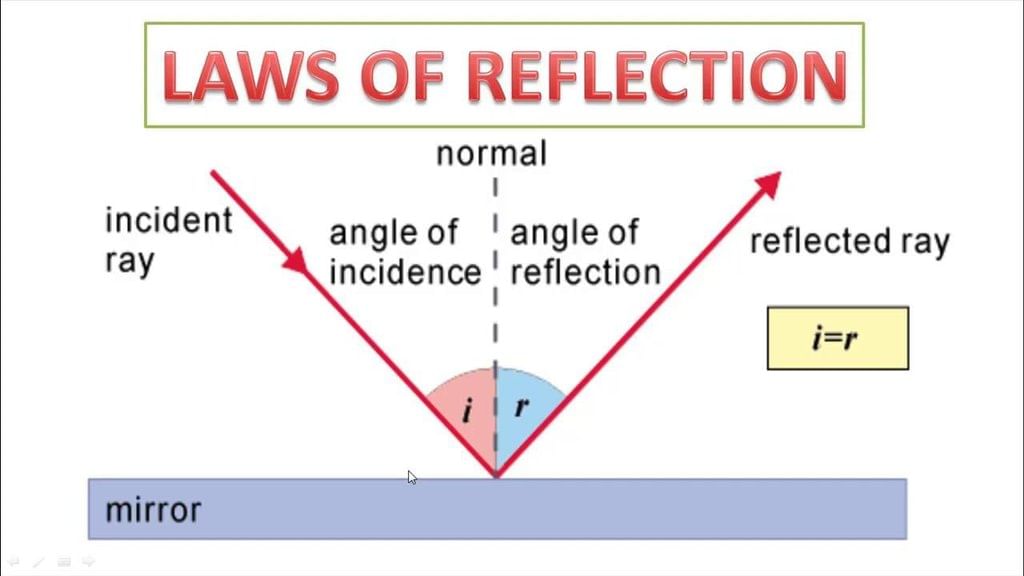
a) i + r = 90°
b) i = r
c) i > r
d) i < r
Answer: b) i = r
Angle of incidence equals angle of reflection for all mirrors.
Fill in the Blanks
Instruction: Fill in the blanks with the correct word based on the chapter.
- A concave mirror can form an __________ image when the object is very close.
Answer: enlarged (erect)
Close objects appear bigger and upright. - A convex mirror always forms an __________ and __________ image.
Answer: erect; diminished
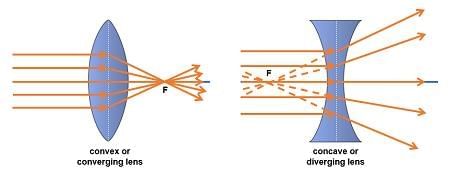
Hence its use in vehicle mirrors for wider view. - A convex lens is thicker at the __________ than at the edges.
Answer: middle
Convex lenses converge light. - A concave lens is a __________ lens because it spreads light rays apart.
Answer: diverging
Rays move away after passing through it. - The human eye contains a __________ lens that changes shape to focus.
Answer: convex
It accommodates to view near and far objects.
Very Short Answer Questions
Instruction: Answer the following questions in one line.
- Why do vehicle side-view mirrors use convex mirrors?
Answer: They give a wider field of view and form erect, smaller images. - What is lateral inversion?
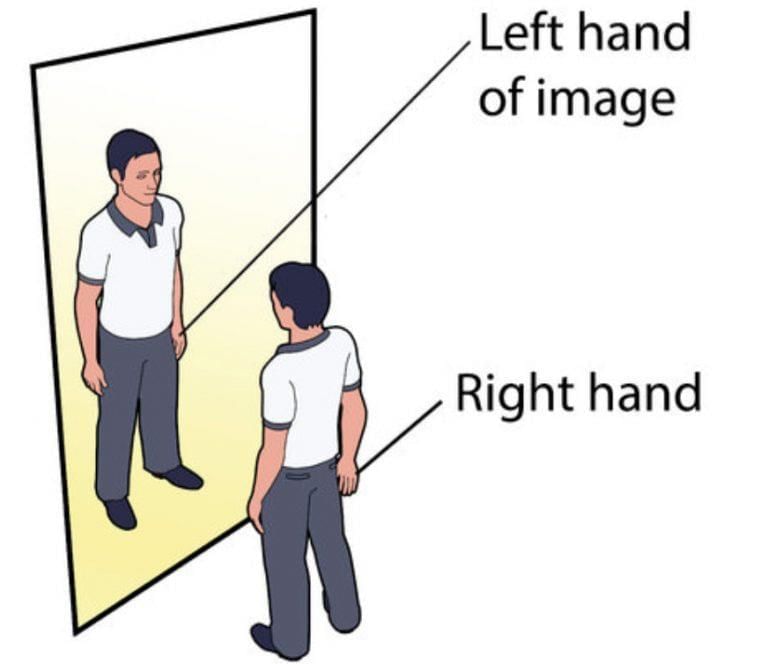
Answer: Left–right reversal seen in mirror images. - State the two laws of reflection in words.
Answer: i = r; and incident ray, normal, reflected ray lie in the same plane. - Which mirror can focus sunlight onto paper?
Answer: Concave mirror (it converges parallel rays). - Which lens always gives an erect and diminished image?
Answer: Concave lens.
Lateral Inversion
Short Answer Questions
Instruction: Answer the following questions in 2–3 lines.
- How does a concave mirror’s image change as the object moves away?
Answer: Very close: image is erect and enlarged. Farther away: image becomes inverted and its size decreases with distance. - Why do convex mirrors make objects seem farther away?
Answer: They form diminished images, so objects look smaller and therefore appear farther—hence the safety warning on vehicle mirrors. - Explain why a convex lens can burn paper but a concave lens cannot.
Answer: A convex lens converges sunlight to a sharp, hot point; a concave lens diverges light and cannot focus it to ignite paper. - How do we know the laws of reflection apply to spherical mirrors?
Answer: Each incident ray still reflects with i = r and stays in the same plane; the curvature only changes the overall direction (convergence/divergence) of reflected rays. - What images do concave and convex lenses form at various distances?
Answer: Convex lens: erect enlarged when close; inverted and varying size when farther. Concave lens: always erect and diminished.
Match the Following
Instruction: Match Column A with the correct option in Column B.Column AColumn B1) Concave mirrora) Erect, diminished image at any distance (diverges rays)2) Convex mirrorb) i = r3) Convex lensc) Converges parallel rays to a point; can burn paper4) Concave lensd) Erect, diminished image; wider field of view5) First law of reflectione) Enlarged erect image when close; inverted when far
Correct Matches:
- Concave mirror — e) Enlarged erect image when close; inverted when far
Explanation: Image nature depends on object distance. - Convex mirror — d) Erect, diminished image; wider field of view
Explanation: Hence used in vehicle mirrors and at turns. - Convex lens — c) Converges parallel rays to a point; can burn paper
Explanation: Acts as a converging lens focusing sunlight. - Concave lens — a) Erect, diminished image at any distance (diverges rays)
Explanation: Always produces smaller, upright images. - First law of reflection — b) i = r
Explanation: Angle of incidence equals angle of reflection.