Previous Year Questions 2025
Q1: In the given figure, PA is a tangent from an external point P to a circle with centre O. If ∠POB = 115°, then ∠APO is equal to:
(a) 25°
(b) 65°
(c) 90°
(d) 35°
Ans: (a)
∠POB + ∠POA = 180 (Linear Pair)
⇒ 115° + ∠POA = 180° (∵ ∠POB = 115°)
⇒ ∠POA = 180° – 115° = 65°
Now, OA ⊥ PA (∵ Tangent at any point of a circle is perpendicular to the radius through the point of contact)
⇒ ∠PAO = 90°
In ΔPOA,
∠PAO + ∠AOP + ∠APO = 180°
⇒ 90° + 65° + ∠APO = 180°
⇒ ∠APO = 180° – 90° – 65° = 25°.
Q2: In the adjoining figure, TS is a tangent to a circle with centre O. The value of 2x° is
(a) 22.5°
(b) 45°
(c) 67.5°
(d) 90°
Ans: (b)
Since, TS is a tangent of circle.
∴ OS ⊥ ST (∵ Tangent is perpendicular to the radius at the point of contact)
∴ ∠OST = 90°
In ΔOST, ∠OST + ∠STO + ∠SOT = 180°
⇒ 3x° + x° + 90° = 180° ⇒ 4x° = 90° ⇒ 2x° = 45°
Q3: In the given figure, PB is a tangent to the circle with centre O at B. AB is a chord of the circle of length 24 cm and at a distance of 5 cm from the centre of the circle. If the length PB of the tangent is 20 cm, find the length of OP.
Ans:
Given, length of chord AB= 24 cm,
OM = 5 cm, length of tangent PB = 20 cm 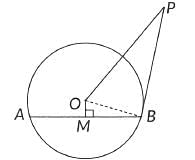
Construction: Join OB.
To find: Length of OP.
Since OM ⊥ AB, M is mid point of AB.
MB = 1/2 AB = 24/2 = 12 cm
In right triangle OMB, using Pythagoras theorem
OB² = OM² + MB²
⇒ OB² = 5² + (12)² = 169
⇒ OB = 13 cm
As, BP is a tangent to circle at B, OB ⊥ BP. So, in right triangle OBP, using Pythagoras theorem
OP² = PB² + OB²
⇒ OP² = (20)² + (13)²
⇒ OP² = 400 + 169 = 569
⇒ OP = √569 cm
Q4: In the given figure, PC is a tangent to the circle at C. AOB is the diameter which when extended meets the tangent at P. Find ∠CBA and ∠BCO, if ∠PCA = 110°.
Ans: 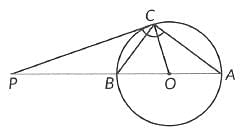
Given, PC is a tangent to the circle at C.
∴ OC ⊥ PC (·.· Tangent at any point of a circle is perpendicular to the radius through point of contact.)
⇒ ∠OCP = 90°
Now, ∠PCA = ∠OCP + ∠ACO
⇒ 110° = 90° + ∠ACO
[∵ ∠PCA = 110° (Given)]
⇒ ∠ACO = 110° – 90° = 20°
In ΔOAC, OA = OC (Radii of circle)
∴ ∠OAC = ∠OCA = 20°
∴ ∠AOC = 180° – 20° – 20° = 140°
∠BOC + ∠AOC = 180° (Linear pair)
⇒ ∠BOC = 180° – 140° = 40°
In ΔBOC,
∠BOC + ∠CBO + ∠BCO = 180°
⇒ 40° + ∠CBO + ∠BCO = 180° [∵ OB = OC (Radii of circle) ∴ ∠CBO = ∠BCO]
⇒ 2∠BCO = 140° ⇒ ∠BCO = 70°
∴ ∠CBA = 70°
Q5: In the given figure, O is the centre of the circle and BCD is tangent to it at C. Prove that ∠BAC + ∠ACD = 90°.
Ans: 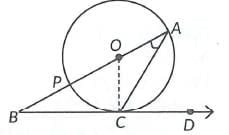 As OC ⊥ BD
[∵ tangent at any point of a circle is perpendicular to radius through point of contact]
Also, OC = OA [Radii of circle]
∴ ∠OAC = ∠OCA [Angles opposite to equal sides are equal]
Now, ∠OCO = 90°
⇒ ∠OCA + ∠ACD = 90°
⇒ ∠BAC + ∠ACD = 90°
Q6: If tangents PA and PB drawn from an external point P to the circle with centre O are inclined to each other at an angle of 80° as shown in the given figure, then the measure of ∠POA is
(a) 40°
(b) 50°
(c) 60°
(d) 80°
Ans: (b)
Given, PA and PB are two tangents drawn from external point P. Also, given ∠APB = 80°. We know that tangents are perpendicular to the radius through the point of contact.
∴ ∠OAP = ∠OBP = 90°
Since, OP is angle bisector of ∠APB.
In ΔPAO, we have ∠APO + ∠OAP + ∠POA = 180°
⇒ 40° + 90° + ∠POA = 180°
⇒ 130° + ∠POA = 180°
⇒ ∠POA = 180° – 130° = 50°
Q7: Assertion (A): If two tangents are drawn to a circle from an external point, then they subtend equal angles at the centre of the circle.
Reason (R): A parallelogram circumscribing a circle is a rhombus.
(a) Both Assertion (A) and Reason (R) are true and Reason (R) is the correct explanation of the Assertion (A).
(b) Both Assertion (A) and Reason (R) are true, but Reason (R) is not the correct explanation of the Assertion (A).
(c) Assertion (A) is true, but Reason (R) is false.
(d) Assertion (A) is false, but Reason (R) is true.
Ans: (b)
Q8: In the adjoining figure, PA and PB are tangents to a circle with centre O such that ∠P = 90°. If AB = 3√2 cm, then the diameter of the circle is
(a) 3√2 cm
(b) 6√2 cm
(c) 3 cm
(d) 6 cm
Ans: (d)
Given, ∠P = 90°, AB = 3√2 cm.
PA and PB are tangents.
So, ∠OBP = ∠OAP = 90° and ∠P = 90° ⇒ ∠O = 90°.
⇒ ∠APB is a square.
Since, AB = OA √2
⇒ 3√2 = OA √2 ⇒ OA = 3
⇒ Diameter = 2, OA = 2 × 3 = 6 cm
Q9: For a circle with centre O and radius 5 cm, which of the following statements is true?
P: Distance between every pair of parallel tangents is 5 cm.
Q: Distance between every pair of parallel tangents is 10 cm.
R: Distance between every pair of parallel tangents must be between 5 cm and 10 cm.
S: There does not exist a point outside the circle from where length of tangent is 5 cm.
(a) P
(b) Q
(c) R
(d) S
Ans: (b)
Since, parallel tangents are drawn at the end points of the diameter of the circle.
⇒ Distance between a pair of parallel tangents
= diameter of circle = 2 x 5 = 10 cm
Only, statement ‘Q’ is correct.
Q10: A person is standing at P outside a circular ground at a distance of 26 m from the centre of the ground. He found that his distances from the points A and B on the ground are 10 m (PA and PB are tangents to the circle). Find the radius of the circular ground.
Ans:
QA ⊥AP
[∵ Tangent at any point of a circle is perpendicular to radius thought point of contact]
∴ AOP is a right angle triangle
Using Pythagoras theorem,
OP2 = OA2 + AP2 ⇒ (26)2 = OA2 + (10)2
⇒ OA2 = 676 – 100 = 576 ⇒ OA = 24 m
So, radius of circular ground is 24 m.
Q11: Prove that the tangents drawn at the ends of a diameter of a circle are parallel.
Ans:
Given: A circle C(O, r) with diameter PQ.
Let AB and CD are two tangents drawn to the circle at point P and Q.
To prove: AB || CD
Proof: Since, tangent at a point to a circle is perpendicular to the radius through the point of contact.
∴ PQ ⊥ AB and PQ ⊥ CD
∠APO = ∠DQO = 90°
⇒ ∠APQ = ∠DQP (Alternate angles)
∴ AB || CD.
Q12: Prove that opposite sides of a quadrilateral circumscribing a circle subtend supplementary angles at the centre of the circle.
Ans:
Given: ABCD is a quadrilateral circumscribing a circle whose sides AB, BC, CD and DA touches the circle at P, Q, R and S respectively.
To prove: ∠AOB + ∠COD = 180° and ∠BOC + ∠ADD= 180°
Construction: Join OP, OQ, OR and OS.
Proof: Since we know that tangents drawn from an external point to a circle subtend equal angles at the centre.
∴ ∠1 = ∠2,
∠3 = ∠4,
∠5 = ∠6 and
∠7 = ∠8
Now, ∠1 + ∠2 + ∠3 + ∠4 + ∠5 + ∠6 + ∠7 + ∠8 = 360°
[Sum of all angles around a point is 360°]
⇒ 2(∠2 + ∠3 + ∠6 + ∠7) = 360° and
2(∠1 + ∠8 + ∠4 + ∠5) = 360°
⇒ (∠2 + ∠3) + (∠6 + ∠7) = 180°
⇒ (∠1 + ∠8) + (∠4 + ∠5) = 180°
⇒ ∠AOB + ∠COD = 180° and ∠AOD + ∠BOC = 180°
Q13: In the adjoining figure, TP and TQ are tangents drawn to a circle with centre O. If ∠OPQ = 15° and ∠PTQ = θ, then find the value of sin 2θ.
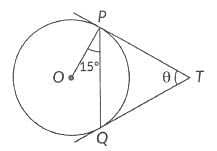
Ans:
We have, ∠OPT = 90°
[∵ OP is radius and PT is tangent]
⇒ 15° + ∠QPT = 90° ⇒ ∠QPT = 90° – 15°
⇒ ∠QPT = 75°
∴ ∠TQP = ∠QPT = 75° [∵ TP = TQ]
In ΔTPQ,
∠PTQ = 180° – ∠TPQ – ∠TQP = 180° – 75° – 75° = 30°
⇒ θ = 30°
∴ sin 2θ = sin 60° = √3/2
Previous Year Questions 2024
Q1: The maximum number of common tangents that can be drawn to two circles intersecting at two distinct points is:
(1 Mark) (CBSE 2024)
(a) 4
(b) 3
(c) 2
(d) 1
Ans: (c)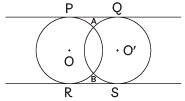 Here, circle with centre O and O’ are intersecting at two distinct points A and B. So, in this situation PQ, RS are the tangents which can be drawn.
Q2: In the given figure, O is the centre of the circle. MN is the chord and the tangent ML at point M makes an angle of 70° with MN. The measure of ∠MON is: (1 Mark) (CBSE 2024)
(a) 120º
(b) 140º
(c) 70º
(d) 90º
Ans: (b)
OM ⊥ ML [as tangent from centre is ⊥ at point of contact]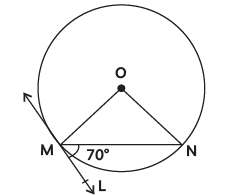
∠OML = 90º (∵ The angle between a tangent and a radius at the point of contact is always 90º)
and ∠NML = 70º
⇒ ∠OMN + ∠NML = 90º
⇒ ∠OMN = 90º – 70º = 20º
∵ OM = ON = Radii of same circle
∴ ∠OMN = ∠ONM = 20º (Angle opposite to equal sides are equal)
In ∆MON,
∠OMN + ∠ONM + ∠MON = 180º
⇒ 20º + 20º + ∠MON = 180º
⇒ ∠MON = 140º
Q3: In the given figure, if PT is tangent to a circle with centre O and ∠TPO = 35º, then the measure of ∠x is (1 Mark) (CBSE 2024)
(a) 110º
(b) 115º
(c) 120º
(d) 125º
Ans: (d)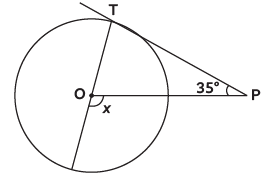 ∠OTP = 90º [Line from centre is ⊥ to tangent at point of contact]
∠x = ∠TPO + ∠OTP [Exterior Angle Property]
x = 35º + 90º = 125º
Previous Year Questions 2023
Q1: In the given figure, PT is a tangent at T to the circle with centre O. If ∠TPO = 25°, then x is equal to:
(a) 25°
(b) 65°
(c) 90°
(d)115° (1 Mark) (CBSE 2023)
Ans: (d)
Since tangent is perpendicular to radius at the point of contact.
∴ ∠PTO = 90°
Hence, by the exterior angle formula, in ΔOTP, we get x = 90° + 25°
= 115°
Q2: In the given figure, PQ is tangent to the circle centred at O. If ∠AOB = 95o, then the measure of ∠ABQ will be (1 Mark) (2023)
(a) 47.5°
(b) 42.5°
(c) 85°
(d) 95°
Ans: (a)
We have ∠AOB = 95°
In ΔAOB, ∠OAB = ∠OBA (Angle opposite to equal sides are equal)
Now, ∠OAB + 95° + ∠OBA =180° (Angle sum property of a triangle)
= 2∠OAB = 85° 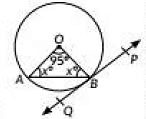
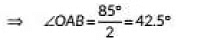
∴ ∠OAB = ∠OBA = 42.5° [From (i)]
Now, OB is perpendicular to the tangent line PQ
∠OBQ = 90°
∠ABQ + ∠OBA = ∠OBQ = 90°
∠ABQ = 90° – 42.5°
= 47.5°
Q3: In the given figure. TA is tangent to the circle with centre O such that OT = 4 cm, ∠OTA= 30o, then the length of TA is
(1 Mark)(2023)
(a) 2√3 cm
(b) 2cm
(c) 2√2 cm
(d) √3 cm
Ans: (a)
Draw OA ⊥ TA.
In ΔOTA,
∠OAT = 90° [∵ Tangent to a circle is perpendicular to the radius passing through the point of contact]
and ∠OTA = 30°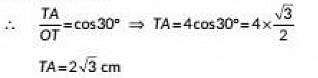
Q4: In the figure, from an external point P, two tangents PQ and PR are drawn to a circle of radius 4 cm with centre O. If ∠QPR= 90°. then the length of PQ is (1 Mark) (2023)
(a) 3 cm
(b) 4 cm
(c) 2 cm
(d) 2√2 cm
Ans: (b)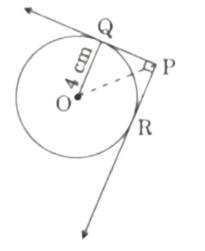
Draw a line segment joining the points R and O
Now OQ and OR are equal (Radii of a circle)
∠QPR = 90° (Given)
And ∠OQP = ∠ORP = 90° (Tangents make 90 degree angle with radius)
Now, in Quadrilateral PQOR
Sides OQ = OR (Radii)
and PR = PQ (Tangents from same point)
And ∠QPR = ∠PRO = ∠PQO = 90°
Therefore, Quadrilateral PQOR is a square.
Since, all sides of a square are equal,
⇒ OR = RP = PQ = OQ = 4 cm
Hence, length of PQ is 4 cm.
Q5: The length of tangent drawn to a circle of radius 9 cm from a point 41 cm from the centre is (1 Mark) (2023)
(a) 40 cm
(b) 9 cm
(c) 41 cm
(d) 50 cm
Ans: (a)
OB ⊥ AB [∵As tangent to a circle is perpendicular to the radius through the point of the contact]
In ΔOAB,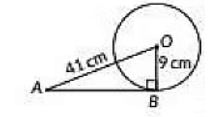
OA2 = OB2 + AB2 [By Pythagoras theorem]
⇒ (41)2 = 92 + AB2
⇒ AB2 = 412 – 92
= (41 – 9)(41 + 9)
= (32)(50)
= 1600
⇒ AB = 
= 40 cm
Q6: In the given figure. O is the centre of the circle and PQ is the chord. If the tangent PR at P makes an angle of 50° with PQ, then the measure of ∠POQ is (1 Mark) (2023)
(a) 50°
(b) 40°
(c) 100°
(d) 130°
Ans: (c)
PR is tangent which touches circle at point P.
So, ∠OPR = 90°
∠OPQ = 90° – ∠RPQ = 90° – 50° = 40°
In, ΔPOQ,
OP = OQ (Radii of circle)
So, ∠OQP = ∠OPQ=40°
⇒ ∠POQ = 180° – 40° – 40° = 100°
Q7: Case Study: The discus throw is an event in which an athlete attempts to throw a discus. The athlete spins anti-clockwise around one and a half times through a circle, then releases the throw. When released, the discus travels along the tangent to the circular spin-orbit.
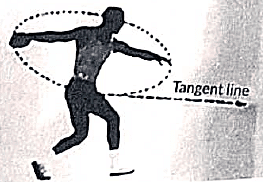
In the given figure, AB is one such tangent to a circle of radius 75cm. Point O is the centre of the circle and ∠ABO = 30°. PQ is parallel to OA.
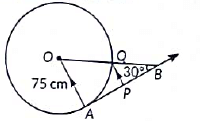
Based on the above information
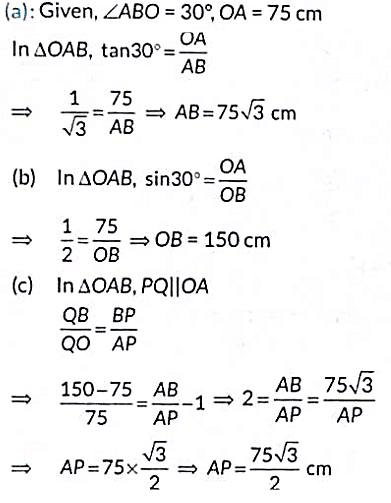
(a) Find the length of AB.
(b) Find the length of OB.
(c) Find the length of AP.
OR
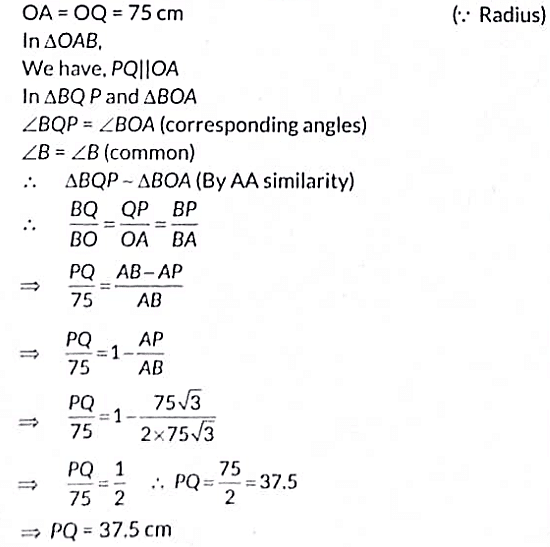
Find the value of PQ. (4 Marks) (2023)
Ans:
OR
Q8: Two tangents TP and TQ are drawn to a circle with centre O from an external point T. Prove that ∠PTQ = 2∠OPQ.
(3 Marks)(2023)
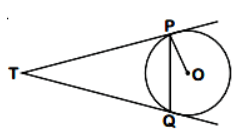
Ans:
We know that the lengths of tangents drawn from an external point to a circle are equal.
∴ TP = TQ … (1)
∴ ∠TQP = ∠TPQ (angles of equal sides are equal) … (2)
Now, PT is tangent, and OP is the radius.
∴ OP ⊥ TP (Tangent at any point of a circle is perpendicular to the radius through the point of contact)
∴ ∠OPT = 90°
or, ∠OPQ + ∠TPQ = 90°
or, ∠TPQ = 90° – ∠OPQ … (3)
In ∆TPQ,
∠TPQ + ∠PQT + ∠QTP = 180° (Sum of angles of a triangle is 180°)
or, 90° – ∠OPQ + ∠TPQ + ∠QTP = 180°
or, 2(90° – ∠OPQ) + ∠TPQ = 180° [from (2) and (3)]
or, 180° – 2∠OPQ + ∠TPQ = 180°
or, 2∠OPQ = ∠TPQ
Hence Proved
Q9: In the given figure, a circle is inscribed in a quadrilateral ABCD in which ∠B = 90°. If AD = 17 cm, AB = 20 cm and DS = 3 cm, then find the radius of the circle. (3 Marks) (2023)
Ans:
Given:
∠B = 90° , AD = 17 cm , AB = 20 cm, DS = 3 cm (where S is the point of tangency on side AD)
From the properties of tangents, we know:
- Tangents drawn from an external point to a circle are equal in length.
- DS = DR (tangents from point D are equal).
- AR = AQ (tangents from point A are equal).
Since AD = 17 cm and DS = 3 cm, we calculate AR as:
- AR = AD – DS = 17 cm – 3 cm = 14 cm
Thus, AR = 14 cm.
From the property that AR = AQ, we get:
- AQ = 14 cm.
Since AB = 20 cm and AQ = 14 cm, we calculate BQ as:
- BQ = AB – AQ = 20 cm – 14 cm = 6 cm.
OQ ⊥ BQ and OP ⊥ BP because a tangent at any point of a circle is perpendicular to the radius at the point of contact.
Since both OQ = BQ and the angles between the tangents are 90°, quadrilateral BQOP must be a square.
Since BQ = OQ = r, the radius of the inscribed circle is:
r = 6 cm.
Q10: From an external point, two tangents are drawn to a circle. Prove that the line joining the external point to the centre of the circle bisects the angle between the two tangents. (3 Marks) (CBSE 2023)
Ans: Let P lie an external point, O be the centre of the circle and PA and PB are two tangents to the circle as shown in figure.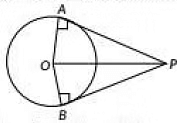
In ΔOAP and ΔOBP.
OA = OB [Radius of the circle]
OP = OP [common]
PA = PB [∵ Tangents drawn from an external point to a circle are equal]
So, ΔOAP ≅ ΔOPB
So, ∠APO = ∠BPO (By cpct)
Hence. OP bisects ∠APB
Q11: Two concentric circles are of radii 5 cm and 3 cm. Find the length of the chord of the larger circle which touches the smaller circle. (3 Marks) (CBSE 2023)
Ans: Let the centre of the two concentric circlet is O and AB be the chord of the larger circle which touches the smaller circle at point P as shown in figure.
∴ AB is a tangent to the smaller circle at point P
⇒ OP ⊥ AB
By Pythagoras theorem, in ΔOPA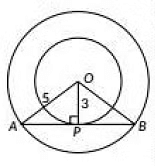
OA2 = AP2 + OP2
⇒ 52 = AP2 +32
⇒ AP2 =52 – 32 = 25 – 9
⇒ AP2 = 16 ⇒ AP = 4cm
In ΔOPB Since, OP ⊥ AB
AP = PB [∵ Perpendicular drawn from the centre of the circle bisects the chord]
∴ AB = 2AP = 2 x 4 = 8 cm
∴ The length of the chord of the larger circle is 8 cm.
Q12: Prove that the angle between the two tangents drawn from an external point to a circle is supplementary to the angle subtended by the line segment joining the points of contact at the centre. (3 Marks) (2023)
Ans: Let PA and PB are two tangents on a circle from point P as shown in the figure.
Let is known that tangent to a circle is perpendicular to the radius through the point of contact.
∠OAP =∠OBP = 90° ……..(i)
In quadrilateral AOBP,
∠OAP + ∠APB + ∠PBO + ∠BOA = 360°
90° + ∠APB + 90° + ∠BOA = 360° [Using (i)]
∠APB + ∠BOA = 360° – 180°
∴ ∠APB + ∠BOA = 180°
Hence proved.
 | Get additional INR 200 off today with EDUREV200 coupon. |
Previous Year Questions 2022
Q1: In Fig, AB is the diameter of a circle centred at O. BC is tangent to the circle at B. If OP bisects the chord AD and ∠AOP= 60°, then find m∠C. (2022)
Ans: Since, OP bisects the chord AD, therefore ∠OPA = 90° …. [∵ The line drawn through the centre of a circle to bisect a chord is perpendicular to the chord]
Now, In ΔAOP,
∠A = 180° – 60° – 90°
= 120° – 90°
= 30°
Also, we know that the tangent at any point of a circle is perpendicular to the radius through the point of contact
∴ ∠ABC = 90°
Now, In ΔABC,
∠C = 180° – ∠A – ∠B
= 180° – 30° – 90°
= 150° – 90°
= 60°
Q2: In Fig. XAY is a tangent to the circle centred at 0. If ∠ABO = 40°. Then find ∠BAY and ∠AOB (2022)
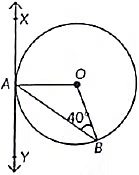
Ans: 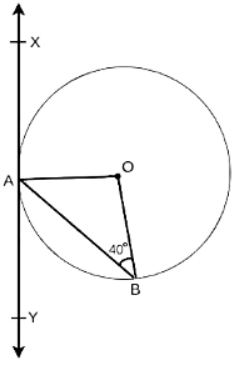
Given, ∠ABO = 40°
∠XAO = 90° …(Angle between radius and tangent)
OA = OB …(Radii of same circle)
⇒ ∠OAB = ∠OBA
∴ ∠OAB = 40°
Now, applying the linear pair of angles property,
we get
∠BAY + ∠OAB + ∠XAO = 180°
⇒ ∠BAY + 40° + 90° = 180°
⇒ ∠BAY + 130° = 180°
⇒ ∠BAY = 180° – 130°
⇒ ∠BAY = 50°
Now, In ΔAOB,
∠AOB + ∠OAB + ∠OBA = 180°
or, ∠AOB + 40° + 40° = 180°
or, ∠AOB = 180° – 80° = 100°
Hence proved.
Q3: In Figure, two circles with centres at O and O’ of radii 2r and r, respectively, touch each other internally at A. A chord AB of the bigger circle meets the smaller circle at C. Show that C bisects AB. (2022)
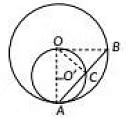
Ans:
Join OA, OC, and OB.
Clearly, ∠OCA is the angle in a semi-circle.∴ ∠OCA=90∘
In right triangles OCA and OCB, we have:OA=OB=r
∠OCA=∠OCB=90∘ and OC=OC
So, by RHS-criterion of congruence, we get:△OCA≅△OCB
∴AC = CB
Q4: In Figure, PQ and PR are tangents to the circle centred at O. If ∠OPR = 45°, then prove that ORPQ is a square. (2022)
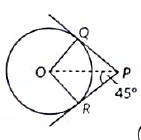
Ans: It is given that ∠QPR = 90°
We know that the lengths of the tangents drawn from the outer point to the circle are equal.
PQ = PR … (1)
The radius is Perpendicular to the tangent line at the point of contact.
∴ ∠PQO = 90°
and
∠ORP = 90°
In quadrilateral OQPR:
∠QPR + ∠PQO + ∠QOR + ∠ORP = 360°
⇒ 90° + 90° + ∠QOR + 90° = 360°
⇒ ∠QOR = 360° – 270° = 90°
∴ QPR = ∠PQO = ∠QOR = ∠ORP = 90°
It can be concluded that PQOR is a square.
Q5: In Fig., there are two concentric circles with centre O. If ARC and AQB are tangents to the smaller circle from point A lying on the larger circle, find the length of AC if AQ = 5 cm. (2022)
Ans:
Here, AC and AB are the tangents from external point A to the smaller circle.
∴ AC = AB
Now, AB is the chord of the bigger circle and OQ is the perpendicular bisector of chord AB.
∴ AQ = QB
or, AB = 2AQ
or, AB = 2(5) = 10 cm [Given AQ = 5 cm]
or, AC = 10 cm
Q6: In Figure, O is the centre of the circle. PQ and PR are tangent segments. Show that the quadrilateral PQOR is cyclic. (2022)
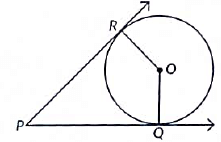
Ans: Given: PQ and PR are tangents from an external point P.
To prove: PQOR is a cyclic quadrilateral.
Proof :
OR and OQ are radius of circle centred at O, and PR and PQ are tangents.
∠ORP = 90° and ∠OQP = 90°
In quadrilateral PQOR, we have
∠OQP + ∠QOR + ∠ORP + ∠RPQ = 360°
90° + ∠QOR + 90° + ∠RPQ = 360°
180° + ∠QOR + ∠RPQ = 360°
∠QOR + ∠RPQ = 360° – 180°
So, ∠O + ∠P = 180°
∠P and ∠O are opposite angles of quadrilateraI which are supplementary.
∴ PQOR is a cyclic quadrilateral.
Q7: In Figure O is the centre of a circle of radius 5 cm. PA and BC are tangents to the circle at A and B respectively. If OP = 13 cm. then find the length of tangents PA and BC. (2022)
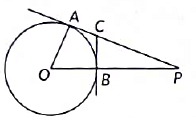
Ans:
We are given:
The radius of the circle, OA = 5 cm,
The distance from the external point P to the center O, OP = 13 cm.
Since PA is a tangent to the circle at point A, it is perpendicular to the radius OA. Thus, △OAP is a right triangle.
Using the Pythagorean theorem in △OAP:
OP² = OA² + PA²
Substitute the known values:
13² = 5² + PA²
Simplify:
169 = 25 + PA²
Solve for PA²:
PA² = 169 − 25 = 144
Take the square root:
PA = √144 = 12 cm
Thus, the length of PA is:
PA = 12 cm
In PBC, using Pythagoras theorem
PB=8 cm, BC=x, PC=(12-x), √PBC=90o
So, PB2+BC2=PC2
82+x2=(12-x)2
x=10/3=3.33
BC=3.33
Q8: In fig. PQ is a chord of length 8 cm of a circle of radius 5 cm. The tangents at P and Q meet at a point T. Find the length of TP. (2022)
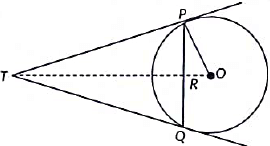
Ans: In the given figure,
PQ = 8 cm and OP = 5 cm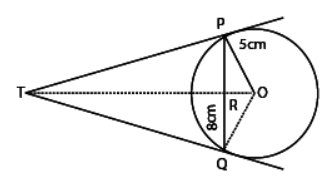
Join OT.
Let it meet PQ at the point R.
Then ∆TPQ is isosceles and TO is the angle bisector of ∠PTO.
[∴ TP = TQ = Tangents from T upon the circle]
∴ OT ⊥ PQ
∴ OT bisects PQ.
PR = RQ = 4 cm
Now,
OR = √(OP² – PR²) = √(5² – 4²) = 3 cm
Now,
∠TPR + ∠RPO = 90° (∴ TPO = 90°)
= ∠TPR + ∠PTR (∴ TRP = 90°)
∴ ∠RPO = ∠PTR
Now, Right triangle TRP is similar to the right triangle PRO. [By A-A Rule of similar triangles]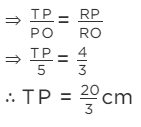
[∵Tangents drawn from an external point to a circle are equal in length]
Q9: Prove that a parallelogram circumscribing a circle is a rhombus. (2022)
Ans: Given : A parallelogram ABCD circumscribing a circle with centre O.
To prove : ABCD is a rhombus.
Proof: We know that the tangents drawn to a circle from an external Doint are eaual in length.
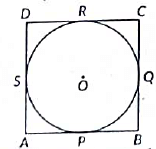
⇒ AP = AS [Tangents drawn from A] …(i)
⇒ BP = BQ [Tangents drawn from B] …(ii)
⇒ CR= CQ [Tangents drawn from C] …(iii)
⇒ DR = DS [Tangents drawn from D] …(iv)
Adding (i), (ii), (iii) and (iv) we get
AP + BP + CR + DR = AS + BQ + CQ + DS
= (AP + BP) + (CR + DR) = (AS + DS) + (BQ + CQ)
⇒ AB + CD = AD + BC
⇒ 2AB = 2BC [Opposite sides of the given parallelogram are equal ∴ AB = DC and AD = BC)
AB = BC = DC = AD
Hence, ABCD is a rhombus.
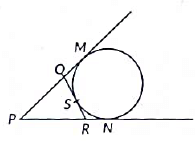
Q10: In Fig, if a circle touches the side QR of ΔPQR at S and extended sides PQ and PR at M and N, respectively, then
Prove that (2022)
Ans: Given: A circle is touching a side QR of ΔPQR at point S.
PQ and PR are produced at M and N respectively.
To prove: 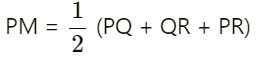
Proof: PM = PN …(i) (Tangents drawn from an external point P to a circle are equal)
QM = QS …(ii) (Tangents drawn from an external point Q to a circle are equal)
RS = RN …(iii) (Tangents drawn from an external point R to a circle are equal)
Now, 2PM = PM + PM
= PM + PN …[From equation (i)]
= (PQ + QM) + (PR + RN)
= PQ + QS + PR + RS …[From equations (i) and (ii)]
= PQ + (QS + SR) + PR
= PQ + QR + PR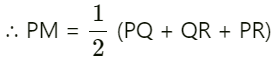
Hence proved.
Q11: In the figure, a triangle ABC with ∠B = 90° is shown. Taking AB as diameter, a circle has been drawn intersecting AC at point P. Prove that the tangent drawn at point P bisects BC. (2022)
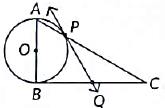
Ans:
According to the question,
In a right angle ΔABC is which ∠B = 90°, a circle is drawn with AB as diameter intersecting the hypotenuse AC at P.
Also PQ is a tangent at P
To Prove: PQ bisects BC i.e. BQ = QC
Proof: ∠APB = 90° …[Angle in a semicircle is a right-angle]
∠BPC = 90° …[Linear Pair]
∠3 + ∠4 = 90° …[1]
Now, ∠ABC = 90°
So in ΔABC
∠ABC + ∠BAC + ∠ACB = 180°
90° + ∠1 + ∠5 = 180°
∠1 + ∠5 = 90° …[2]
Now, ∠1 = ∠3 …[Angle between tangent and the chord equals angle made by the chord in alternate segment]
Using this in [2] we have
∠3 + ∠5 = 90° …[3]
From [1] and [3] we have
∠3 + ∠4 = ∠3 + ∠5
∠4 = ∠5
QC = PQ …[Sides opposite to equal angles are equal]
But also, PQ = BQ …[Tangents drawn from an external point to a circle are equal]
So, BQ = QC
i.e. PQ bisects BC.
Q12: In the figure, two circles touch externally at P. A common tangent touches them at A and B, and another common tangent is at P, which meets the common tangent AB at C. Prove that ∠APB = 90°. (2022)
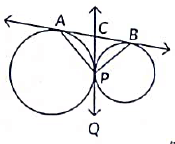
Ans: Let common tangent at P meets the tangent AB at C. Since, tangents drawn from an external point to a circle are equal
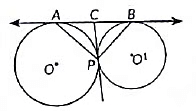
∴ AC = CP
and BC = CP
⇒ ∠CAP = ∠CPA = x (say) …(i)
and ∠CBP = ∠CPB = y (say) …(ii)
Now, ∠ACP+ ∠BCP = 180° [Linear pair] …(*)
In ΔACP, ∠ACP + ∠CPA + ∠CAP = 180° …(iii)
and in ΔBCP, ∠BCP+ ∠CPB + ∠CBP = 180°…(iv)
Adding (iii) and (iv), we get
∠ACP + x + x + ∠BCP + y + y = 360°
∠ACP + ∠BCP + 2x + 2y = 360° [Using (i) & (ii)]
= 2(x + y) = 360° – 180° = 180°[Using (‘))
⇒ x + y = 90°
i.e., ∠CPA + ∠CPB = 90° => ∠APB = 90°
Previous Year Questions 2021
Q1: In the given figure, PT and PS are tangents to a circle with centre O, from a point P such that PT = 4 cm and ∠TPS = 60°. Find the length of the chord TS. (2021)
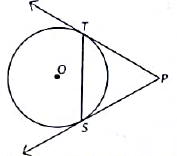
Ans:
Given: PT = 4 cm and ∠TPS = 60°.
To Find: Length of the chord TS and the radius of the circle.
Step 1: In triangle PTS given
PT = 4 cm and PS = 4 cm
Since, PT = PS = 4 cm
Let, ∠PST = ∠PTS = x and as we know ∠TPS = 60°
Now, in triangle PTS
∠PST + ∠PTS + ∠TPS = 180°
x + x + 60° = 180°
2x = 120°
x = 60°
So, ∠PST = ∠PTS = ∠TPS = 60°
Thus, PT = TS = PS = 4 cm
Step 2: An equilateral triangle has equal sides and angles of 60 degrees. Triangle PTS is equilateral, and chord TS = 4 cm.
Step 3: In triangle POS:
OS/PS = tan 30°
OS = P × tan 30°
OS = 4/√3 cm
Hence, the radius of the circle is 4/√3 and chord TS = 4 cm.
| Also read: Circle Theorems -1 |
Previous Year Questions 2020
Q1: In the figure, PQ is tangent to the circle with the centre at O, at the point B. If ∠AOB = 100°, then ∠ABP is equal to (2020)
(a) 50°
(b) 40°
(c) 60°
(d) 80°
Ans: (a)
Given that
∠ AOB = 100°
Since OA = OB [Radii]
So ∠ OAB = ∠ OBA = 40° [Angle opposite the similar sides are equal]
Since PQ is tangent on the circle. So OB is perpendicular to PQ.
So,
∠ OBP = 90° [angle between radii and tangent is 90°]
∠ OBA + ∠ ABP = 90°
∠ ABP = 90 – ∠ OBA
∴ ∠ ABP = 90° – 40°
∴ ∠ ABP = 50°
Q2: In the given figure, PT is a tangent at T to the circle with centre O. If ∠TPO = 25°, then x is equal to (2020)
(a) 25°
(b) 65°
(c) 90°
(d) 115°
Ans: (d)
Since ∠TPO = 25° and ∠OTP = 90° [Angle between radii and tangent is 90°]
x = ∠OTP + ∠TPO
= 90° + 25° = 115°
[∵ Radius is perpendicular to the tangent T]
Q3: In the given figure, QR is a common tangent to the given circles, touching externally at point T. The tangent at T meets QR at P If PT = 3.8 cm, then the length of QR(in cm] is (2020)
(a) 3.8
(b) 7.6
(c) 5.7
(d) 1.9
Ans: (b)
It is known that the length of the tangents drawn from an external point to a circle are equal.
∴ QP = PT= 3.8 cm and PR = PT = 3.8 cm
Now, QR = QP + PR = 3.8cm + 3.8cm = 7.6 cm
Q4: In Figure, if tangents PA and PB from an external point P to a circle with centre O are inclined to each other at an angle of 80° then ∠POA is equal to (2020)
(a) 50°
(b) 60°
(c) 80°
(d) 100°
Ans: (a)
Construction: Join OP
A tangent at any point of a circle is perpendicular to the radius at the point of contact.
In ΔOAP and in ΔOBP:
- OA = OB (radii of the circle are always equal)
- AP = BP (length of the tangents)
- OP = OP (common)
Therefore, by SSS congruency ΔOAP ≅ ΔOBP.
If two triangles are congruent, then their corresponding parts are equal.
Hence:
- ∠POA = ∠POB
- ∠OPA = ∠OPB
Therefore, OP is the angle bisector of ∠APB and ∠AOB.
Hence, ∠OPA = ∠OPB = 1/2 (∠APB)
= 1/2 × 80°
= 40°
By the angle sum property of a triangle, in ΔOAP:
∠A + ∠POA + ∠OPA = 180°
OA ⊥ AP (The tangent at any point of a circle is perpendicular to the radius through the point of contact.)
Therefore, ∠A = 90°
90° + ∠POA + 40° = 180°
130° + ∠POA = 180°
∠POA = 180° – 130°
∠POA = 50°
Thus, option (A) 50° is the correct answer.
Q5: In the figure, a quadrilateral ABCD is drawn to circumscribe a circle. Prove that AB + CD = BC + AD. (2020)
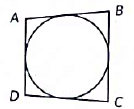
Ans: Let the circle touches the sides AB, BC, CD and DA of quadrilateral ABCD at P, Q, R and S respectively Since, lengths of tangents drawn from an external point to the circle are equal.
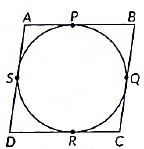
AP = AS …(1) (Tangents drawn from A)
BP = BQ …(2) (Tangents drawn from B)
CR = CQ …(3) (Tangents drawn from C)
DR = DS …(4) (Tangents drawn from D)
Adding (1), (2), (3) and (4), we get
AP + BP + CR + DR = AS + BQ + CQ + DS
⇒ (AP + PB) + (CR + RD) = (AS + SD) + (BQ + QC)
⇒ AB + CD = AD + BC
Q6: In figure, find the perimeter of ΔABC if AP =12 cm. (2020)
Ans:
Step 1: Identify the Tangents
From the problem, we know that AP and AQ are tangents to the circle from point A, and BC is also a tangent. According to the properties of tangents from an external point, the lengths of the tangents drawn from the same external point to a circle are equal.
Step 2: Set Up the Equations
Since AP = 12 cm, we can conclude that:
- AP = AQ = 12 cm (Equation 1)
Step 3: Identify Other Tangents
From point B, the tangents BD and BP are equal:
- BD = BP (Equation 2)
From point C, the tangents CD and CQ are equal:
- CD = CQ (Equation 3)
Step 4: Express Perimeter of Triangle ABC
The perimeter of triangle ABC can be expressed as:
Perimeter = AB + BC + AC
Step 5: Substitute for BC
Since BC is composed of the tangents from B and C:
BC = BD + CD
Thus, we can rewrite the perimeter as:
Perimeter = AB + (BD + CD) + AC
Step 6: Express AB and AC in Terms of Tangents
From the properties of tangents:
- AP = AB + BP
- AQ = AC + CQ
Substituting BP and CQ with BD and CD respectively, we have:
- AP = AB + BD (Equation 4)
AQ = AC + CD (Equation 5)
Step 7: Substitute Equations into PerimeterNow, substituting the expressions from Equations 4 and 5 into the perimeter equation:Perimeter = (AP – BD) + (BD + CD) + (AQ – CD)
Step 8: Simplify the Expression
Since AP = AQ and both are equal to 12 cm:
Perimeter = (12 – BD) + (BD + CD) + (12 – CD)
This simplifies to:
Perimeter = 12 + 12 = 24 cm
Previous Year Questions 2019
Q1: In the given figure, a circle is inscribed in a ΔABC having sides BC = 6 cm, AB = 10 cm and AC = 12 cm. Find the lengths BL, CM and AN. (2019)
Ans: Let BL = x, BN = x
[∵ Tangents drawn from an external point to to the circle are equal in length]
CL = CM = 8 – x [∵ BC = 8cm]
AN = AM = 10 – x [∵ AB = 10cm]
But AC= 12cm[Given]
∴ AM + MC = 12
10 – x + 8 – x = 12
⇒ 18 – 2x = 12
⇒ 6 = 2x
⇒ x = 3
Length of BL = 3cm
Length of CM = 8 – 3 = 5 cm
Length of AN = 10 – 3 = 7 cm
Q2: Prove that tangents drawn at the ends of the diameter of a circle are parallel. (2019)
Ans:
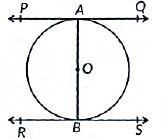
Given : A circle C(O, r)with diameter AB and let PQ and RS be the tangents drawn to the circle at point A and B.
To prove: PQ || RS
Proof: Since tangent at a point to a circle is perpendicular to the radius through the point of contact.
∴ AB ⊥ PQ and AB ⊥ R S
⇒ ∠PAB = 90° and ∠ABS = 90°
⇒ ∠PAB = ∠ABS
⇒ PQ || RS [∵ ∠PAB and ∠ABS are alternate interior angles]
Previous Year Questions 2017
Q1: The difference between the radii of the smaller circle and the larger circle is 7 cm and the difference between the areas of the two circles is 1078 sq. cm. Find the radius of the smaller circle. [CBSE Delhi 2017 (C)]
Ans: Given: r2 – r1 = 7 (r2 > r1) …(i)
 (From equation (i))
 ….. (ii)
Adding (i) and (ii), we get
2r2 = 56
⇒ r2 = 28 cm
Also, r1 = 21 cm (From equation (i))
∴ Radius of simaller circle = 21 cm.
Q2: Prove that the tangent drawn at any point of a circle is perpendicular to the radius through the point of contact. [AI (C) 2017]
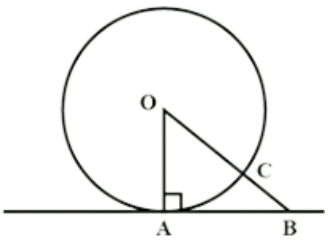
Ans:
Referring to the figure:
OA = OC (Radii of circle)
Now OB = OC + BC
∴ OB > OC (OC being radius and B any point on tangent)
⇒ OA < OB
B is an arbitrary point on the tangent.
Thus, OA is shorter than any other line segment joining O to any point on the tangent.
Shortest distance of a point from a given line is the perpendicular distance from that line.
Hence, the tangent at any point of the circle is perpendicular to the radius.
Q3: In Fig., PQ is a chord of length 8 cm of a circle of radius 5 cm. The tangents drawn at P and Q intersect at T. Find the length of TP. [AI (C) 2017, Foreign 2015]
Ans: Given: PQ is a chord of length 8 cm
Radius OP = 5 cm. PT and QT are tangents to the circle.
To find: TP
OT is perpendicular bisector of PQ
∠ORP = 90°
(Line joining the centre of circle to the common point of two tangents drawn to circle is perpendicular bisector of line joining the point of contact of the tangents.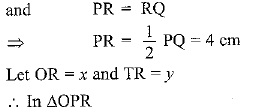

⇒ 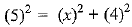

x2 = 9
⇒ x = 3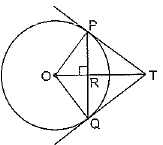
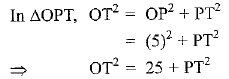
(OR + RT)2 = 25 + PT2
(3 + y)2 = 25 + PT2
9 + y2 + 6y = 25 + PT2 …….(i)
In ΔPRT, TP2 = PR2 + RT2
⇒ PT2 = (4)2 + (y)2 …….(ii)
Put value of PT2 in eq (i)
9 + y2 + 6y = 25 + 16 + y2
6y = 25 + 16 – 9
6y = 32
y = 32/6 = 16/3 cm
Putting y = 16/3 cm in eq (ii), we get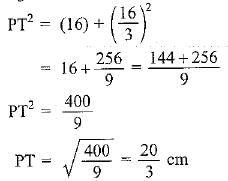
Q4: From an external point P, two tangents PA and PB are drawn to the circle with centre O. Prove that OP is the perpendicular bisector of chord AB. (CBSE 2017)
Ans: Join OA and OB.
In ΔOAP and ΔOBP.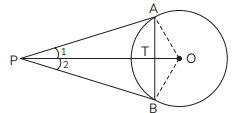
OA = OB [Radii of same circle]
PA = PB [Tangents from external point]
OP = OP [Common]
So ΔOAP ≅ ΔOBP (By SSS rule)
∠1 = ∠2 [By C.P.C.T.]
Now, In ΔATP and ΔBTP.
PA = PB [Tangents from external point]
AT = BT [By C.P.C.T.] …(1)
∠ATP = ∠BTP [By CPCT] …(2)
Since, ATB is a straight line.
∠ATP + ∠BTP = 180º
⇒ ∠ATP + ∠ATP = 180º [From (2) ]
⇒ 2∠ATP = 180º
⇒ ∠ATP = 90º …(3)
From (1) and (3) we can say that OP is ⊥ bisector of AB
Q5: In the given figure, PQ is a tangent from an external point P and QOR is a diameter. If ∠POR = 130º and S is a point on the circle, find ∠1 + ∠2. (CBSE 2017)
Ans: Given, PQ is a tangent to a circle, and QOR is a diameter of a circle.
Also, ∠POR = 130º
Now, ∠RST = 1/ 2 ∠POR
∠2 = 1/ 2 × 130º = 65º …(i) [∠TOR = ∠POR]
[Since, angle subtended by the arc at centre is twice the angle subtended by it on any remaining part of the circle]
Since, ROQ is the diameter of the circle
∴ ∠ROT + ∠QOT = 180º
∠QOT = 180º – 130º = 50º …(ii)
and ∠PQR = 90º …(iii) [tangent at any point of a circle is perpendicular to the radius through the point of contact]
In ΔQOP
∠QOP + ∠PQO + ∠OPQ = 180º
⇒ 50º + 90º + ∠1 = 180º [from (ii) and (iii)]
∠1 = 180º – 140º = 40º …(iv)
∴ ∠1 + ∠2 = 40º + 65º [From (i) and (iv)]
= 105º
Hence, the sum of ∠1 + ∠2 is 105º
Q6: In the figure, the radius of the circle of DABC of area 84 cm2 is 4 cm and the lengths of the segments AP and BP into which side AB is divided by the point of contact P are 6 cm and 8 cm. Find the lengths of the sides AC and BC. (CBSE 2017)
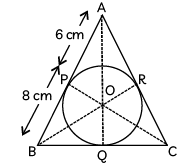
Ans: Given: area (∆ABC) = 84 cm2
Radius of circle, r = OP = OQ = OR = 4 cm AP = 6 cm and BP = 8 cm
Now AP = AR = 6 cm [Q two tangents from an external point to a circle are equal]
Similarly, BP = BQ = 8 cm
and QC = RC = x (say)
AC = 6 + x
and BC = 8 + x
Now, area (∆ABC) = area (∆AOB) + area (∆BOC) + area (∆AOC)
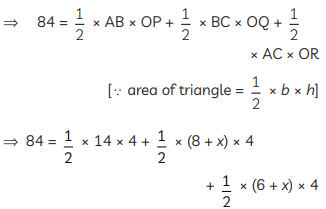
⇒ 84 = 28 + (16 + 2x) + (12 + 2x)
⇒ 84 = 56 + 4x
⇒ 4x = 84 – 56
⇒ 4x = 28
⇒ x = 7
Hence, AC = 6 + 7 = 13 cm
and BC = 8 + 7 = 15 cm.
Previous Year Questions 2016
Q1: If from an external point P of a circle with centre 0, two tangents PQ and PR are drawn such that QPR = 120°, prove that 2PQ = PO. [CBSE Delhi (F) 2016]
Ans: Given, ∠QPR = 120°
Radius is perpendicular to the tangent at the point of contact.
∠OQP = 90° ⇒ ∠QPO = 60°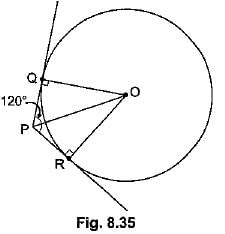
(Tangents drawn to a circle from an external point are equally inclined to the segment, joining the centre to that point.)
Q2: In Fig. 8.42, AP and BP are tangents to a circle with centre O, such that AP = 5 cm and ∠APS = 60°. Find the length of chord AB. [CBSE Delhi 2016]
Ans: PA = PB (Tangents from an external point are equal)
and ∠APB = 60°
⇒ ∠PAB = ∠PBA = 60° (Angle opposite to similar sides are equal)
∴ ΔPAB is an equilateral triangle.
Hence AB = PA = 5 cm.
Q3: In Fig. 8.43 from an external point P, two tangents PT and PS are drawn to a circle with centre O and radius r. If OP = 2r, show that ∠OTS = ∠OST = 30°. [CBSE (AI) 2016]
Ans: Let ∠TOP = θ
∴ 
Hence, ∠TOS = 120°
In ∠OTS, OT = OS (Radii of circle)
⇒ 
Q4: In Fig. 8.44, are two concentric circles of radii 6 cm and 4 cm with centre O. If AP is a tangent to the larger circle and BP to the smaller circle and the length of AP is 8 cm, find the length of BP. [CBSE (F) 2016]
Ans: OA = 6 cm, OB = 4 cm, AP = 8 cm
OP2 = OA2 + AP2 = 36 + 64 = 100 [Pythagoras Theorem]
⇒ OP = 10 cm
Similarly BP2 = OP2 – OB2 = 100 – 16 = 84 [Pythagoras Theorem]
⇒ 
Q5: From an external point P, tangents PA and PR are drawn to a circle with centre O. If ∠PAB = 50°, then find ∠AOB. [CBSE Delhi 2016]
Ans: ∵ PA = PB ⇒ ∠BAP = ∠ABP = 50°
∴ ∠APB = 180° – 50° – 50° = 80°
and ∠AOB = 180° – 80° = 100° [Sum of opposite side of a quadrilateral is 180°]
Q6: In Fig. 8.29, PQ is a tangent at point C to a circle with centre O. If AB is a diameter and ∠CAB = 30°, find ∠PCA. [CBSE (AI) 2016]
Ans: ∠ACB = 90° (Angle in the semicircle)
∠CAB = 30° (given)
In ΔABC,
90° + 30° + ∠ABC = 180° [Angle sum property]
⇒ ΔABC = 60°
Now, ∠PCA = ∠ABC (Angles in the alternate segment)
∴ ∠PCA = 60°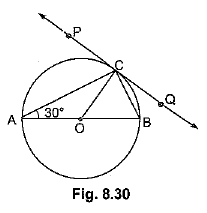
OR
Construction: Join O to C.
∠PCO = 90° (∵ Line joining centre to point of contact is perpendicular to PQ)
In ΔAOC, OA = OC (Radii of circle)
∴ ∠OAC = ∠OCA = 30° (Equal sides have equal opp. angles)
Now, ∠PCA = ∠PCO – ∠ACO
= 90° – 30° = 60°
Q7: Two tangents PA and PB are drawn to the circle with centre O, such that ∠APB = 120°. Prove that OP = 2AP. (Foreign 2016)
Ans: Given. A circle C(0, r). PA and PB are tangents to the circle from point P, outside the circle such that ∠APB = 120°. OP is joined.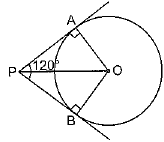
To Prove. OP = 2AP.
Construction. Join OA and OB.
Proof. Consider Δs PAO and PBO
PA = PB [Tangents to a circle, from a point outside it, are equal.]
OP = OP [Common]
∠OAP = ∠OBP = 90°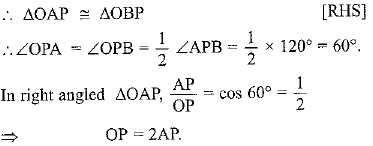
Q8: In Fig. 8.62, two equal circles, with centres O and O’, touch each other at X.OO’ produced meets the circle with centre O’ at A. AC is tangent to the circle with centre O, at point C. O’D is perpendicular to AC. Find the value of [CBSE (AI) 2016]
Ans: AC is tangent to circle with centre O.
Thus ∠ACO = 90°
In ΔAO’D and ΔAOC
∠ADO’ = ∠ACO = 90º
∠A = ∠A (Common)

Q9: In Fig. 8.63, O is the centre of a circle of radius 5 cm. T is a point such that OT = 13 cm and OT intersects the circle at E. If AB is a tangent to the circle at E, find the length of AB, where TP and TQ are two tangents to the circle. [CBSE Delhi 2016]
Ans:
(Tangents from an external point to a circle are equal)
In right ΔAET.
TA2 = TE2 + EA2
⇒ (12 – x)2 = 64 + x2 ⇒ 144 + x2 – 24x = 64 + x2
⇒ x = 80/24 ⇒ x = 3.3 cm
Thus, AB = 6.6 cm
 | Practice Test: Circles |
Previous Year Questions 2015
Q1: In the figure, PQ is a chord of a circle with centre O and PT is a tangent. If ∠QPT = 60°, find ∠PRQ. (CBSE 2015)
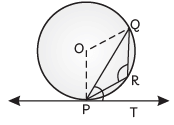
Ans: Given, ∠QPT = 60°
So, OP is the radius of the circle.
Now, ∠OPT = 90°
∠OPQ = ∠OPT – ∠QPT = 90° – 60° = 30°
In ΔOPQ, OP = OQ [radii of circle]
∠OQP = ∠OPQ = 30° [Q Angles opposite to equal sides are equal]
∠POQ = 180° – (30° + 30°) = 120°
Reflex ∠POQ = 360° – 120° = 240°
We know that, angle subtended by an arc at the centres double the angle subtended by it on the remaining part of the circle.
so, ∠PRQ = 1/ 2 Reflex ∠POQ
Therefore, 240 / 2 ° = 120°
Previous Year Questions 2014
Q1: Prove that the parallelogram circumscribing a circle is a rhombus. [CBSE Delhi 2014; CBSE 2019 (30/5/1)]
Ans: Let ABCD be a parallelogram such that its sides touch a circle with centre O.
We know that the tangents to a circle from an exterior point are equal in length.
Therefore, we have
AP = AS (Tangents from A) … (i)
BP = BQ (Tangents from B) … (ii)
CR = CQ (Tangents from C) … (iii)
And DR = DS (Tangents from D) … (iv)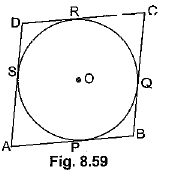
Adding (i), (ii), (iii) and (iv), we have
(AP + BP) + (CR + DR) = (AS + DS) + (BQ + CQ)
AB + CD = AD + BC
AB + AB = BC + BC (∵ ABCD is a parallelogram ∴ AB = CD, BC = DA)
2AB = 2BC ⇒ AB = BC
Thus, AB = BC = CD = AD
Hence, ABCD is a rhombus.
Q2: Prove that the lengths of two tangents drawn from an external point to a circle are equal. [CBSE, Delhi 2014, (F) 2014, Delhi 2016, (AI) 2016, (F) 2016, CBSE Delhi 2017, (AI) 2017, (F) 2017, Delhi 2017 (C)]
Ans: Given: AP and AQ are two tangents from a pointed to a circle C (O, r).
To Prove: AP = AQ
Construction: Join OP, OQ and OA.
Proof: In order to prove that AP = AQ, we shall first prove that ΔOPA ≅ ΔOQA.
Since a tangent at any point of a circle is perpendicular to the radius through the point of contact.
∴ OP ⊥ AP and OQ ⊥ AQ
⇒ ∠OPA = ∠OQA = 90° ……..(i)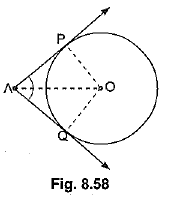
Now, in right triangles OPA and OQA, we have
OP = OQ (Radii of a circle)
∠OPA = ∠OQA (Each 90°)
and OA = OA (Common)
So, by RHS-criterion of congruence, we get
Hence, lengths of two tangents from an external point are equal.