Let us do (Page 155). I. Work in pairs and answer the questions that follow. Share your answers with your classmates and teacher.
1. Have you ever used a seed or a sapling to grow a plant?
2. What kind of care did the plant need? Who helped you with it?
3. How did you feel when you saw the plant grow?
Ans:
1. Yes, I planted a mango seed in a pot last year.
2. It needed water, sunlight, and soil. My mother helped me water it regularly.
3. I felt happy and proud when it sprouted tiny leaves.
II. What kind of trees do people plant in their homes? Why is it important to plant trees?
Ans: People plant trees like neem, mango, or tulsi at home for shade, fruits, or beauty. Planting trees is important because they give oxygen, clean the air, and provide homes for birds.
III. Name some fruit trees that grow in your region. What type of conditions help these fruit trees grow?
Ans: In my region, mango, guava, and lemon trees grow. They need warm weather, lots of sunlight, and well-drained soil to grow well.
Let us discuss (Page 159)
I. Arrange the events in order of occurrence in the story.Two have been done for you. Share your answers with your classmatesand the teacher.
1. Rakesh discovered that the small, well-rooted twig had grown into a cherry tree.
2. Rakesh was sent to live with his grandfather in Mussoorie.
3. Rakesh pressed the cherry seed into the soft soil with his thumb. (5)
4. The cherry tree grew quickly after the rains arrived early.
5. Rakesh bought a bunch of cherries and ate most of them.
6. A goat entered the garden and ate all the leaves of the young cherry tree.
7. Rakesh’s parents grew maize, rice, and barley in a village. (1)
8. Rakesh sprinkled water on the cherry tree and surrounded it with pebbles.
9. Grandfather told Rakesh that cherry trees were tough.
10. Rakesh kept rolling the last cherry seed in his mouth.
Ans:
1. Rakesh’s parents grew maize, rice, and barley in a village.
2. Rakesh was sent to live with his grandfather in Mussoorie.
3. Rakesh bought a bunch of cherries and ate most of them.
4. Rakesh kept rolling the last cherry seed in his mouth.
5. Rakesh pressed the cherry seed into the soft soil with his thumb.
6. Rakesh discovered that the small, well-rooted twig had grown into a cherry tree.
7. Rakesh sprinkled water on the cherry tree and surrounded it with pebbles.
8. The cherry tree grew quickly after the rains arrived early.
9. A goat entered the garden and ate all the leaves of the young cherry tree.
10. Grandfather told Rakesh that cherry trees were tough.
Let us discuss (Page 164)
I. Complete the table given below based on your understanding of Part II of the story. One example has been done for you. Share your answers with your classmates and teacher.
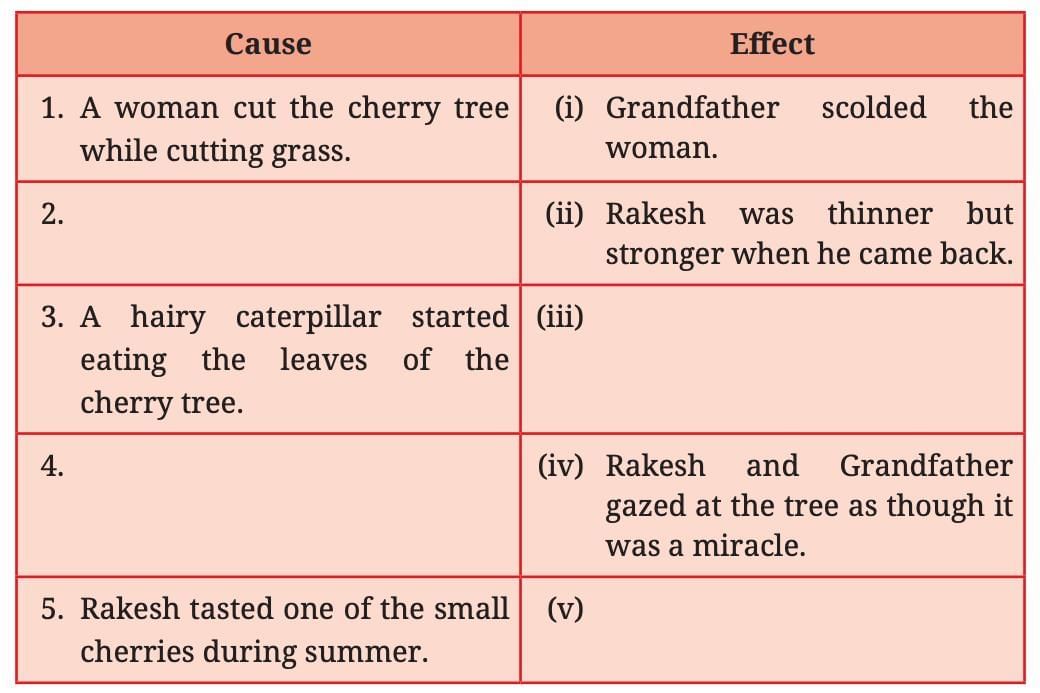
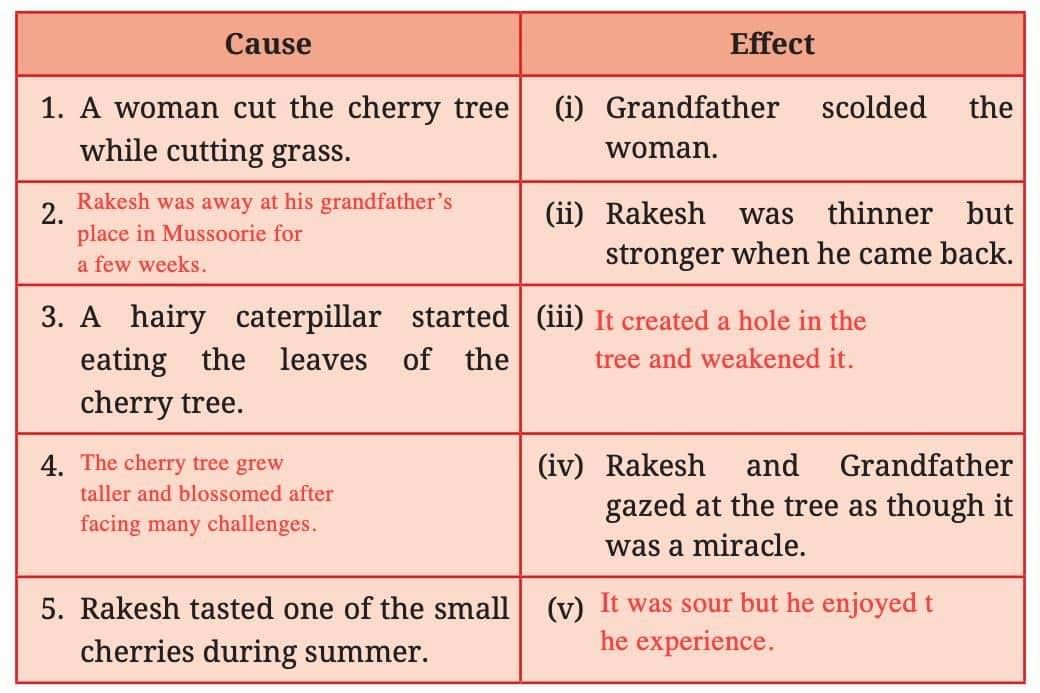
Ans:
Let us think and reflect (Page 164)
I. Read the given extracts and answer the questions that follow.
1. “Have a cherry, Grandfather,” he said, as soon as he saw his grandfather in the garden. Grandfather took one cherry, and Rakesh promptly ate the other two. He kept the last seed in his mouth for some time, rolling it round and round on his tongue until all the tang had gone. Then he placed the seed on the palm of his hand and studied it. “Are cherry seeds lucky?” asked Rakesh. “Of course.” “Then I’ll keep it.” “Nothing is lucky if you put it away. If you want luck, you must put it to some use.”
(i) Substitute the underlined phrase with a correct word from the extract. The Kho-kho captain changed her strategy quickly and without delay when a new player came in from the opposing team.
(ii) What does Rakesh’s action of rolling the cherry seed in his mouth most likely suggest about his mood at that moment?
A. He is feeling impatient and restless.
B. He is enjoying the taste and the moment.
C. He is bored and has nothing better to do.
D. He is thoughtful and feels playful.
(iii) Complete the following sentence suitably with reference to Rakesh and his grandfather. Rakesh’s decision to plant the seed shows that ______________. (he respects and values his grandfather’s advice/he has a close bond with his grandfather and a willingness to learn from him)
(iv) How does the grandfather’s advice reflect his view about luck and effort?
Ans: (i) promptly
(ii) B. He is enjoying the taste and the moment.
(iii) he respects and values his grandfather’s advice
(iv) Luck becomes meaningful only when combined with effort; one must act on opportunities, not just depend on luck.
2. Winter came early. The cherry tree bent low with the weight of snow. Field mice sought shelter in the roof of the cottage. The road from the valley was blocked, and for several days there was no newspaper, and this made Grandfather quite grumpy. His stories began to have unhappy endings. In February, it was Rakesh’s birthday. He was nine, and the tree was four, but almost as tall as Rakesh.
(i) Complete the following sentence suitably. The phrase ‘field-mice sought shelter in the roof of the cottage suggests that _____________.
(ii) What can be inferred about the cherry tree’s toughness from the line, ‘The cherry tree bent low with the weight of snow’?
A. The weight of the tree was more than the snow.
B. The tree could withstand harsh weather.
C. The tree was growing close to the ground.
D. The snow gave support to the tree.
(iii) How did the early winter affect Grandfather’s mood and storytelling?
(iv) Complete the sentence by choosing the correct option. The comparison of Rakesh’s age to the cherry tree’s age symbolises _______________. (the tree’s growth paralleling Rakesh’s own development/the tree standing as a dear one on Rakesh’s birthday)
Ans:
(i) the weather was extremely cold and harsh.
(ii) B. The tree could withstand harsh weather.
(iii) It made Grandfather grumpy, and his stories began to have unhappy endings.
(iv) the tree’s growth paralleling Rakesh’s own development.
II. Answer the following questions.
1. Why did Rakesh’s parents send him to Mussoorie?
2. Why did Rakesh let the praying mantis remain on the branch of the cherry tree?
3. How is life in the Himalayan foothills described in the story?
4. What might Rakesh mean when he says, “Is this what it feels like to be God?” at the end of the story?
5. How does the writer describe the relationship between Rakesh and his grandfather?
6. What can you infer about the connection between humans and nature based on the story?
7. Imagine Rakesh reflects on his wonderful experience of watching a seed being transformed into a full-grown cherry tree. Write how he must have felt.
Ans:
- They sent him to Mussoorie to stay with his grandfather and attend school, as there were no schools in their village.
- He saw it as the tree’s first visitor and wanted to let it stay, showing his care for nature.
- It’s described as challenging, with stony soil, cold winds, and monsoon rains, but also beautiful with oak and deodar forests and clear mountain air.
- He feels amazed and powerful, like a creator, because he grew a tree from a tiny seed, giving life and beauty.
- They share a close, caring bond, reading stories, talking, and spending time together under the cherry tree.
- Humans and nature are connected through care and growth, like Rakesh nurturing the tree, showing respect and love for the environment.
- Rakesh felt proud and joyful watching the seed grow into a tall tree with blossoms and cherries, amazed at how his care helped create something so beautiful.
Let us learn (Page 166)
I. Each word list has one word that does not match the other words. Identify the odd word. One example has been done for you.
1. chop, trim, slice, mince (‘chop’, ‘slice’ and ‘mince’ are words used for cutting with a knife; whereas ‘trim’ is to cut a part with a pair of scissors)
2. plodded, galloped, scrambled, trudged
3. tender, delicate, soft, smooth
4. stared, peered, pecked, gazed
5. growing, blossoming, progressing, planting
Ans:
1. chop, trim, slice, mince: trim (uses scissors, others use a knife).
2. plodded, galloped, scrambled, trudged: galloped (fast movement, others are slow).
3. tender, delicate, soft, smooth: smooth (describes texture, others describe fragility).
4. stared, peered, pecked, gazed: pecked (physical action, others are visual).
5. growing, blossoming, progressing, planting: planting (starting action, others are ongoing).

II. Choose the most suitable taste words given in the box below and write against the food items that follow.1. tamarind
2. jaggery
3. neem leaves
4. paneer (cottage cheese)
5. lemon
6. pickle
7. a dish of vegetables
Now, use any five taste words and make sentences of your own.
Ans:
1. tamarind – sour
2. jaggery – sweet
3. Neem leaves – bitter
4. paneer (cottage cheese) – bland (tasteless)
5. lemon – tangy
6. pickle – spicy
7. a dish of vegetables – salty
Sentences using any five taste words:
1. The lemonade was too sour to drink without sugar.
2. I love the sweet flavour of fresh mangoes.
3. Neem juice is very bitter, but it’s good for health.
4. The curry was too spicy for the children to enjoy.
5. This soup is quite bland; it needs more seasoning.
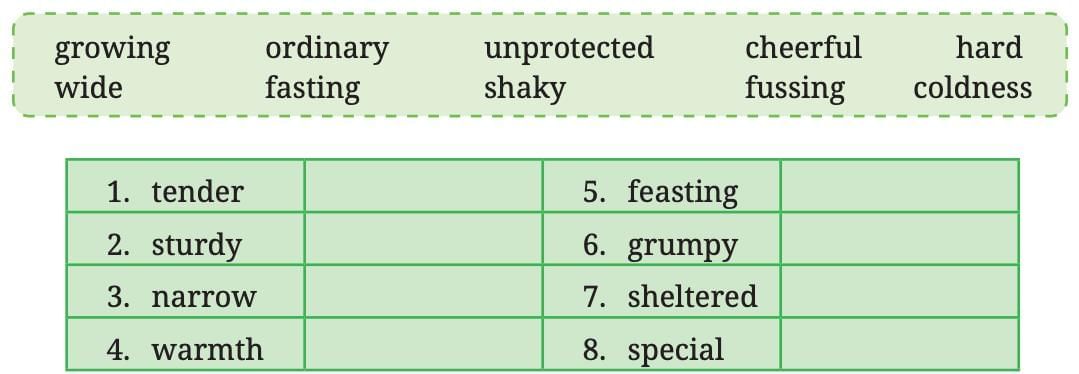
III. Choose the correct antonyms for the textual words given below from the box. There are two extra words that you will not need.Ans:
- tender: hard
- sturdy: shaky
- narrow: wide
- warmth: coldness
- feasting: fasting
- grumpy: cheerful
- sheltered: unprotected
- special: ordinary
IV. Read the following lines from the text and underline all the verbs and identify the form of tense.
1. Rakesh was on his way home from school when he bought the cherries.
2. Rakesh was looking for Grandfather without finding him in any of his favourite places around the house.
3. Rakesh and Grandfather gazed at the tree as though it had performed a miracle.
The forms of tenses in the given statements are Simple Past Tense(1 and 3), Past Progressive Tense (2), and Past Perfect Tense (3).
Now, fill in the blanks with the correct form of Simple Past, Past Progressive, or Past Perfect Tenses of the verbs given in brackets. One example has been done for you.
(i) I was sitting (sit) with my grandparents in the garden, sharing the wonderful memories from my childhood. As we (ii) ______________ (talk),I (iii) ______________ (realise) how much wisdom they (iv) ______________ (impart) to me over the years. WhileI (v) ______________ (listen) to their stories for hours together, I (vi) ______________ (remember) the times we(vii) ______________ (spend) together planting flowers and learning about life. By the time I left, the sun(viii) ______________ (set), and I (ix) ______________(feel) a deep sense of gratitude for the bond we(x) ______________ (nurture) through love, care, and countless memories.
Ans:
1. Rakesh was on his way home from school when he bought the cherries. Simple Past Tense
2. Rakesh was looking for Grandfather without finding him in any of his favourite places around the house. Past Progressive Tense
3. Rakesh and Grandfather gazed at the tree as though it had performed a miracle. Simple Past Tense, Past Perfect Tense
(i) I was sitting (sit) with my grandparents in the garden, sharing the wonderful memories from my childhood. As we (ii) were talking (talk), I (iii) realised (realise) how much wisdom they (iv) had imparted (impart) to me over the years. While I (v) was listening (listen) to their stories for hours together, I (vi) remembered (remember) the times we (vii) had spent (spend) together planting flowers and learning about life. By the time I left, the sun (viii) had set (set), and I (ix) felt (feel) a deep sense of gratitude for the bond we (x) had nurtured (nurture) through love, care, and countless memories.
V. Study the punctuation marks in the following sentences from the text.
- “Hey, not there,” said Grandfather, “I’ve sown mustard in that bed. Plant it in that shady corner, where it won’t be disturbed.”
- When Grandfather saw what had happened, he went after the woman and scolded her, but the damage could not be repaired.
- She did not try to avoid the tree: one sweep, and the cherry tree was cut in two.
Now, punctuate the following paragraph appropriately.
every sunday roshni would visit her grandparents house on their farm come sit grandpa would say patting the bench on their porch roshni loved these moments where the world slowed down and storiesflowed like magic grandma would bring tea her eyes twinkling with joy im excited to hear about your younger days the adventures the lessonsand the memories roshni said eagerly grandpa smiled softly his wrinkled hands resting on the cane ah the olddays… when everything was simple and happiness was all we had roshni could feel the warmth of those memories he sat in silence boundnot by words but by a timeless bond
Ans:
Every Sunday, Roshni would visit her grandparents’ house on their farm. “Come, sit,” Grandpa would say, patting the bench on their porch. Roshni loved these moments where the world slowed down and stories flowed like magic. Grandma would bring tea, her eyes twinkling with joy. “I’m excited to hear about your younger days—the adventures, the lessons, and the memories,” Roshni said eagerly. Grandpa smiled softly, his wrinkled hands resting on the cane. “Ah, the old days… when everything was simple, and happiness was all we had,” he said. Roshni could feel the warmth of those memories. They sat in silence, bound not by words but by a timeless bond.
Let us listen (Page 170)
I. You will listen to a conversation between a son and his mother. As you listen, select four true statements from 1–7 given below.
1. The mother encouraged her son to deliver a presentation on the Chipko Movement.
2. The son was surprised to know about the Appiko Movement.
3. The son agreed that the Chipko Movement was about people uniting to make an impact.
4. The mother expressed a desire to share more details about SaalumaradaThimakka.
5. The mother was curious to hear about Saalumarada Thimakka.
6. The mother and son were in disagreement about the work of JadavPayeng.
7. The son found the information on Jadav Payeng wonderful.
Ans: Please refer to the transcript.
Let us speak (Page 170)
A syllable is a single, unbroken vowel sound in a word. Some words have only one syllable. Some have two, and some more than two. For example, the word ‘tree’ has one syllable. The word ‘cherry’ has two syllables—che-rry. (Here the hyphen is used to mark the gap between the two syllables.)
A syllable can also be called a ‘beat’ because you can clap out the ‘beats’ in the word.
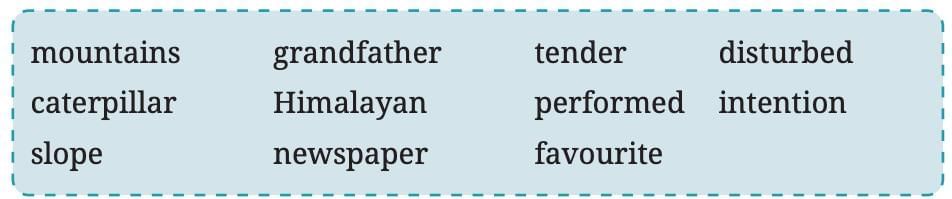
I. Work in pairs. Read aloud the following words from the text. Write the number of syllables in each word. Check your answers with your classmates and teacher.
Now, read the words aloud again with the beats. Check if the number of syllables matches with the number of beats.
Ans:
- mountains – 2 syllables
- grandfather – 3 syllables
- tender – 2 syllables
- disturbed – 3 syllables
- caterpillar – 4 syllables
- Himalayan – 4 syllables
- performed – 2 syllables
- intention – 3 syllables
- slope – 1 syllable
- newspaper – 3 syllables
- favourite – 3 syllables
II. Speak about Van Mahotsav Diwas and its significance. Before you speak in the class or assembly, prepare yourself on the following points:
- When is it celebrated?
- Who celebrates it?
- Why is it celebrated?
- How is it celebrated?
- What is the message it conveys?
Ans: - Van Mahotsav Diwas is celebrated in the first week of July every year.
- People across India, including students, farmers, and government officials, celebrate it.
- It promotes tree planting to save the environment and increase greenery.
- People plant trees, hold awareness campaigns, and organise events in schools and communities.
- It teaches us to protect trees and nature to ensure a healthy planet for the future.
Let us write (Page 171)
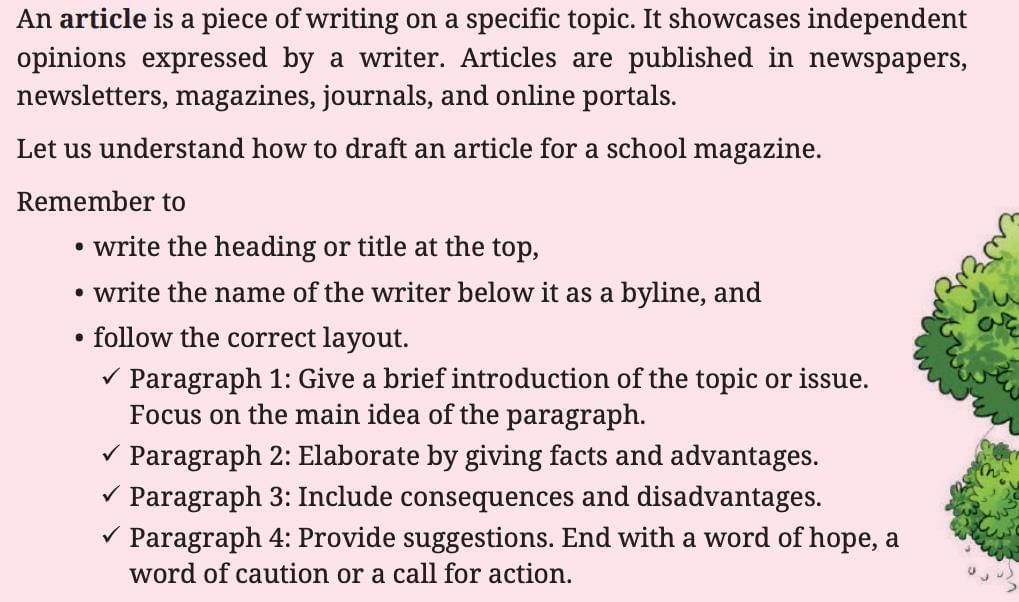
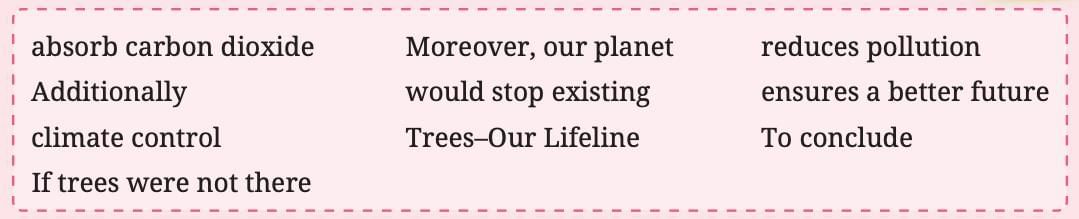
Now, complete the article for a magazine on ‘Trees–Our Lifeline’. Use the words and phrases given in the box below.
(i) ________________ -by ________________ (write your name and class)Trees are essential for life on Earth. Without them, life as we know (ii) ________________. This is the reason why trees are our lifeline. Trees provide us with food, shelter, and even medicine. Trees(iii) ________________ and release oxygen, helping us breathe. This process also(iv) ________________ and keeps the environment clean. (v) ________________, trees give us fruits, nuts, and other foods. Trees also help in (vi) ________________and prevention of soil erosion. (vii) ________________, the air would be polluted, and we would struggle to breathe. (viii) ________________ would be barren, lacking food, shelter, and life-giving greenery. (ix) ________________,trees are true friends. Protecting and planting trees (x) ________________ for everyone on Earth. Therefore, we must act now to protect and plant more trees, preserving Earth’s green lifeline for future generations.
Ans:
(i) Trees–Our Lifeline – by [Your Name] and Class
Trees are essential for life on Earth. Without them, life as we know it
(ii) would stop existing. This is the reason why trees are our lifeline. Trees provide us with food, shelter, and even medicine. Trees
(iii) absorb carbon dioxide and release oxygen, helping us breathe. This process also
(iv) reduces pollution and keeps the environment clean.
(v) Additionally, trees give us fruits, nuts, and other foods. Trees also help in
(vi) climate control and prevention of soil erosion.
(vii) If trees were not there, the air would be polluted, and we would struggle to breathe.
(viii) Moreover, our planet would be barren, lacking food, shelter, and life-giving greenery.
(ix) To conclude, trees are true friends. Protecting and planting trees
(x) ensures a better future for everyone on Earth. Therefore, we must act now to protect and plant more trees, preserving Earth’s green lifeline for future generations.