Sound is an essential part of our everyday life, coming to us in many different forms. But what is sound exactly?
Sound is a type of energy that creates a sensation of hearing. It is made by vibrations and travels in waves. It is important to understand that sound waves are a kind of mechanical wave, which means they need a medium (like air, water, or solids) to move through.
Key Characteristics of Sound
Nature of Sound: Sound is produced by vibrations and travels in waves.
Transmission: Sound requires a medium (such as air, water, or solids) to travel.
Loudness and Intensity: Loudness is how our ears respond to the intensity of sound.
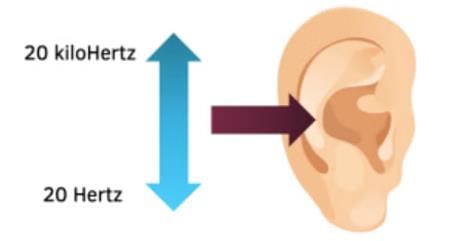
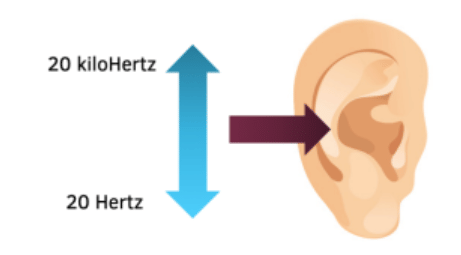
Audible Range: The typical range of hearing for most people is between 20 Hz and 20 kHz. Sounds below this range are called ‘infrasonic’, while those above are called ‘ultrasonic’.
When you clap, you create a sound. But can you make sound without using any energy? In this chapter, we will explore how sound is made, how it travels through different mediums, and how it is detected by our ears.
Production of Sound
Sound is created by objects that vibrate. It is a type of energy that we hear with our ears. When objects vibrate, they generate sound waves made of compressions and rarefactions, which are key to understanding how sound moves through the air. A compression is a part of the sound wave where the pressure is higher, while rarefaction is where the pressure is lower.
Activity:
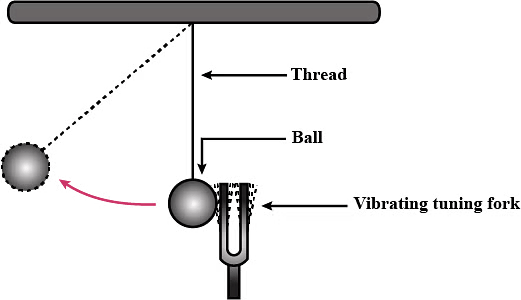
Vibrating tuning fork just touching the suspended Table Tennis ball
Objective: Observe how vibrations create sound and influence nearby objects.
Materials: Tuning fork, rubber pad, small ball (table tennis or plastic), thread, needle.
Procedure:
Strike the tuning fork against the rubber pad to make it vibrate.
Hold the vibrating fork near your ear and listen to the sound.
Touch a vibrating prong with your finger and feel the vibrations.
Hang a small ball using a thread. Lightly touch the ball with the vibrating fork and watch how it moves.
Observations:
The vibrating fork makes sound.
Touching the prong lets you feel the vibrations.
The ball moves when it is touched by the vibrating fork.
Conclusion: Vibrations create sound, and sound can also be produced by plucking, scratching, rubbing, blowing, or shaking different objects.
Sound can be generated through various actions that cause objects to vibrate. Vibration means the quick back-and-forth movement of an object. The sound of a human voice comes from vibrations in the vocal cords. When a stretched rubber band is plucked, it vibrates and makes sound.
Compression is the area of high pressure in a sound wave.
Rarefaction is the area of low pressure in a sound wave.
In brief, sound is made by vibrating objects, and grasping the ideas of compression and rarefaction is important for understanding how sound travels through different materials.
Try yourself:What is vibration?
A.The production of sound through striking objects
B.The motion of an object from side to side
C.The rapid to and fro motion of an object
D.The buzzing sound produced by bees
Propagation of Sound
Sound Propagation and Waves:
A wave is a disturbance that travels through a medium, causing its particles to move and set nearby particles in motion.
The particles themselves do not move forward; rather, the disturbance moves forward.
Sound can be thought of as a wave because it is the movement of particles in a medium.
Sound waves are known as mechanical waves because they depend on the movement of particles.
Sound can be seen as variations in density or pressure in the medium.
Sound Propagation in Air:
Air is the most common medium for sound transmission.
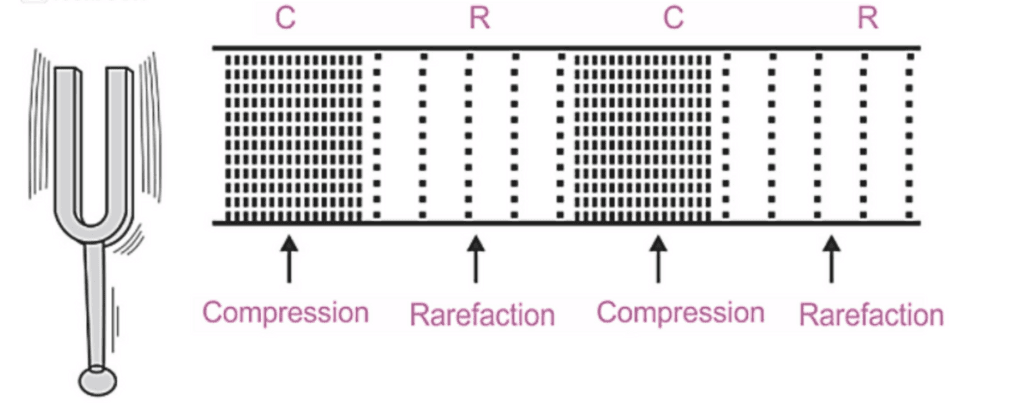
When a vibrating object moves forward, it compresses the air in front of it, creating a high-pressure area known as compression (C).
This compression then moves away from the vibrating object.
When the object moves backward, it creates a low-pressure area called rarefaction (R).
As the object oscillates quickly, it produces a series of compressions and rarefactions in the air, forming the sound wave.
Compression indicates high pressure, whereas rarefaction indicates low pressure.
Compression (C) & Rarefaction (R) of sound
Pressure relates to the number of particles in a given volume of the medium.
A higher density of particles results in more pressure, and a lower density results in less pressure.
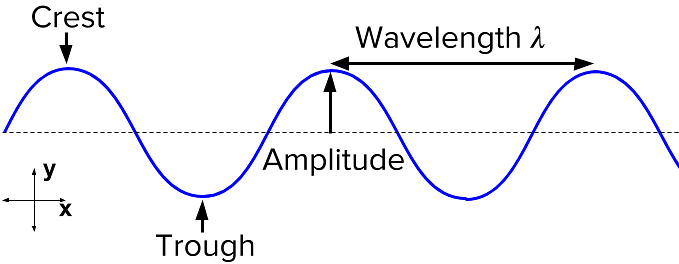
The distance between two consecutive compressions or rarefactions is known as the wavelength, λ.
The time taken for one complete oscillation of the density or pressure is called the time period, T.
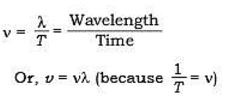
The speed (v), frequency (f), and wavelength (λ) of sound are connected by the equation: v = fλ.
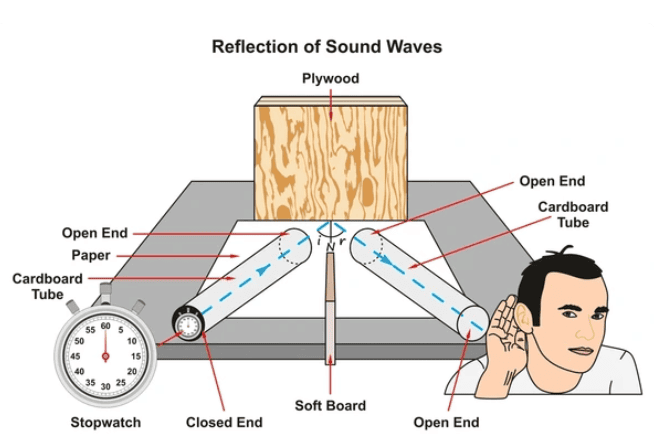
The law of reflection of sound states that the angles of incidence and reflection are equal concerning the normal to the reflecting surface at the point of incidence, and all three lie in the same plane.
Sound Waves are Longitudinal Waves
A wave is a disturbance that travels through a medium, causing its particles to move and set nearby particles in motion. The individual particles do not move forward themselves; instead, the disturbance moves through the medium.
Sound travels through the medium by a series of compressions (C) and rarefactions (R). These areas of closely packed and spaced out particles create longitudinal waves.
In longitudinal waves, the particles of the medium move in the same direction as the wave is travelling. They oscillate back and forth around their resting position without changing their location.
Sound waves are defined by how the particles in the medium move and are classified as mechanical waves. Air is the most common medium for sound transmission.
How Sound Waves Work
When a vibrating object moves forward, it compresses the air in front, creating a high-pressure area known as a compression (C).
When the object moves backward, it creates a low-pressure area called a rarefaction (R). Compression refers to high pressure, while rarefaction refers to low pressure.
Pressure is linked to the number of particles in a given volume; a denser medium results in higher pressure, and a less dense medium results in lower pressure.
Transverse Waves
Another type of wave is called a transverse wave. In these waves, particles do not move in the same direction as the wave travels but rather move up and down around their average position.
This means that in transverse waves, the individual particles move at a right angle to the direction of wave travel.
An example of a transverse wave is the ripples created on the surface of water when a pebble is dropped into it.
Try yourself:In longitudinal waves, how do particles of the medium move in relation to the direction of wave propagation?
A.Perpendicular to the direction of wave propagation
B.Parallel to the direction of wave propagation
C.Back and forth around their position of rest
D.They remain stationary
Characteristics of a Sound Wave
We can describe a sound wave by its:
Frequency
Amplitude
Speed
Key Characteristics of Sound Waves
Sound waves can be described by their frequency, amplitude, and speed.
The density and pressure of the medium change with distance as the sound wave travels.
Compressions are areas of high density and pressure, while rarefactions are areas of low pressure.
Wavelength is the distance between two consecutive compressions or rarefactions, represented by λ (lambda) with the SI unit of metre.
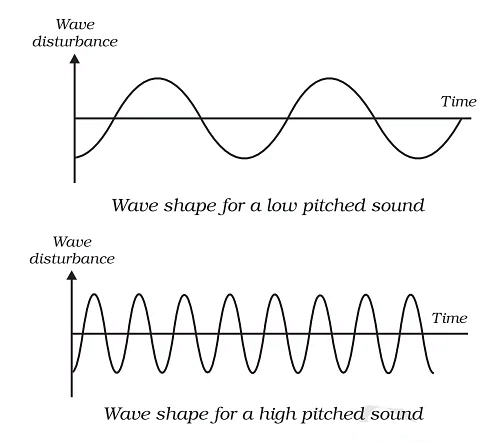
Frequency represents the number of oscillations per unit time and is measured in hertz (Hz), usually represented by ν (Greek letter, nu).
The time period (T) is the time taken for one complete oscillation, and frequency and time period are inversely related.
The audible range of hearing for average human beings is in the frequency range of 20 Hz – 20 kHz.
Sound waves with frequencies below the audible range are called “infrasonic,” and those above are called “ultrasonic.”
Pitch, Amplitude, and Loudness
Pitch is determined by the frequency of the sound wave, where higher frequency corresponds to a higher pitch.
Amplitude refers to the size of the maximum disturbance in the medium.
Loudness is a response of the ear to the intensity of sound, with greater amplitude producing a louder sound.
The loudness of a sound decreases as it travels further from its source.
Quality and Speed of Sound
Quality or timbre refers to the feature that distinguishes one sound from another with the same pitch and loudness.
Sound waves with a single frequency are called tones, while those with a mix of frequencies are called notes.
The speed of sound is the distance travelled by a point on a wave per unit time, calculated as Speed of sound = wavelength × frequency.
The speed of sound depends mainly on the nature and the temperature of the transmitting medium.
Intensity of Sound
Intensity of sound refers to the amount of sound energy passing through a unit area per second.
Loudness is a response of the ear to the intensity of sound.
Even sounds with the same intensity can be heard as different loudness due to differences in the ear’s sensitivity.
Speed of Sound In Different Media
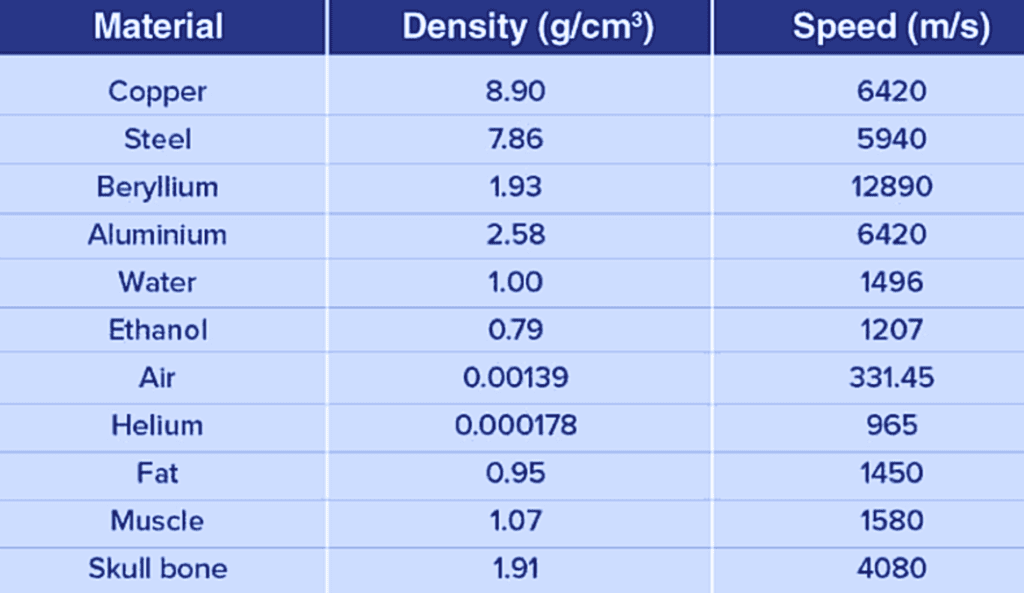
Sound travels through a medium at a finite speed, which is slower than the speed of light.
The speed of sound depends on the properties of the medium and is affected by temperature; as temperature rises, the speed of sound in the medium increases.
The speed of sound varies in different media at a given temperature and decreases when moving from a solid to a gas.
Raising the temperature in a medium generally increases the speed of sound.
What is the definition of sound?
A.Sound is a type of energy that makes us see things through our eyes.
B.Sound is a form of energy that makes us hear things through our ears.
C.Sound is a type of energy that makes us taste things with our tongues.
D.Sound is a form of energy that makes us feel things with our hands.
Reflection of Sound
Sound waves behave like a rubber ball bouncing off a wall when they hit a solid or liquid surface.
Similar to light, sound follows the laws of reflection that you may have studied before.
When sound strikes a surface, it reflects in such a way that the angles of incidence and reflection are equal in relation to the normal (a line that is perpendicular to the surface) at the point where it hits.
These angles and the normal line are all in the same plane.
For sound waves to reflect, they need a sufficiently large obstacle, regardless of whether it is smooth or rough.
Echo
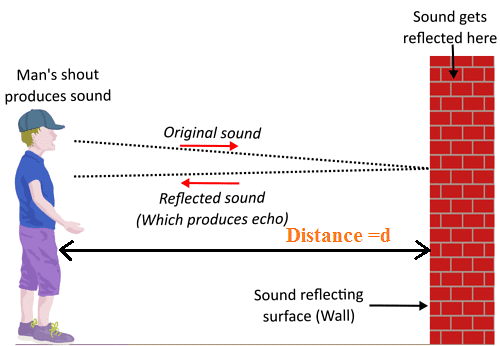
An echo is the sound we hear when the original sound is bounced back to us. The sensation of sound lingers in our brain for about 0.1 seconds.
Yelling or clapping near a suitable reflecting surface can create an echo.
Man producing echo
Conditions for Hearing a Distinct Echo
To hear a clear echo, there must be a time gap of at least 0.1 seconds between the original sound and the reflected sound. If we consider the speed of sound to be 344 m/s at a temperature of 22 °C in air, the total distance the sound travels must be at least (344 m/s) × 0.1 s = 34.4 m.
For a distinct echo, the minimum distance between the sound source and the reflecting surface should be half of the total distance, which is 17.2 metres. This distance can change depending on the temperature of the air.
Echoes can happen more than once because of repeated reflections.
Reverberation
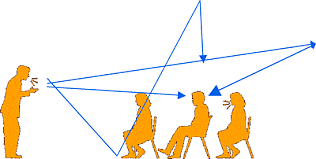
When a sound is made in a large hall, it continues to exist because of multiple reflections from the walls until its intensity decreases enough that it can no longer be heard. This ongoing presence of sound due to reflections is known as reverberation.
Reverberation of Sound
Too much reverberation in an auditorium or large hall is not desirable.
To reduce reverberation, the walls and ceiling of the auditorium are usually covered with materials that absorb sound, such as compressed fibreboard, rough plaster, or curtains.
Additionally, the materials used for seating are selected for their sound-absorbing properties.
Question: A person clapped his hands near a cliff and heard the echo after 2 s. What is the distance of the cliff from the person if the speed of sound, v, is taken as 346 m/s?
Solution: Given,
Speed of sound: 346 m/s
Time taken for hearing the echo: 2 s
Distance travelled by the sound
Distance = 346 m/s × 2 s = 692 m
In 2 seconds, sound travels twice the distance between the cliff and the person.
Therefore, the distance between the cliff and the person is: Distance = 692 m / 2 = 346 m
Minimum Distance for Distinct Echoes
To hear distinct echoes, the minimum distance of the obstacle from the source of sound must be half of the total distance covered by the sound, which is at least 17.2 m.
This distance can change with temperature, as the speed of sound varies with temperature.
Uses of Multiple Reflections of Sound
Megaphones and Loudhailers: These devices are made to direct sound in a specific direction rather than spreading it everywhere. They usually have a tube and a conical opening that reflect sound waves, directing most of the sound towards the audience.
Stethoscopes: A stethoscope is a medical instrument used by doctors to listen to sounds inside the body, especially in the heart or lungs. The sound of the patient’s heartbeat reaches the doctor’s ears through multiple reflections of sound within the stethoscope.
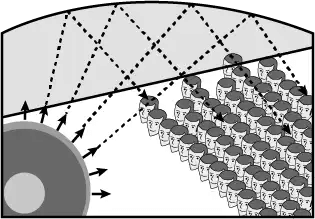
Auditoriums and Concert Halls: In concert halls, conference rooms, and cinemas, the ceilings are often curved to make sure that sound reaches every corner of the hall. This helps to spread sound evenly throughout the space. The rolling of thunder is another example, caused by the repeated reflections of sound from different surfaces, like clouds and the ground.
Curved ceiling of conference hall
Try yourself:What is the minimum time interval required for a distinct echo to be heard?
A.0.01 seconds
B.0.1 seconds
C.1 second
D.10 seconds
Range of Hearing
The range of sound that humans can hear is from about 20 Hz to 20,000 Hz (where one Hz equals one cycle per second). Children under five years old and some animals, like dogs, can hear sounds up to 25 kHz (one kHz equals 1000 Hz).
As people age, their ears become less responsive to higher frequencies.
Sounds that are below 20 Hz are known as infrasonic sound or infrasound. If we were able to hear infrasound, we might perceive vibrations like those of a pendulum, similar to how we hear a bee’s wings.
Rhinoceroses communicate using infrasound at frequencies as low as 5 Hz. Animals like whales and elephants also produce sounds in the infrasound range.
It has been noted that some animals can detect low-frequency infrasound before earthquakes occur. Earthquakes generate low-frequency infrasound prior to the main shock waves, which may warn the animals.
Frequencies above 20 kHz are referred to as ultrasonic sound or ultrasound. Animals such as dolphins, bats, and porpoises produce ultrasound.
Certain moths have exceptionally sensitive hearing, enabling them to hear the high-frequency sounds made by bats, helping them to escape. Additionally, rats can create ultrasound during play.
Ultrasound has various applications in both medical and industrial fields.
Try yourself:What is the upper limit of the audible range for children under five years old and some animals?
A.10,000 Hz
B.15,000 Hz
C.20,000 Hz
D.25,000 Hz
Applications of Ultrasound
1. Cleaning Hard-to-Reach Objects
Objects are placed in a cleaning solution while ultrasonic waves are sent through it.
The high frequency of the waves causes dust, grease, and dirt to detach and fall away.
This method ensures thorough cleaning, even in complex shapes like spiral tubes or electronic components.
2. Detecting Cracks and Flaws
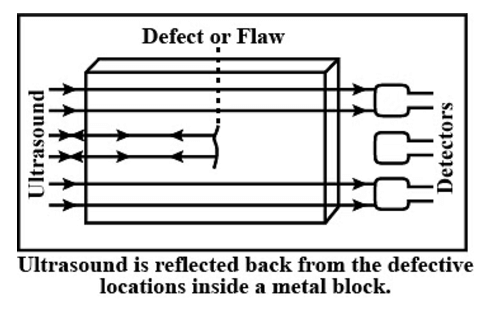
Ultrasound is used to identify cracks and flaws in metal blocks used in construction.
Ordinary sounds with longer wavelengths cannot detect these flaws as they bend around corners.
Ultrasonic waves pass through the metal block, and detectors identify the transmitted waves.
If there is a defect, the ultrasound reflects back, indicating the presence of a flaw.
3. Echocardiography
Ultrasonic waves are reflected from different parts of the heart to create an image.
Echocardiography is essential for diagnosing heart conditions and abnormalities.
4. Ultrasonography
Ultrasonic waves are used to image internal organs of the human body.
A doctor can examine organs like the liver, gall bladder, uterus, and kidneys.
Changes in tissue density cause the waves to reflect, turning into electrical signals.
These signals create images that help detect abnormalities, such as stones or tumours.
Ultrasonography is especially useful during pregnancy to check for congenital defects and growth issues.
5. Medical Treatment: Kidney Stone Breakage
Ultrasound can break small kidney stones into fine pieces.
The fragments can then be flushed out through urine, avoiding invasive procedures.


 Compression (C) & Rarefaction (R) of sound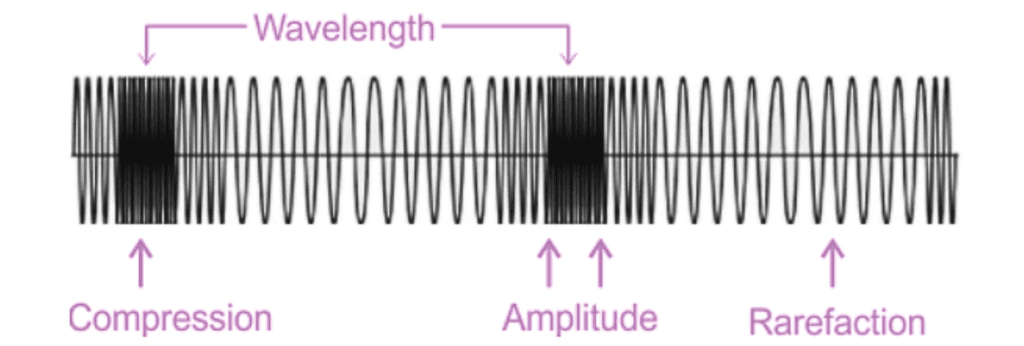
 Man producing echo
 Reverberation of Sound