Q1: What was the barter system?
Ans: The barter system was the exchange of goods and services without using money.
Q2: What was a major problem with the barter system?
Ans: A major problem with the barter system was the double coincidence of wants, meaning both parties had to want what the other offered.
Q3: What is money?
Ans: Money is a common tool used for buying and selling goods and services.
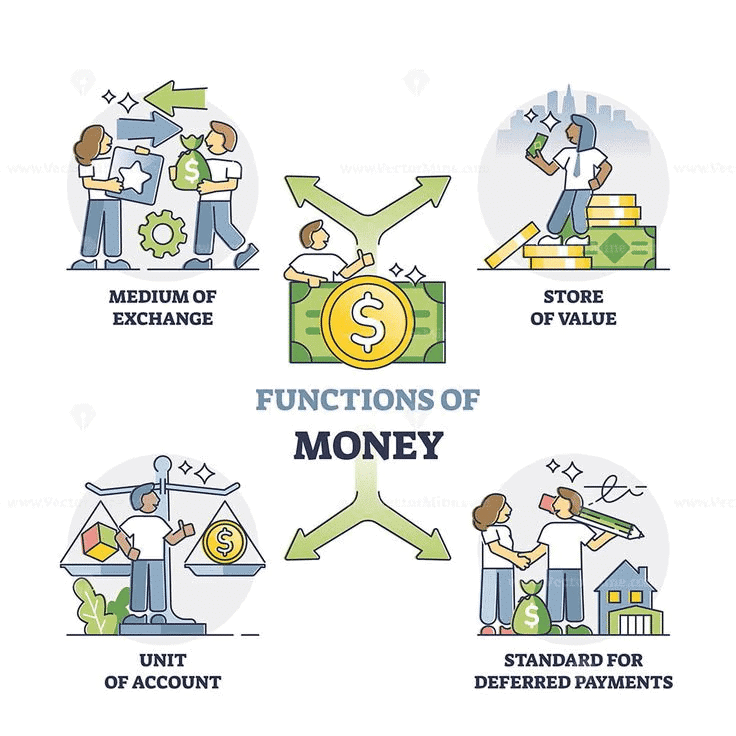
Functions of Money
Q4: Who is John Maynard Keynes?
Ans: John Maynard Keynes was an economist who said that money connects the present to the future by helping us save and spend later.
Q5: Why did the barter system become inefficient?
Ans: The barter system became inefficient due to problems like the difficulty of finding someone who wanted what you offered and the inability to divide goods like cattle.
Q6: How does money solve the problems of the barter system?
Ans: Money solves these problems by being portable, divisible, durable, and a standard measure of value.
Q7: What is meant by “double coincidence of wants”?
Ans: Double coincidence of wants means both parties in a trade must want what the other offers, which is rare and difficult.
Q8: How is money different from goods in the barter system?
Ans: Money is portable, divisible, and accepted by everyone, unlike goods which may not be easily traded or split.
Q9: What is the importance of the medium of exchange function of money?
Ans: The medium of exchange function allows money to be used universally for buying and selling goods and services.
Q10: How does money serve as a store of value?
Ans: Money serves as a store of value by allowing people to save it and use it later, unlike perishable goods like wheat.
Q11: What does “common denomination” mean in the context of money?
Ans: Common denomination means money is used to measure the value of goods, making it easy to compare prices.
Q12: What is a “standard of deferred payment”?
Ans: A standard of deferred payment means money can be used to make payments later, as in buying goods on credit.
Q13: What are “cowrie shells” in relation to money?
Ans: Cowrie shells were used as money in ancient times in different parts of the world, including India.
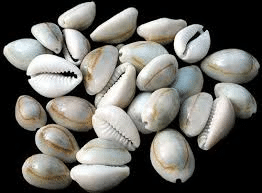
Cowrie Shells
Q14: What are “Rai stones”?
Ans: Rai stones were large stone discs used as money in Micronesia, symbolizing wealth.
Q15: Why were coins important in the history of money?
Ans: Coins were important because they provided a standardized, easily recognizable form of money made from precious metals like gold and silver.
Q16: What were “kārshāpanas” in ancient India?
Ans: Kārshāpanas were ancient Indian coins made from precious metals, used for transactions in the Mauryan Empire.
Q17: What was the role of the Roman coins in India?
Ans: Roman coins found in Tamil Nadu and Kerala show that India had strong maritime trade connections with the Roman Empire.
Q18: When was paper currency introduced in India?
Ans: Paper currency was introduced in India in the late 18th century by banks like the Bank of Bengal and Bank of Bombay.
Q19: What are modern banknotes in India made of?
Ans: Modern Indian banknotes are made of cotton paper, with special features like raised marks for the visually impaired.
Q20: What is the ₹ symbol, and who designed it?
Ans: The ₹ symbol represents the Indian Rupee and was designed by Udaya Kumar in 2010, combining Devanagari and Roman characters.
Q21: What is digital money?
Ans: Digital money refers to intangible money that exists electronically, such as through mobile payments or bank transfers.
Q22: What are QR codes used for in modern transactions?
Ans: QR codes are used for digital payments, allowing customers to pay directly from their bank accounts using their phones.
Q23: What is UPI?
Ans: UPI (Unified Payments Interface) is a digital payment system that enables instant transfer of money between bank accounts using smartphones.
Q24: How did the introduction of paper currency benefit trade?
Ans: Paper currency made it easier to carry large sums of money for trade and reduced the need to transport heavy coins.
Q25: What is one example of a modern barter system in India?
Ans: The Junbeel Mela in Assam is a modern example where people exchange roots, vegetables, and handmade goods for food items like rice cakes.