Page No: 64
Oral Comprehension Check
Q1: What are the elders in Goa nostalgic about?
Ans: The elders in Goa are nostalgic about the good old Portuguese days and their love for the famous bread loaves. The writer also mentions that although the eaters of loaves have vanished, the bread makers still do exist.
Q2: Is bread-making still popular in Goa? How do you know?
Ans: Yes, bread-making is still popular in Goa. It is evident from the fact that the bread makers still exist, though the eaters have gone away. The presence of the mixers, moulders, the ones who bake the loaves and the time-tested furnaces are a proof of their existence
Q3: What is the baker called?
Ans: The bakers are known as pader.
Q4: When would the baker come every day? Why did the children run to meet him?
Ans: The baker came twice every day, once when he set out in the morning on his selling round, and then again when he returned after emptying his huge basket. The children ran to meet him not because of their love of the loaf, which was bought by the maid-servant of the house. They actually longed for the bread bangles, which they chose carefully. Sometimes, it was a sweet bread of special make.
Page No: 65
Oral Comprehension Check
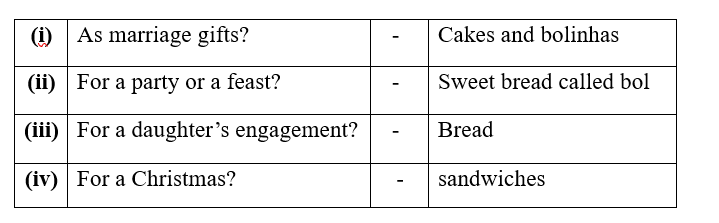
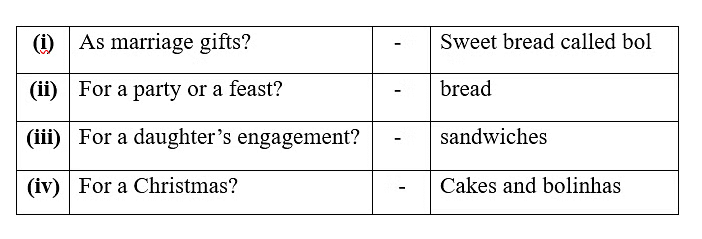
Q1: Match the following. What is a must Ans:Q2: What did the bakers wear: (i) in the Portuguese days? (ii) when the author was young?
Ans: (i) In the Portuguese days, the bakers had a peculiar dress known as the kabai. It was a single-piece long frock reaching down to the knees.
(ii) When the author was young, he saw the bakers wearing a shirt and trousers, which were shorter than full-length ones and longer than half pants.
Q3: Who invites the comment − “he is dressed like a pader”? Why?
Ans: Anyone who wears a half-pant that reaches just below the knees invites the comment that “he is dressed like a pader”. This was so because the bakers were known as pader and they wore such half pants.
Q4: Where were the monthly accounts of the baker recorded?
Ans: The bakers usually collected their bills at the end of the month and their monthly accounts were recorded on some wall in the house with a pencil.
Q5: What does a ‘jackfruit-like appearance’ mean?
Ans: A ‘jackfruit-like appearance’ means a plump physique. Such a physique was linked to the bakers because they never starved. Baking was a profitable profession. The baker, his family, and his servants always looked happy and prosperous and had a ‘jackfruit-like appearance’.
Page No: 66
Thinking About the Text
Q1: Which of these statements are correct?
(i) The pader was an important person in the village in the old times.
(ii) Paders still exist in Goan villages.
(iii) The paders went away with the Portuguese.
(iv) The paders continue to wear a single-piece long frock.
(v) Bread and cakes were an integral part of Goan life in the old days.
(vi) Traditional bread-baking is still a very profitable business.
(vii) Paders and their families starve in the present times.
Ans:
(i) Correct
(ii) Correct
(iii) Incorrect. The paders still exist in Goan villages.
(iv) Incorrect. The priests wear shirts and trousers that are shorter than full-length ones and longer than half pants.
(v) Incorrect. Bread and cakes are still an integral part of Goan life.
(vi) Correct
(vii) Incorrect. Baking is still a very profitable business in Goa.
Q2: Is bread an important part of Goan life? How do you know this?
Ans: Yes, bread is an important part of Goan life. It is often used for marriage gifts and feasts. Bread is also used by mothers for preparing sandwiches during their daughters’ engagement. The author mentions that the fragrance of fresh loaves is loved by everyone in Goa. The elders are served loaves and the youngsters long for bread-bangles. Therefore, it is necessary to have bread for all occasions in every household. Baking is therefore considered a profitable business in Goa as people have loved tasty bread since the Portuguese days.
Q3: Tick the right answer. What is the tone of the author when he says the following?
(i) The thud and the jingle of the traditional baker’s bamboo can still be heard in some places. (nostalgic, hopeful, sad)
(ii) Maybe the father is not alive but the son still carries on the family profession. (nostalgic, hopeful, sad)
(iii) I still recall the typical fragrance of those loaves. (nostalgic, hopeful, naughty)
(iv) The tiger never brushed his teeth. Hot tea could wash and clean up everything so nicely, after all. (naughty, angry, funny)
(v) Cakes and bolinhas are a must for Christmas as well as other festivals. (sad, hopeful, matter-of-fact)
(vi) The baker and his family never starved. They always looked happy and prosperous. (matter-of-fact, hopeful, sad)
Ans: (i) Nostalgic
(ii) Hopeful
(iii) Nostalgic
(iv) Funny
(v) Matter-of-fact
(vi) Matter-of-factPage No: 78
Writing
I. In this extract, the author talks about traditional bread-baking during his childhood days. Complete the following table with the help of the clues on the left. Then write a paragraph about the author’s childhood days.
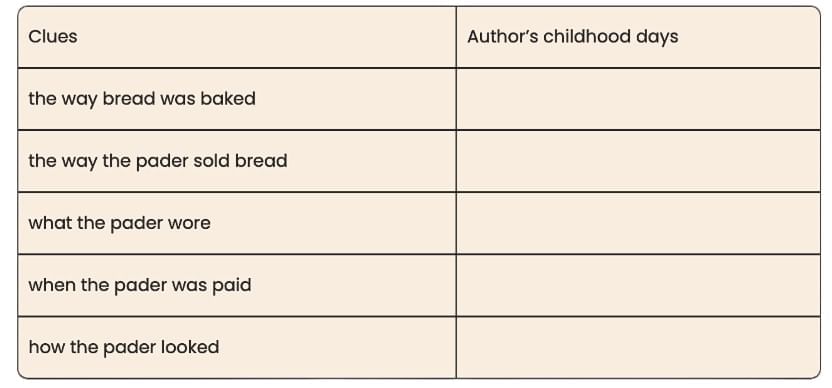
Ans:

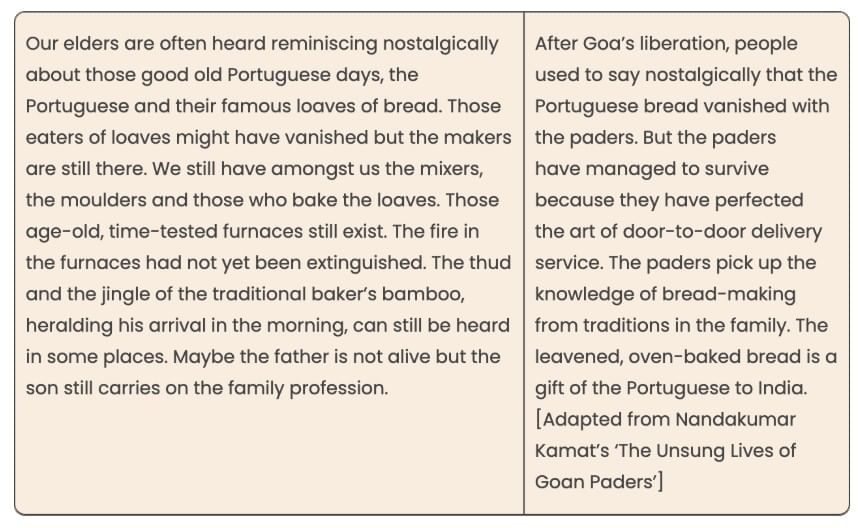
II. Q1: Compare the piece from the text (on the left below) with the other pieceon Goan bakers (on the right). What makes the two texts so different?Are the facts the same? Do both writers give you a picture of the baker?
Q2: Now find a travel brochure about a place you have visited. Look at thedescription in the brochure. Then write your own account, adding detailsfrom your own experience, to give the reader a picture of the place,rather than an impersonal, factual description.
Ans: Do it Yourself!
Page No: 70
Thinking about the Text
Q1: Where is Coorg?
Ans: Coorg is the smallest district of Karnataka, located midway between Mysore and Mangalore.
Q2: What is the story about the Kodavu people’s descent?
Ans: The fiercely independent people of Coorg are believed to be the descendants of people of Greek or Arabic origin. As the story goes, a section of Alexander’s army moved south along the coast and settled there when they could not return to their country. These people married amongst the locals and their culture is apparent in the martial traditions, marriage and religious rites, which are distinct from the Hindu mainstream. This is the beautiful story about the Kodavu people’s descent.
Q3: What are some of the things you now know about
(i) the people of Coorg?
(ii) the main crop of Coorg?
(iii) the sports it offers to tourists?
(iv) the animals you are likely to see in Coorg?
(v) its distance from Bangalore, and how to get there?
Ans:
(i)The people of Coorg are independent. They are of Greek or Arabic descent. They have a tradition of hospitality. They enjoy recounting numerous tales of valor related to their sons and fathers. Kodavas are the only people in India permitted to carry firearms without a license. The author has described the people of Coorg as a proud race of martial men and beautiful women.
(ii) Coffee is the main crop of Coorg. The air smells of invigorating coffee. Coffee estates and colonial bungalows stand tucked under tree canopies in prime corners of the town.
(iii) The sports that Coorg offers to tourists are river rafting, canoeing, rappelling, rock climbing, mountain biking, and trekking.
(iv) The animals that you are likely to see in Coorg include Macaques, Malabar squirrels, langurs, slender lorises, wild elephants, etc. You can also see birds, bees and butterflies giving you company around the corner.
(v) By road, Coorg is around 250 – 260 kilometres from Bangalore and there are two routes to reach there. One route is via Mysore, which is the most frequented one. The other route is via Neelamangal, Kunigal and Chanrayanapatna.
Page No: 71
Q4: Here are six sentences with some words in italics. Find phrases from the text that have the same meaning. (Look in the paragraphs indicated)
(i) During monsoons, it rains so heavily that tourists do not visit Coorg. (para 2)
(ii) Some people say that Alexander’s army moved south along the coast and settled there. (para 3)
(iii) The Coorg people are always ready to tell stories of their sons’ and fathers’ valor. (para 4)
(iv) Even people who normally lead an easy and slow life get smitten by the high-energy adventure sports of Coorg. (para 6)
(v) The theory of Arab origin is supported by the long coat with embroidered waist-belt they wear. (para 3)
(vi) Macaques and Malabar squirrels observe you carefully from the tree canopy. (para 7)
Ans:
(i) Keep many visitors away
(ii) as one story goes
(iii) are more than willing to recount
(iv) The most laidback individuals become converts to
(v) draws support from
(vi) keep a watchful eye

Thinking about the Language
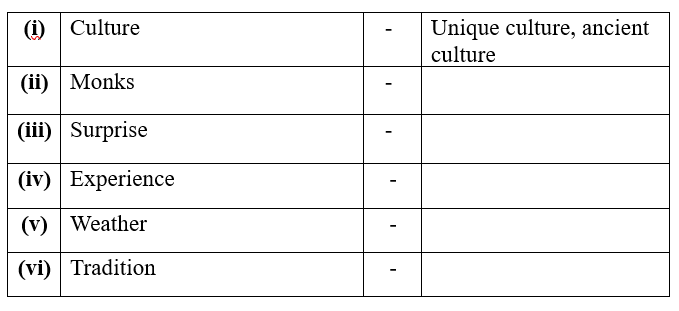
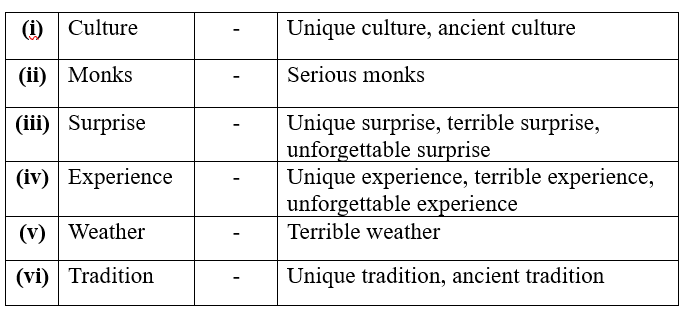
Q1: Here are some nouns from the text.Work with a partner and discuss which of the nouns can collocate with which of the adjectives given below. The first one has been done for you.

Ans:
Page No. 72
Q2: Complete the following phrases from the text. For each phrase, can you find at least one other word that would fit into the blank?
(i) tales of _______________
(ii) coastal _______________
(iii) a piece of ______________
(iv) evergreen ______________
(v) _____________ plantations
(vi) _____________bridge
(vii) wild __________________
You may add your own examples to this list.
Ans: From the text
(i) tales of valor
(ii) coastal town
(iii) a piece of heaven
(iv) evergreen rainforests
(v) coffee plantations
(vi) rope bridge
(vii) wild elephants
Other than the text
(i) tales of morality
(ii) coastal food
(iii) a piece of cake
(iv) Evergreen hero
(v) crop plantations
(vi) sturdy bridge
(vii) wild animals
Thinking about the LanguageQ1: Look at these words: upkeep, downpour, undergo, dropout, walk-in. They are built up from a verb (keep, pour, go, drop, walk) and an adverb or a particle (up, down, under, out, in).
Use these words appropriately in the sentences below. You may consult a dictionary.
(i) A heavy ___________ has been forecast due to low pressure in the Bay of Bengal.
(ii) Rakesh will ___________major surgery tomorrow morning.
(iii) My brother is responsible for the ______________of our family property.
(iv) The ____________rate for this accountancy course is very high.
(v) She went to the Enterprise Company to attend a _______________ interview.
Ans:
(i) A heavy downpour has been forecast due to low pressure in the Bay of Bengal.
(ii) Rakesh will undergo major surgery tomorrow morning.
(iii) My brother is responsible for the upkeep of our family property.
(iv) The dropout rate for this accountancy course is very high.
(v) She went to the Enterprise Company to attend a walk-in-interview.
Q2: Now fill in the blanks in the sentences given below by combining the verb given in brackets with one of the words from the box as appropriate.

(i) The Army attempted unsuccessfully to ___________ the government. (throw)
(ii) Scientists are on the brink of a major ___________in cancer research. (break)
(iii) The State Government plans to build a ______________for Bhubaneswar to speed up traffic on the main highway. (pass)
(iv) Gautama’s ____________on life changed when he realized that the world is full of sorrow. (look)
(v) Rakesh seemed unusually _______________ after the game. (cast)
Ans: (i) The Army attempted unsuccessfully to overthrow the Government.
(ii) Scientists are on the brink of a major breakthrough in cancer research.
(iii) The State Government plans to build a bypass for Bhubaneswar to speed up traffic on the main highway.
(iv) Gautama’s outlook on life changed when he realized that the world is full of sorrow.
(v) Rakesh seemed unusually downcast after the game.
Page No: 75
Q1: Think of suitable −ing or −ed adjectives to answer the following questions.
How would you describe
(i) a good detective serial on television? ___________________
(ii) debate on your favorite topic ‘Homework Should Be Banned’?_______
(iii) how you feel when you stay indoors due to incessant rain?_____________
(iv) how do you feel when you open a present? __________________
(v) How did you feel when you watch your favorite program on television? _______________
(vi) the look on your mother’s face as you waited in a queue? ______________
(vii) how you feel when tracking a tiger in a tiger reserve forest?______________
(viii) the story you have recently read, or a film you have seen?______________
Ans:
(i) a good detective serial on television? Interesting
(ii) a debate on your favorite topic ‘Homework Should Be Banned’? Exciting
(iii) how you feel when you stay indoors due to incessant rain? Bored
(iv) how you feel when you open a present? Excited
(v) how you feel when you watch your favorite program on television? Interested
(vi) the look on your mother’s face as you waited in a queue? Tired
(vii) how you feel when tracking a tiger in a tiger reserve forest? Thrilled
(viii) the story you have recently read, or a film you have seen? Boring