Short Answer Questions
Q1. How does the Moon’s position in the sky change each day?
Ans: The Moon’s position shifts slightly eastward each day, so it is not in the same place at the same time. This is why its rise and set times also change daily.
Q2. Why does the Moon sometimes appear in the daylight?
Ans: The Moon can rise before sunset, sometimes in the afternoon. In such cases, it is visible in the sky while the Sun is still up.
Q3. What does the simple ball-and-lamp model of the Moon help us understand?
Ans: The model shows how sunlight falls on the Moon and creates different phases. By turning with the ball, we can see changes in the illuminated portion, similar to what happens in reality.
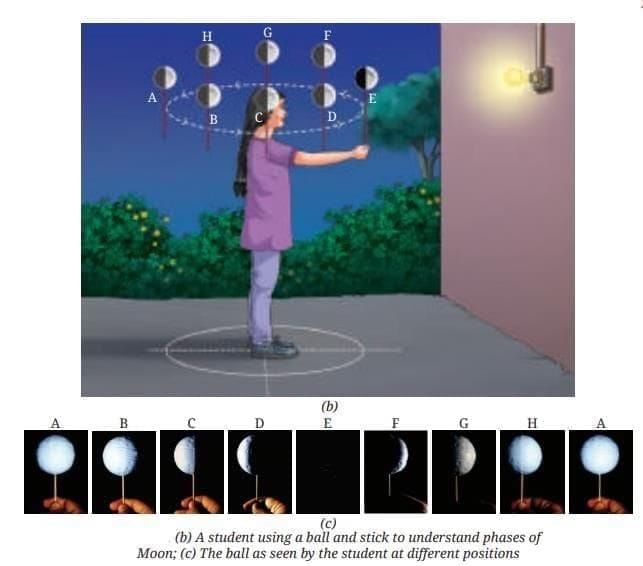
Q4. Why is the line between the bright and dark portions of the Moon always curved?
Ans: The Moon is spherical, so the dividing line between sunlight and shadow is curved. This curve is visible from Earth during all phases.
Q5. Why are Moon phases not caused by Earth’s shadow?
Ans: Moon phases happen because we see varying parts of its sunlit side as it orbits Earth. Earth’s shadow only causes a lunar eclipse, which is rare.
Q6. Why don’t we have eclipses every full Moon or new Moon?
Ans: The Moon’s orbit is tilted compared to Earth’s orbit. This tilt means the Sun, Earth, and Moon usually don’t line up perfectly.
Q7. How does the Sun’s apparent motion help us measure a day?
Ans: The Sun appears to move across the sky because Earth rotates on its axis. From one midday to the next takes about 24 hours, which we call a day.
Q8. What is the difference between a lunar year and a solar year?
Ans: A lunar year, based on 12 Moon cycles, is about 354 days. A solar year, based on Earth’s revolution around the Sun, is about 365¼ days.
Q9. How do luni-solar calendars align with the solar year?
Ans: They add an extra month every 2–3 years. This keeps lunar months in sync with the seasons of the solar year.
Q10. Why do solar festivals like Makar Sankranti slowly shift dates over centuries?
Ans: The sidereal year used in some calendars is slightly longer than the tropical year. This difference causes the date to drift by one day roughly every 71 years.
Q11. How does a satellite like Cartosat help in disaster management?
Ans: Cartosat provides high-quality images of Earth’s surface. These images help detect changes and assess damage during events like floods or cyclones.
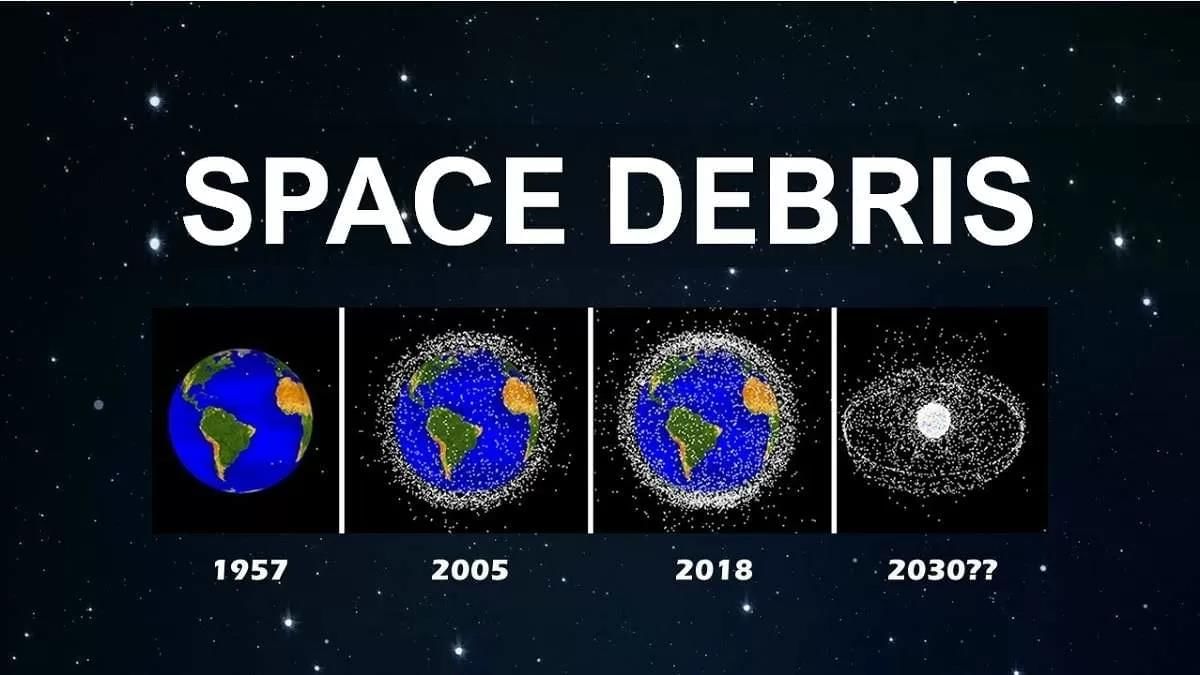
Q12. What is space debris and why is it a concern?
Ans: Space debris is non-functional satellites or rocket parts left in orbit. It can collide with working satellites and create hazards in space.
Long Answer Questions
Q1. Explain the waxing and waning periods of the Moon and how they form a monthly cycle.
Ans:
- The waxing period is when the bright portion of the Moon increases, starting from the new Moon and becoming full in about two weeks. The waning period is when the bright portion decreases, starting from the full Moon and becoming new Moon in about two weeks.
- Together, waxing and waning make a repeating cycle every month. This cycle takes about 29.5 days from one full Moon to the next.
- These changes occur because of the Moon’s revolution around Earth and the changing angle between the Sun, Earth, and Moon.
Q2. Describe the difference between crescent and gibbous phases of the Moon, and how they appear.
Ans:
- A crescent Moon appears when less than half of the Moon’s visible surface is illuminated. It can occur during both waxing and waning periods.
- A gibbous Moon appears when more than half, but not all, of the surface is lit. This also happens during both waxing and waning. These appearances change gradually as the Moon moves in its orbit around Earth.
Q3. How can a simple ball-and-lamp model help explain the phases of the Moon?
Ans:
- In this model, the ball represents the Moon, the lamp represents the Sun, and the observer’s head represents Earth. Holding the ball and moving in a circle around your head changes the portion of the ball lit by the lamp that you can see.
- When the ball is opposite the lamp, the lit side faces you completely, like a full Moon. When the ball is between your head and the lamp, the dark side faces you, like a new Moon. At other positions, you see partly lit shapes such as crescents or gibbous phases.
Q4. Why do eclipses not happen every new Moon or full Moon?
Ans:
- Although full Moons and new Moons happen every month, eclipses are rare. This is because the Moon’s orbit is slightly tilted compared to Earth’s orbit around the Sun.
- Most of the time, the Sun, Earth, and Moon are not perfectly aligned. A lunar eclipse can only happen when Earth’s shadow falls on the Moon, and a solar eclipse happens only when the Moon’s shadow falls on Earth. These alignments occur only a few times a year.
Q5. Explain how the motion of the Sun in the sky helps in measuring a day.
Ans:
- The Sun appears to rise in the east, move across the sky, and set in the west because Earth rotates on its axis. The highest position of the Sun in the sky, when shadows are shortest, marks noon.
- The time from one noon to the next is called a mean solar day. This length is about 24 hours, which is the basic unit for measuring time in days. This daily cycle has been used since ancient times to keep track of time.
Q6. Compare the main features of lunar, solar, and luni-solar calendars.
Ans:
- A lunar calendar is based on the Moon’s phases, with each month about 29.5 days and a year about 354 days. A solar calendar is based on Earth’s revolution around the Sun, giving a year of about 365 days, with leap years to adjust for the extra ¼ day.
- A luni-solar calendar combines lunar months with extra months added every few years to match the solar year. India uses luni-solar calendars for many festivals. Each system reflects the natural cycles of the Sun or Moon.
Q7. How are Indian festivals linked to astronomical events and calendar systems?
Ans:
- Many Indian festivals are set according to the phases of the Moon, such as Diwali on the new Moon and Holi on the full Moon. Others are based on solar positions, such as Makar Sankranti, which marks the Sun’s northward movement.
- Luni-solar calendars adjust dates to match both Moon phases and seasonal cycles. This is why festival dates change in the Gregorian calendar each year. These links show how culture and astronomy are closely connected.
Q8. Describe the uses of artificial satellites and give examples of Indian space missions.
Ans:
- Artificial satellites help in communication, navigation, weather monitoring, disaster management, and space research. Satellites like Cartosat provide high-quality images for mapping and disaster response.
- India’s space agency ISRO has launched missions like Chandrayaan for Moon study, Aditya-L1 for Sun research, and Mangalyaan for Mars exploration. AstroSat studies stars and galaxies, while student-built satellites encourage learning.
- These satellites are vital for science, safety, and everyday technology.