Probe and Ponder
1. Can we make mirrors which can give enlarged or diminished images?
Ans:
- Yes! Concave mirrors can make enlarged (bigger) images when objects are close, like a dentist’s mirror for seeing teeth better.
- Convex mirrors always make diminished (smaller) images, like side-view mirrors on cars that show a wider view but make things look tinier.
2. On side-view mirrors of vehicles, there is a warning that says “Objects in mirror are closer than they appear”. Why is this warning written there?
Ans:
- These are convex mirrors, which make images smaller and show a bigger area behind the vehicle.
- But because things look smaller, they seem farther away than they really are.
- The warning reminds drivers that cars or bikes might be closer to avoid accidents.
3. Why is there a curved line on some reading glasses?
Ans:
- Reading glasses often use convex lenses, which are curved to help focus light and make small text look bigger.
- The curve helps bend light rays to fix vision problems, like making far or near things clearer.
4. Share your questions
Ans: Here are some fun questions you might think of from the chapter:
- How does a magnifying glass make things look bigger?
- Why do spoons act like funny mirrors?
- Can lenses in our eyes change shape?
- What happens if you use a concave mirror to focus sunlight?
Keep the Curiosity Alive
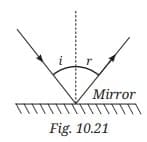
1. A light ray is incident on a mirror and gets reflected by it (Fig. 10.21). The angle made by the incident ray with the normal to the mirror is 40°. What is the angle made by the reflected ray with the mirror?
Ans: (ii) 50°.
The angle of incidence is 40° (between incident ray and normal). By the law of reflection, the angle of reflection is also 40°. So, the angle between the reflected ray and the mirror is 90° – 40° = 50°.
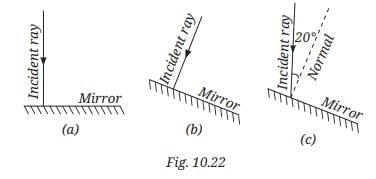
2. Fig. 10.22 shows three different situations where a light ray falls on a mirror:
(i) The light ray falls along the normal
(ii) The mirror is tilted, but the light ray still falls along the normal to the tilted surface.
(iii) The mirror is tilted, and the light ray falls at an angle of 20° from the normal.
Draw the reflected ray in each case (Use a ruler and protractor for accurate drawing). What is the angle of reflection in each case?
Ans: (i) When the ray falls along the normal, the reflected ray goes back along the same path. Angle of reflection = 0°.
(ii) For the tilted mirror with ray along the normal, reflected ray goes back along the normal. Angle = 0°.
(iii) For the ray at 20° to the normal, reflected ray is also at 20° to the normal on the other side. Angle of reflection = 20°.
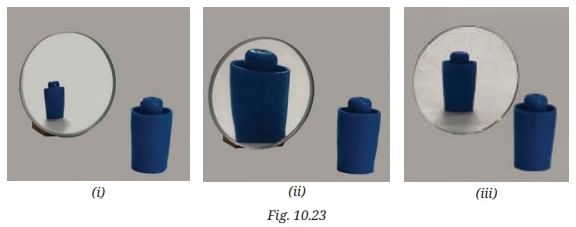
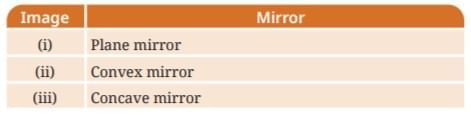
3. In Fig. 10.23, the cap of a sketch pen is placed in front of three types of mirrors. Match each image with the correct mirror.
Ans:
- (i) Convex mirror (small and erect).
- (ii) Concave mirror (enlarged image).
- (iii) Plane mirror (same size and erect).
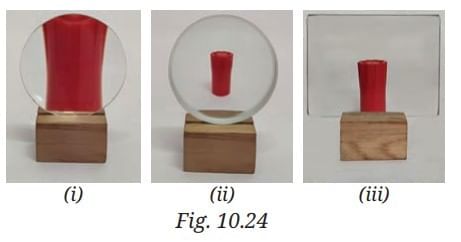
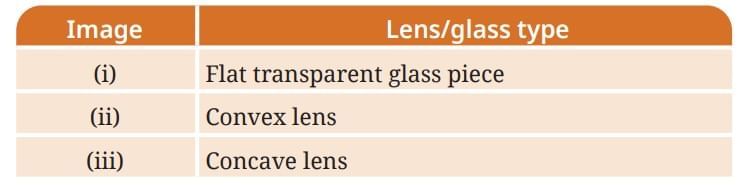
4. In Fig. 10.24 the cap of a sketch pen is placed behind a convex lens, a concave lens, and a flat transparent glass piece — all at the same distance. Match each image with the correct type of lens or glass.
Ans:
(i) Convex lens (enlarged if close).
(ii) Concave lens (diminished and erect).
(iii) Flat transparent glass piece (same size, no change).
5. When the light is incident along the normal on the mirror, which of the following statements is true:
(i) Angle of incidence is 90°
(ii) Angle of incidence is 0°
(iii) Angle of reflection is 90°
(iv) No reflection of light takes place in this case
Ans:
(ii) Angle of incidence is 0°.
The ray hits straight on, so incidence and reflection angles are both 0°, and it bounces straight back.
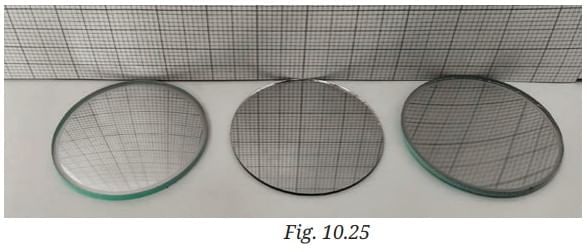
6. Three mirrors—plane, concave and convex are placed in Fig. 10.25. On the basis of the images of the graph sheet formed in the mirrors, identify the mirrors and write their names above the mirrors.
Ans: Left: Plane mirror (straight lines, same size).
Middle: Concave mirror (lines curve inward, can enlarge).
Right: Convex mirror (lines curve outward, diminished view).
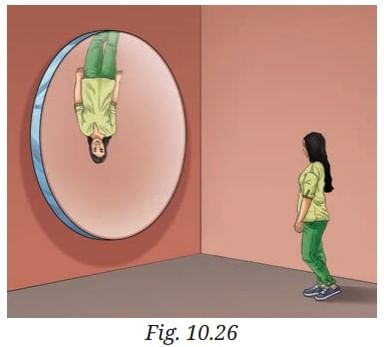
7. In a museum, a woman walks towards a large convex mirror (Fig. 10.26). She will see that:
(i) her erect image keeps decreasing in size.
(ii) her inverted image keeps decreasing in size.
(iii) her inverted image keeps increasing in size and eventually it becomes erect and magnified.
(iv) her erect image keeps increasing in size.
Ans: (i) her erect image keeps decreasing in size.
Convex mirrors always show erect, smaller images that get even tinier as you get closer.
8. Hold a magnifying glass over text and identify the distance where you can see the text bigger than they are written. Now move it away from the text. What do you notice? Which type of lens is a magnifying glass?
Ans: When close, the text looks bigger (enlarged and erect). As you move it away, the image might flip upside down and change size. A magnifying glass is a convex lens.
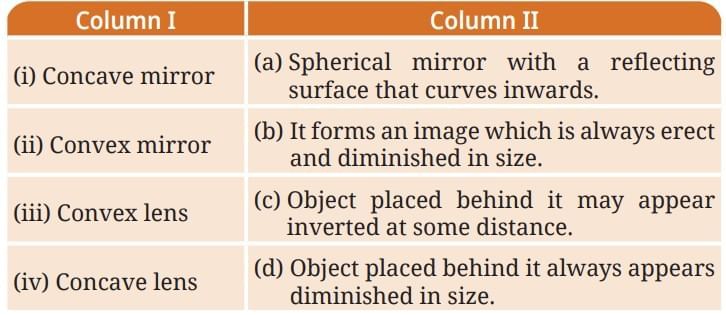
9. Match the entries in Column I with those in Column II.
Ans:
(i) Concave mirror – (a) Spherical mirror with a reflecting surface that curves inwards.
(ii) Convex mirror – (b) It forms an image which is always erect and diminished in size.
(iii) Convex lens – (c) Object placed behind it may appear inverted at some distance.
(iv) Concave lens – (d) Object placed behind it always appears diminished in size.
10. The following question is based on Assertion/Reason.
Assertion: Convex mirrors are preferred for observing the traffic behind us.
Reason: Convex mirrors provide a significantly larger view area than plane mirrors.
Choose the correct option:
(i) Both Assertion and Reason are correct and Reason is the correct explanation for Assertion.
(ii) Both Assertion and Reason are correct but Reason is not the correct explanation for Assertion.
(iii) Assertion is correct but Reason is incorrect.
(iv) Both Assertion and Reason are incorrect.
Ans: (i) Both Assertion and Reason are correct and Reason is the correct explanation for Assertion.
Convex mirrors give a wider view, helping see more traffic, even if images are smaller.
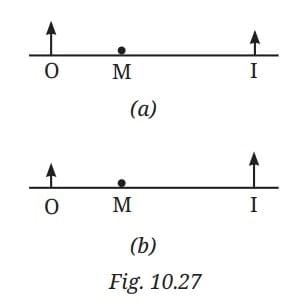
11. In Fig. 10.27, note that O stands for object, M for mirror, and I for image. Which of the following statements is true?
(i) Figure (a) indicates a plane mirror and Figure (b) indicates a concave mirror.
(ii) Figure (a) indicates a convex mirror and Figure (b) indicates a concave mirror.
(iii) Figure (a) indicates a concave mirror and Figure (b) indicates a convex mirror.
(iv) Figure (a) indicates a plane mirror and Figure (b) indicates a convex mirror.
Ans: Figure (a) indicates a convex mirror and Figure (b) indicates a concave mirror.
Concave mirror shows enlarged image; convex shows smaller image.
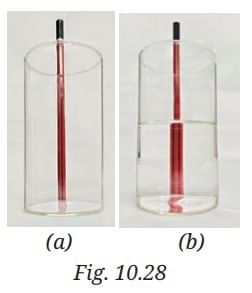
12. Place a pencil behind a transparent glass tumbler (Fig. 10.28a). Now fill the tumbler halfway with water (Fig. 10.28b). How does the pencil appear when viewed through the water? Explain why its shape appears changed.
The pencil looks bent or broken at the water surface. This is because light bends (refracts) when going from water to air, making the part in water look shifted.
Discover, Design, and Debate
1. Visit a nearby hospital or the clinic of an ENT specialist, or a dentist, with your teacher or parents. Request the doctor to show you the mirrors used for examining ear, nose, throat, and teeth. Identify the kind of mirror used in these instruments.
Ans: Dentists use concave mirrors to get a bigger, clearer view of your teeth—it makes small areas look enlarged so they can spot problems easily. ENT doctors also use concave mirrors (sometimes on a headband) to focus light and see inside your ear, nose, or throat better. These mirrors curve inwards to magnify things when held close. It’s safe and helps doctors do their job without hurting you!
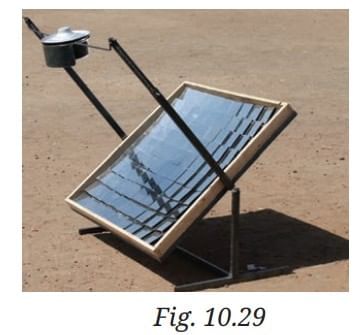
2. Harnessing sunlight is key to solving future energy challenges. In devices like solar cookers (Fig. 10.29), mirrors are used to converge sunlight and generate heat. In India, such designs are used in villages, thus saving electricity and reducing fossil fuel use. Think of a design for a solar cooker for your school or home and prepare a detailed proposal for it including the budget required.
Ans: Solar cookers are great for using free sunlight to cook food without gas or electricity—perfect for saving energy in villages or at home!
My Design Idea: Let’s make a simple box-type solar cooker. It’s like a cardboard box lined with shiny materials to trap heat. Inside, place a big concave mirror at the bottom to focus sunlight onto a black cooking pot (black absorbs heat better). Cover the top with a clear glass lid to let light in but keep heat inside. Add aluminum foil on the inside walls for extra reflection. You can adjust the box to face the sun.
How It Works: The concave mirror curves inwards to converge sunlight, making a hot spot on the pot to cook things like rice or veggies in 1-2 hours on a sunny day.
Materials and Budget (in ₹):
- Cardboard box (big enough for a pot): ₹100
- Aluminum foil (for lining and reflecting): ₹50
- Concave mirror (small one from a science kit): ₹150
- Glass sheet for lid: ₹200
- Black paint for the pot: ₹50
- Glue and tape: ₹50
Total Budget: ₹600. This is affordable and eco-friendly—try building it with friends and test cooking something simple!
3. Use online tools or animation to do virtual experiments with spherical mirrors and lenses. Move objects in the simulation and observe how the image changes.
Ans:
Activity: Use online tools to play with spherical mirrors and lenses. Move objects and see image changes.
Simple Answer: Go to free websites like PhET Interactive Simulations (search “PhET geometric optics” or “mirrors and lenses”). They’re like virtual labs!
What I Observed:
- Concave Mirror: Place an object close—it shows a big, upright (erect) image, great for magnifying. Move it farther—the image flips upside down (inverted) and gets smaller.
- Convex Mirror: Always shows a small, upright image that gives a wide view, like in car mirrors—things look tinier but you see more area.
- Convex Lens: Close object = big, upright image (like a magnifying glass). Far object = inverted and smaller.
- Concave Lens: Always small, upright images that spread out light—used in glasses to fix vision.
It’s super fun—change distances and see how images flip or resize. This helps understand why dentists use concave mirrors or why cameras have lenses!