Multiple Choice Questions (MCQs)
Instruction: Select the correct option for each question.
- Why can we sometimes see the Moon in the daytime?
a) The Moon produces its own light
b) The Moon is closer than the Sun
c) Moonrise can occur in the afternoon and the Moon reflects sunlight
d) The Sun is off during the day
Answer: c) Moonrise can occur in the afternoon and the Moon reflects sunlight
The Moon reflects sunlight and rises ~50 minutes later each day, so it can be above the horizon in daylight. - What causes the phases of the Moon?
a) Earth’s shadow falling on the Moon every night
b) Changing relative positions of the Sun, Earth, and Moon
c) Clouds covering the Moon
d) Changes in Moon’s shape
Answer: b) Changing relative positions of the Sun, Earth, and Moon
We see different portions of the Moon’s sunlit half as it orbits Earth. - Which day corresponds to no visible Moon in the sky?
a) Full Moon (Purnima)
b) Half Moon
c) New Moon (Amavasya)
d) Gibbous Moon
Answer: c) New Moon (Amavasya)
On new Moon day, the non-illuminated side faces Earth. - In India, the waxing period of the Moon is called:
a) Krishna Paksha
b) Shukla Paksha
c) Dakshinayana
d) Uttarayana
Answer: b) Shukla Paksha
Shukla Paksha is the brightening phase from new Moon to full Moon. - Which statement about eclipses is correct?
a) Lunar eclipses happen every full Moon
b) Phases are caused by eclipses
c) Lunar eclipses can occur only on full Moon day
d) Solar eclipses can occur only on full Moon day
Answer: c) Lunar eclipses can occur only on full Moon day
Eclipses need special alignment; lunar on full Moon, solar on new Moon. - The length of time from one full Moon to the next is about:
a) 7 days
b) 14 days
c) 29.5 days
d) 365 days
Answer: c) 29.5 days
This synodic month defines the lunar month. - The Gregorian calendar keeps the year aligned with seasons by:
a) Adding a month every year
b) Subtracting a week in winter
c) Adding a leap day every 4 years with century rules
d) Ignoring the extra quarter day
Answer: c) Adding a leap day every 4 years with century rules
Leap rule: divisible by 4; skip century years unless divisible by 400. - Which calendar combines lunar months with solar-year adjustments?
a) Pure lunar calendar
b) Solar calendar
c) Luni-solar calendar
d) Sidereal-only calendar
Answer: c) Luni-solar calendar
It inserts an extra month (e.g., Adhika Maasa) to sync with seasons. - Convex mirrors on vehicles carry the warning because they:
a) Invert the image
b) Magnify the image
c) Show diminished images that seem farther
d) Block sunlight
Answer: c) Show diminished images that seem farther
(Context link to earlier optics is fine) Convex mirrors give a wider view with smaller images. - Which ISRO mission is for studying the Sun?
a) Chandrayaan-2
b) Mangalyaan
c) Aditya L1
d) AstroSat only studies Earth
Answer: c) Aditya L1
Aditya L1 observes the Sun from a special orbit near L1.
Fill in the Blanks
Instruction: Fill in the blanks with the correct word based on the chapter.
- The changing bright shapes of the Moon seen from Earth are called its __________.
Answer: phases
Phases are waxing/waning shapes like crescent, gibbous, full, new. - The period from full Moon to new Moon is called __________ Paksha.
Answer: Krishna
Krishna Paksha is the waning fortnight. - The Moon does not emit light; it __________ sunlight.
Answer: reflects
Its surface reflects the Sun’s light. - The time from one noon (shortest shadow) to the next is about 24 hours and is called a __________ solar day.
Answer: mean
Mean solar day standardizes daily timekeeping. - A lunar month is about __________ days long.
Answer: 29.5
Full Moon to full Moon is ~29.5 days. - The Indian National (Saka) Calendar begins on __________ March in a normal year.
Answer: 22
In leap years, it begins on 21 March. - Years divisible by 4 are leap years, with exceptions for century years not divisible by __________.
Answer: 400
Century years must be divisible by 400 to be leap years. - Artificial satellites are human-made objects placed into __________ around Earth.
Answer: orbit
They circle Earth to provide services like communication and weather data. - Space junk from old satellites and rockets is called space __________.
Answer: debris
Debris can collide with working satellites. - Vikram Sarabhai is known as the Father of the Indian __________ programme.
Answer: space
VSSC is named in his honor.
Very Short Answer Questions
Instruction: Answer the following questions in one line.
- Why don’t eclipses happen every month?
Answer: The Moon’s orbit is tilted, so Sun–Earth–Moon don’t align perfectly most months. - Which phase shows more than half illuminated but not full?
Answer: Gibbous. - How much later does the Moon rise each successive day on average?
Answer: About 50 minutes later. - Name one festival linked to the new Moon.
Answer: Diwali (new Moon of Kartika). - Give one use of artificial satellites.
Answer: Weather monitoring (also communication, navigation, disaster management).
Short Answer Questions
Instruction: Answer the following questions in 2–3 lines.
- Explain why the Moon appears to change shape.
Answer: Half the Moon is always sunlit; as the Moon orbits Earth, we see varying fractions of the lit half. This changing view creates phases like crescent, gibbous, full, and new. - Differentiate waxing and waning phases.
Answer: Waxing (Shukla Paksha): illuminated portion grows from new to full. Waning (Krishna Paksha): illuminated portion decreases from full to new. - How do lunar, solar, and luni-solar calendars differ?
Answer: Lunar calendars track Moon phases (≈354 days/year). Solar calendars track Earth’s revolution and seasons (≈365 days). Luni-solar calendars use lunar months with periodic extra months to match the solar year. - What is the Indian National (Saka) Calendar and when does it start?
Answer: A solar calendar used officially in India; it has 365 days and starts on 22 March (21 March in leap years). - List two ISRO missions and their focus.
Answer: Chandrayaan (Moon exploration) and Aditya L1 (studying the Sun); also AstroSat (space observatory) and Mangalyaan (Mars).
Match the Following
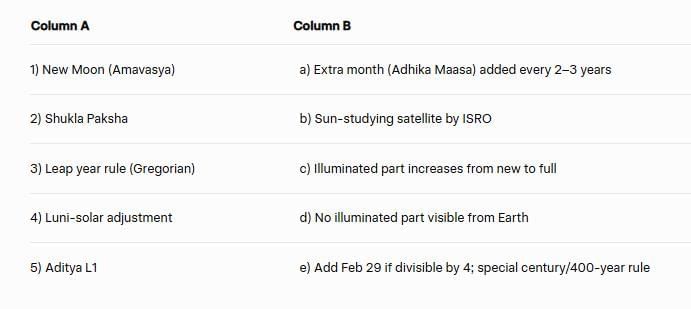
Instruction: Match Column A with the correct option in Column B.
Correct Matches:
- New Moon (Amavasya) — d) No illuminated part visible from Earth
Explanation: The dark side faces Earth on new Moon day. - Shukla Paksha — c) Illuminated part increases from new to full
Explanation: Waxing fortnight in Indian tradition. - Leap year rule (Gregorian) — e) Add Feb 29 if divisible by 4; special century/400-year rule
Explanation: Keeps calendar aligned with seasons. - Luni-solar adjustment — a) Extra month (Adhika Maasa) added every 2–3 years
Explanation: Synchronizes lunar months with the solar year. - Aditya L1 — b) Sun-studying satellite by ISRO
Explanation: Observes the Sun from the L1 point region.