Introduction
“My Childhood,” an excerpt from Dr. A.P.J. Abdul Kalam’s autobiography Wings of Fire, takes us into his humble beginnings in Rameswaram, a small coastal town. From there, he rose to become India’s beloved President. The chapter shares heartwarming stories of his simple life, shaped by strong family values like kindness, honesty, hospitality, and unity.
About the Author
Dr. A.P.J. Abdul Kalam (1931–2015), fondly called the “Missile Man of India,” was a brilliant scientist and the 11th President of India. He played a key role in India’s space and defence programs, contributing to the development of missiles that strengthened the nation’s defence capabilities.
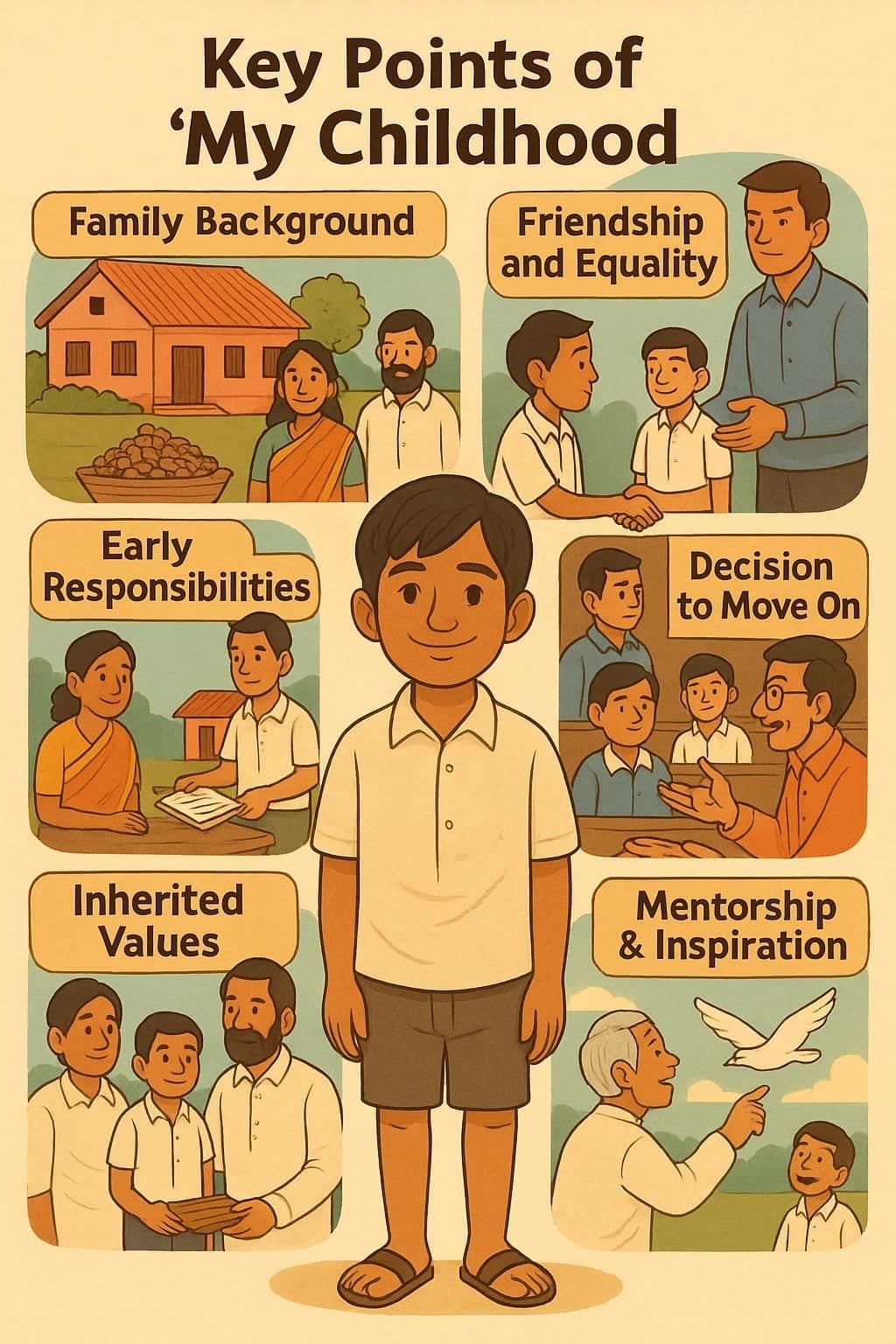
Key Points of “My Childhood”
- Family and Early Life: Kalam was born in a middle-class Tamil Muslim family in Rameswaram. His father, Jainulabdeen, was honest and disciplined; his mother, Ashiamma, was kind and generous. They lived in a spacious ancestral home on Mosque Street.
- Early Responsibilities: During World War II, Kalam sold tamarind seeds and later delivered newspapers—his first earnings, which taught him the value of pride and hard work.
- Values and Lessons: He inherited honesty and discipline from his father, and kindness from his mother. His friendships crossed religious lines, reflecting values of unity and equality.
- Facing Prejudice: Kalam once faced discrimination at school but was supported by his Hindu friend’s father and his teacher, Sivasubramania Iyer, who promoted equality and broke social barriers.
- Mentorship and Growth: Iyer’s support and encouragement inspired Kalam to dream big and overcome social limitations.
- A New Beginning: With his father’s blessing, Kalam left Rameswaram to pursue higher studies, ready to soar like a seagull.
Detailed Summary
Dr. Kalam was born into a middle-class Tamil Muslim family in Rameswaram, a small town in Tamil Nadu. His father, Jainulabdeen, was a wise and generous man who lived a simple life and provided for the family’s basic needs. His mother, Ashiamma, was equally kind and often fed many people daily, reflecting the family’s spirit of generosity. Kalam describes his childhood home as a secure and peaceful place.
Kalam recalls his days as a curious and hardworking boy. During the Second World War, when he was just eight years old, he earned his first wages by selling tamarind seeds to a provision shop and then by helping his cousin distribute newspapers. This small job instilled a sense of pride and responsibility in him.
His family valued education, kindness, and discipline. Kalam inherited honesty and self-discipline from his father and faith in goodness of people from his mother. He grew up alongside friends from different religious and social backgrounds, such as Ramanadha Sastry, Aravindan, and Sivaprakasan. Despite their religious differences, their bond was strong, and they shared a deep sense of unity.
Try yourself:
What values did Dr. Kalam inherit from his parents in his childhood?
- A.Kindness and generosity
- B.Honesty and self-discipline
- C.Unity and perseverance
- D.Simplicity and humility
View Solution
The rigid social structure of Rameswaram was evident when a new teacher asked Kalam to sit at the back of the class because he was Muslim. This act of discrimination deeply saddened both Kalam and his friend Ramanadha Sastry, who cried when Kalam was moved. However, Ramanadha’s father, Lakshmana Sastry, stood up against this injustice, reprimanding the teacher and urging him to change his attitude. This incident left a lasting impact on Kalam.
Kalam’s science teacher, Sivasubramania Iyer, played a significant role in breaking social barriers and inspiring Kalam to aim high. Despite his orthodox beliefs, Iyer encouraged Kalam and treated him as an equal. When Iyer invited Kalam to his home for a meal, his wife initially objected due to their religious differences. However, Iyer served Kalam himself and later persuaded his wife to overcome her biases. This act of kindness and determination left a strong impression on Kalam.
As Kalam grew older, he aspired to study beyond Rameswaram. His father supported his decision, comparing him to a seagull that must fly high and explore. Quoting Khalil Gibran, his father emphasised that children must follow their own paths in life. With his family’s encouragement, Kalam left Rameswaram to pursue his education and build his future.
Theme & Message of “My Childhood”
Theme
The main theme of the chapter is the importance of values, unity, and mentorship in shaping a person’s life. It highlights how family support, childhood experiences, and the guidance of teachers can inspire someone to overcome challenges and achieve greatness. The chapter also touches on breaking social barriers and promoting equality.
Message
The chapter delivers the following messages:
- Strong values shape strong people: Honesty, kindness, and discipline, as taught by Kalam’s parents, are the foundation of a successful life.
- Unity in diversity: Friendship and harmony can thrive despite religious and social differences.
- Mentorship matters: Good teachers and mentors can inspire you to aim high and break barriers.
- Overcome social prejudice: Treat everyone equally, regardless of their background, to create a fair and just society.
- Follow your dreams: With family support and determination, you can achieve your goals and rise above limitations.
Difficult Words
- Austere: Simple, strict, and severe in lifestyle.
- Erstwhile: Former or previous.
- Inborn: A quality or feeling present from birth.
- Princely Sum: A large amount of money, used ironically in this context to refer to a small amount.
- Communal Intolerance: Hostility or prejudice against people from different religious or ethnic groups.
- Unprecedented: Something that has never been done or experienced before.
- Perturbed: Disturbed or troubled by something.
- Orthodox: Strictly following traditional religious practices.
- Segregation: The separation of people based on differences like race, religion, etc.