Q1: Surface area of bowl of radius r cm is (a) 4πr2 (b) 2πr2 (c) 3πr2 (d) πr2 Ans: (c)
Sol: The area of a circle of radius r is πr2 Thus if the hemisphere is meant to include the base then the surface area is 2πr2 + πr2 = 3πr2
Q2: A conical tent is 10 m high and the radius of its base is 24 m then slant height of the tent is (a) 26 (b) 27 (c) 28 (d) 29 Ans: (a)
Sol: Height (h) of conical tent = 10 m Radius (r) of conical tent = 24 m Let the slant height of the tent be l l2 = h2 + r2 l2 = (10)2 + (24)2 l2 = 100 + 576 l2 = 676 l = √676
l = √262 l = 26 m Therefore, the slant height of the tent is 26 m.
Q3: Diameter of the base of a cone is 10.5 cm and its slant height is 10 cm . then curved surface area. (a) 155 cm2 (b) 165 cm2 (c) 150 cm2 (d) none of these Ans: 165 cm2
Sol: Diameter of the base of the cone is 10.5 cm and slant height is 10 cm. Curved surface area of a right circular cone of base radius, [‘r’]and slant height, l is πr. Diameter, d = 10.5 cm Radius, r = 10.5 / 2 cm= 5.25 cm Slant height, l = 10 cm Curved surface area = πrl = 3.14 × 5.25 × 10 = 165 cm Thus, curved surface area of the cone = 165 cm2.
Q4: The surface area of a sphere of radius 5.6 cm is (a) 96.8π cm2 (b) 94.08π cm2 (c) 90.08π cm2 (d) none of these Ans: (b)
Sol: Given radius of sphere = 5.6 cm Surface area of sphere = 4πr2 = 4 × 3.14 × (5.6)2 Surface area of sphere = 393.88 cm2
Q5: The height and the slant height of a cone are 21 cm and 28 cm respectively then volume of cone (a) 7556 cm3 (b) 7646 cm3 (c) 7546 cm3 (d) None of these Ans: (c)
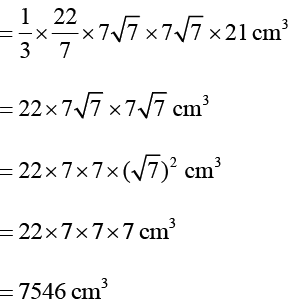
Sol: Volume of the cone = 1/3 πr2h Given Slant height = l= 28 cm Height of cone = h= 21 cm Let radius of cone = r cm l2 = h2 + r2 282 = 212 + r2 282 – 212 = r2 r2 = 282 – 212 r2 = (28 – 21)(28 + 21) r2 =(7)(49) r = √7(49) r = √7(7)2 r = 7√7 cm Volume of the cone = 1/3 πr2 h
Fill in the blank
Q1: Surface area of sphere of diameter 14cm is____________. Ans: 616cm2
Sol: Given Diameter of sphere =14cm radius =7cm surface area of sphere = 4πr2 = 4π(7)2 = 4 × 3.14 × 49 surface area of sphere = 616cm2
Q2: Volume of hollow cylinder is ______________. Ans: π(R2−r2)h
Sol: The formula to calculate the volume of a hollow cylinder is given as, Volume of hollow cylinder =π(R2−r2)h cubic units, where, ‘R′ is the outer radius, ‘ r ‘ is the inner radius, and, ‘ h ‘ is the height of the hollow cylinder.
Q3: Find the volume of a sphere whose surface area 154cm2 is_________________. Ans: 179.67cm3
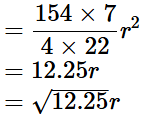
Sol: Given surface area of sphere =154cm2 Let radius of the sphere = r cm 4πr2 = 1544 × 227 × r2 =154r2
Volume of sphere =4/3πr3 =179.67cm3
Q4: A hemispherical bowl has a radius of 3.5cm. What would be the volume of water it would contain__________. Ans: 89.8cm3
Sol: The volume of water the bowl contain =2/3πr3 Radius of hemisphere =r=3.5cm The volume of water the bowl can contain =2/3πr3 = 2/3 × 22/7 × 3.5 × 3.5 × 3.5cm3 = 89.8cm3
Q5: The formula for the volume of a cone is __________.
Ans: 13 π r2 h
Sol: The formula for the volume of a cone is: 13 π r2 h
True / False
Q1: The volume of a sphere is equal to two-third of the volume of a cylinder whose height and diameter are equal to the diameter of the sphere. Ans: True
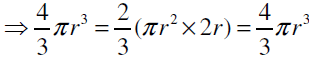
Sol: Let the radius of the sphere = r. According to the question, height and diameter of cylinder = diameter of sphere. So, the radius of the cylinder = r And, the height of the cylinder = 2r We know that, Volume of sphere = 2/3 volume of cylinder Hence, the given statement “the volume of a sphere is equal to two-third of the volume of a cylinder whose height and diameter are equal to the diameter of the sphere” is true.
Q2: If the radius of a right circular cone is halved and height is doubled, the volume will remain unchanged. Ans: False
Sol: Let the original radius of the cone = r Let height of the cone = h. The volume of cone = 1/3 πr2h Now, when radius of a height circular cone is halved and height is doubled, then We can observe that the new volume = half of the original volume. Hence, the given statement “if the radius of a right circular cone is halved and height is doubled, the volume will remain unchanged” is false.
Q3: If the radius of a cylinder is doubled and its curved surface area is not changed, the height must be halved. Ans: True
Sol: Let radius of the cylinder = r Height of the cylinder = h Then, curved surface area of the cylinder, CSA = 2πrh According to the question, Radius is doubled and curved surface area is not changed. New radius of the cylinder, R = 2r New curved surface area of the cylinder, CSA’ = 2πrh …(i) Alternate case: When R = 2r and CSA’ = 2πrh But curved surface area of cylinder in this case, CSA’= 2πRh = 2π(2r)h = 4πrh …(ii) Comparing equations (i) and (ii), We get, Since, 2πrh ≠ 4πrh equation (i) ≠ equation (ii) Thus, if h = h/2 (height is halved) Then, CSA’ = 2π(2r)(h/2) = 2πrh Hence, the given statement “If the radius of a cylinder is doubled and its curved surface area is not changed, the height must be halved” is true.
Q4: Doubling the radius of a sphere will double its volume. Ans: False
Sol: Formula for the volume of a sphere:
V = 43 π r3
If the radius is doubled (i.e., r becomes 2r), then the new volume V’ is:
V’ = 43 π (2r)3 = 43 π 8r3 = 8 × 43 π r3
Thus, doubling the radius increases the volume by a factor of 8, not 2.
Q5: The total surface area of a cone is the sum of its lateral surface area and the area of its circular base. Ans: True
Sol: The total surface area of a cone is the sum of its lateral surface area and the area of its circular base:
Lateral Surface Area = π r l
Area of Circular Base = π r2
Total Surface Area = π r l + π r2
For a cone with radius r and slant height l, the total surface area A is given by:
A = π r l + π r2
Subjective Type Questions
Q1: Diameter of the base of a cone is 10.5 cm and its slant height is 10 cm . Find its curved surface area and its total surface area.
Ans: Diameter = 10.5 cm Slant height of cone (l ) = 10 cm Curved surface area of cone, =165 cm2 Total surface area of cone,
Q2: A Joker’s cap is in the form of a right circular cone of base radius 7 cm and height 24 cm. Find the area of the sheet required to make 10 such caps.
Ans: Radius of cap (r) = 7cm, Height of cap (h) =24 cm Slant height of the cone (l)
Area of sheet required to make a cap = CSA of cone = πrl
∴ Area of sheet required to make 10 caps = 10 × 550 = 5500 cm2
Q3: Find the surface area of a sphere of diameter: (i) 14cm
Ans: (i) Diameter of sphere = 14cm, Therefore, Radius of sphere = 14/2 = 7cm Surface area of sphere = 4πr2 = 4 × 22/7 × 7 × 7 = 616cm2
(ii) 21cm
Ans: Diameter of sphere = 21cm ∴ Radius of sphere =21/2cm Surface area of sphere = 4πr2 = 4 × 22/7 × 21/2 × 21/2 =1386cm2
(iii) 3.5cm
Ans: Diameter of sphere = 3.5cm ∴ Radius of sphere =3.5/2 = 1.75cm Surface area of sphere = 4πr2 = 4 × 22/7 × 1.75 × 1.75 = 38.5cm2
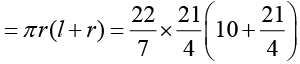
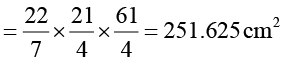
Q4: A hemispherical bowl is made of steel, 0.25cm thick. The inner radius of the bowl is 5cm . Find the outer curved surface area of the bowl.
Ans: Inner radius of bowl (r)= 5cm Thickness of steel (t) = 0.25cm ∴ Outer radius of bowl (R) = r + t = 5 + 0.25 = 5.25cm ∴ Outer curved surface area of bowl = 2πR2 = 2 × 22/7 × 5.25 × 5.25 = 2 × 22/7 × 21/4 × 21/4 = 693/4 =173.25cm2
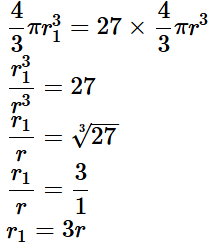
Q5: Twenty-seven solid iron spheres, each of radius r and surface area S are melted to form a sphere with surface area S ‘. Find the: (i) radius r ‘ of the new sphere.
Ans: Volume of 1 sphere, V = 4/3πr3 Volume of 27 solid sphere = 27 × 4/3πr3 Let r1 is the radius of the new sphere. Volume of new sphere = Volume of 27 solid sphere
(ii) ratio of S and S ‘.
Ans: S1 : S = 9 : 1 S : S1 = 1 : 9
Q6: A capsule of medicine is in the shape of a sphere of diameter 3.5mm . How much medicine (in mm3) is needed to fill this capsule?
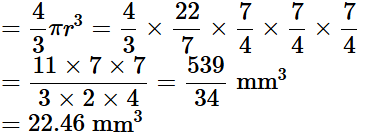
Ans: Diameter of spherical capsule = 3.5mm ∴ Radius of spherical capsule (r) = 3.5/2 = 35/20 = 7/4mm Medicine needed to fill the capsule = Volume of sphere
 =179.67cm3
 Hence, the given statement “the volume of a sphere is equal to two-third of the volume of a cylinder whose height and diameter are equal to the diameter of the sphere” is true.
 We can observe that the new volume = half of the original volume.
Slant height of cone (l ) = 10 cm
=165 cm2



S1 : S = 9 : 1