Reflect and Respond
I. Read the questions given below and share your answers with your classmates and teacher.
1. What kind of music do you prefer to listen to — vocal or instrumental?
Ans (Sample):
I prefer vocal music because the combination of melody and meaningful lyrics creates a deeper emotional connection. I also enjoy instrumental music when I want to concentrate or relax, as the absence of words allows the mind to wander freely.
2. Name your favourite musician(s).
Ans (Sample):
My favourite musicians include A.R. Rahman, known for blending Indian classical, folk, and contemporary music; Lata Mangeshkar, whose voice carries unmatched depth and purity; and Pandit Ravi Shankar, for his mastery of the sitar.
3. Give reasons for your choice.
Ans (Sample):
A.R. Rahman’s music transcends language and genre, evoking emotion across cultures. Lata Mangeshkar’s rare purity of voice makes even a simple melody deeply moving. Pandit Ravi Shankar’s sitar mastery demonstrates how an instrument can speak the full range of human emotion.
Check Your Understanding
I. Read the poem again to complete the poet’s diary about her feelings on music. Fill in the blanks with words from the poem.
Ans:
Today, I’ve been thinking about how essential music is to me. It is like an ocean that calls me to its 1. shore. Music is the 2. rhythm that harmonises with my 3. core, moving me in ways I can’t explain. When I feel sad or upset about things, music is the 4. therapy that eases the ache. It is amazing how music has the power to lift my 5. spirits, and give me strength to pull through difficult times. I know that it is the effect of music whenever I feel 6. cheerful. Music is the much 7. needed, dependable friend when there is no one to 8. care. Thank you, my dear music, for being my all-time comfort.
II. Let us appreciate the poem.
1. The phrase ‘moves me’ in the line ‘That moves me to the core,’ is an example of __________.
Ans:
Personification (or a figurative expression). Music — a non-living thing — is given the quality of a living force capable of emotionally moving a person. “Moves” works on two levels: the literal idea of being stirred, and the deeper emotional meaning of being deeply affected.

2. The poet uses metaphors for music. List these metaphors and rewrite them as similes.
Ans:
3. What is the rhyme scheme of the poem? What impact does it have?
Ans:
The rhyme scheme is ABCB — the second and fourth lines of each stanza rhyme (e.g., shore/core, blue/through, there/care). This gives the poem a gentle, flowing musicality that mirrors its subject. The alternating rhyme creates a pleasing rhythm without feeling rigid — like a melody with a recurring but unhurried pattern — making the poem feel like a song itself.
4. What is the poet’s purpose in using the word ‘music’ repetitively?
Ans:
- It is anaphora — creating a chant-like, hymn-like structure that itself becomes musical.
- It emphasises the centrality of music in the poet’s life as the defining presence in all her emotional states.
- It functions as accumulation — each repetition attributes a new quality (ocean, rhythm, therapy, friend), building a cumulative portrait of music’s many roles.
- It creates a sense of devotion and gratitude — like returning again and again to the name of something deeply loved.
5. What is the message the poet wishes to convey through the poem?
Ans:
The central message is that music is not merely entertainment but a companion, a healer, and a source of strength — particularly in moments of sadness, loneliness, or difficulty. Through her comparisons to an ocean, therapy, and a needed friend, the poet conveys that music transforms the inner state from sorrow to hope. The poem is an invitation to every reader to cherish music as an active, vital presence that listens when no one else does.
6. Identify the mood of the poem from the options given below.
(i) nostalgic (ii) thoughtful (iii) amused (iv) playful
Ans: (ii) Thoughtful.
The poet is reflecting deeply on her personal relationship with music — how it sustains her through difficult times and functions as a dependable friend. The tone is sincere and contemplative throughout, not nostalgic (looking back longingly), amused, or playful.
7. Give evidence from the poem to support that the speaker is the poet herself.
Ans:
- “I need when I feel blue” — the first-person “I” and admission of personal sadness confirm lived experience.
- “Music lifts my spirits” — “my spirits” is a direct first-person claim.
- “The times when I’m most cheerful, / It’s clear, music was there” — a personal pattern of experience only the speaker can confirm.
- “That moves me to the core” — deeply personal, subjective language.
Critical Reflection
I. Read the extract given below and answer the questions that follow.
Music is the therapy
I need when I feel blue.
Music lifts my spirits
To make sure I pull through.
(i) Complete the following sentence suitably. The phrase ‘feel blue’ indicates __________.
Ans:
…a state of sadness, melancholy, or emotional distress. It is an idiomatic expression where blue is associated with low mood. The poet uses it to describe moments when she is emotionally down and most in need of music’s healing power.
(ii) Identify the line which shows music makes the poet happy.
Ans:
“Music lifts my spirits” — “lift one’s spirits” means to make someone feel happier and more positive. This line directly shows music’s power to elevate the poet’s mood from sadness to happiness.
(iii) What does the last line of the extract signify?
Ans:
“To make sure I pull through” signifies that music gives the poet the strength and resilience to overcome difficulties. “Pull through” means to succeed in coping with something very difficult. Music is not merely pleasurable but a genuine source of emotional support that helps her persevere through hardship.
(iv) State whether the following sentence is true or false. Music plays a vital role in the poet’s life.
Ans: True.
The entire poem is a testament to this — the poet turns to music when sad, it lifts her spirits, and gives her strength to “pull through.” Music is not peripheral but a core emotional resource for her.
(v) Select the central idea of the extract from the following options.
- A. Music brings comfort during sadness.
- B. Music is a necessity in times of happiness.
- C. Music improves our ability to pull heavy loads.
- D. Music is a source of knowledge and excitement.
Ans: A.
The extract specifically describes the poet turning to music when she “feels blue,” and music responding by lifting her spirits and helping her pull through — focus is on music as therapeutic comfort in emotional difficulty.
II. Answer the following questions.
1. How is music able to move the poet ‘to the core’?
Ans:
Music is able to move the poet to the very deepest part of her being because it bypasses rational thought and speaks directly to human emotion — resonating with something fundamental within her through its melody, beat, and harmony. Music’s power may come from its connection to memory, its ability to express what words cannot, or its physical resonance with the body’s own rhythms. For the poet, music penetrates to her emotional centre rather than entertaining only the surface of her mind.
2. Why does the poet compare music to a ‘needed friend’?
Ans:
A true friend is present when others are not, listens without judgement, and provides comfort simply by being there — and music fulfils all these qualities. The word “needed” is especially significant — it is not just a friend but an essential one, particularly in loneliness. The final lines describe the specific context: when “no one seems to care,” music provides companionship that fills the void. By calling it a friend, the poet elevates music from an activity to a relationship — personal, reliable, and deeply comforting.
3. Explain the poet’s attitude towards music.
Ans:
- Music as essential: She treats it as fundamental to her existence — as necessary as water or as indispensable as a true friend.
- Music as healing: The comparison to “therapy” shows she sees music as a curative force that actively eases emotional pain.
- Music as companion: Her reference to a “needed friend” reveals she trusts music like a loyal companion — it is always there.
- Music as joy: Being “most cheerful” when music was present shows her attitude includes shared celebration, not only comfort in sorrow.
Overall, the poet’s attitude is one of warm, personal devotion — she relates to music as something almost alive and responsive.
4. Support the opinion that this poem has a universal appeal.
Ans:
- Music is universally experienced: Every culture in the world has music — the poem therefore speaks to readers across all nationalities, languages, and ages.
- Universal emotions: Sadness, longing for comfort, joy, and the need for friendship are experiences every human being goes through.
- Music as therapy is globally recognised: The idea of music as healing is acknowledged worldwide in medicine, psychology, and spiritual practice.
- Simple, accessible language: The poem has no cultural-specific references, making it easy for any reader anywhere to connect with.
- Music as a friend: Virtually everyone who loves music has experienced it as a companion in loneliness — making this metaphor universally relatable.
5. Compare your experience of music with the feelings expressed in the poem.
Ans (Sample):
Like the poet, I find music has the remarkable ability to shift my mood almost instantly. When overwhelmed by studies, a favourite instrumental piece calms me — matching the poet’s experience of music as “therapy.” I also relate to music as a companion during lonely moments, when a well-chosen song seems to say: someone else has felt this too. However, unlike the poet who primarily finds comfort in sorrow, I find music also intensifies happiness — making joyful occasions feel richer and more alive.
Vocabulary in Context

I. Classify the words given in the box as positive emotions and negative emotions. Then fill in the blanks choosing the correct word from the brackets.

Ans:
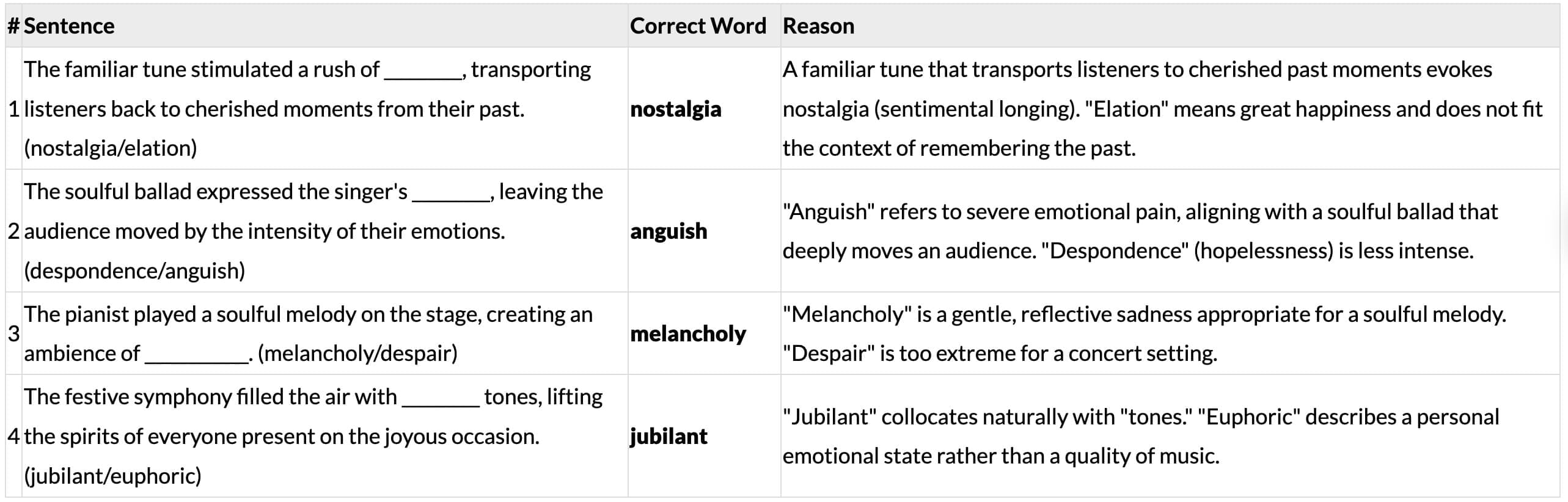
Fill in the blanks by choosing the correct word from those given in brackets.
Ans:
II. Phrasal Verbs — Understanding ‘pull through’ and ‘moves me’
Read the highlighted word in the line given below.
To make sure I pull through
The meaning of the verb ‘pull’ is ‘move or remove something’. The preposition ‘through’ means ‘from one end or side to the other’. However, when they come together they convey a completely different meaning. Here, ‘pull through’ means ‘to succeed in doing something very difficult’.
Now, read the following lines from the poem.
Music is the rhythm
That moves me to the core.
The phrase ‘moves me’ means ‘to make somebody do something’.
‘Move’ also has different meanings. For example, to change position, to make progress, to take action, cause strong feelings.
Information:
“Pull through” — Together, means to succeed in surviving or coping with something very difficult.
“Moves me” — means to cause somebody to have strong feelings of sadness or sympathy. “Move” has multiple meanings: to change position, make progress, take action, and cause strong feelings.
III. Choose the correct meaning from the box for the underlined phrasal verbs in the following sentences.
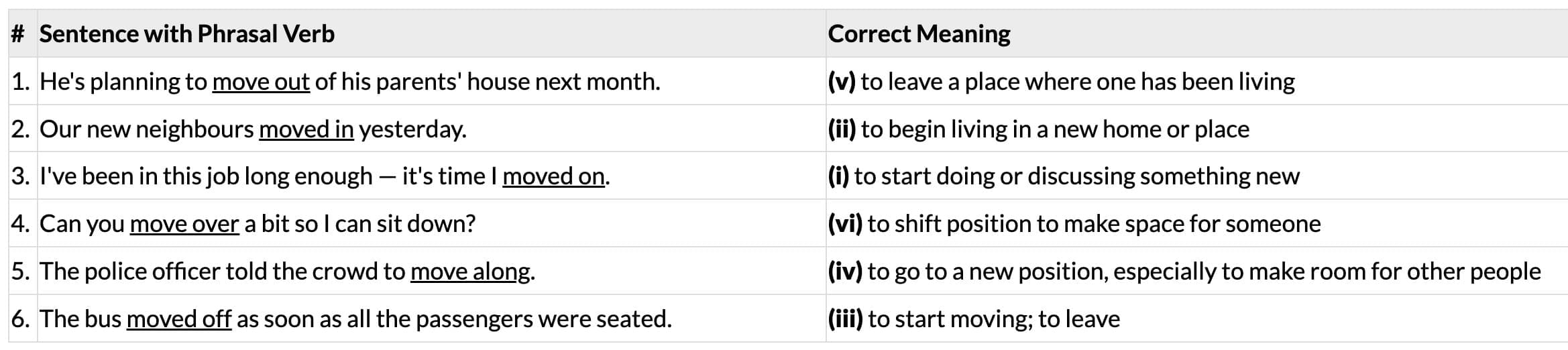
Ans:
IV. Create phrasal verbs from the verbs ‘put’, ‘get’, ‘look’, ‘break’. Find their meanings and make sentences.
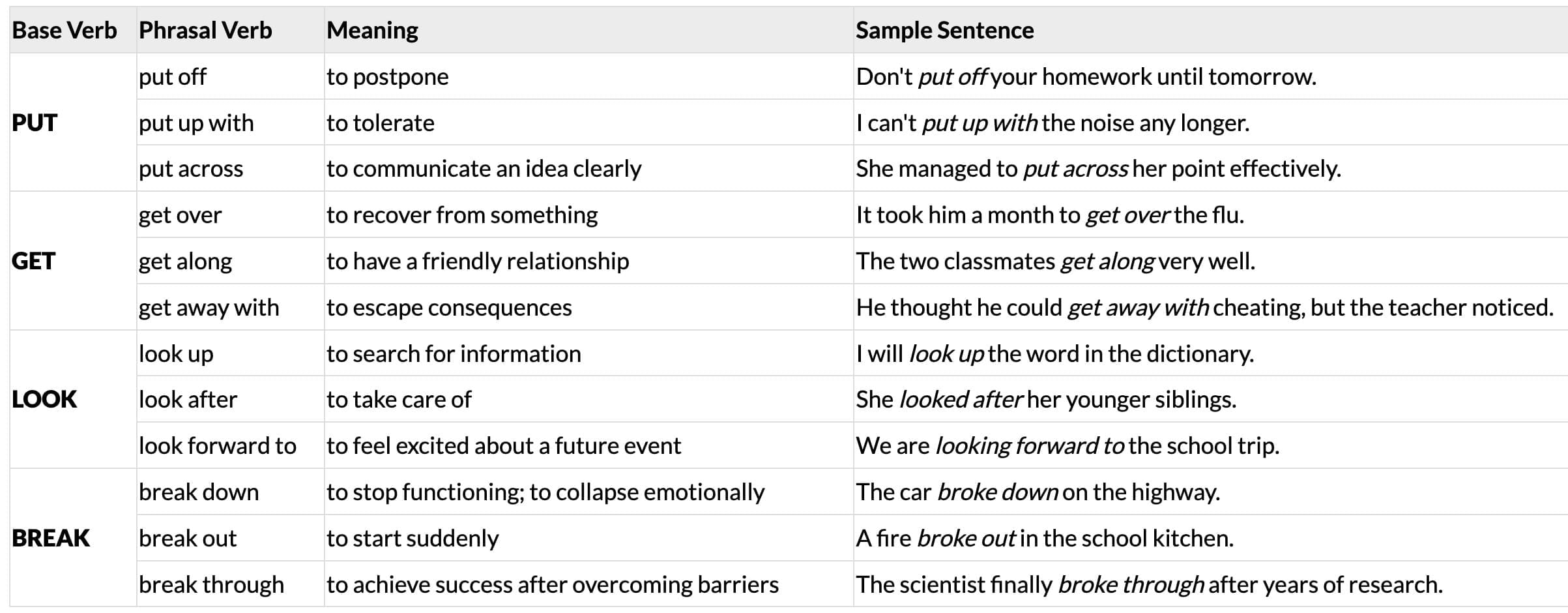
Ans:
Speaking Activity
I. Work in groups of four. Use the cues to present a role play in the class.
Music Teacher
Encourages the student to take up music classes by explaining the benefits of music for concentration, creativity, and emotional well-being.
Student 1
Confused — feels music class may take away time from studies; worried about managing both music practice and academic work.
Student 2
An active music learner — convinced that music is beneficial and that time management makes it possible to do both well.
Parent
Initially doubtful — concerned about the child’s academic performance — but becomes supportive after listening to the discussion.
Ans: Sample Role Play
Music Teacher: Good morning. I’m so glad we could all meet today. I wanted to talk about Arjun joining our music programme. What is your opinion on him taking music classes this term?
Parent: Personally, I believe it could be a distraction from his studies. He has board exams coming up, and we’re worried about his grades.
Student 1 (Arjun): That’s exactly what I’ve been thinking. I’d love to learn the sitar, but I don’t know how I’ll manage music practice and finish all my school assignments.
Student 2 (Priya): I understand your concern, Arjun. I had the same doubts when I started. But from my perspective, learning music has actually helped me concentrate better. I now make a weekly timetable and it really works.
Music Teacher: Research shows that music and academics support each other. Learning rhythm and patterns in music actually strengthens mathematical and linguistic thinking. I hold the opinion that a student who learns music develops better discipline and focus.
Parent: Is that so? In your view, is it realistic to manage both music and studies at Arjun’s level?
Student 2: Absolutely. I practise for just thirty minutes a day and it doesn’t affect my studies at all. In fact, when I feel stressed before exams, music helps me calm down and focus again.
Student 1: I never thought about it that way. Maybe I should try. I have a strong feeling that I’d enjoy it once I begin.
Parent: All right, after hearing this discussion, I must say I’m now quite open to it. Let’s give it a try, Arjun — but do maintain your study hours.
Music Teacher: Wonderful! I’m confident you won’t regret it. Music will be a friend to you for life.
Writing Task
I. Your school is organising a musical evening on 21 June, World Music Day. You are presenting a Sitar recital at the event. Draft an invitation letter requesting your grandparents to attend the event.
Ans: Sample Invitation Letter
24, Sector 8,
Chandigarh – 160 008
15 June 20XX
Dear Dadi and Dada,
I hope you are both in the best of health and enjoying the summer. I have been thinking of you a lot this past week, and I have a very special reason for writing to you today.
Our school, Green Valley Public School, is organising a grand musical evening on 21 June 20XX to celebrate World Music Day. The event will be held in the School Auditorium, Sector 12, Chandigarh, and will begin at 5:30 p.m. There will be wonderful performances by students in various musical forms — both vocal and instrumental.
The most exciting news is that I will be presenting a Sitar recital at the event! It is the first time I will be performing on stage for a large audience, and I have been practising very hard for the past two months. I truly wish you could be there to watch.
Please do try to come to Chandigarh for the occasion — your presence would mean the world to me and would certainly make my performance even more special. We will arrange comfortable seating for you, and you are most welcome to stay with us for a few days afterwards.
I eagerly await your response. Please do write back or call soon.
Yours affectionately,
Arjun