Introduction
Time helps us know when things happen and how long they last. Everyday activities—like waking up, going to school, playing, or sleeping—happen at certain times. We measure time in hours, minutes, and seconds. In this chapter, you will learn how hours and minutes are used for most daily activities, while seconds are used for very quick actions like a race, a blink, or turning a page.
What Are Seconds, Minutes, and Hours?
Time is like an invisible ruler that measures how long things take. But instead of using centimetres or metres, we use seconds, minutes, and hours. The smallest unit we often use is a second.
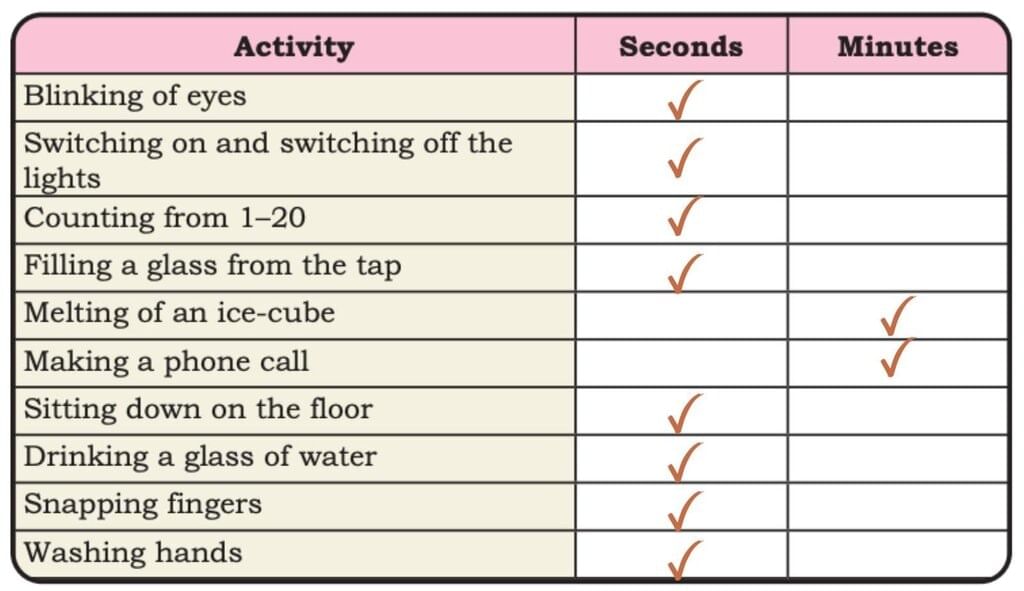
- A second is very quick — it’s about the time it takes to blink your eyes, snap your fingers, or say the word “go!” Sixty of these tiny moments make 1 minute.
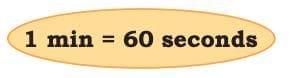
- A minute is a little longer — enough time to take a sip of water, tie your shoelaces, or read a short paragraph in a book. One minute = 60 seconds.
- An hour is made of 60 minutes, which means it has 3,600 seconds in total! That’s a lot of seconds. An hour is long enough to watch a cartoon, do a short homework assignment, or play outside with friends before coming back in.
Here’s a quick way to remember:
- Seconds are for quick actions.
- Minutes are for short tasks.
- Hours are for long activities.
Next time you do something, think about it — should you measure it in seconds, minutes, or hours? You’ll start to see time in a whole new way!
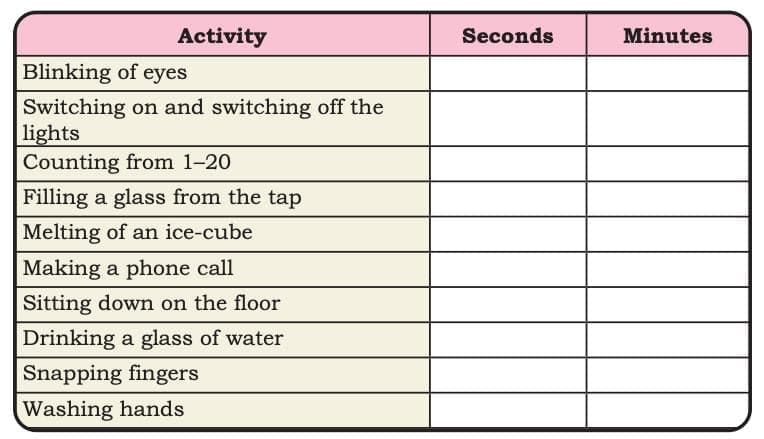
Example: Estimate whether you would take seconds or minutes to complete the following activities. Tick the appropriate cell.
Ans:
Try yourself:
What is a second often compared to?
- A.A minute
- B.A blink
- C.A task
- D.An hour
View SolutionTime Duration (Elapsed Time)
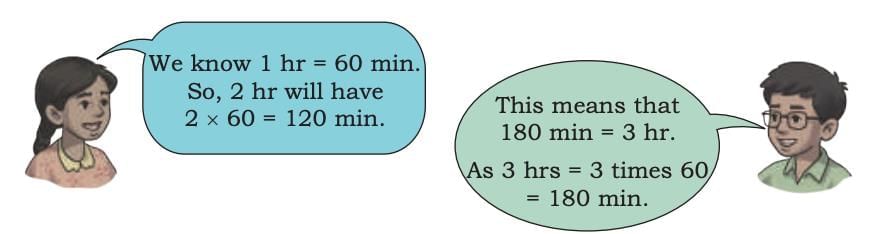
Did you know… 1 minute has 60 seconds and 1 hour has 60 minutes? That means in 1 hour, there are 3,600 seconds! Imagine counting every second for a whole hour – it would take forever!
Time duration tells us how long something lasts — from the moment it starts to the moment it ends.
Let’s say a football match starts at 01:15 p.m. and ends at 01:42 p.m.. From 1:15 to 1:42 is 27 minutes. That’s the time duration of the match. For quick activities, we use seconds instead of minutes. If something takes 90 seconds, we can change it into minutes and seconds:
- 60 seconds = 1 minute
- 30 seconds left over
So, 90 seconds = 1 minute 30 seconds.
Sometimes, the end minutes are smaller than the start minutes. In that case, we borrow 1 hour (which is 60 minutes) before subtracting. This trick helps us find the answer easily.
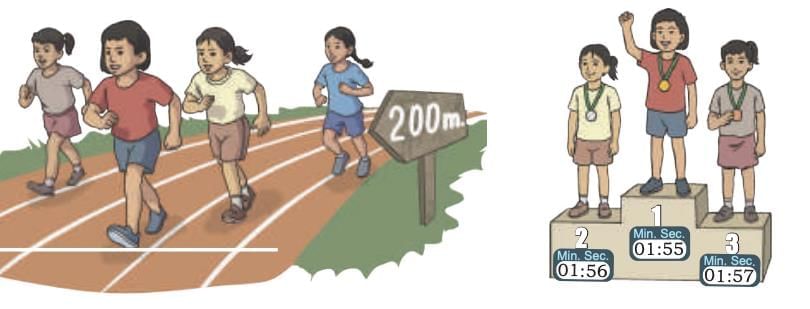
Example: Akira, Sunita, and Mary are participating in a 200 m walking race
Do you notice the use of a new unit, ‘seconds’, in the picture?
In situations like a race, ‘seconds’ help us observe small differences in the time taken by participants.
Each participant took 1 minute, but how much more? Identify the child who won the race. How much time did the child take?
Ans: The child who won the race is the one standing in the first place podium — she took 1 minute 55 seconds to complete the 200 m walking race. In races, even a difference of 1 second can change the winner, which is why seconds are used along with minutes to measure time precisely.
Try yourself:
What is time duration?
- A.How long something lasts
- B.The speed of an object
- C.A way to measure weight
- D.The distance traveled
View Solution
Mastering the Clock
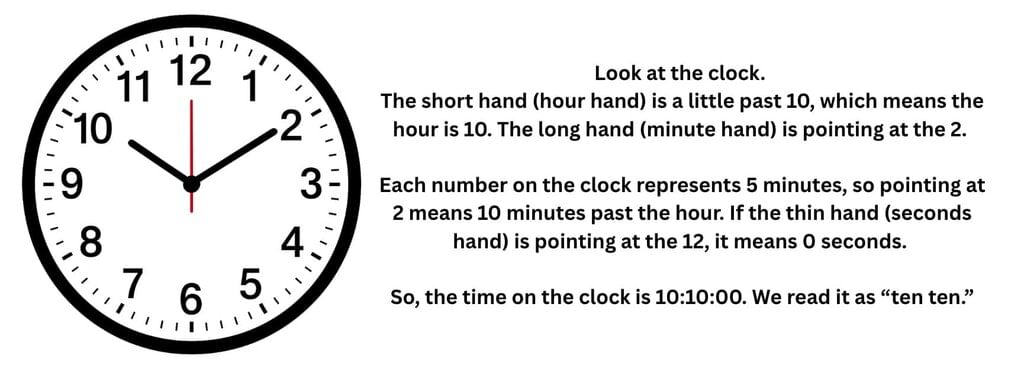
A clock usually has three hands – the hour hand, the minute hand, and the second hand. The hour hand is short and shows the hour, the minute hand is long and shows the minutes, and the seconds hand is thin and moves quickly to show the seconds.
How to read time using a clock:
- Look at the hour hand first and see which number it is pointing to or between.
- Check the minute hand next. Each big number on the clock represents 5 minutes. For example, if the minute hand is on “3,” it means 15 minutes past the hour.
- Check the seconds hand if needed. Like the minute hand, each number represents 5 seconds, and one full round of the seconds hand is 60 seconds or 1 minute.
Example:
Let us perform an activity:
Raghav practices yoga in the morning.
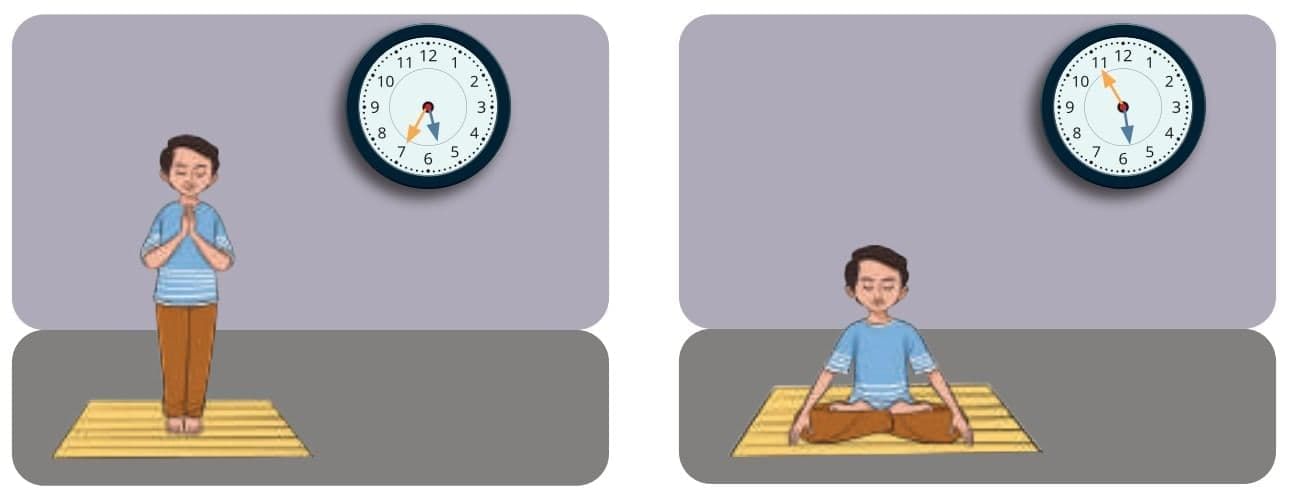
Let us find out
1. At what time did Raghav start practising Yoga? ……………….
Ans: The clock shows the short hand (hour hand) between 6 and 7, and the long hand (minute hand) on 6.
That means the time is 6:30 a.m.
2. At what time did he finish? …………….
Ans: The second clock shows the short hand near 6 and the long hand on 12. That means the time is 6:55 a.m.
3. How much time did he spend practising Yoga? ………………..
Ans: Start time = 6:30 a.m.
End time = 6:55 a.m.
Time taken = 25 minutes.
4. Find the time elapsed between the given time periods. Share your strategies.
(a) 01:15 p.m. to 01:42 p.m.?
→ 42 minutes − 15 minutes = 27 minutes.
(b) 03:18 p.m. to 08:18 p.m.?
→ 8 hours 18 minutes − 3 hours 18 minutes = 5 hours.
(c) 09:15 a.m. to 11:30 a.m.?
→ Hours: 11 − 9 = 2 hours.
Minutes: 30 − 15 = 15 minutes.
Total = 2 hours 15 minutes.
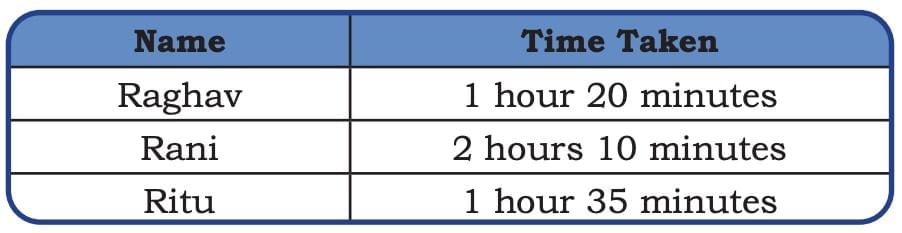
5. The table below shows the time taken by 3 children to paint a picture.
(a) Who took the longest time?
Ans: Rani (2 hours 10 minutes)
(b) Who took the least time?
Ans: Raghav (1 hour 20 minutes)
Try yourself:
What is the main focus of ‘Mastering the Clock’?
- A.Understanding schedules
- B.Creating clocks
- C.Learning to tell time
- D.Improving time management
View SolutionConverting Time Formats
Time can be written in two different ways — the 12-hour format and the 24-hour format. Both show the same time of day but in a different style. Learning to read and change between these formats is important because clocks, watches, and timetables often use different systems.
1. 12-hour format
In the 12-hour format, the numbers on the clock go from 1 to 12 and then repeat. To show whether the time is in the morning or in the afternoon/evening, we use a.m. and p.m.
- a.m. stands for “ante meridiem,” which means “before midday.” It is used for times from midnight (12:00 a.m.) to just before noon (11:59 a.m.).
- p.m. stands for “post meridiem,” meaning “after midday.” It is used for times from noon (12:00 p.m.) to just before midnight (11:59 p.m.).
For example, if the clock shows 05:30 a.m., it means half past five in the morning. If the clock shows 02:30 p.m., it means half past two in the afternoon.
2. 24-hour format
The 24-hour format counts the hours of the day continuously from midnight (00:00 hours) to just before the next midnight (23:59 hours). There is no need for a.m. or p.m., because the hour number itself tells you if it is morning or evening.
- Morning times (midnight to 11:59 a.m.) are written the same as in the 12-hour format, but with hours written as two digits. For example, 5:30 a.m. becomes 05:30 hours.
- Afternoon and evening times (12:00 noon to 11:59 p.m.) are written by adding 12 to the hour number. For example, 2:30 p.m. becomes 14:30 hours, and 11:45 p.m. becomes 23:45 hours.
Let us perform an activity:
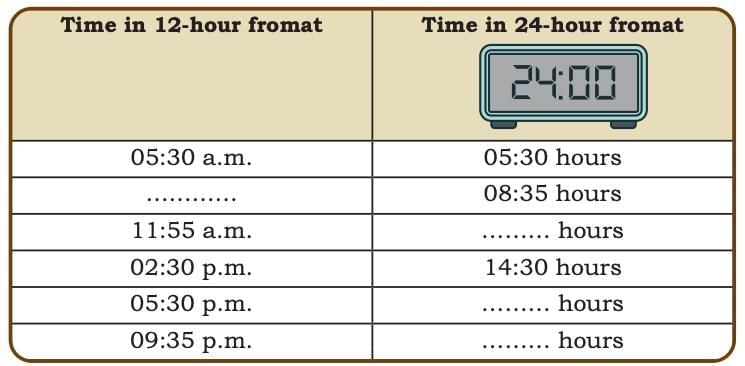
1. Fill in the blanks by writing the time in the appropriate format.
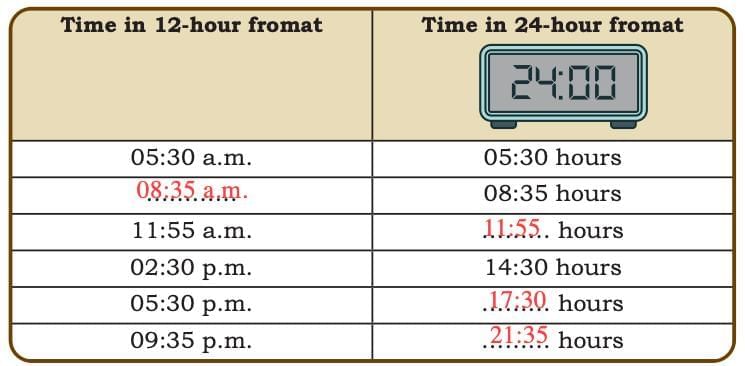
Ans:
2. Match the following.
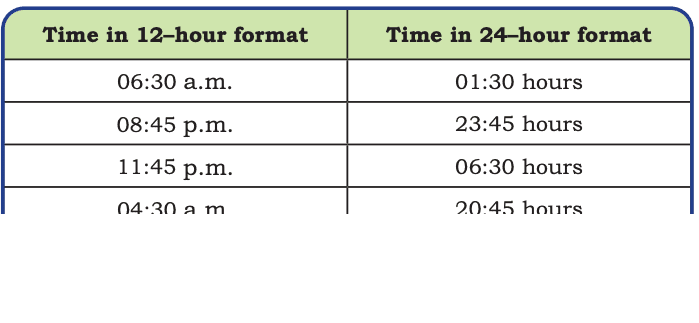
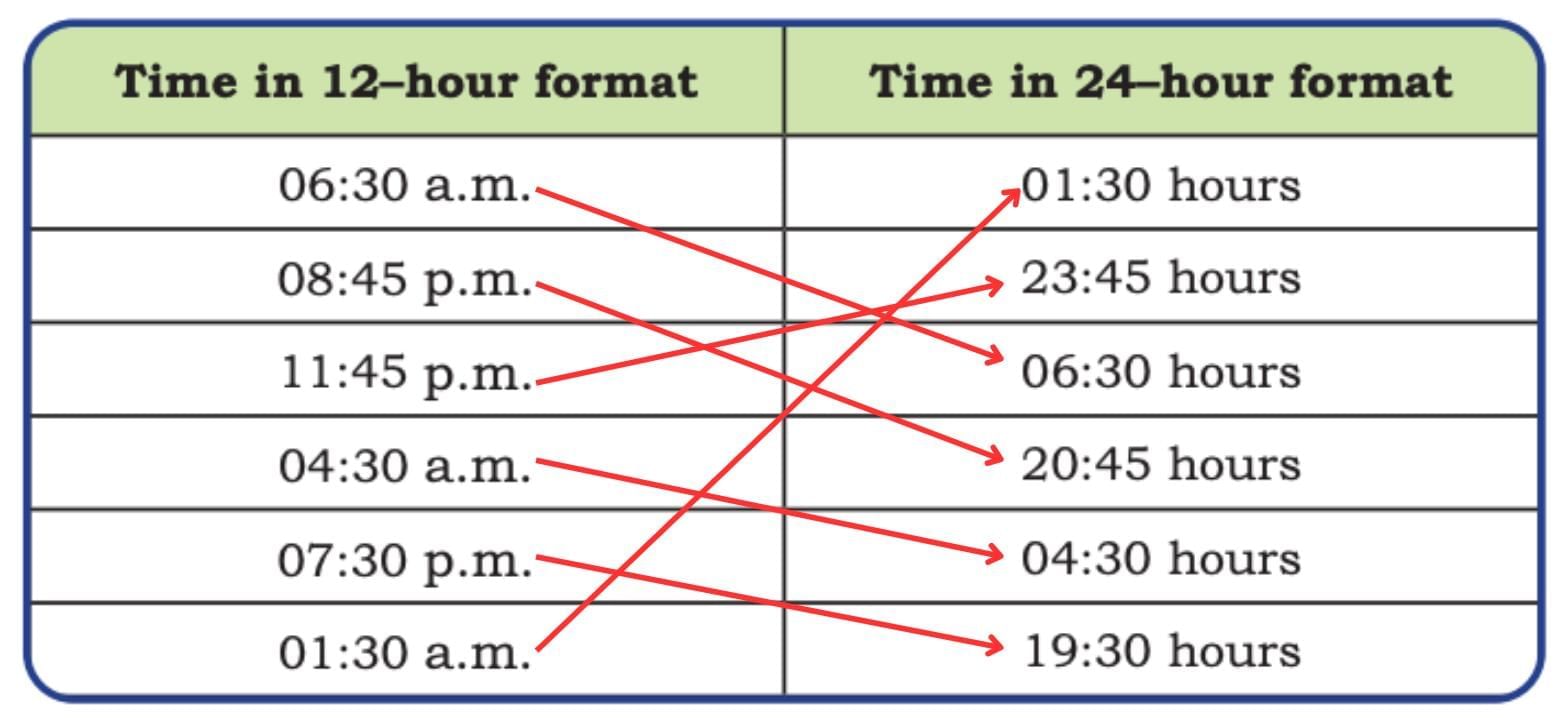
Ans:
Try yourself:
What does a.m. stand for?
- A.After morning
- B.Around midday
- C.Before midday
- D.After midday
View Solution
Conclusion
Time helps us know when things happen and how long they last. Seconds are for very quick actions, minutes are for short tasks, and hours are for long activities. By learning to read the clock, we can tell the exact time, work out how long something took, and change between the 12-hour and 24-hour formats. Understanding time makes it easier to follow schedules, be on time, and use every moment wisely.