Introduction
Have you ever looked through a magnifying glass and felt like you entered a new world?
In “The Glass” by Walter de la Mare, the poet talks about the magic of seeing ordinary things extraordinarily. Through the eyes of a curious observer and with the help of a simple round glass (a magnifying lens), the small wonders of nature, chalk, moss, water, and insects suddenly become vast and magical. This poem celebrates how imagination and observation can turn even the tiniest object into something marvellous.
About the Poet
Walter de la Mare (1873–1956) was a British poet and short story writer known for his dreamlike, mysterious, and imaginative poems. Many of his poems explore childhood, nature, and fantasy. He had a special talent for finding magic in ordinary things and creating rich images with simple words. “The Glass” is a perfect example of how he turns scientific observation into poetic wonder, encouraging readers to see more deeply into the world around them.
Key Points of the Poem
- The poem is about a person using a round glass, a magnifying glass, to look closely at everyday natural objects.
- This lens makes small things like chalk, moss, or water appear large, detailed, and magical.
- The speaker sees a whole forest in a piece of moss, and a hive of bees in a drop of water, showing how much beauty and detail are hidden in tiny things.
- The speaker also watches a spider spinning its web and notices how clever and skilled the spider is, though flies still fall into its trap.
- The poem shows how observation, combined with curiosity and imagination, can make the world more exciting.
- It ends by saying that using special lenses (like telescopes), we could even imagine walking on the moon—highlighting the power of science and wonder.
- The tone of the poem is playful, curious, and filled with admiration for the hidden beauty in nature.
- It encourages the reader to look closely and never underestimate the power of small things.
Try yourself:
What does the speaker see in a piece of moss?
- A.A forest
- B.A spider
- C.A bee
- D.A flower
View Solution
Explanation of the Poem
Stanza 1
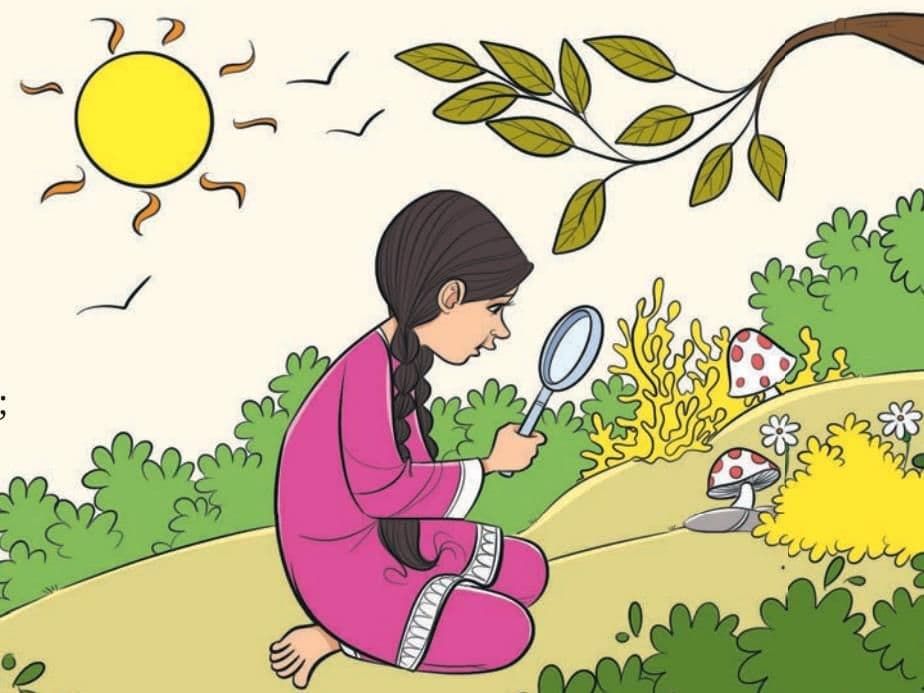
With this round glass
I can make Magic talk—
A myriad shells show
In a scrap of chalk;
Of but an inch of moss
A forest—flowers and trees;
A drop of water
Like hive of bees.
Explanation:
The speaker begins by talking about a magical round glass—a magnifying glass. When he looks through it, ordinary things become magical. In a small piece of chalk, he can see tiny shell shapes, as if the chalk holds secrets from the ocean. Just an inch of moss appears to be a whole forest, with miniature flowers and trees. A single drop of water looks like a busy beehive, full of activity. This shows how the glass reveals the hidden, detailed world that our eyes normally miss. It also shows the power of observation and imagination.
Stanza 2
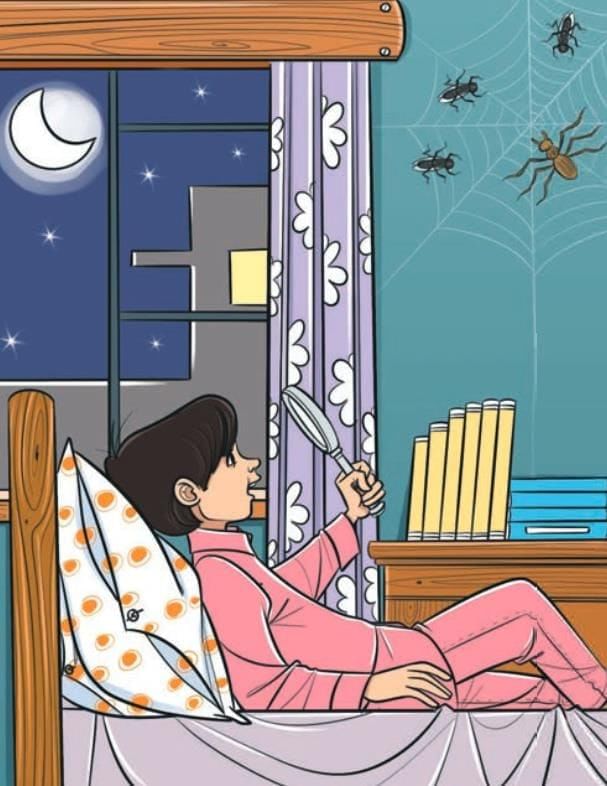
I lie in wait and watch
How the deft spider jets
The woven web-silk
From his spinnerets;
The tigerish claws he has!
And oh! the silly flies
The stumble into his net—
With all those eyes!
Explanation:
Now, the speaker watches a spider closely through the glass. He describes how the spider skillfully spins silk from its spinnerets (the part of the body that releases thread). The word “deft” shows the spider is very skilled at its work. The spider’s claws are compared to a tiger’s, showing its strength and danger, even though it’s tiny. The speaker also notices how flies with many eyes still get trapped, showing that even though they can see well, they’re not always careful. This part of the poem shows the cruel but fascinating part of nature and how even small creatures are full of surprises.
Stanza 3
Not even the tiniest thing
But this my glass
Will make more marvellous
And itself surpass.
Yes, and with lenses like it,
Eyeing the moon,
‘Twould seem you’d walk there
In an afternoon!
Explanation:
In the final part, the poet says that even the smallest object becomes wonderful when seen through the glass. It shows more than expected—it “surpasses” itself, meaning it becomes even more amazing. He then takes this idea even further by imagining using powerful lenses (like telescopes) to look at the moon. Through such lenses, it might seem like you could walk on the moon just in an afternoon! This ending blends science and imagination, showing that with the right tools and curiosity, we can explore entire worlds tiny and distant.
Theme/Message
Theme
- Curiosity and Observation: The poem celebrates how carefully looking at the world can reveal its hidden beauty.
- Magic in the Everyday: Even common objects like moss, water, and insects hold amazing details when closely observed.
- Science and Imagination: The magnifying glass and telescope are tools of science, but they also open doors to creativity and wonder.
- Nature’s Hidden Wonders: Nature is full of life, even in the tiniest spaces. The poem teaches us to pay attention to the small things.
Message
- There is magic all around us—if we take the time to look closely.
- Even the smallest object can be full of beauty, life, and mystery.
- Curiosity is a powerful tool. It can turn learning into an adventure.
- We should never ignore the little things—sometimes they show us the biggest wonders.
Try yourself:
What is the main idea of the text?
- A.It shares a message.
- B.It discusses a theme.
- C.It provides a summary.
- D.It gives a lesson.
View Solution
Difficult Words
- Myriad: A very large number of something.
- Deft: Skilful and quick in movement.
- Jet: To move rapidly or shoot out quickly.
- Spinnerets: The part of a spider that produces silk.
- Tigerish: Having qualities similar to a tiger, often fierce or aggressive.
- Marvellous: Causing great wonder; extraordinary.
- Claws: Sharp, curved nails on animals, used for gripping or holding.
- Hives: Structures where bees live and store honey.
- Woven: Made by interlacing threads or materials.
- Silky: Smooth and soft like silk.
- Lens: A piece of glass or other transparent material that focuses light.
- Forest: A large area covered chiefly with trees and undergrowth.
- Scrap: A small piece or fragment of something.
- Stumble: To trip or lose balance while walking.
- Extraordinary: Very unusual or remarkable.