Reflect and Respond
I. Why are words important? Can we communicate without words? How? Share your answers with your classmates and teacher.
Ans:
Why words are important: Words are the primary medium of human communication — they allow us to express thoughts, feelings, and ideas with precision, build relationships, preserve culture, and inspire others.
Can we communicate without words? Yes — through body language, facial expressions, eye contact, touch, sign language, art, music, and in modern times, emojis and symbols. Non-verbal communication is often more honest than words.
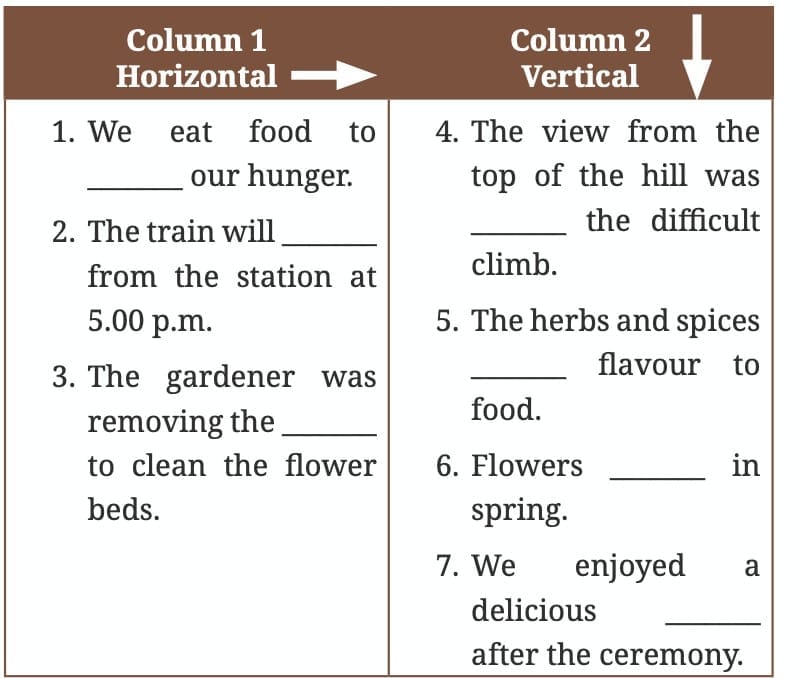
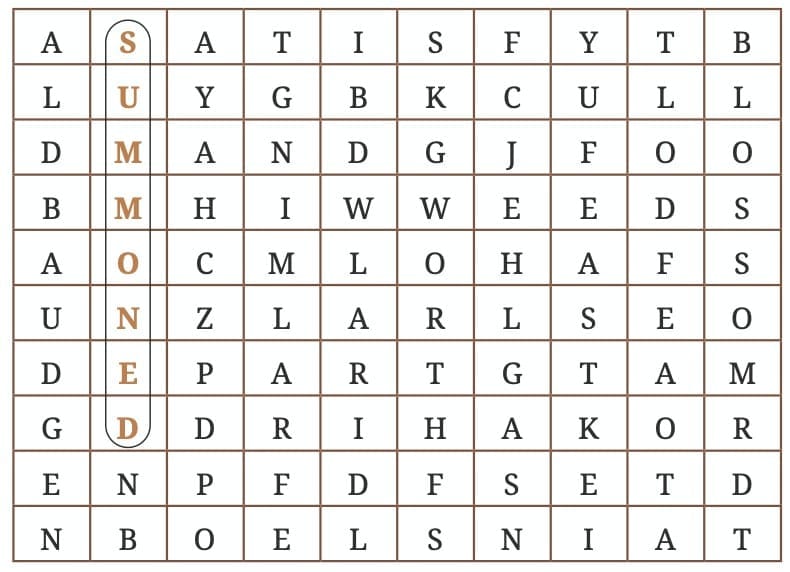
II. Use the given sentences as clues to find words from the grid and fill the blanks.
Example given: My mother summoned me to introduce her friends.
Ans:
Column 1 – Horizontal:
- We eat food to satisfy our hunger.
- The train will depart from the station at 5.00 p.m.
- The gardener was removing the weeds to clean the flower beds.
Column 2 – Vertical:
- The view from the top of the hill was worth the difficult climb.
- The herbs and spices add flavour to food.
- Flowers blossom in spring.
- We enjoyed a delicious feast after the ceremony.
Check Your Understanding
I. Fill in the blanks with one word from the poem. One example has been done for you.
Ans: In this poem, the poet reflects that words fail to truly satisfy what the heart wants to convey. Words are compared to summer birds who 1. depart, leaving nothing behind. The heart is equated to a 2. pilgrim who finds that words are as worthless as 3. weeds when needed. He feels that a few sincere words can bring more 4. joy than many meaningless ones. He adds that a voice that brings happiness to a 5. lonely place does not say much, but the few words it does, are very precious. Moreover, if words could satisfy us, the 6. world would celebrate but words often fail to do that. The poem ends on the note that empty words may look impressive with lots of flowers, but they cannot produce anything valuable, like a 7. fruit.
II. Let us appreciate the poem.
1. Read the poem again. Find any four sets of rhyming words and also write the rhyme scheme of the poem.
Ans:
Four sets of rhyming words: heart/depart, care/air, earth/worth, needs/weeds, said/head, way/say, cheer/dear, impart/heart.
Rhyme scheme: ABAB — the first and third lines rhyme (A), and the second and fourth lines rhyme (B).
Example: “If words could satisfy the heart” (A) / “The heart might find less care” (B) / “But words, like summer birds, depart” (A) / “And leave but empty air” (B).
2. Read the following phrases and sentences taken from the poem. Identify the poetic device in each of them and explain what the poet wants to communicate through their usage.
(i) But words, like summer birds, depart…
Ans: Simile. Words are compared to migratory summer birds using “like” — temporary and fleeting. Just as birds fly away leaving nothing, words are spoken and vanish, leaving no lasting impact on the heart.
(ii) heart, a pilgrim upon earth…
Ans: Metaphor. The heart is directly called a pilgrim — always journeying in search of meaningful communication and true emotional connection, but frequently finding that words fail to satisfy its quest.
(iii) words are of as little worth / As just so many weeds
Ans: Simile. Words are compared to weeds — plentiful but useless. Hollow words are like weeds that clutter communication without adding real emotional value or comfort.
(iv) If words could satisfy the chest… Oft satisfy the least!
Ans: Irony / Paradox. Words promise to satisfy but in practice satisfy the least — the contrast between hopeful potential and ironic failure highlights the gap between what words could do and what they actually deliver in moments of need.
(v) The world might hold a feast…
Ans: Hyperbole / Metaphor. An exaggerated and metaphorical expression of universal celebration — if words truly satisfied human emotion, the resulting happiness would be so immense it would be like the entire world feasting together.
(vi) Like plants that make a gaudy show / All blossom to the root
Ans: Simile. Empty, showy words are compared to plants covered in blossoms — impressive on the outside but setting up a contrast with the next line to show they lack substance underneath.
(vii) But whose poor nature cannot grow / One particle of fruit!
Ans: Metaphor / Symbolism. “Fruit” symbolises substance, meaning, and real outcome. Just as a fruitless plant is ultimately useless despite its blossoms, hollow words — however decorative — produce no real result.
3. Which words are repeated in the poem? Why does the poet use repetition?
Ans:
Repeated words: “words” (almost every stanza — the central subject), “heart” (satisfy the heart, never touch the heart), “satisfy” (stanzas 1, 5, and 6).
Purpose of repetition: Keeping “words” at the forefront maintains the poem’s focus. Repeating “satisfy” underscores the central irony — words promise satisfaction but rarely deliver it. Repetition creates a rhythmic insistence that mirrors the poem’s frustrated, reflective tone and drives home the message that fewer, sincere words are far more powerful than many hollow ones.
4. The stanzas 4, 5, and 6 end with exclamation marks. Choose the option that displays the emotions being expressed through them.
(i) 4. disillusionment 5. admiration and 6. frustration
(ii) 4. frustration 5. admiration and 6. disillusionment
(iii) 4. admiration 5. frustration and 6. disillusionment
(iv) 4. frustration 5. disillusionment and 6. admiration
Ans: (iii) — but best answer is (ii):
- Stanza 4 (“But, oh! those few, how dear!”) — admiration for the precious few sincere words that truly touch the heart.
- Stanza 5 (“Oft satisfy the least!”) — frustration at hollow words failing to deliver what they promise.
- Stanza 6 (“One particle of fruit!”) — disillusionment at the fruitless, showy nature of empty words.
III. Identify examples of hyperbole from the given lines
If words could satisfy the chest, / The world might hold a feast.
Ans: “The world might hold a feast” is the hyperbole — a deliberate exaggeration suggesting that if words truly fulfilled every emotional longing, the resulting happiness would be like the entire world celebrating at a grand feast.
Work in pairs. Complete the sentences given below with hyperboles. Use the hints given in the brackets.
Ans:
- I have tonnes of things to do this weekend.
- The player missed the basket by a mile.
- My mother is so tired that she can sleep for a decade.
- I will be back in two seconds.
IV. Rhythm and stressed syllables – underline the stressed syllables in all lines of the poem.
Ans — GUIDED STRESS PATTERN (Iambic pattern):
Stanza 1:
If words could sa-tis-fy the heart, / The heart might find less care; / But words, like sum-mer birds, de-part, / And leave but emp-ty air.
Stanza 2:
The heart, a pil-grim up-on earth, / Finds of-ten, when it needs, / That words are of as lit-tle worth / As just so ma-ny weeds.
Stanza 3:
A lit-tle said, and tru-ly said, / Can deep-er joy im-part / Than hosts of words, which reach the head, / But nev-er touch the heart.
Stanza 4:
The voice that wins its sun-ny way, / A lone-ly home to cheer, / Hath oft the few-est words to say; / But, oh! those few, how dear!
Stanza 5:
If words could sa-tis-fy the chest, / The world might hold a feast; / But words, when sum-moned to the test, / Oft sa-tis-fy the least!
Stanza 6:
Like plants that make a gau-dy show, / All blos-som to the root; / But whose poor na-ture can-not grow, / One par-ti-cle of fruit!
Critical Reflection
I. Read the following lines and answer the questions.Extract 1:
“The heart, a pilgrim upon earth,
Finds often, when it needs,
That words are of as little worth
As just so many weeds.”
(i) Why has the poet referred to the heart as ‘a pilgrim’?
Ans: A pilgrim is a traveller journeying in search of something deeply meaningful. Similarly, the heart is always seeking true emotional connection and comfort. Like a pilgrim who often finds the destination difficult to reach, the heart frequently finds that words fail to provide the genuine satisfaction it seeks.
(ii) When would a heart ‘need’ words?
Ans: A heart needs words in moments of emotional vulnerability — grief, loneliness, pain, or longing for comfort and reassurance. These are the moments when someone seeks consolation, encouragement, or genuine connection — and also, ironically, when the poet observes that words most frequently fail.
(iii) Complete the sentence with an appropriate reason.
The words are like weeds because __________.
Ans: …they are plentiful and grow abundantly, yet have no real value — just like weeds that occupy space without contributing anything meaningful. Empty, hollow words clutter communication without providing real emotional nourishment to the heart that needs them.
(iv) Mention two emotions the heart might be experiencing when it finds words to be of ‘little worth’.
Ans:
- Disappointment — the heart hoped words would offer comfort or understanding but they have failed to do so.
- Loneliness — despite hearing many words, the heart feels unheard and isolated because none of them connected with its deeper need for genuine emotional understanding.
(v) What do these lines suggest about the nature of communication?
Ans: These lines suggest that true communication is not about the quantity of words but their sincerity and depth — words must reach the heart, not merely the head. Many words can be spoken without real meaning, leaving the listener empty and unsatisfied. Genuine communication requires intent, feeling, and authenticity.
Extract 2:
“If words could satisfy the chest,
The world might hold a feast;
But words, when summoned to the test,
Oft satisfy the least!”
(i) How can words ‘satisfy the chest’?
Ans: “Satisfy the chest” refers to inner emotional fulfilment. Words satisfy the chest when they are sincere and heartfelt — comforting words during grief, genuine encouragement, or a true expression of love provide deep emotional satisfaction. The poet suggests that if words could consistently achieve this, the effect would bring universal happiness.
(ii) How can words be ‘summoned to the test’?
Ans: Words are summoned to the test when they are required in moments of genuine emotional need — grief, reconciliation, encouragement, or courage in speaking a difficult truth. In such critical moments, words are called upon to prove their worth — and the poet observes these are precisely the moments they most often fail.
(iii) What does ‘the world’ holding ‘a feast’ imply?
Ans: It is a hyperbolic and metaphorical expression implying universal celebration. If words could truly fulfil every human emotional longing, the resulting happiness would be so immense it would be like the entire world celebrating at a grand feast — the poet’s way of imagining an idealistic world where words have their full hoped-for power.
(iv) Complete the sentence with an appropriate reason.
The poet mentions that words satisfy the least because __________.
Ans: …they are often hollow, excessive, and insincere — spoken out of habit rather than genuine feeling. When put to the test of comforting a lonely heart or healing a wounded spirit, most words fall short, and their apparent abundance only masks their inner emptiness.
(v) Select the word that does not mean the same as ‘oft’.
A. always B. usually C. frequently D. often
Ans: A. always. ‘Oft’ means frequently — something that happens many times but not necessarily every time. ‘Always’ means at all times without exception, which is a stronger and different meaning.
II. Answer the following questions.
1. What is the comparison that the poet draws between words and ’empty air’?
Ans: The poet compares words to summer birds that depart and “leave but empty air.” Just as migratory birds fill the world briefly and fly away leaving only empty skies, words are spoken and vanish, leaving no lasting warmth or comfort. The phrase “empty air” captures the emotional disappointment that follows when words fail to truly connect.
2. According to the poet, meaningful words are more precious than a lot of them. Explain.
Ans: The poet states: “A little said, and truly said, / Can deeper joy impart / Than hosts of words, which reach the head, / But never touch the heart.” A few genuinely felt words carry more emotional power than a flood of hollow ones. In Stanza 4, a voice that cheers a lonely home does so with the fewest words — and those few are “immeasurably dear.” The poet’s argument is one of quality over quantity: it is not how much we say but how sincerely we say it. Many hollow words are like gaudy, fruitless plants — impressive but producing nothing of real worth.
3. Do you agree that the poet presents contrasting ideas related to ‘words’ in the poem? If yes, why? If no, why not?
Ans: Yes. The central contrast is between the potential of words and their actual performance — words could satisfy the heart and bring universal celebration, but in reality they depart like summer birds and prove as worthless as weeds. Another contrast is between quantity and quality: “hosts of words” reach only the head, while a few sincere words touch the heart. These contrasts between appearance (gaudy blossoms) and substance (no fruit) drive home the poem’s central message.
4. The theme of loneliness hovers over the poem. Support this statement with examples from the text.
Ans:
- “The heart, a pilgrim upon earth” — a solitary traveller on a journey, seeking connection but finding it elusive.
- “A lonely home to cheer” (Stanza 4) — the most direct reference; a voice bringing warmth to a lonely, isolated home.
- “Words are of as little worth / As just so many weeds” — when a lonely heart finds words offer no comfort, its loneliness deepens.
- The poem’s overall quiet, reflective, disappointed mood conveys emotional isolation — as if the poet speaks from personal experience of longing for words that truly connect.
5. How does the poet convey the superficial nature of words? What ought to be done to address this?
Ans:
How the poet conveys superficiality:
- Words as summer birds — fleeting, insubstantial, leaving nothing behind.
- Words as weeds — plentiful but providing no real nourishment.
- “Hosts of words, which reach the head, / But never touch the heart” — the most direct statement of superficiality.
- Words as gaudy, fruitless plants — impressive outwardly but producing nothing of value.
- The irony of words satisfying “the least” when tested.
What ought to be done: The poet’s solution lies in contrast — the voice that cheers a lonely home does so with the fewest words, but those few are deeply sincere. The remedy is to speak less and mean more: choose words carefully, speak from the heart rather than the head, and ensure every word carries genuine emotion and intent.
Vocabulary in Context
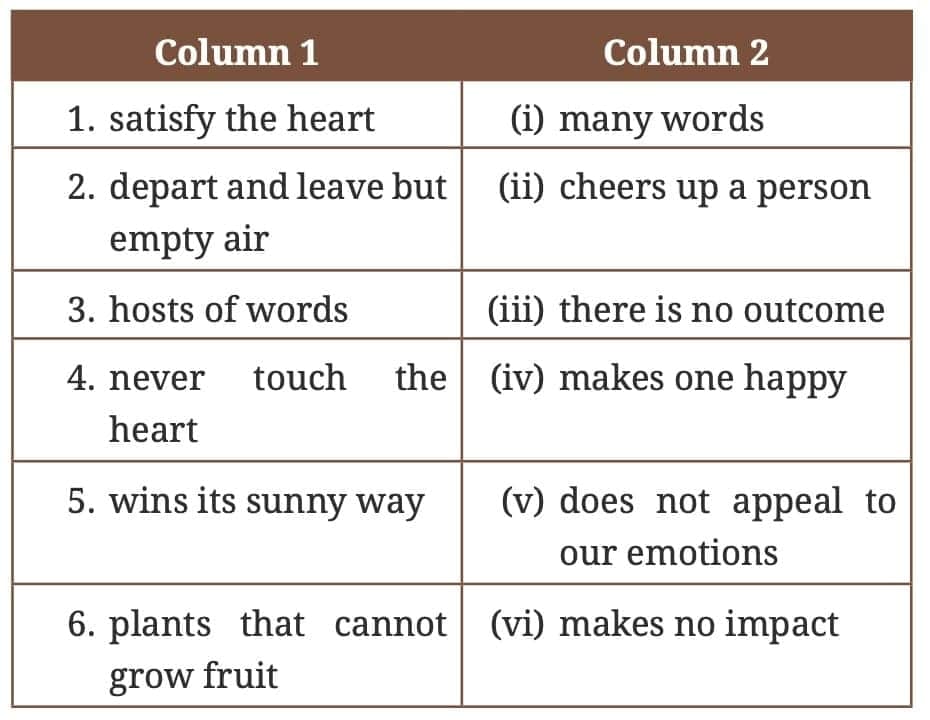
I. Match the phrases in Column 1 with their correct meanings in Column 2. Use each phrase in a sentence of your own.
Ans (sentences):
- Nothing can truly satisfy the heart like the presence of a loved one in times of sorrow.
- His hollow promises would always depart and leave but empty air, never translating into action.
- The politician spoke for an hour, using hosts of words, but said nothing of real substance.
- A speech filled with statistics and jargon may inform the mind, but it will never touch the heart.
- Her kind and gentle manner wins its sunny way into the hearts of everyone she meets.
- A friendship based on flattery alone is like plants that cannot grow fruit — it looks beautiful but bears nothing lasting.

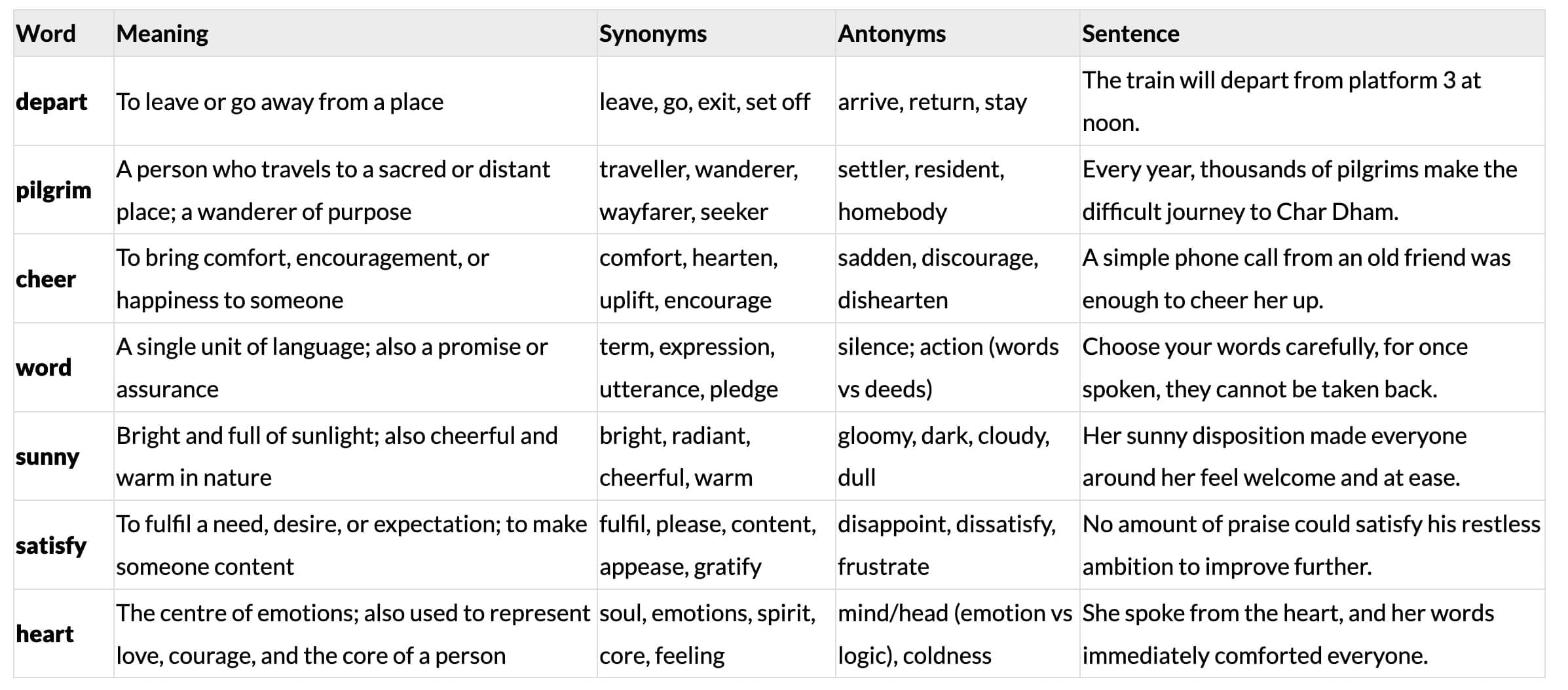
II. Create a ‘Word Map’ for each of the words from the poem given in the box.
Speaking Activity
I. Read the following quotations and select the one you like the most. Explain the quotation and share the reason for your choice with your classmates and teacher. You may talk about a connected personal experience too.
SAMPLE RESPONSE
I chose the quotation by Mahatma Gandhi: “It is better in prayer to have a heart without words than words without a heart” because it resonates deeply with the central message of the poem we have just studied.
Explanation of the quotation: Gandhi says that true communication — whether with God or with people — does not require an abundance of words. What matters is whether those words are backed by sincere feeling. A prayer or conversation that comes from the depths of the heart, even without words, is far more valuable than a beautifully worded prayer or speech that carries no genuine emotion. It is the feeling behind the words that gives them life and meaning.
Reason for choosing it: I selected this quotation since it connects perfectly with what Charles Swain argues in the poem “Words” — that a little, truly said, can impart deeper joy than hosts of hollow words. Both Gandhi and Swain believe that sincerity is the soul of communication.
Personal experience: I remember a time when I was upset and a friend simply sat with me quietly, occasionally saying “I understand” — just two words, spoken with genuine feeling. That mattered infinitely more than the many well-meaning but hollow phrases others offered. It taught me that two sincere words are worth more than two hundred hollow ones.
Writing Task
I. Write an essay on any one quotation from the speaking activity. Follow the guidelines given (Introduction, Body, Counterargument, Conclusion).
Essay on: “Whatever words we utter should be chosen with care, for people will hear them and be influenced by them for good or ill.” – Gautama Buddha
Introduction
The above words, spoken by Gautama Buddha, are among the most timeless pieces of wisdom ever shared with humanity. They remind us that every word we speak carries weight — and that weight can uplift or destroy, heal or wound. This quotation appealed to me deeply because it places a profound responsibility on each one of us as speakers, communicators, and human beings. In this essay, I will explore the power and responsibility that comes with the words we choose to speak, and why Buddha’s counsel remains urgently relevant in today’s world.
Body — Paragraph 1: Words Shape Reality
Words are not merely sounds or symbols — they are instruments of influence. History is full of examples of how words have shaped the course of events. Mahatma Gandhi’s words ignited a freedom movement; Martin Luther King Jr.’s speeches transformed a nation’s conscience. On a personal level, a teacher’s encouraging remark can define a student’s future, while a careless word of criticism can shatter confidence that takes years to rebuild. Buddha’s warning — that words influence people “for good or ill” — is proven daily in our own lives.
Body — Paragraph 2: The Responsibility of Speaking
In addition to their power, words carry enormous moral responsibility. In today’s age of social media, a single carelessly typed message can reach millions in seconds. Misinformation, cyberbullying, and hate speech are all consequences of words chosen without care. Consequently, Buddha’s counsel becomes even more critical in the digital age. Before we speak — or type — we must ask ourselves: Is this true? Is this necessary? Is this kind? Choosing words carefully is not about suppressing expression; it is about ensuring that what we express has the power to build rather than destroy.
Body — Paragraph 3: Sincerity Over Quantity
The poet Charles Swain, in the poem “Words,” reinforces Buddha’s wisdom by pointing out that “a little said, and truly said, can deeper joy impart than hosts of words, which reach the head, but never touch the heart.” This suggests that it is not how many words we speak, but how carefully and sincerely we choose them, that determines their impact. A single word of genuine encouragement can change a life, while a flood of hollow flattery leaves the listener empty. Finally, choosing words with care means choosing fewer, more meaningful ones.
Counterargument
Some may argue that placing too much emphasis on choosing words carefully could lead to overthinking — making people hesitant and unable to speak freely and spontaneously. They might say that natural, unguarded speech is more authentic than carefully curated words. However, this criticism is not entirely valid. Being mindful of one’s words does not mean being scripted or unnatural — it means developing a habit of thoughtfulness and empathy. Over time, careful choice of words becomes instinctive, not laboured.
Conclusion
In conclusion, Buddha’s counsel that words must be chosen with care is a guiding principle for all human interaction — personal, professional, and public. Words, once spoken, cannot be taken back. They linger in the hearts and minds of those who hear them, influencing their feelings, choices, and lives. As students, citizens, and communicators, we owe it to ourselves and to others to speak thoughtfully, sincerely, and with compassion. For it is not the volume of our words, but their truth and kindness, that defines their lasting worth.