Multiple Choice Questions
Instruction: Select the correct option for each question.
Q1. What is the primary material in Mrs. Jones’s garden?
(a) Flowers
(b) Grass
(c) Stones
(d) Trees
Q2. What does the poem suggest about Mrs. Jones’s attitude toward her garden?
(a) She is embarrassed by it
(b) She wants to change it
(c) She ignores it
(d) She takes pride in it
Q3. What is the setting of the interaction between the speaker and Mrs. Jones in the third stanza?
(a) A market
(b) Mrs. Jones’s garden
(c) The speaker’s house
(d) A park
Q4. What does the “strange device” on the sundial suggest about Mrs. Jones’s taste?
(a) She prefers modern technology
(b) She likes simple designs
(c) She values unusual features
(d) She dislikes decorative items
Q5. What creates the ironic moment in the poem’s final stanza?
(a) The speaker steps on the flower he admires
(b) Mrs. Jones forgets about her garden
(c) The speaker buys a plant from Mrs. Jones
(d) Mrs. Jones changes her garden’s designFill in the Blanks
Instruction: Fill in the blanks with the correct word based on the chapter.
Q1. Mrs. Jones’s garden has a ______ path that twists and turns.
Q2. The ______ in Mrs. Jones’s garden is a tool that tells time using the sun.
Q3. The speaker finds the tiny plants so small that they seem to have no ______ at all.
Q4. Mrs. Jones is described as an ______ gardener who loves her stone garden.Very Short Answer Questions
Instruction: Answer the following questions in one line.
Q1. What is the name of the poet who wrote “A Concrete Example”?
Q2. What contains water lilies in Mrs. Jones’s garden?
Q3. How long do the speaker and Mrs. Jones talk about the flower?
Q4. What does Mrs. Jones say when the speaker asks where the flower is?
Q5. What type of garden feature is the rockery in the poem?Short Answer Questions
Instruction: Answer the following questions in 2–3 lines.
Q1. How does the poem’s structure contribute to its readability?
Q2. Why does the speaker think the tiny plants are insignificant?
Q3. How does the dialogue in the third stanza make the poem more humorous?
Q4. How does the poem show Mrs. Jones’s unique taste in gardening?
Q5. What lesson about perception does the poem teach?Match the Following
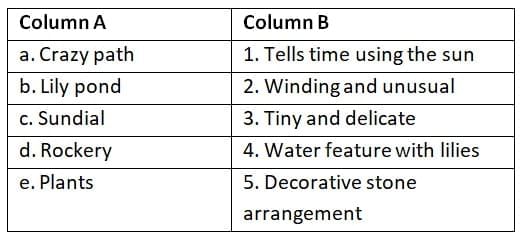
Instruction: Match Column A with the correct option in Column B.
Check out the solutions of this worksheet here.