Have you ever noticed how things move around you? Like a fan spinning, or a door opening? All these movements involve ‘turns’, and these turns help us understand ‘angles’. Let’s explore this fun topic together!
What is a Turn?
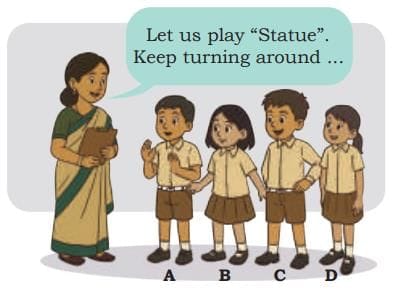
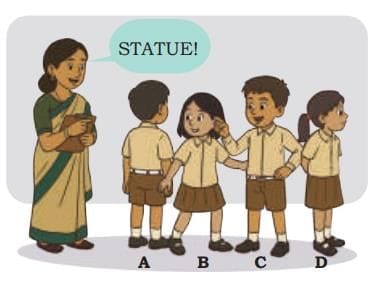
Can you recognise the child in the picture who has made a full turn? Who has made a half turn? How do you know?
The child in the picture that has made a full turn is “C” and the child in the picture who has made a half turn is “A”
Lets see how we know this.
Turns
When you spin all the way around and come back to where you started, that’s a full turn. Think about the minute hand of a clock. When it goes all the way around from 12 and comes back to 12, it has made a full turn.
- Example: A giant wheel makes a full turn when it comes back to its starting position.
If you spin halfway around, so you are facing the opposite direction, that’s a half turn.
- Example: If Reema takes two half turns in the same direction, it’s like she has made a full turn.
If you spin just a little bit, like turning to face the side, that’s a quarter turn. A quarter turn is one-fourth of a full turn.
- Example: If Reema takes 2 quarter turns in the same direction, it’s like she has made a half turn. If she takes 4 quarter turns in the same direction, it’s like she has made a full turn.
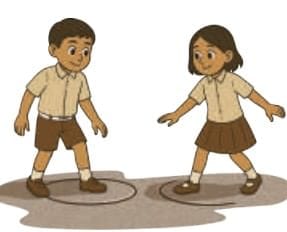
Ashutosh and Sahana are making circles, each having one foot fixed and rotating at one spot on the ground.
Ashutosh made a complete circle by making a full turn. Sahana is making a half-moon shape with a half turn.
Everyday Objects and Turns
- Taps: When you open or close a tap, you turn it.
- Doors with hinges: Doors swing open and close, making turns.
- Scissors: When you open and close scissors, they make turns.
- Clothes clip: When you open a clothes clip, it makes a turn.
Think about the maximum turn these objects can make. Some can make a quarter turn, some a half turn, and some even a full turn!
Try yourself:
What is a full turn?
- A.Turning halfway around
- B.Spinning all the way around
- C.Turning to the side
- D.Making a half-moon shape
View Solution
Different Types of Angles
- Angles are formed when two lines or objects meet at a point and turn. Let’s learn about different types of angles using the example of Pragya and her straws.
- Pragya joined a green and yellow straw with paper clips. She holds the green straw steady and turns the yellow straw around. Observe different turns of the yellow straw:
- Right Angle
-
- When the yellow straw makes a quarter (1/4) of a full turn, it looks like a right angle. A right angle is like the corner of a square or a book. It looks like an ‘L’ shape.
- Acute Angle
-
- If the yellow straw makes less than a quarter turn, it looks like an acute angle. Acute angles are smaller than a right angle. Think of a sharp point, like the tip of a pencil.
- Obtuse Angle
- When the yellow straw makes more than a quarter turn but less than a half turn, it looks like an obtuse angle. Obtuse angles are bigger than a right angle but smaller than a straight angle.
- Straight Angle
- If the yellow straw makes two quarter turns (which is the same as a half turn), it forms a straight angle. A straight angle looks like a straight line.
- Angles arise in situations that involve a turn.
Angle Measuring Tool
Measuring Turns and Angles
Wouldn’t it be great if we could measure turns and angles? Well, we can! Let’s make our own tool to measure turns.
(a) Making Your Tool
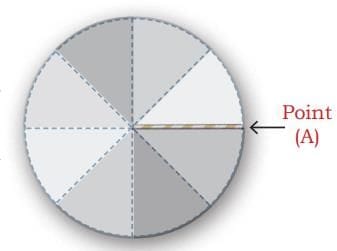
- Take a tracing paper and cut out a circle from it.
- Fold the circle carefully to make 8 equal parts. Imagine folding it in half, then in half again, and then in half one more time.
- Attach a straw to the very center of the circle.
- Mark a starting point on the edge of the circle.
Now you have your very own angle measuring tool!
(b) Using Your Tool
Let’s try using your new tool to understand turns:
- Show a 1/8 turn: Move the straw from the starting point to the first fold line. That’s a 1/8 turn.
- Show a 2/8 turn (which is 1/4 turn): Move the straw to the second fold line. This is a quarter turn, or a right angle!
- Show a 3/8 turn: Move the straw to the third fold line.
- Show a 4/8 turn (which is 1/2 turn): Move the straw to the fourth fold line. This is a half turn, or a straight angle!
Keep turning the straw by 5/8, 6/8, 7/8, and 8/8. When you reach 8/8, you have completed a full turn!
Making a Permanent Tool
You can cut out parts of your folded circle (like 1/8 part and 2/8 parts and paste them on a thicker paper or board. These can be used as handy angle measuring tools.
Try yourself:
What is an angle measuring tool used for?
- A.Drawing
- B.Cooking
- C.Measuring angles
- D.Writing
View Solution
Which Direction?
When things turn, they turn in a certain direction. There are two main directions of turning:
Clockwise Movement
Think about how the hands of a clock move. They move from 12 to 1, then to 2, and so on. This direction of movement is called clockwise movement.
Anti-clockwise Movement
The opposite of clockwise movement is called anti-clockwise movement. If you move your hand from 12 to 11, then to 10, that would be anti-clockwise.
The creatures below have made a quarter turn once. Tick the direction in which they have moved.
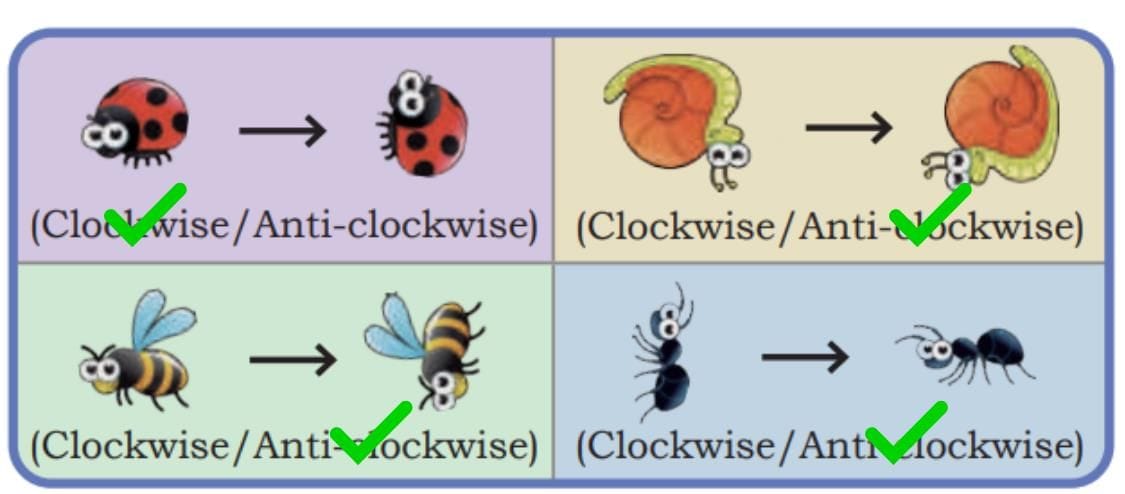
Fun with Turns
1. The children in a class are playing a game in which the teacher tells them the direction in which they should rotate. Complete the table by filling the direction the children will face on completing the given turns. The starting direction is given in the table.
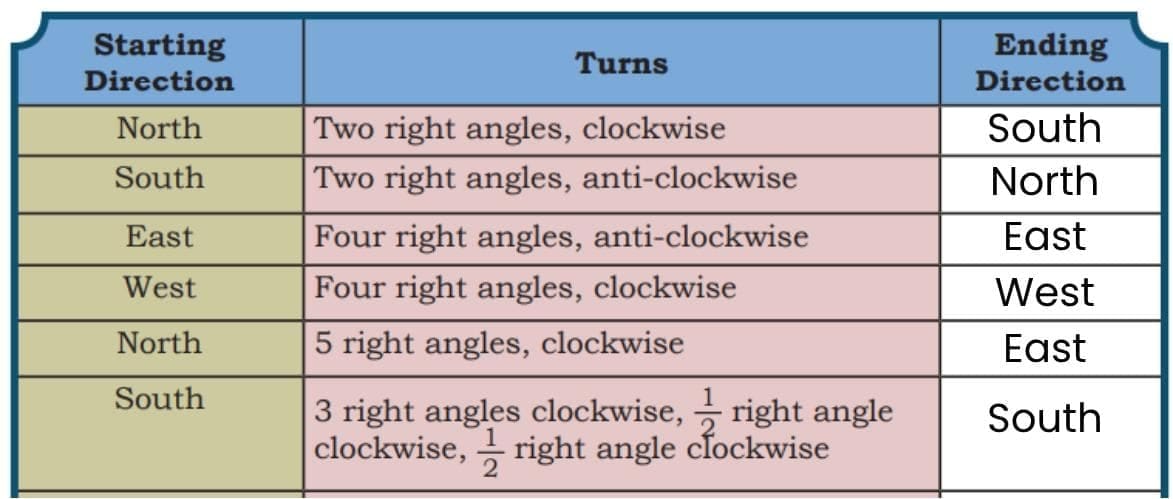
2. Padma is facing the toy shop. What place will she face if she takes a half turn clockwise?
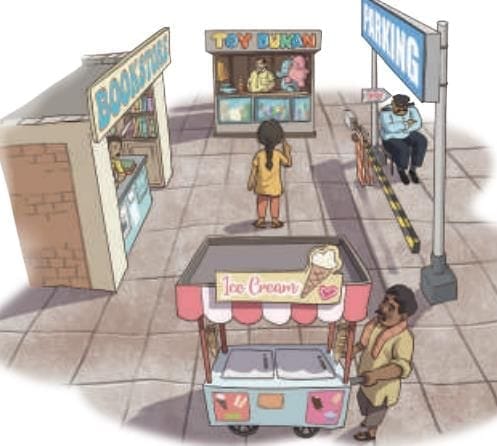
She will face the ice cream side
What other way can she turn to face the same place?
She can turn a half turn anti clockwise to face the same side.