Probe and Ponder
1. If we don’t have an electric lamp while making an electric circuit with an electric cell, is there any other way to find out if current is flowing in the circuit?
- Yes, there are other ways to check if current is flowing. One way is to use a magnetic compass.
- If you place a compass near the wire and close the circuit, the needle of the compass will deflect when the current flows through the wire. This shows that electricity is passing through the circuit.
- Another way is to use a device like an electric bell or buzzer, which will make a sound if current is present.
2. Is it possible to make temporary magnets? How can these be made?
- Yes, temporary magnets can be made easily. Wrapping a long insulated wire around an iron nail and connecting both ends of the wire to a battery turns the nail into an electromagnet (a temporary magnet).
- When electric current flows through the wire, the nail acts like a magnet and can attract magnetic materials. When the current is switched off, the nail loses its magnetism.
3. We can generate heat by burning fossil fuels and wood; but how is heat generated in various electrical appliances?
- In electrical appliances, heat is generated due to the heating effect of electric current.
- When electric current passes through a wire or coil (often made of materials like nichrome), the wire offers resistance to the current. This resistance causes some electrical energy to change into heat energy, making the wire hot.
- That’s why devices like heaters, irons, and toasters become warm when switched on.
4. How do we know if a cell or a battery is dead? Can all cells and batteries be recharged?
- A cell or battery is considered dead if it can no longer provide enough current to light a bulb, move a motor, or run any electrical device. Sometimes the device works weakly or not at all, which signals that the battery is dead.
- Not all cells and batteries can be recharged. Dry cells, like those used in TV remotes, are single-use and cannot be recharged.
- Rechargeable batteries, such as those in mobile phones and laptops, can be used again and again by recharging them with a charger.
5. Share your questions
- Why does reversing the battery terminals in a coil change the direction of the compass needle?
- What happens if we use longer wires to make an electromagnet?
- Which fruit or vegetable makes the strongest electric cell?
- How does a rechargeable battery work differently from a single-use battery?
- What materials are best for making heating elements in electric appliances?
Keep the curiosity alive
1. Fill in the blanks:
(i) The solution used in a Voltaic cell is called ________.
(ii) A current carrying coil behaves like a _______ .
Ans:
(i) The solution used in a Voltaic cell is called electrolyte.
(ii) A current carrying coil behaves like a magnet.
2. Choose the correct option:
(i) Dry cells are less portable compared to Voltaic cells. (True/False)
(ii) A coil becomes an electromagnet only when electric current flows through it. (True/False)
(iii) An electromagnet, using a single cell, attracts more iron paper clips than the same electromagnet with a battery of 2 cells. (True/False)
Ans: (i) Dry cells are less portable compared to Voltaic cells. False
Dry cells are more portable as they use a paste electrolyte and are compact.
(ii) A coil becomes an electromagnet only when electric current flows through it. True.
(iii) An electromagnet, using a single cell, attracts more iron paper clips than the same electromagnet with a battery of 2 cells. False
More cells provide stronger current, leading to a stronger magnetic field and more attraction.
3. An electric current flows through a nichrome wire for a short time.
(i) The wire becomes warm.
(ii) A magnetic compass placed below the wire is deflected.
Choose the correct option:
(a) Only (i) is correct
(b) Only (ii) is correct
(c) Both (i) and (ii) are correct
(d) Both (i) and (ii) are not correct
Ans: Correct option: (c) Both (i) and (ii) are correct
This demonstrates the heating and magnetic effects of electric current.
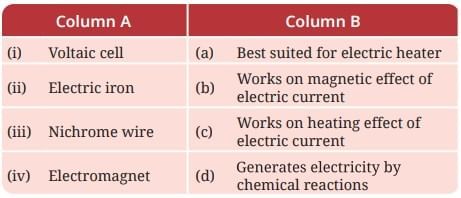
4. Match the items in Column A with those in Column B
Ans: Column AColumn B(i) Voltaic cell(d) Generates electricity by chemical reactions(ii) Electric iron(c) Works on heating effect of electric current(iii) Nichrome wire(a) Best suited for electric heater(iv) Electromagnet(b) Works on magnetic effect of electric current
5. Nichrome wire is commonly used in electrical heating devices because it
(i) is a good conductor of electricity.
(ii) generates more heat for a given current.
(iii) is cheaper than copper.
(iv) is an insulator of electricity.
Ans: (ii) generates more heat for a given current (It offers high resistance, converting more electrical energy to heat).
6. Electric heating devices (like an electric heater or a stove) are often considered more convenient than traditional heating methods (like burning firewood or charcoal). Give reason(s) to support this statement considering societal impact.
Ans. Electric heating devices provide instant, controllable heat without smoke or ash, reducing indoor air pollution and health risks like respiratory issues. They eliminate the need for fuel collection, saving time and reducing deforestation, which benefits the environment and promotes sustainable living in communities.
7. Look at the Fig. 4.4a. If the compass placed near the coil deflects: (i) Draw an arrow on the diagram to show the path of the electric current. (ii) Explain why the compass needle moves when current flows. (iii) Predict what would happen to the deflection if you reverse the battery terminals.
Ans. (i) The path of the electric current would flow from the positive terminal of the cell, through the coil from end A to end B, and back to the negative terminal.
(ii) The compass needle moves because the current flowing through the coil creates a magnetic field, which interacts with the needle’s own magnetism, causing deflection.
(iii) Reversing the battery terminals would reverse the current direction, flipping the electromagnet’s poles and causing the compass needle to deflect in the opposite direction.
8. Suppose Sumana forgets to move the switch of her lifting electromagnet model to OFF position (in introduction story). After some time, the iron nail no longer picks up the iron paper clips, but the wire wrapped around the iron nail is still warm. Why did the lifting electromagnet stop lifting the clips? Give possible reasons.
The electromagnet stops lifting clips because the battery likely depletes over time, stopping the current flow and eliminating the magnetic field. The wire remains warm due to residual heat from earlier current or possible ongoing low-level resistance heating if there’s a partial connection.
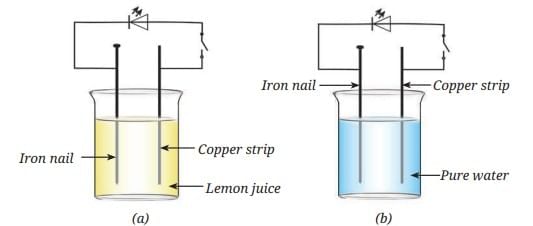
9. In Fig. 4.11, in which case the LED will glow when the switch is closed?
Ans: The LED will glow in (a) with lemon juice, as it acts as an electrolyte enabling chemical reactions to generate current between the iron nail and copper strip. It will not glow in (b) with pure water, which is a poor conductor and does not facilitate the necessary reactions.
10. Neha keeps the coil exactly the same as in Activity 4.4 but slides the iron nail out, leaving only the coiled wire. Will the coil still deflect the compass? If yes, will the deflection be more or less than before?
Ans: Yes, the coil will still deflect the compass as current through it produces a magnetic field. However, the deflection will be less than before, since the iron nail acts as a core that strengthens the magnetic effect.
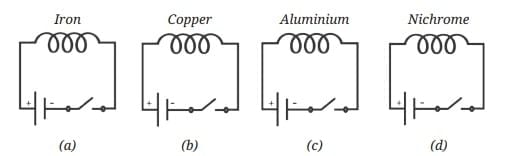
11. We have four coils, of similar shape and size, made up from iron, copper, aluminium, and nichrome as shown in Fig. 4.12. When current is passed through the coils, compass needles placed near the coils will show deflection.
When current is passed through the coils, compass needles placed near the coils will show deflection.
(i) Only in circuit (a)
(ii) Only in circuits (a) and (b)
(iii) Only in circuits (a), (b), and (c)
(iv) In all four circuits
Ans:
Option (iv) In all four circuits (All materials conduct current, producing a magnetic field that deflects the compass, though nichrome’s higher resistance may result in weaker current and deflection).
Discover, design, and debate
Q1. Make coils of turns 25, 50, 75, and 100. Connect them to the same cell one by one. Note the deflection in a magnetic compass placed in the same position in all the cases. Report your observations. Draw conclusion of the effect of number of turns of the coil on the strength of the electromagnet.
Ans:
Activity and Observations:
Coils are made with 25, 50, 75, and 100 turns and each is connected to the same electric cell. A magnetic compass is placed near the end of each coil, and the deflection of the compass needle is observed.Number of TurnsDeflection of Compass Needle25Small deflection observed50More deflection than 25 turns75Even greater deflection100Maximum deflection
Conclusion:
As the number of turns in the coil increases, the strength of the electromagnet also increases. This is seen because the compass needle deflects more each time the number of turns increases. This happens because more turns mean a stronger magnetic field is produced in the coil when current flows.
Q2. Take two thin nichrome wires of equal length and different thickness (approximately one of these wire thickness to be double of the other, say 0.3 mm and 0.6 mm). Connect them one by one in a circuit which has a switch and a cell, and allow the current to flow for 30 s in each case. Momentarily touch these wires. Which wire heats up more? Now repeat the same activity with two nichrome wires of same diameter but of different lengths. Prepare a brief report of your activity.
Ans:
Part 1: Same Length, Different Thickness
Two nichrome wires of the same length (example: 10cm) but different thickness (0.3mm and 0.6mm) are used one by one in a circuit, and current flows for 30 seconds.Wire ThicknessObservation after 30s0.3 mm (thin)Feels hotter to touch0.6 mm (thick)Warms up less, not as hot as 0.3mm
Result:
The thinner nichrome wire (0.3mm) becomes hotter than the thicker wire (0.6mm), because thinner wires have higher resistance and produce more heat when current flows.
Part 2: Same Thickness, Different Lengths
Two wires of same thickness but different lengths (10cm and 20cm) are tested the same way.Wire LengthObservation after 30s10 cm (short)Warms up20 cm (long)Warms up, sometimes more than short
Result:
The longer wire can become warmer because it has more resistance than the shorter wire.
Brief Report:
Nichrome wires with more resistance (thinner or longer) heat up more when electric current flows through them. That is why thin and long wires are used as heating elements in appliances.
Q3. Try to make an electric cell using various fruits and vegetables. Also try with electrodes of different metals. Prepare a brief report.
Ans: Activity:
Fruits like lemon, potato, and tomato are tried as electric cells by inserting two different metal strips (such as copper and zinc, or copper and iron) into them. Several fruits or vegetables may be connected in series to increase the power, and an LED or small bulb is connected to check if electricity is produced.
Observations:
- When copper and zinc metals are used in a lemon, the LED glows dimly.
- More lemons connected together make the LED glow brighter.
- With other fruits and vegetables such as potatoes and tomatoes, electricity is still produced, but lemons usually work the best because of their sour and acidic juice.
- If two metals that are far apart in reactivity (like zinc and copper) are used, the electricity produced is more.
- If plain water is tried instead of fruit, almost no electricity is produced.
Brief Report:
Fruits like lemon or tomato, when combined with different metals, can act as simple electric cells and produce a small amount of electricity. The acidic juice in fruits helps in carrying the current. The choice of metals is important—combinations like zinc and copper are the best for making a fruit cell. This type of cell can glow a small bulb or LED if several are connected together, but they do not provide as much electricity as common batteries.