Page 57
Let Us Find
Identify the appropriate units for measuring each of the following.
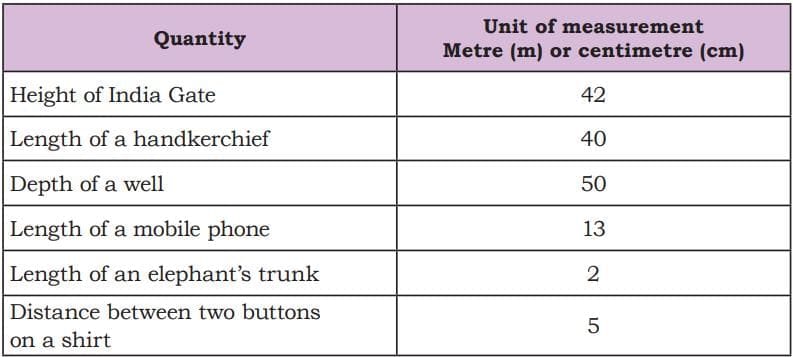
Answer:
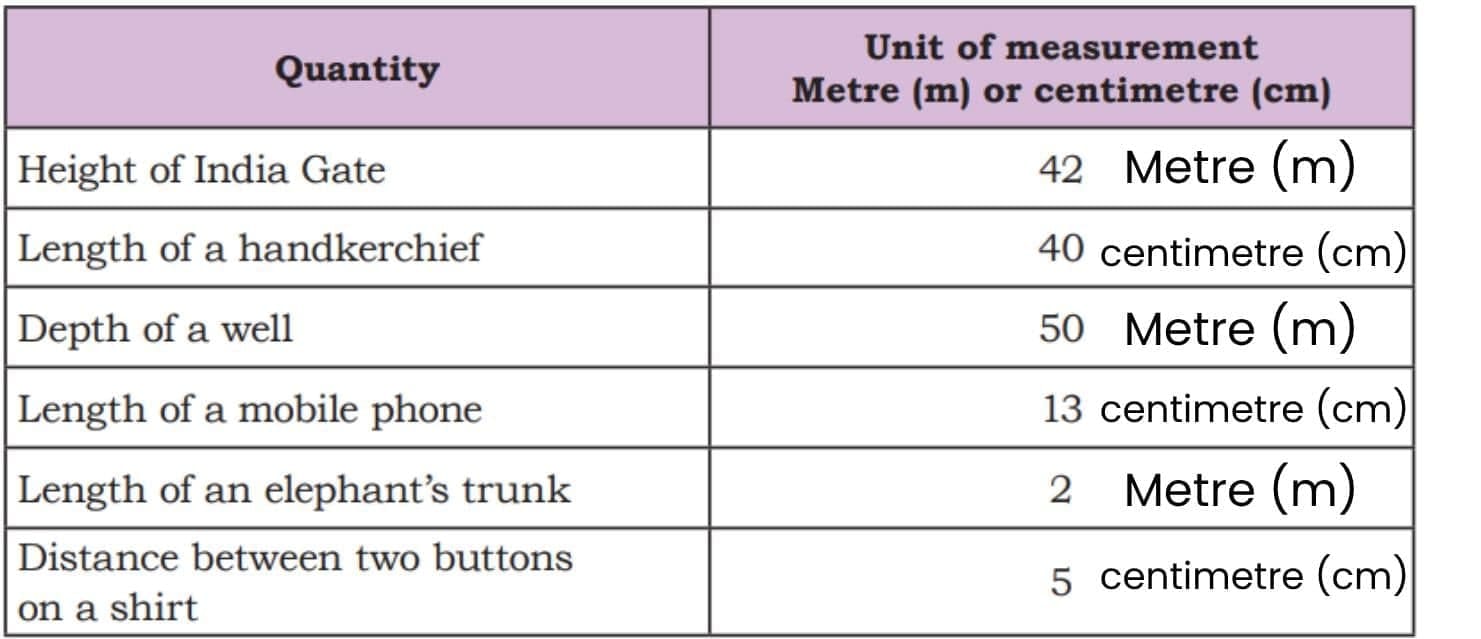
Different Units but Same Measure
Shikha and Sonu are measuring the lengths of saris and stoles in the village weaving centre. Find which measures represent the same sari or stole. You can take help of the double number line below.
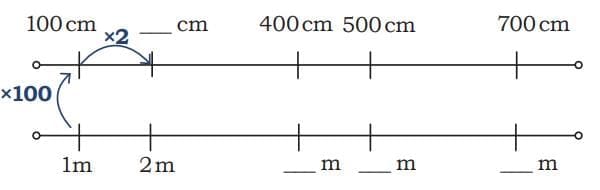
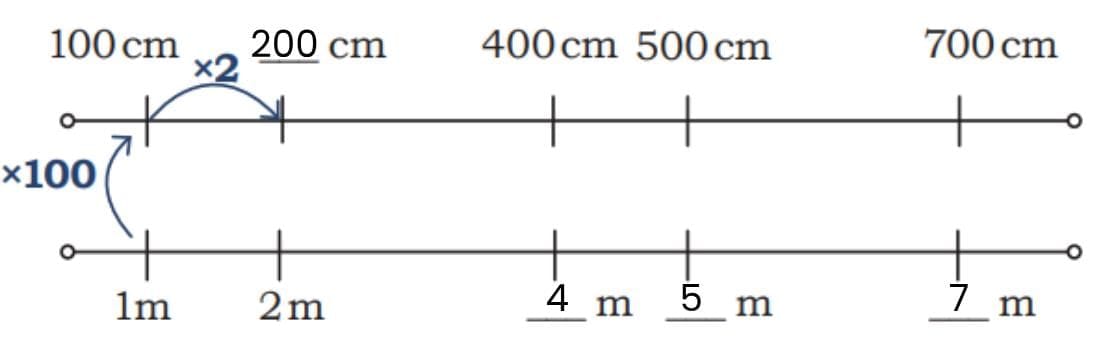
Answer:
Based on the conversion
100 cm & 1 m
200 cm & 2 m
400 cm & 4 m
500 cm & 5 m
700 cm & 7 m
Therefore, the measures that represent the same sari or stole are:
• 204 cm and 2 metre 4 cm
• 540 cm and 5 metre 40 cm
• 750 cm and 6 metre 150 cm
• 240 cm and 2 metre 40 cm
• 404 cm and 2 metre 204 cmPage 58
Let Us Compare
1.Ritika is comparing the lengths of different rods. Compare them using <, =, > signs.
(a) 456 cm ____ 5 m
Answer: 456 cm < 5 m (since 5 m = 500 cm)
(b) 55 cm + 200 cm ____ 200 cm + 54 cm
Answer: 55 cm + 200 cm > 200 cm + 54 cm (since 255 cm > 254 cm)
(c) 6 m 5 cm ___ 6 m 50 cm
Answer: 6 m 5 cm < 6 m 50 cm (since 605 cm < 650 cm)
(d) 2 m 150 cm ___ 3 m 50 cm
Answer: 2 m 150 cm < 3 m 50 cm (since 350 cm < 350 cm is false, 2m 150cm = 350cm, 3m 50cm = 350cm, so 2 m 150 cm = 3 m 50 cm)
(e) 238 cm ____ 138 cm + 1 m
Answer: 238 cm = 138 cm + 1 m (since 138 cm + 100 cm = 238 cm)
2. World’s tallest statue
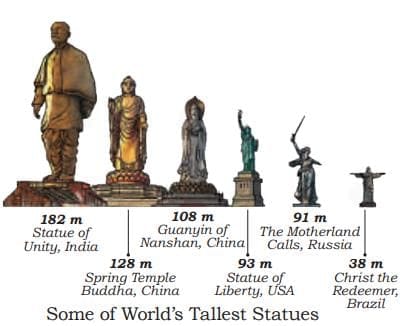
(a) What is the difference between the height of the tallest statue in the world and the Statue of Liberty?
Answer: Tallest statue in the world (from the given list) is Unity, India (182 m).
Height of Statue of Liberty is 93 m.
Difference = 182 m – 93 m = 89 m.
(b) Identify the statues whose heights have the least difference.
Answer: Let’s list the heights: Unity, India: 182 m
Spring Temple Buddha, China: 128 m
Guanyin of Nanshan, China: 108 m
Christ the Redeemer, Brazil: 38 m
The Motherland Calls, Russia: 91 m Statue of Liberty, USA: 93 m
Differences: Statue of Liberty (93m) and The Motherland Calls (91m): 93 – 91 = 2 m (Least difference)
(c) Identify the statues whose heights have the largest difference.
Answer: Largest difference would be between the tallest and the shortest.
Tallest: Unity, India (182 m) Shortest: Christ the Redeemer, Brazil (38 m)
Difference = 182 m – 38 m = 144 m (Largest difference)
(d) The height of which Statue will be equal to the height of the Statue of Unity, if it is doubled?
Answer:
Height of Statue of Unity = 182 m. We need to find a statue whose height, when doubled, equals 182 m. 182 m / 2 = 91 m.
The Statue of The Motherland Calls, Russia has a height of 91 m.
So, if its height is doubled, it will be equal to the height of the Statue of Unity.Page 59
Let Us Do
Measure 100 m and 200 m on your school playground, or any other place in and around your school, using a Long Tape. Mark these points and draw a straight line. Walk on the lines and count the number of steps. Use this relationship between the number of steps taken and distance walked to find distances around you for at least 3 locations. Wherever possible, walk and find the number of steps. Otherwise, find the distance and estimate the number of steps.
(a) Identify and write the locations that are the nearest and the farthest from your home.
Nearest location _______________________________________________________
Farthest location _______________________________________________________
Answer: Nearest location: Local grocery store 500 m
Farthest location: Grandparent’s house 5 km
(b) Write the distances obtained above in increasing order.
_______________, _________________, _________________, __________________.
Answer: 500 m, 1 km, 2 km, 5 km
(c) Name a location that is equal to or more than 1,000 m from your home.
Answer: Local park 1500 m
Let Us Explore
When we walk 1,000 m, we say we have walked 1 km. 1,000 m = 1 km
Kilo stands for thousand. This unit is used to measure long distances.
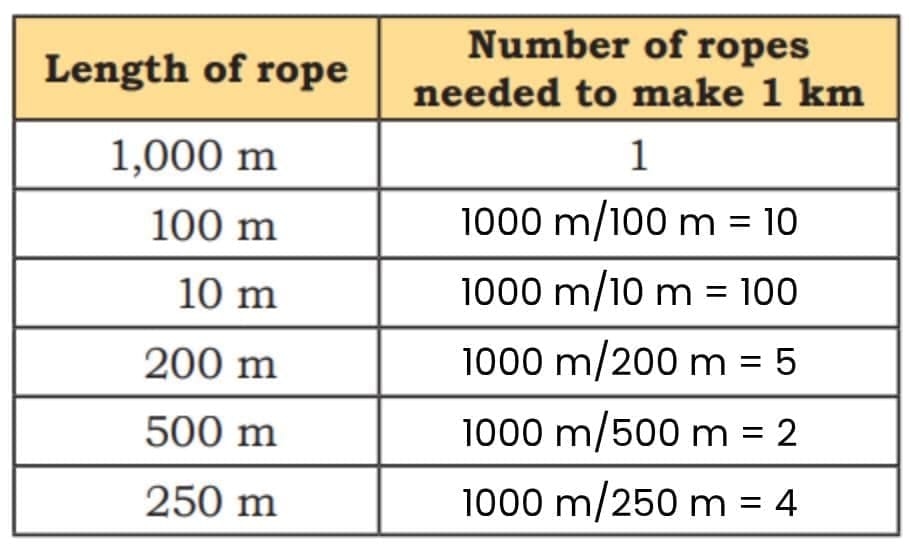
Question: Number of ropes needed to make 1 km
Page 60
Kilometre Race
Sheena and Jennifer are helping to organise a 3-km race. Help them with the arrangements for the race.
1.Water stations are to be arranged after every 500 m. How many water stations must be set up? At what positions from the starting point will these water stations be placed?
Answer: Total race distance = 3 km = 3000 m. Water stations every 500 m.
Number of water stations = Total distance / Interval = 3000 m / 500 m = 6.
Positions: 500 m, 1000 m (1 km), 1500 m (1.5 km), 2000 m (2 km), 2500 m (2.5 km), 3000 m (3 km – finish line).
So, 6 water stations will be set up at 500 m, 1 km, 1.5 km, 2 km, 2.5 km, and 3 km from the starting point.
2. Children need to stand at an interval of 300 m to direct the runners. How many children are needed? At what positions from the starting point will the children be standing?
Answer: Total race distance = 3 km = 3000 m. Children every 300 m.
Number of children = Total distance / Interval = 3000 m / 300 m = 10.
Positions: 300 m, 600 m, 900 m, 1200 m (1.2 km), 1500 m (1.5 km), 1800 m (1.8 km), 2100 m (2.1 km), 2400 m (2.4 km), 2700 m (2.7 km), 3000 m (3 km – finish line).
So, 10 children are needed at 300 m, 600 m, 900 m, 1.2 km, 1.5 km, 1.8 km, 2.1 km, 2.4 km, 2.7 km, and 3 km from the starting point.
3. Red and blue flags are to be placed alternately at every 50 m. How many red and blue flags are needed till the finish line?
Answer:
Total race distance = 3 km = 3000 m. Flags every 50 m.
Number of flag positions = Total distance / Interval = 3000 m / 50 m = 60.
Since flags are placed alternately, there will be 30 red flags and 30 blue flags.
Let Us Do: Longest Train Journey
The longest train journey in India is by The Vivek Express which runs from Dibrugarh in Assam to Kanniyakumari in Tamil Nadu. Look at the stations on the route shown in the table below and answer the questions.
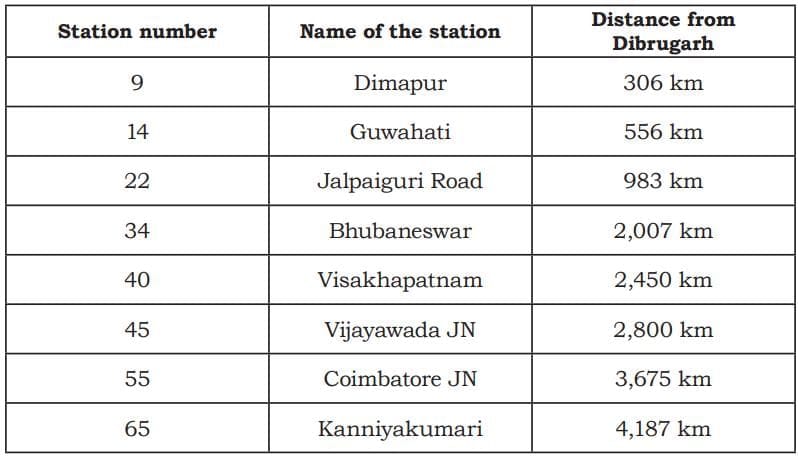
1. The total length of the route from Dibrugarh to Kanniyakumari is _______________ km.
Answer: The total length of the route from Dibrugarh to Kanniyakumari is 4,187 km (distance of Kanniyakumari from Dibrugarh).
2. The distance between Vijayawada and Jalpaiguri road is _______________.
Answer: Distance of Vijayawada JN from Dibrugarh = 2,800 km
Distance of Jalpaiguri Road from Dibrugarh = 983 km
Distance between Vijayawada and Jalpaiguri Road = 2,800 km – 983 km = 1,817 km.
3. Distance between Vijayawada and Visakhapatnam is _______________.
Answer: Distance of Vijayawada JN from Dibrugarh = 2,800 km
Distance of Visakhapatnam from Dibrugarh = 2,450 km
Distance between Vijayawada and Visakhapatnam = 2,800 km – 2,450 km = 350 km.
4. Which two stations are farther apart — Guwahati and Dimapur or Bhubaneswar and Jalpaiguri Road?
Answer: Distance between Guwahati and Dimapur: Guwahati = 556 km, Dimapur = 306 km
Difference = 556 km – 306 km = 250 km.
Distance between Bhubaneswar and Jalpaiguri Road: Bhubaneswar = 2,007 km, Jalpaiguri Road = 983 km
Difference = 2,007 km – 983 km = 1,024 km.
Comparing 250 km and 1,024 km, Bhubaneswar and Jalpaiguri Road are farther apart.
5. What is the distance between Guwahati and Coimbatore JN?
Answer: Distance of Coimbatore JN from Dibrugarh = 3,675 km
Distance of Guwahati from Dibrugarh = 556 km
Distance between Guwahati and Coimbatore JN = 3,675 km – 556 km = 3,119 km.Page 62
Let Us Do
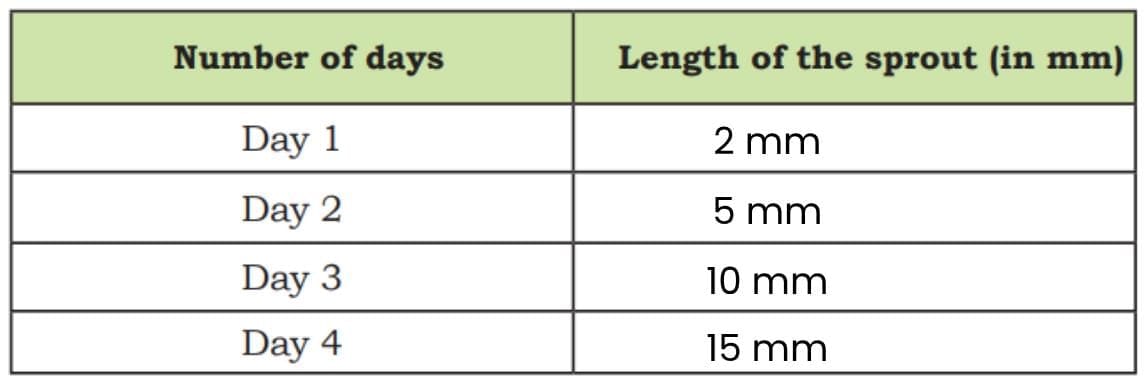
Soak some seeds of whole moong or black or white chana overnight. Next morning, take them out and wrap them in a moist cloth to sprout them. Over the next 4 days, take out one seed each day and measure the length of sprout. For ease of measurement, you can either place the seed on a paper and mark the length of the sprout, or use a thread to find its length.
Answer:
Let Us Draw
Draw lines of the following lengths in your notebook using a scale.
1.5 cm 5 mm
2.3 cm 6 mm
3.8 cm 3 mm
4.36 mm
5.67 mm
How did you draw lines of lengths 36 mm and 67 mm? Share your thoughts in class.
Answer:
To draw lines of lengths 36 mm and 67 mm:
• For 36 mm: Since 10 mm = 1 cm, 36 mm is equal to 3 cm and 6 mm. So, place the scale on the notebook, mark a starting point, and then draw a line up to the 3 cm mark and then 6 small divisions (mm) further.
• For 67 mm: Similarly, 67 mm is equal to 6 cm and 7 mm. Place the scale, mark a starting point, and draw a line up to the 6 cm mark and then 7 small divisions (mm) further.Page 63
Let Us Do
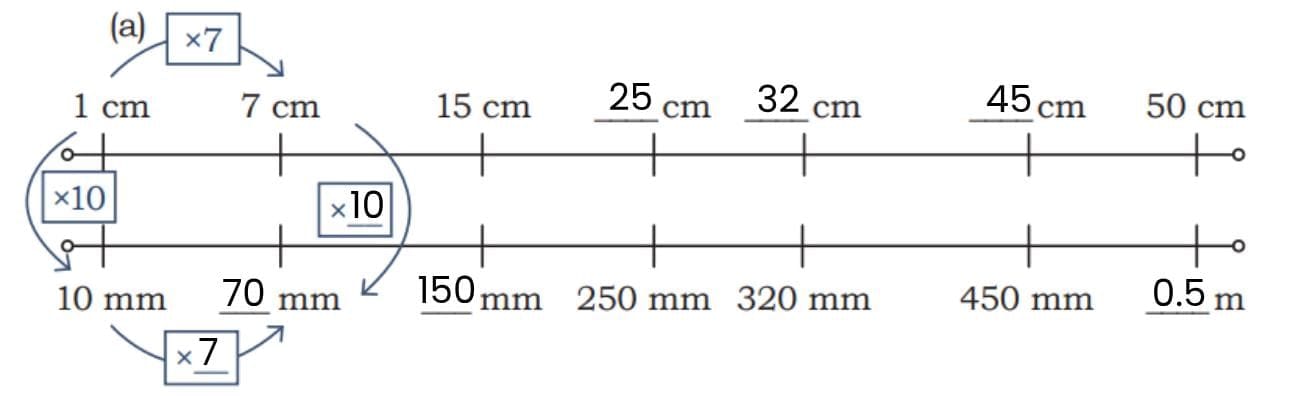
1.Fill in the blanks appropriately in the double number lines given below.
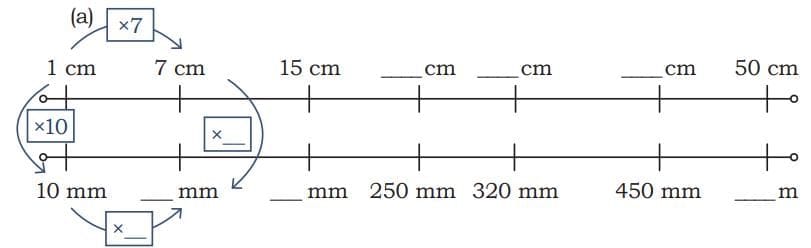
Answer:
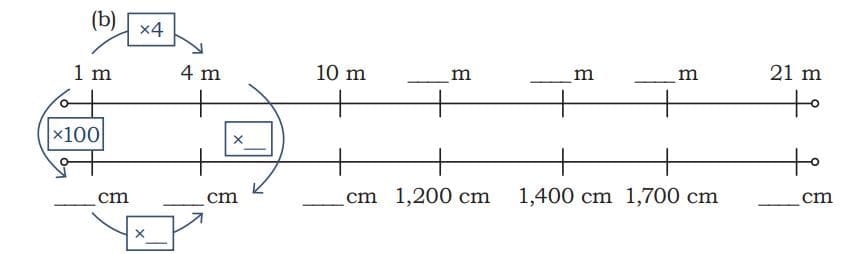
Answer:
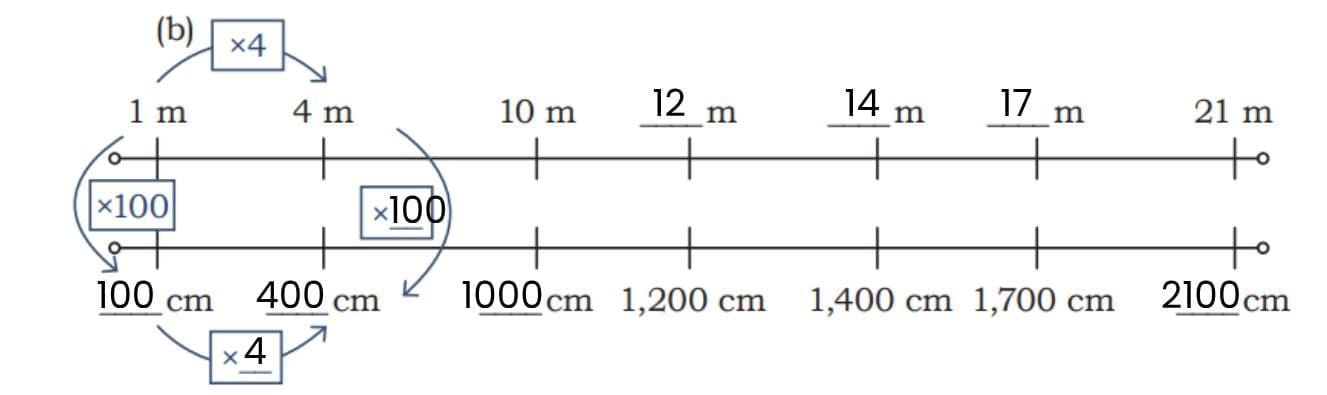
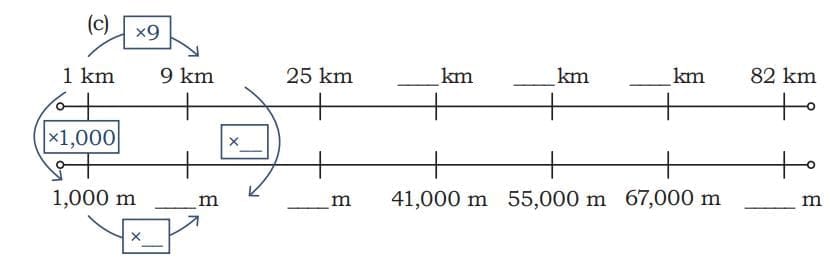
Answer:
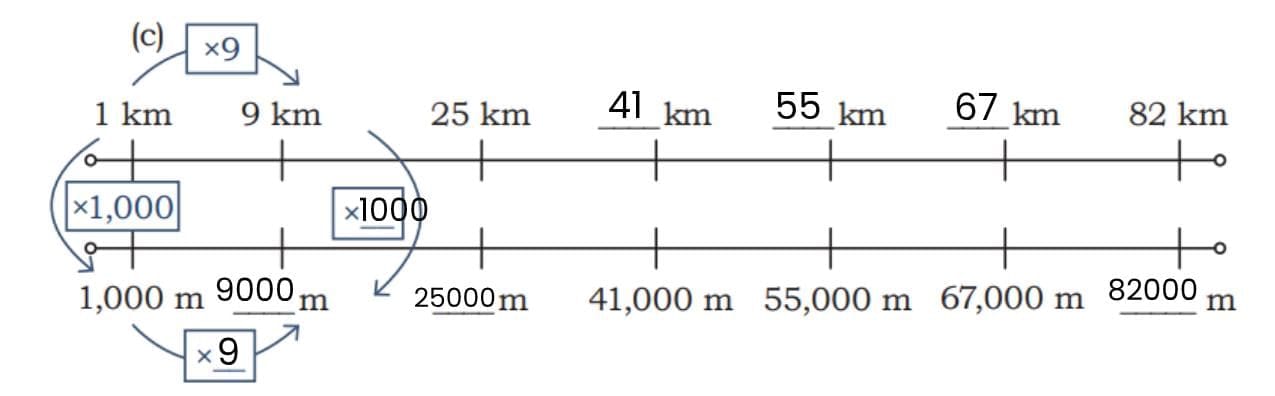
2. Use your understanding from above to fill in the blanks appropriately.
(a) 4 cm 5 mm = ______ mm
Answer: 4 cm 5 mm = 40 mm + 5 mm = 45 mm
(b) 89 mm = ____ cm ____ mm
Answer: 89 mm = 80 mm + 9 mm = 8 cm 9 mm
(c) 234 cm = ____ mm
Answer: 234 cm = 234 × 10 mm = 2340 mm
(d) 514 mm = ____ cm ____ mm
Answer: 514 mm = 510 mm + 4 mm = 51 cm 4 mm
(e) 6 m 34 cm = ____ cm
Answer: 6 m 34 cm = 600 cm + 34 cm = 634 cm
(f) 20 m 12 cm = ____ cm
Answer: 20 m 12 cm = 2000 cm + 12 cm = 2012 cm
(g) 397 m = ______ cm
Answer: 397 m = 397 × 100 cm = 39700 cm
(h) 5,792 cm = ______m ______ cm
Answer: 5,792 cm = 5700 cm + 92 cm = 57 m 92 cm
(i) 9,108 cm = ______ m ______ cm
Answer: 9,108 cm = 9100 cm + 8 cm = 91 m 8 cm
(j) 34 km = _______ m
Answer: 34 km = 34 × 1000 m = 34000 m
(k) 6,870 m = ____ km ____ m
Answer: 6,870 m = 6000 m + 870 m = 6 km 870 m
(l) 10,552 m = ____ km ___ m
Answer: 10,552 m = 10000 m + 552 m = 10 km 552 m
(m) 29 km 30 m = ____ m
Answer: 29 km 30 m = 29 × 1000 m + 30 m = 29000 m + 30 m = 29030 m
(n) 32 km 359 m = ____ m
Answer: 32 km 359 m = 32 × 1000 m + 359 m = 32000 m + 359 m = 32359 mPage 66
Let Us Do
1.Rani has two red-coloured ribbon rolls, one of length 3 m 75 cm and another 2 m 25 cm long. How much ribbon does she have?
Answer:
Length of first ribbon = 3 m 75 cm
Length of second ribbon = 2 m 25 cm
Total ribbon = (3 m + 2 m) + (75 cm + 25 cm)
Total ribbon = 5 m + 100 cm
Since 100 cm = 1 m, Total ribbon = 5 m + 1 m = 6 m.
2. The distance from Bhopal to Sanchi is 48 km 700 m. Bhadbhada Ghat waterfall is on the way, and 17 km 900 m away from Bhopal. How far is Sanchi from the waterfall?
Answer: Total distance from Bhopal to Sanchi = 48 km 700 m
Distance from Bhopal to Bhadbhada Ghat waterfall = 17 km 900 m
Distance from Sanchi to the waterfall = Total distance – Distance to waterfall
km m
48 700
-17 900
We cannot subtract 900 m from 700 m. So, we borrow 1 km (1000 m) from 48 km.
km m
47 1700 (borrowed 1km = 1000m from 48km)
– 17 900
————-
30 800
So, Sanchi is 30 km 800 m from the waterfall.
3. Gulmarg Gondola in Gulmarg, Kashmir is the second longest and second highest cable car in the world. It is divided into two sections. The first section covers 2 km 300 m and the second section covers 2 km 650 m. What is the total distance covered by the cable car?
Answer:
Length of first section = 2 km 300 m
Length of second section = 2 km 650 m
Total distance = (2 km + 2 km) + (300 m + 650 m)
Total distance = 4 km + 950 m Total distance = 4 km 950 m.
4. Circle the bigger length and find the difference.
(a) 11 mm and 1 cm Difference — ________________
Answer: 1 cm = 10 mm. So, 11 mm is bigger. Difference = 11 mm – 10 mm = 1 mm.
(b) 26 mm and 2 cm Difference — ________________
Answer: 2 cm = 20 mm. So, 26 mm is bigger. Difference = 26 mm – 20 mm = 6 mm.
(c) 20 cm and 201 mm Difference — ________________
Answer: 20 cm = 200 mm. So, 201 mm is bigger. Difference = 201 mm – 200 mm = 1 mm.
(d) 1,020 mm and 1m Difference — ________________
Answer: 1 m = 1000 mm. So, 1,020 mm is bigger. Difference = 1020 mm – 1000 mm = 20 mm.
(e) 2 m and 245 cm Difference — ________________
Answer: 2 m = 200 cm. So, 245 cm is bigger. Difference = 245 cm – 200 cm = 45 cm.
(f) 5,678 m and 6 km Difference — ________________
Answer: 6 km = 6000 m. So, 6 km is bigger. Difference = 6000 m – 5678 m = 322 m.
(g) 6 km 1,480m and 7 km 479m Difference — ________________
Answer:6 km 1,480 m = 6 km + 1 km 480 m = 7 km 480 m. Comparing 7 km 480 m and 7 km 479 m, 6 km 1,480 m is bigger. Difference = 7 km 480 m – 7 km 479 m = 1 m.Page 67
Multiplying and Dividing Lengths
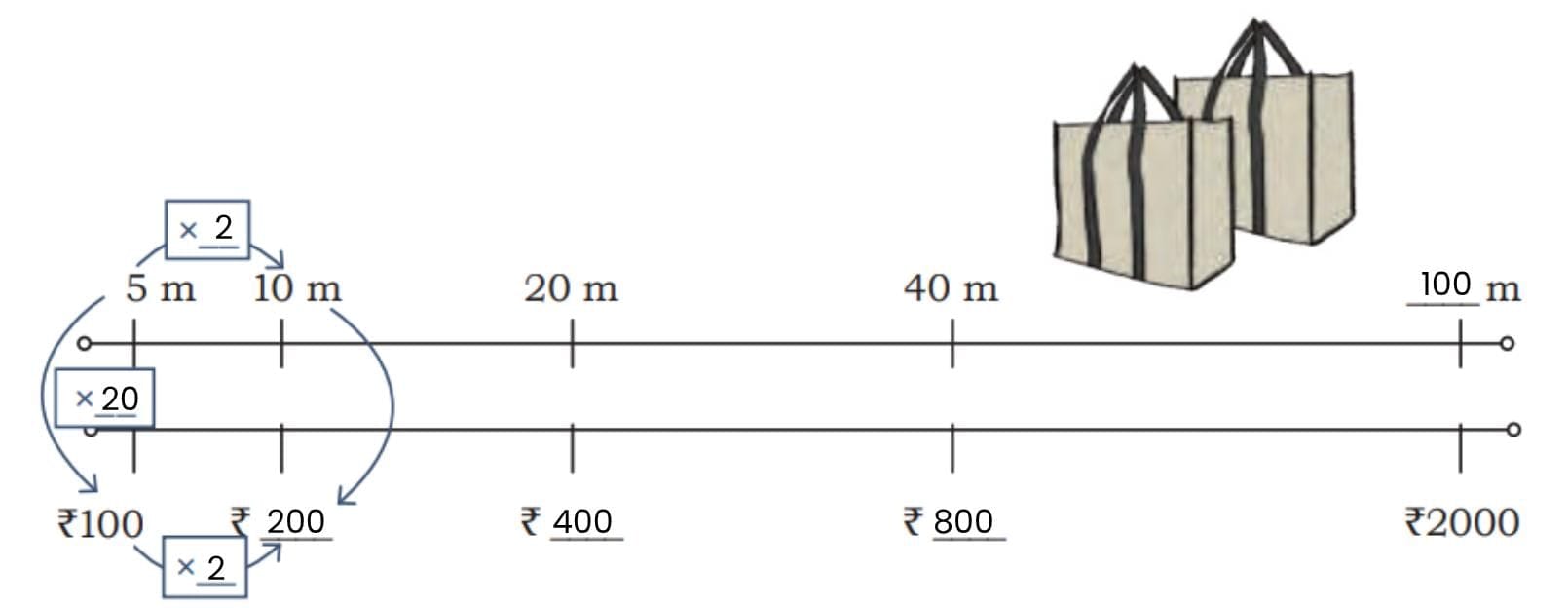
1.A shop sells cloth for making bags at ₹100 for 5 m. How much money is needed to buy a 1 m cloth?
Answer: Cost of 5 m cloth = ₹100 Cost of 1 m cloth = ₹100 ÷ 5 = ₹20.
Now, use the double number line to find the cost of the cloth or the length of cloth that we can buy at a particular cost.
3. Anita is making an embroidery on the border of a sari. She needs a 1 m long thread to embroider a 50 cm sari. How much thread would she need for a 5 m sari border?
A 1 m long thread costs ₹50. How much money will be needed to buy the thread?
Answer:
Thread needed for 50 cm sari = 1 m
First, convert 5 m sari border to cm: 5 m = 500 cm.
If 50 cm sari needs 1 m thread, then 500 cm sari (which is 10 times 50 cm) will need 10 times the thread. Thread needed for 5 m (500 cm) sari = 10 × 1 m = 10 m.
Cost of 1 m thread = ₹50 Cost of 10 m thread = 10 × ₹50 = ₹500.
4. A road 12 km 600 m long is being laid in a town. The workers lay an equal length of road each day, and complete the work in 6 days. How much road-laying work is done on each day?
Answer:
Total length of road = 12 km 600 m
Number of days to complete work = 6 days
Convert total length to meters: 12 km 600 m = 12 × 1000 m + 600 m = 12000 m + 600 m = 12600 m.
Length of road laid each day = Total length / Number of days = 12600 m / 6 = 2100 m
Convert back to km and m: 2100 m = 2000 m + 100 m = 2 km 100 m.
So, 2 km 100 m of road-laying work is done each day.