Short Answer Questions
Q1. Why does increasing the contact area reduce pressure in everyday situations like carrying bags?
Answer: Pressure equals force divided by area, so spreading the same force over a larger area reduces pressure on the surface. That is why wide straps or a cloth pad under a load feel more comfortable.
Q2. How can you demonstrate at home that liquid pressure depends on depth?
Answer: Make small holes at different heights on the side of a water bottle and fill it; the lowest hole shoots water the farthest. This shows pressure increases with depth due to the taller water column above that point.
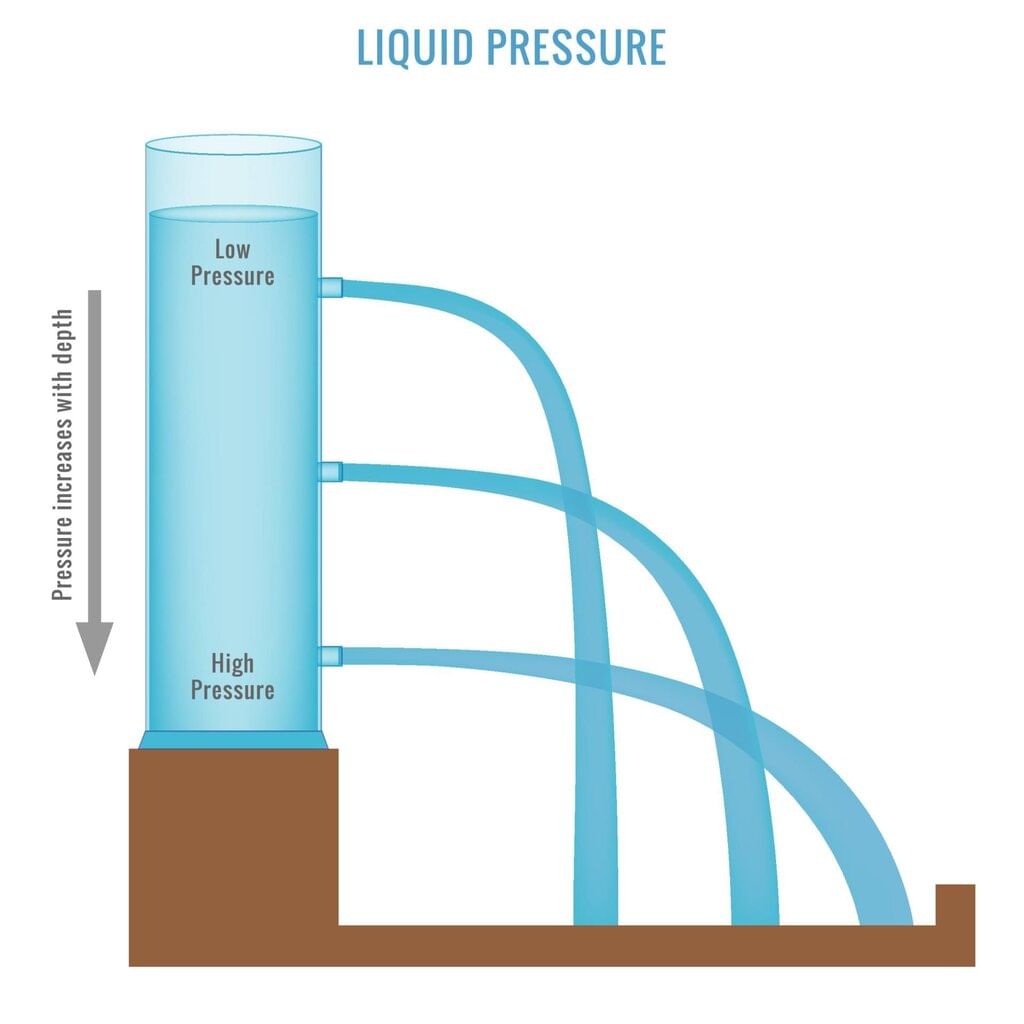
Q3. Why do overhead water tanks provide stronger water flow to taps than ground tanks?
Answer: A higher tank creates a taller water column, which increases water pressure at the outlet. Greater pressure pushes water through pipes more forcefully.
Q4. How do we know that air presses on surfaces even when we cannot see it?
Answer: A rubber sucker sticks to a smooth surface because air outside pushes it on when the inside air is removed. Similarly, an inflated balloon keeps its shape because air inside pushes outward in all directions.
Q5. Why are dams built broader at the base using the idea of pressure distribution?
Answer: Water pressure on the wall increases with depth, so the base faces the largest sideways force. A broader, stronger base resists this greater pressure safely.
Q6. How do differences in air pressure cause winds to blow?
Answer: Air naturally moves from regions of higher pressure to regions of lower pressure to balance pressure differences. The bigger the pressure difference, the stronger the wind.
Q7. What is the difference between a sea breeze and a land breeze in terms of heating and pressure?
Answer: During the day, land heats faster and creates low pressure so cooler sea air moves toward land (sea breeze). At night, land cools faster and air moves from land to sea (land breeze) due to the new pressure pattern.
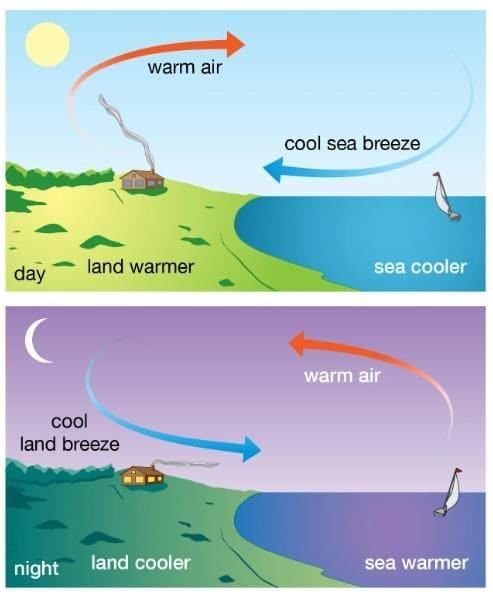
Land and Sea Breeze
Q8. Why can fast-moving air lower pressure and create surprising effects like balloons moving together?
Answer: When air speeds up between objects, the pressure there drops compared to the outside. The higher outside pressure then pushes the objects toward the low-pressure region.
Q9. How do thunderstorms produce lightning through charge separation?
Answer: Strong updrafts and downdrafts make water droplets and ice rub and become charged, with opposite charges separating within the cloud. When the charge difference becomes very large, a sudden discharge occurs as lightning.
Q10. How does a lightning conductor protect a building during a storm?
Answer: The pointed metal rod provides an easy path for the electric charge to travel safely into the ground. This prevents the current from passing through and damaging the building.
Q11. What makes cyclones intensify over the ocean but weaken over land?
Answer: Over warm seas, rising moist air and heat released during condensation strengthen the low-pressure system and winds. After landfall, the cyclone loses moist air supply and friction increases, so it weakens.
Q12. Why is a storm surge one of the most dangerous parts of a cyclone?
Answer: Strong winds push seawater toward land, raising water levels into a tall, fast-moving wall that floods coastal areas. This surge can destroy homes, contaminate water, and block rescue efforts.
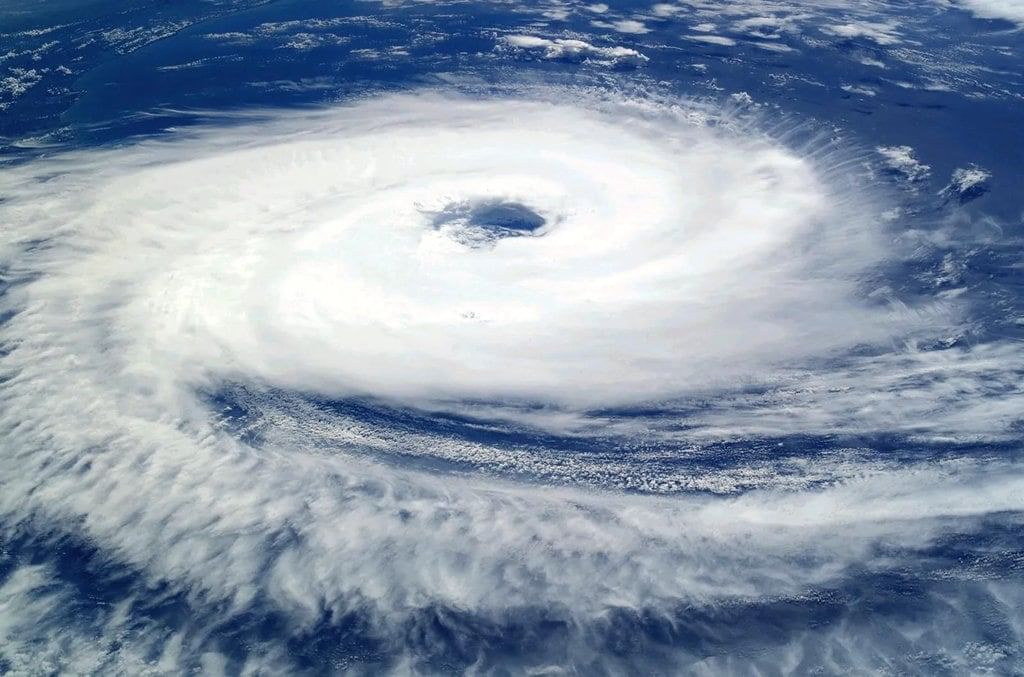
Cyclone
Long Answer Questions
Q1. Explain how pressure depends on force and area, and describe two design choices in everyday tools that use this idea to work better.
Answer:
- Pressure increases when the same force acts on a smaller area and decreases when spread over a larger area. Sharp tools like knives and nails have small contact areas, so they create high pressure and cut or pierce easily.
- Broad straps or handles spread force over more area, lowering pressure and reducing pain. Engineers use this concept to design comfortable backpacks and effective cutting tools.
- Understanding this helps us choose the right tool for the right job.
Q2. Describe an investigation to show that liquid pressure increases with depth and acts in all directions, and explain what the results mean.
Answer:
- Take a plastic bottle and make three small holes at different heights on one side, then fill it with water. You will see jets from the lower holes shoot farther, proving pressure increases with depth.
- Also, water flows sideways from the holes, showing pressure acts in all directions, not just downward. This explains why deep parts of dams face stronger sideways pushes. It also shows why taps connected to higher tanks give stronger flow.
Q3. Explain the concept of atmospheric pressure and how simple activities demonstrate its strength and direction.
Answer:
- Atmospheric pressure is the push from air molecules on surfaces in all directions. A rubber sucker sticks to glass because removing air underneath creates lower pressure inside, while higher outside pressure holds it tightly.
- An inflated balloon keeps its shape because air inside presses outward equally in all directions. We are not crushed because internal body fluids exert pressure that balances outside air pressure.
- These examples show air pressure is real, strong, and acts everywhere.
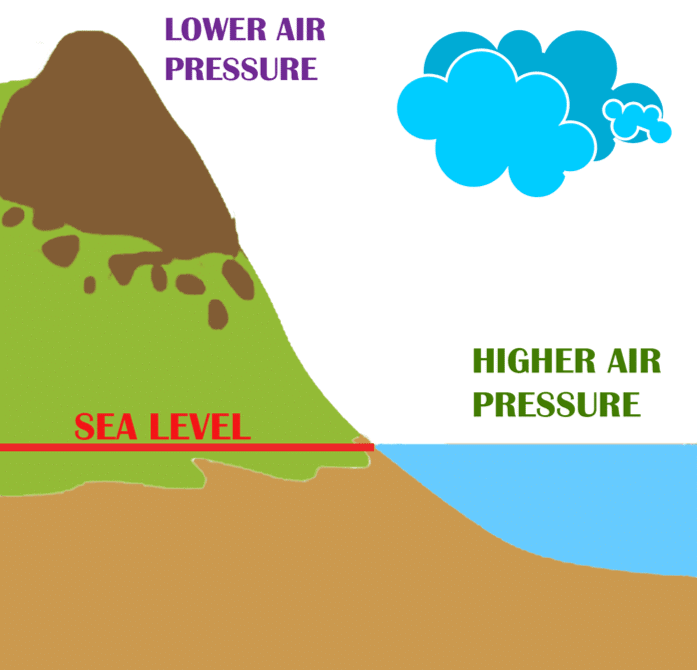
Atmospheric Pressure
Q4. Discuss how pressure differences create winds and compare calm conditions with strong wind conditions using clear examples.
Answer:
- Air moves from high-pressure regions to low-pressure regions to balance pressures. On calm days, the pressure difference is small, so air moves gently and we feel a breeze.
- During strong winds, the pressure difference is large, so air rushes quickly, sometimes causing damage. A sea breeze forms in the day as cool, high-pressure sea air moves toward warm, low-pressure land, while a land breeze forms at night in the opposite direction. These patterns come from how heating changes pressure.
Q5. Explain why high-speed winds lower air pressure locally and describe two real-life effects this can cause.
Answer:
- When air speeds up, its pressure drops in that region compared to the still air around it. Blowing between two hanging balloons makes the pressure between them lower, so higher outside pressure pushes them together.
- During storms, fast wind over a roof creates low pressure above, while higher indoor pressure can push the roof upward. This effect also helps planes lift because fast air over the wing lowers pressure on top. Lower pressure zones guide how winds move and interact.
Q6. Describe step by step how thunderstorms form and how charge separation leads to lightning and thunder.
Answer:
- Warm, moist air rises quickly and cools, forming tall clouds with strong updrafts and downdrafts. Water droplets and ice particles rub and become charged, with positive charges gathering near the top and negative charges near the bottom.
- When the charge difference becomes very large, air breaks down as an insulator, and a sudden discharge occurs as lightning. Lightning rapidly heats air, causing it to expand and produce thunder. This process can repeat within a cloud, between clouds, or between a cloud and the ground.
Q7. Explain the life cycle of a cyclone from formation over warm oceans to weakening over land, and relate it to pressure changes.
Answer:
- Over warm seas, moist air heats, rises, and creates a low-pressure center at the surface. As water vapor condenses into rain, heat is released, making air rise more and lowering pressure further.
- Surrounding air rushes in and spins due to Earth’s rotation, building a powerful system with an eye of very low pressure. Around the eye, winds are strongest and rain is heavy. After landfall, the cyclone loses warm, moist air and weakens due to friction and lack of fuel.
Q8. Describe a safety and preparedness plan for cyclones and thunderstorms, explaining why each step reduces risk to people and property.
Answer:
- Staying informed through IMD warnings helps families act before danger arrives. Keeping an emergency kit with water, food, medicines, and a flashlight supports survival during power cuts and blocked roads.
- Moving to strong shelters or cyclone centers reduces the risk from high winds and storm surges. During lightning, avoiding tall objects and metal and staying in vehicles or indoors lowers the chance of strikes.
- Proper building features like lightning conductors and strong roofs further protect life and property.