Q1. The Parliament of India consists of— (a) Lok Sabha and Rajya Sabha only (b) The President and Lok Sabha (c) The President, Lok Sabha, and Rajya Sabha (d) The Prime Minister and Lok Sabha
Ans: (c) The President, Lok Sabha, and Rajya Sabha The Indian Parliament includes the President and the two Houses.
Q2. How many Lok Sabhas have been formed as of June 2024? (a) 15 (b) 16 (c) 17 (d) 18
Ans: (d) 18 The 18th Lok Sabha began in June 2024.
Q3. Who presides over the sessions of the Lok Sabha? (a) President (b) Vice President (c) Speaker (d) Prime Minister
Ans: (c) Speaker The Speaker maintains order and discipline in Lok Sabha.
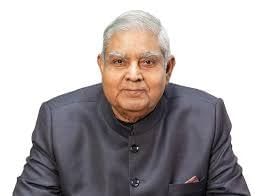
Q4. Who is the chairperson of the Rajya Sabha? (a) Prime Minister (b) Speaker (c) Vice President of India (d) President of India
Ans: (c) Vice President of India The Vice President acts as the Chairperson of Rajya Sabha.
Vice President of India
Q5. Which of the following is not a legislative function of Parliament? (a) Making laws (b) Checking the government (c) Signing bills into law (d) Approving budgets
Ans: (c) Signing bills into law That is done by the President, not Parliament.
Q6. In the lawmaking process, a proposal for a law is called— (a) Act (b) Bill (c) Gazette (d) Clause
Ans: (b) Bill A bill is a draft proposal, which becomes an Act once passed.
Q7. Article 21A of the Constitution makes education for children of which age group a Fundamental Right? (a) 0 to 6 years (b) 6 to 14 years (c) 14 to 18 years (d) 18 to 21 years
Ans: (b) 6 to 14 years Article 21A guarantees free and compulsory education for this age group.
Q8. The President appoints the Prime Minister based on— (a) Seniority in Parliament (b) Support of the majority in Lok Sabha (c) Rajya Sabha majority (d) Governor’s recommendation
Ans: (b) Support of the majority in Lok Sabha The Prime Minister must have majority support in the Lok Sabha.
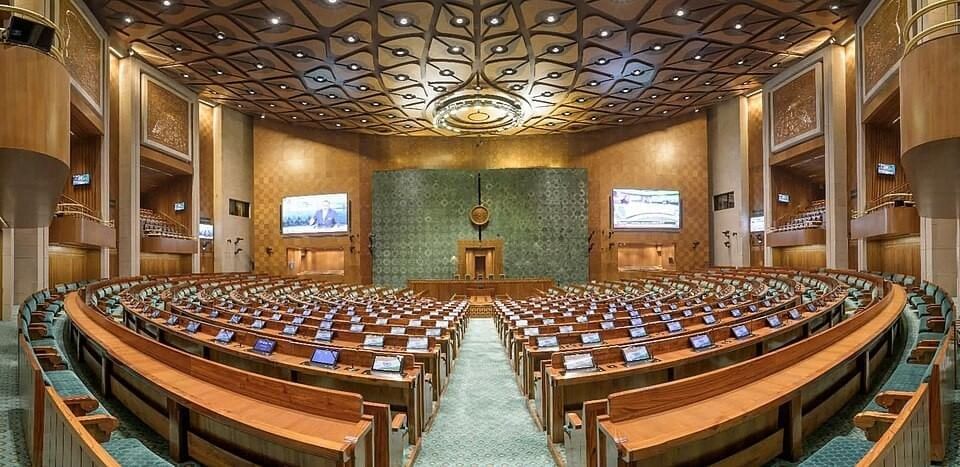
Lok Sabha
Q9. Which list allows both Union and State governments to make laws? (a) Union List (b) State List (c) Concurrent List (d) Federal List
Ans: (c) Concurrent List In case of conflict, Union law prevails.
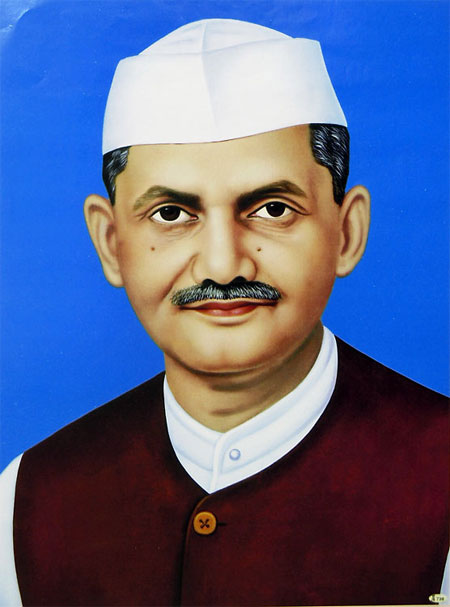
Q10. Which former Prime Minister resigned as Railway Minister in 1956 after a train accident? (a) Jawaharlal Nehru (b) Lal Bahadur Shastri (c) Atal Bihari Vajpayee (d) Morarji Desai
Ans: (b) Lal Bahadur Shastri He took moral responsibility and resigned.
Lal Bahadur Shastri
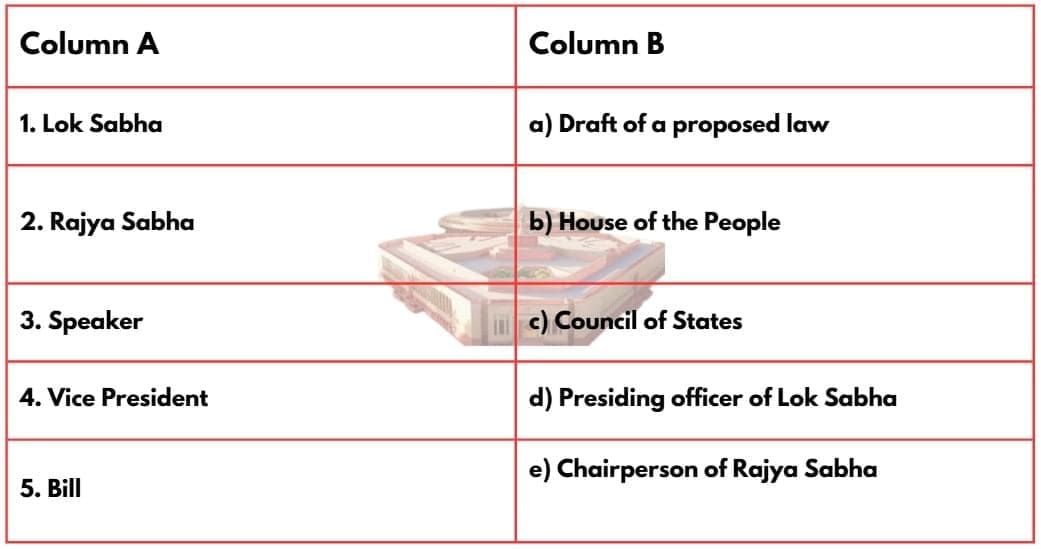
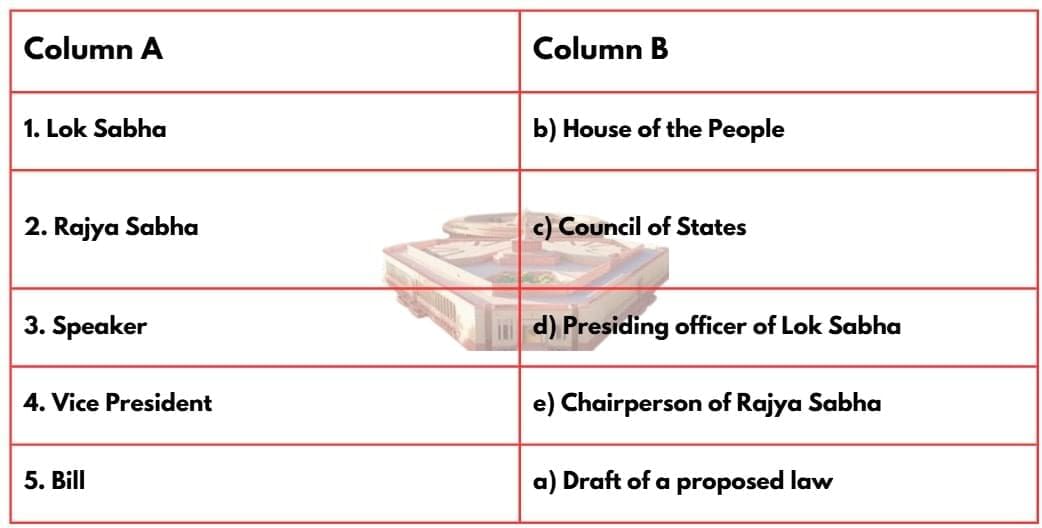
Match the Following
Ans: True or False
Q1. The Rajya Sabha is a permanent house and never dissolves completely. Ans: True
It is called the Permanent House; one-third of members retire every two years.
Q2. Only State governments can legislate on Defence and Foreign Affairs. Ans: False
These are Union List subjects.
Q3. The Parliament meets three times a year—Budget, Monsoon, and Winter Sessions. Ans: True
These are the three annual sessions of Parliament.
Q4. Money Bills can only be introduced in the Rajya Sabha. Ans: False
They can only be introduced in the Lok Sabha with the President’s recommendation.
Q5. Judiciary acts as the guardian of the Constitution. Ans: True
It interprets and safeguards the Constitution.
Q6. All states in India have a bicameral legislature with two houses. Ans: False
Only six states have bicameral legislatures; others have unicameral.
Fill in the Blanks
Q1. The Indian Parliament follows a ______ system consisting of two houses. Ans: Bicameral
Q2. The presiding officer of the Lok Sabha is called the ______. Ans: Speaker
Q3. The RTE Act makes education for children aged ______ to ______ a Fundamental Right. Ans: 6, 14
Q4. The Prime Minister and Council of Ministers are collectively responsible to the ______. Ans: Lok Sabha
Q5. The ______ appoints the Prime Minister of India. Ans: President
Q6. In case of conflict in the Concurrent List, the ______ law prevails. Ans: Union
Q7. ______ Hour in the Lok Sabha is used by MPs to hold ministers accountable. Ans: Question
Very Short Answer Questions
Q1. What is meant by the term “bicameral legislature”? Ans: A legislature with two houses/chambers, like the Lok Sabha and Rajya Sabha in India.
Q2. Who are the members of the Union Executive? Ans: The President, Vice President, Prime Minister, and Council of Ministers.
Q3. What is meant by federalism? Ans: A system where power is shared between the central government, state governments, and local bodies.
Q4. Define a ‘bill’ in the context of Parliament. Ans: A bill is a draft proposal for a law that has to be passed by Parliament before becoming an Act.
Q5. What is the role of the Judiciary in checks and balances? Ans: It ensures laws and actions follow the Constitution and protects Fundamental Rights.
Q6. Mention two states that have bicameral legislatures. Ans: Uttar Pradesh and Maharashtra (also Andhra Pradesh, Bihar, Karnataka, Telangana).
Q7. What are the three lists in the Constitution that divide subjects for lawmaking? Ans: Union List, State List, and Concurrent List.
Q8. Why are legislatures important in a democracy? Ans: They make laws, hold the government accountable, approve budgets, and represent the people’s will.
Q9. State one major challenge faced by India’s legislatures. Ans: Poor-quality debates, disruptions, and bills being delayed.
Q10. Who said in the Lok Sabha, “Governments will come and go, parties will rise and fall, but the nation and its democracy must endure”? Ans: Atal Bihari Vajpayee.