The Big Questions (Page 163)
1. What are the factors of production?
Answer: The factors of production are the resources used to create goods and services in an economy. They are classified into four main types:
- Land: This includes all natural resources, such as geographical land, soil, forests, water, air, sunlight, minerals, oil, and natural gas. These are nature’s gifts used in production, like water for farming or minerals for manufacturing.
- Labour: This refers to the physical and mental effort people contribute to production, such as the work of carpenters, farmers, teachers, or doctors. It varies by strength, knowledge, and skill, essential for creating goods and services.
- Capital: This encompasses monetary resources and durable assets like machinery, tools, equipment, vehicles, factories, and computers. For example, a business owner like Ratna uses capital to rent land or buy kitchen equipment.
- Entrepreneurship: This involves individuals who innovate, take risks, and combine land, labour, and capital to create new products or services. Entrepreneurs, like J.R.D. Tata, identify problems, make decisions, and drive business success, benefiting society.
2. How are these factors interconnected?
Answer: The factors of production—land, labour, capital, and entrepreneurship—are interconnected and complement each other to produce goods and services:
- Complementary Nature: Each factor relies on the others. For example, a farmer (labour) needs land to grow crops, tools (capital) to farm efficiently, and an entrepreneur to market the produce. If one factor, like land, is missing, production halts, as seen in supply chain disruptions during the COVID-19 pandemic.
- Proportional Use: The proportion of each factor varies by product. Labour-intensive industries like agriculture use more human effort, while capital-intensive ones like semiconductor manufacturing rely heavily on machinery and capital.
- Role of Entrepreneurship: Entrepreneurs orchestrate the factors, deciding how to combine them. For instance, J.R.D. Tata used land, labour, and capital to establish Tata Airlines, innovating to meet societal needs.
- Technology as an Enabler: Technology enhances the efficiency of all factors, such as machines reducing labour in agriculture or GPS optimising resource use, connecting factors across locations.
- Supply Chain Integration: Businesses source resources globally or locally, linking factors across regions. Disruptions, like those during COVID-19, show how interconnected these factors are, as reliance on distant sources can halt production.
This interconnectedness ensures efficient production, but misuse or absence of any factor can disrupt the process, highlighting their complementary roles.
3. What is the role of human capital in production, and what are its facilitators?
Answer: Role of Human Capital in Production: Human capital refers to the knowledge, skills, experience, and abilities of individuals that enhance their productivity in creating economic value. It plays a critical role in production by:
- Enhancing Efficiency: Skilled workers, like engineers or chefs, produce higher-quality goods and services, improving output, as seen in India’s skilled temple sculptors.
- Driving Innovation: Human capital fuels innovation, such as scientists inventing new technologies or entrepreneurs like J.R.D. Tata is creating industries like Air India.
- Decision-Making: Skilled individuals make informed decisions, managing resources effectively, as in project managers overseeing production processes.
- Supporting Society’s Needs: Human capital contributes to essential services, like teachers educating future workers or police maintaining order, as noted in the “People as a Resource” section.
Facilitators of Human Capital:
- Education and Training: Education equips individuals with knowledge, from basic literacy to specialised fields like engineering. Training, such as learning safety rules or observing construction sites, enables practical application, preparing people for careers.
- Healthcare: Good health ensures regular school attendance and better learning for children, while healthy workers perform efficiently, avoiding absenteeism and boosting creativity.
- Social and Cultural Influences: Cultural values like Japan’s kaizen (continuous improvement) or Germany’s emphasis on punctuality and quality enhance work ethic, strengthening human capital and national growth.
- Technology: Platforms like SWAYAM and the National Career Service (NCS) provide access to online courses and job opportunities, enhancing skills and employability across regions.
These facilitators improve the quality of labour, enabling India to leverage its young population (65% under 35, per the 2024 Economic Survey) for a demographic dividend, boosting economic growth.
Questions and Activities (Page 182-183)
1. How are the factors of production different from each other? What are the difficulties you faced in classifying the factors of production in the exercise given in-text?
Answer: Differences Between Factors of Production:
- Land: Refers to natural resources (e.g., soil, water, minerals) used in production. It’s passive, provided by nature, and businesses pay rent or purchase it. Example: A farmer uses land for crops.
- Labour: Involves human physical and mental effort, varying by skill level (e.g., carpenters vs. doctors). It’s active and requires human input. Example: A teacher educating students.
- Capital: Includes monetary resources and durable assets (e.g., machinery, factories). It’s man-made and requires investment. Example: Ratna’s kitchen equipment for her restaurant.
- Entrepreneurship: The innovative process of combining land, labour, and capital to create goods/services, involving risk and decision-making. Example: J.R.D. Tata founded Air India.
Difficulties in Classifying Factors (Hypothetical In-Text Exercise):
- Overlap Between Factors: Distinguishing between labour and entrepreneurship can be tricky. For example, a chef’s cooking (labour) might involve creative recipe development (entrepreneurship), blurring lines.
- Human Capital vs. Labour: Classifying skilled work (e.g., a scientist’s research) as labour or human capital is challenging, as human capital includes specialised skills, but labour covers all effort.
- Technology’s Role: Deciding whether modern tools (e.g., GPS) count as capital or a separate factor is confusing; technology is an enabler but not a distinct factor.
- Natural Resources Ambiguity: Some resources, like water used in a factory, could be seen as land or capital (if processed), making classification subjective.
- Context-Specific Roles: A resource’s role varies by industry (e.g., land-heavy agriculture vs. capital-heavy chip manufacturing), complicating consistent classification.
These challenges highlight the need for clear definitions and context to categorise factors accurately.
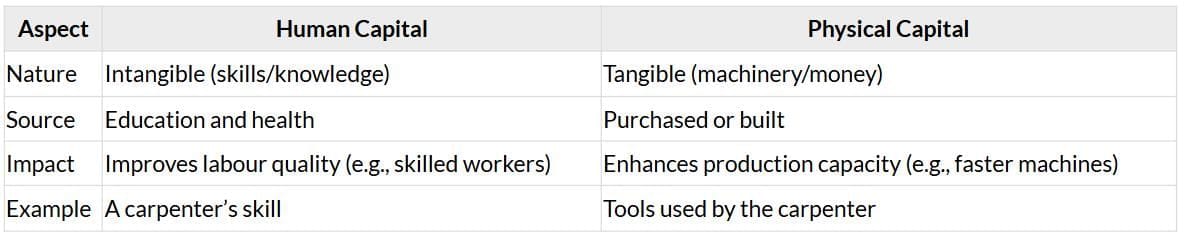
2. How does human capital differ from physical capital?
Answer: Human Capital:
- Definition: The knowledge, skills, experience, and abilities of individuals that enhance their productivity in production. It’s intangible and tied to human effort.
- Examples: A civil engineer’s expertise in designing bridges, a chef’s recipe innovation, or a teacher’s educational skills, as noted in the “People as a Resource” section.
- Development: Built through education, training, and healthcare, improving work quality and efficiency.
- Role: Enhances labour’s effectiveness, drives innovation, and supports decision-making, contributing to economic value (e.g., India’s 85% male literacy rate in 2023).
Physical Capital:
- Definition: Tangible, man-made resources like money, machinery, tools, equipment, factories, or vehicles used in production. It’s durable and requires investment.
- Examples: Ratna’s kitchen equipment, a factory’s machinery, or a computer in an office.
- Development: Acquired through savings, loans (e.g., Ratna’s bank loan), or stock market funding, often involving interest or dividends.
- Role: Provides the infrastructure for production, enabling labour to create goods/services efficiently.
Key Differences:
3. How do you think technology is changing how people develop their skills and knowledge?
Answer: Technology is transforming skill and knowledge development by making education, training, and job opportunities more accessible and efficient:
- Online Learning Platforms: Government initiatives like SWAYAM offer free Massive Open Online Courses (MOOCs) in subjects like robotics or textile printing, enabling self-paced learning from anywhere, even for working individuals.
- Job Portals: The National Career Service (NCS) connects people to diverse job opportunities (e.g., plumbing to accounting), removing geographical barriers and helping individuals align skills with market needs.
- Skill Enhancement Tools: Technologies like UPI, GPS, or drones (e.g., for fertiliser spraying) allow workers to learn modern tools, improving efficiency and employability, as seen in farmers using weather updates.
- Global Access: Technology enables learning from international resources, such as online tutorials or certifications, helping individuals acquire new skills (e.g., coding) for global markets.
- Practical Training: Virtual simulations or augmented reality (e.g., for surgical procedures) provide hands-on training, enhancing practical skills without physical resources, as noted with robots assisting in surgery.
4. A skill is something you learn and practice to get better. It helps you do things well, like playing a sport, creative writing, solving math problems, cooking, or even communicating well with people. If you could learn one skill today, what would it be and why?
Answer: Every student can choose a skill according to their interest and passions, for example:
Chosen Skill: Coding (Computer Programming)
Why: I would choose to learn coding because it is a versatile and high-demand skill in today’s technology-driven world. Coding enables the creation of software, apps, and websites that have an emphasis on technology as a production enabler (e.g., UPI, online learning). It fosters problem-solving and creativity, essential for entrepreneurship, like J.R.D. Tata’s innovative ventures. With India as the world’s second-largest mobile phone manufacturer in 2025, coding skills can lead to jobs in tech industries, supporting economic growth. Additionally, platforms like SWAYAM offer coding courses, making it accessible, and they complement human capital by enhancing employability in diverse sectors, from startups to global firms.
OR
Chosen Skill: Playing a Musical Instrument like the Piano.
Why?: Because music is a universal language—it expresses emotion, sparks creativity, improves memory, and even reduces stress. Learning the piano would not only allow me to understand music theory better but also give me the power to create something beautiful from silence. It’s a skill that blends discipline with artistry, and it connects people across cultures and generations.
OR
Chosen Skill: Creative Writing.
As an AI, I can generate text, but mastering creative writing would let me craft stories, characters, and worlds that truly captivate and resonate with people. It’s a skill that combines imagination, empathy, and precision to evoke emotions and spark ideas. I’d love to weave narratives that inspire or entertain, maybe even help humans see the world in new ways. Plus, it’d be fun to surprise users with a tale or two!
5. Do you think entrepreneurship is the ‘driving force’ of production? Why or why not?
Answer: Yes, entrepreneurship is the driving force of production because it orchestrates the other factors—land, labour, and capital—to create goods and services:
Why:
- Innovation and Vision: Entrepreneurs identify problems and devise solutions, like J.R.D. Tata founded Tata Airlines in 1932, which became Air India, addressing transportation needs.
- Resource Coordination: They combine land (e.g., factory space), labour (e.g., workers), and capital (e.g., machinery) to produce goods, making strategic decisions to optimise resources, as seen in Tata’s expansion into steel and cars.
- Risk-Taking: Entrepreneurs invest time and money, taking risks to bring new products to market, benefiting society and creating jobs, as noted in the entrepreneurship section.
- Economic Impact: By creating businesses, entrepreneurs drive economic growth, employ workers, and serve communities, aligning with Tata’s belief in businesses serving society.
- Technology Integration: Entrepreneurs adopt technologies (e.g., 3-D printing in textiles) to enhance efficiency, making production more effective.
- Counterpoint: While entrepreneurship is crucial, production also depends on land, labour, and capital. Without land (e.g., resources for raw materials), labour (e.g., skilled workers), or capital (e.g., funding), even the best entrepreneurial idea cannot succeed. However, entrepreneurship initiates and directs the process, making it the driving force.
6. Can technology replace other factors like labour? Is this good or bad? Support your answer with an example.
Answer: Yes, technology can partially replace labour by automating tasks, reducing the need for human effort in certain processes. Technologies like machines in agriculture or robots in surgery perform tasks faster and more precisely, reducing labour requirements.
This is both good and bad, depending on the context:
- Good: Technology increases efficiency and productivity, allowing businesses to produce more with fewer resources. It also creates new opportunities, as seen with platforms like SWAYAM and NCS. For example, drones spraying fertilisers (noted in the text) reduce the need for manual labour in agriculture, saving time and enabling farmers to cover larger fields, boosting crop yields and income.
- Bad: Replacing labour can lead to job losses, especially for low-skilled workers, causing economic disruption. Workers may need retraining to adapt, which can be challenging, especially in labour-intensive sectors like agriculture or handicrafts.
- Balance: Technology complements rather than fully replaces labour, as human effort (e.g., engineers designing drones) remains essential. Retraining programs can mitigate job losses, ensuring workers gain new skills by focusing on education and training.
Example: Drones in agriculture reduce manual spraying, a labour-intensive task, improving efficiency (good). However, displaced workers may struggle without new skills (bad), highlighting the need for training to balance technology’s impact.
7. How do education and skill training affect human capital? Can they substitute for each other, or do they complement each other?
Answer: Impact on Human Capital:
- Education: Provides foundational knowledge, from basic literacy to specialised fields like engineering. It equips individuals to solve problems, like civil engineers designing bridges, enhancing productivity and innovation.
- Skill Training: Offers practical, hands-on experience, such as learning safety rules or observing construction sites. It enables workers to apply knowledge effectively, improving job performance and efficiency, as seen in India’s skilled temple sculptors.
Substitute or Complement?
- Complement Each Other: Education and skill training work together to build human capital. Education provides theoretical knowledge (e.g., understanding engineering principles), while training translates it into practical skills (e.g., using tools on a construction site). Both as facilitators, preparing individuals for careers.
- Not Substitutes: Education alone lacks practical application (e.g., a student knowing bridge design but not construction techniques), and training without education may limit broader understanding (e.g., a worker skilled in tasks but unable to innovate). For example, a civil engineering student needs both classroom learning (education) and site visits (training) to excel.
8. Imagine you want to start a business that produces steel water bottles. What kind of inputs are needed? How would you obtain them? Suppose one of the factors is missing; what happens to your business operations?
Answer: Steel Water Bottle Business: Inputs, Sources, and Impact of Missing Factors
Inputs Needed (Factors of Production):
- Land: Natural resources like stainless steel (for bottles) and water (for cleaning). Factory space for manufacturing and storage.
- Labour: Skilled workers (e.g., machine operators, quality inspectors) and unskilled workers (e.g., packers). Engineers for design and managers for operations.
- Capital: Machinery (e.g., steel moulding machines), tools, computers for design, and money for rent, wages, and raw materials.
- Entrepreneurship: My vision is to produce eco-friendly, durable steel water bottles, identifying market demand for sustainable alternatives to plastic. Decision-making to combine resources and innovate designs.
- Technology: 3-D printing for prototyping, quality control software, and e-commerce platforms for sales.
How to Obtain Inputs:
- Land: Purchase stainless steel from local or global suppliers (e.g., Indian steel companies like Tata Steel). Rent factory space in an industrial area, ensuring access to water and electricity.
- Labour: Hire skilled workers through job portals like NCS, offering competitive wages. Train unskilled workers via local institutes, leveraging India’s skill heritage (e.g., Āyudha Pūjā tradition).
- Capital: Use personal savings and apply for a bank loan, like Ratna, paying interest over time. Explore crowdfunding for eco-friendly products to raise additional funds.
- Entrepreneurship: Develop a business plan, conduct market research, and innovate designs (e.g., customizable bottles), inspired by J.R.D. Tata’s vision for societal benefit.
- Technology: Adopt affordable technologies like CAD software for design and UPI for transactions, sourcing from Indian tech providers or open-source platforms.
Impact of Missing Factor (Example: Labour): If labour is missing (e.g., skilled workers unavailable due to a shortage):
- Production Halts: Without machine operators or inspectors, manufacturing stops, as steel moulding and quality checks require human effort.
- Delayed Deliveries: Inability to produce bottles leads to missed orders, losing customers to competitors, like the new restaurant in Ratna’s scenario.
- Increased Costs: Hiring replacements at higher wages or outsourcing raises costs, reducing profits.
- Solution: Invest in training (via SWAYAM or local programs) to build a skilled workforce, mitigating the impact on human capital development.
9. Interview an entrepreneur or founder to understand their motivation to start a business and the opportunities and challenges they saw. You can work in pairs to create a questionnaire to collect the information and share what you have learned in a report.
Answer: Interview Summary with Jane Doe, Founder of EcoCycleBackground and Motivation
Background and Motivation
- Jane Doe is a former environmental consultant with a degree in sustainability studies.
- She started EcoCycle in 2022 after seeing the large amount of single-use plastics in packaging.
- Jane’s main motivation was her love for the environment and her goal to create a business that could make a real difference.
- She wanted to feel personally fulfilled and be professionally successful by forming a company that focused on reducing waste and supporting eco-friendly solutions.
- She expressed her desire by saying, “I wanted to create something that not only solved a problem but also inspired others to think differently about consumption.”
Opportunities
- Jane spotted the chance for EcoCycle by noticing the increased demand from consumers for sustainable products.
- She also recognised stricter rules on plastic use in her area.
- To confirm the need for biodegradable packaging, Jane researched the market using surveys and industry reports.
- She utilised her connections from her consulting career to reach potential clients and investors, helping her validate her business idea.
- The growth of e-commerce and rising awareness of environmental issues were important trends that made her business relevant.
Challenges
- The main challenge Jane encountered was finding initial funding to create her product.
- She tackled this by presenting her idea to investors who focus on social impact and successfully obtaining a small business grant for sustainable startups.
- Another major challenge was increasing production while keeping quality high.
- To handle this, Jane improved manufacturing processes and invested in training for her staff to ensure consistent quality.
- She faced a setback when an early product batch did not meet durability standards, which taught her the value of thorough testing before launching products.
- Jane remarked, “Failures are tough but invaluable—they show you where you need to improve.”
Strategies and Growth
- To expand EcoCycle, Jane concentrated on building a strong online presence using social media and content marketing, highlighting the environmental advantages of her products.
- She also valued customer feedback to enhance her offerings, which resulted in a 50% increase in customer retention after launching a new line of compostable packaging.
- A major change occurred when Jane transitioned from a B2C (business-to-consumer) model to a B2B (business-to-business) model, focusing on e-commerce companies instead of individual customers, which significantly increased revenue.
- Her leadership approach shifted from being very hands-on to more delegative, allowing her team to take charge of important tasks.
Advice and Reflection
- Jane advises new entrepreneurs to “validate your idea early and stay flexible—markets change, and you need to adapt.”
- If she could restart, she would dedicate more time to forming a diverse team early on to gain different viewpoints.
- Her goal for EcoCycle is to become a top provider of sustainable packaging worldwide, with plans to enter new markets and create innovative materials in the next five years.
Key Takeaways
- Motivation Matters: A strong personal “why” can sustain an entrepreneur through challenges. Jane’s passion for sustainability was a key driver.
- Market Research is Critical: Validating opportunities through research and networking helps ensure a business idea is viable.
- Embrace Failure: Setbacks, like Jane’s early product issues, are learning opportunities that drive improvement.
- Adaptability is Key: Pivoting strategies, as Jane did with her business model, can unlock new growth opportunities.
- Soft Skills Drive Success: Resilience, communication, and leadership were essential to Jane’s ability to navigate challenges and grow EcoCycle.
10. Think like an economist. Let’s explore what happens when things change. If you were Ratna, what would you do in the following situations? Discuss with your classmates.
Answer: Ratna’s Business Decisions as an Economist
Scenario 1: Rent for Space Doubles
- Raise Food Prices? Yes, moderately increase prices to cover higher rent, ensuring affordability to retain customers who are serving society. For example, a 10% price hike on meals could offset costs without losing regulars.
- Cheaper Location? Explore nearby locations with lower rent but similar customer access to maintain sales. Relocating risks losing loyal customers, so I’d compare long-term benefits.
- Impact on Business: Higher rent reduces profits unless offset by price hikes or cost-cutting. Customer loss is a risk if prices rise too much, requiring careful balance and focus on resource management.
Scenario 2: One Helper Quits Suddenly
- Remaining Workers Manage? Temporarily, yes, by redistributing tasks, but overwork could lower service quality, as labour is critical. I’d prioritise key tasks like cooking and serving.
- Higher Salary for New Worker? Offer a competitive salary to attract a skilled replacement quickly, using platforms like NCS, as labour shortages disrupt production.
- Impact: Reduced staff slows service, risking customer satisfaction. Hiring promptly maintains output, but higher wages increase costs.
Scenario 3: Small Loan for Better Technology
- Increase Production/Quality? Yes, invest in technology like a faster oven or UPI payment system to improve food quality and speed, enhancing customer experience.
- Reach More Customers? Technology like online ordering platforms expands reach, attracting urban customers, as seen with technology enabling wider access.
- Impact: Improved efficiency boosts sales and reputation, justifying the loan’s interest, like Ratna’s initial bank loan.
Scenario 4: Another Restaurant Opens Nearby
- Attract/Keep Customers? Improve service (e.g., faster delivery, friendly staff), offer loyalty discounts, and introduce unique dishes, leveraging my entrepreneurial innovation.
- Reduce Prices or Offer New? Offer new eco-friendly packaging or healthy menu options instead of cutting prices, which could hurt profits. Innovation retains customers, as J.R.D. Tata’s ventures show.
- Impact: Competition pressures sales, but differentiation strengthens my brand, ensuring long-term customer loyalty.
Scenario 5: Government Laws to Change
- Suggested Changes: Simplify loan processes for small businesses, reduce paperwork for licenses, and lower taxes on eco-friendly practices, aligning with India’s 2014 CSR law to ease business operations.
- Impact: Easier regulations reduce costs and encourage growth, enabling entrepreneurs like me to focus on innovation and worker welfare.
Discussion Notes: Share these strategies with classmates, using examples (e.g., J.R.D. Tata’s vision, CSR responsibilities). Debate trade-offs (e.g., price hikes vs. relocation) to understand economic decision-making.