Ever bought fruits at a shop and saw the shopkeeper use a weighing scale? That’s measuring weight.
Ever filled a water bottle or a milk jug? That’s measuring capacity.
We use units like kilograms (kg), grams (g), litres (l), and millilitres (ml) to measure.
Sometimes we need to change units, add, subtract, multiply, or divide to solve problems.
These skills help in shopping, cooking, sports, farming, and many other daily activities.
Check! Check!
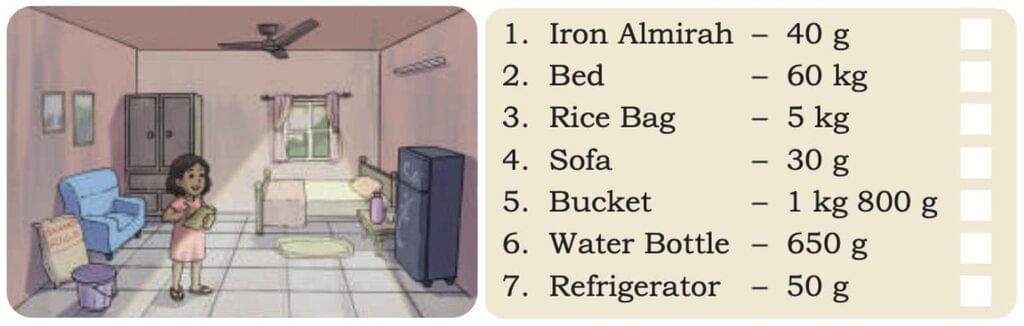
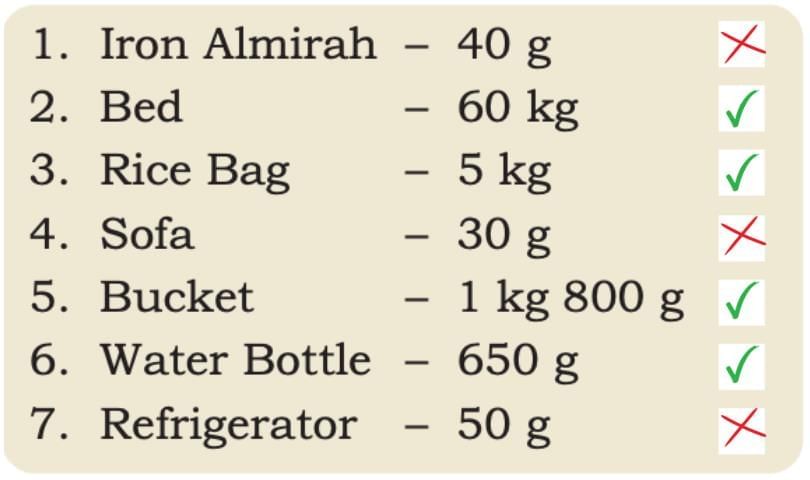
Anu has recorded the weights of the items in her house. Check if she has recorded them correctly by putting a tick against them if they look correct.
Sol:
Explanation:
1. This is too light because iron almirahs are very heavy and can weigh many kilograms.
2. This sounds correct because beds are heavy but not too heavy to move with help. 3. This is correct because we often buy rice in 5 kg bags. 4. This is too light because sofas are big and heavy, not as light as a few grams. 5. This is correct because buckets can weigh this much, especially if they are big or filled with something. 6. This is correct because a full water bottle can weigh around this much. 7. This is too light because refrigerators are very heavy and can weigh many kilograms.
Understanding Weighing Scale
A weighing scale tells us how heavy something is. We can see these in shops, kitchens, bathrooms, and even in school labs.
Scales can look different, but all of them do the same job – they measure weight.
The number ‘0’ on the scale means nothing is on it, so there is no weight.
Before you measure anything, look at the scale to see if it is at 0.
If the scale is not at 0 before you start, the weight will not be correct.
Some scales have a small knob or button that can move the pointer back to 0. This is called “zeroing” the scale.
When the scale is at 0, it measures only the weight of the thing you put on it.
Reading Weight
Look at the biggest numbers first. They tell you the weight in kilograms or grams.
See where the pointer is pointing. Check if it’s between two big numbers.
Count the small lines between the big numbers – each small line is usually 100 g or 50 g, depending on the scale.
Start from the smaller big number and add the small lines until you reach the pointer.
Write the weight in kilograms and grams, or only grams if it’s a small weight.
Always check from the zero mark to be sure the scale is correct before reading.
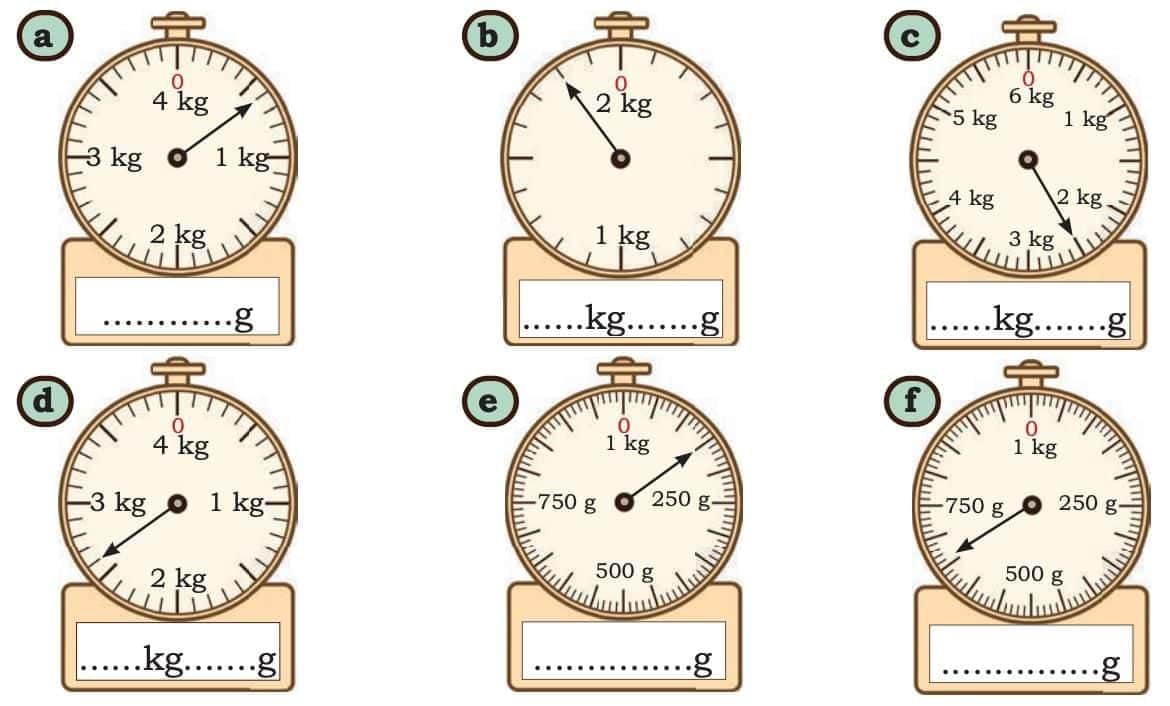
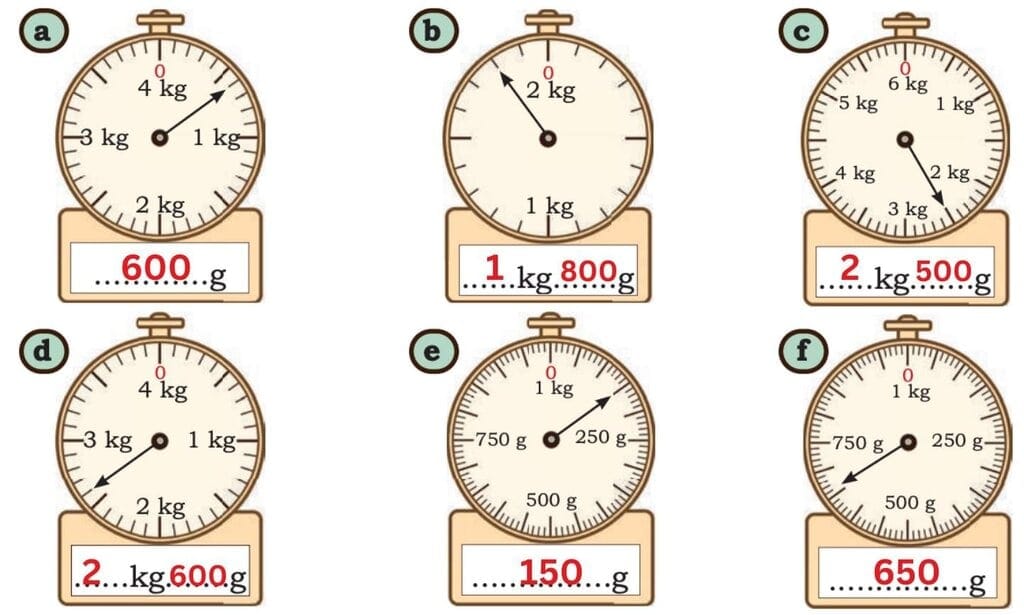
Read the ScalesRead the scales. Write the correct weight in the space given below.
Sol:
(a)
Needle between 0 and 1 kg.
Each small line = 100 g.
Needle at 600 g.
(b)
Between 1 kg and 2 kg.
Needle at 1 kg 800 g.
(c)
Between 2 kg and 3 kg.
Exactly halfway → 2 kg 500 g.
(d)
Between 2 kg and 3 kg.
Needle at 2 kg 600 g.
(e)
Between 0 g and 250 g.
Needle at 150 g.
(f)
Between 500 g and 750 g.
Needle at 650 g.
Units of Weight and their Relationship
Weight can be measured in kilograms (kg) and grams (g).
1 kilogram = 1,000 grams. This means a kilogram is a bigger unit and grams are smaller units.
If we have a weight in kilograms and want to know it in grams, we multiply by 1,000. Example: 3 kg = 3 × 1,000 = 3,000 g.
If we have a weight in grams and want to know it in kilograms, we divide by 1,000. Example: 2,500 g = 2,500 ÷ 1,000 = 2.5 kg.
Kilograms are used for heavier things like a bag of rice or a person’s weight.
Grams are used for lighter things like a chocolate bar or a pencil.
Match the weights
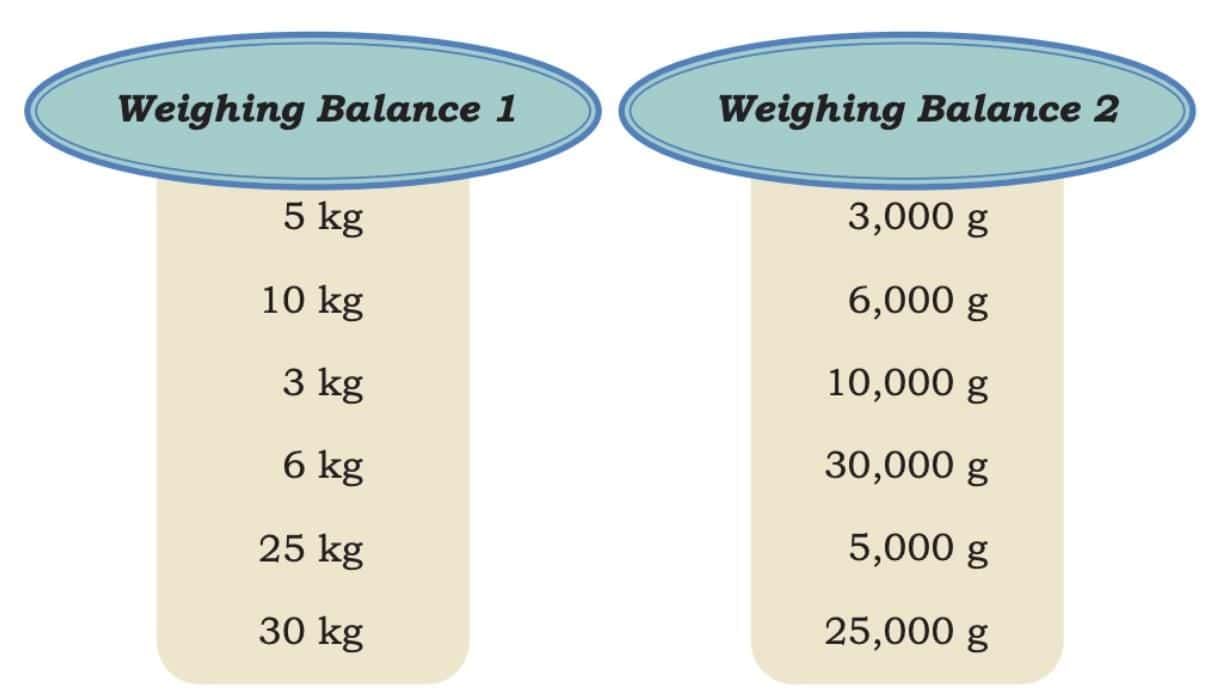
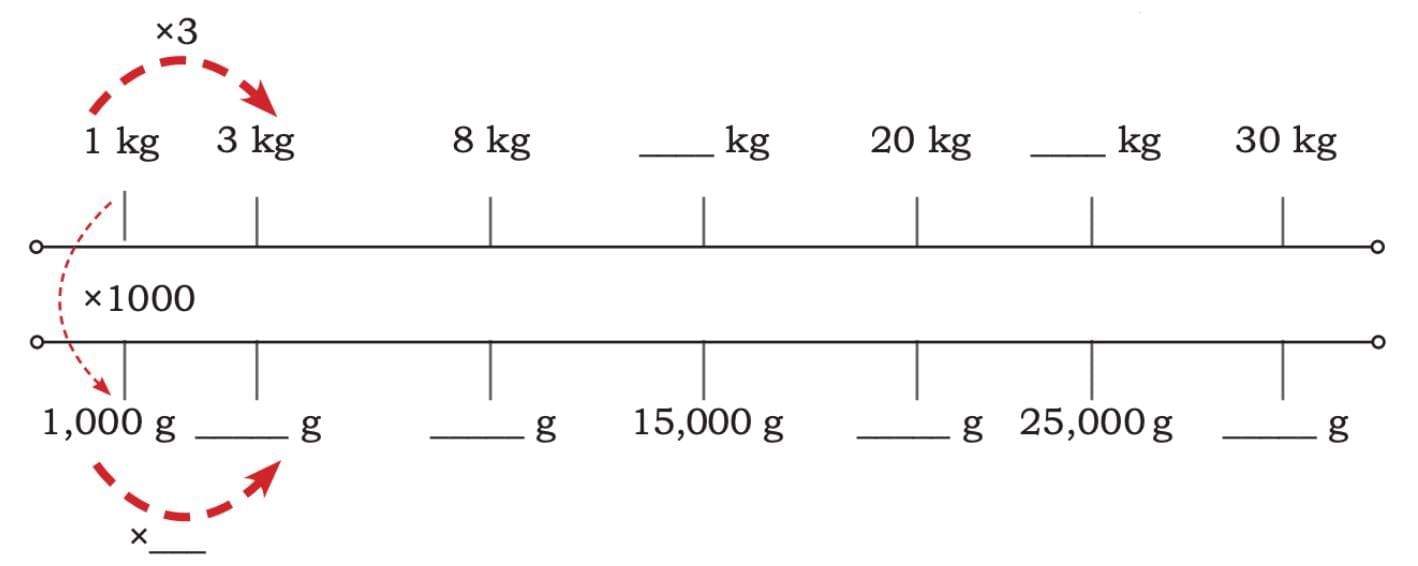
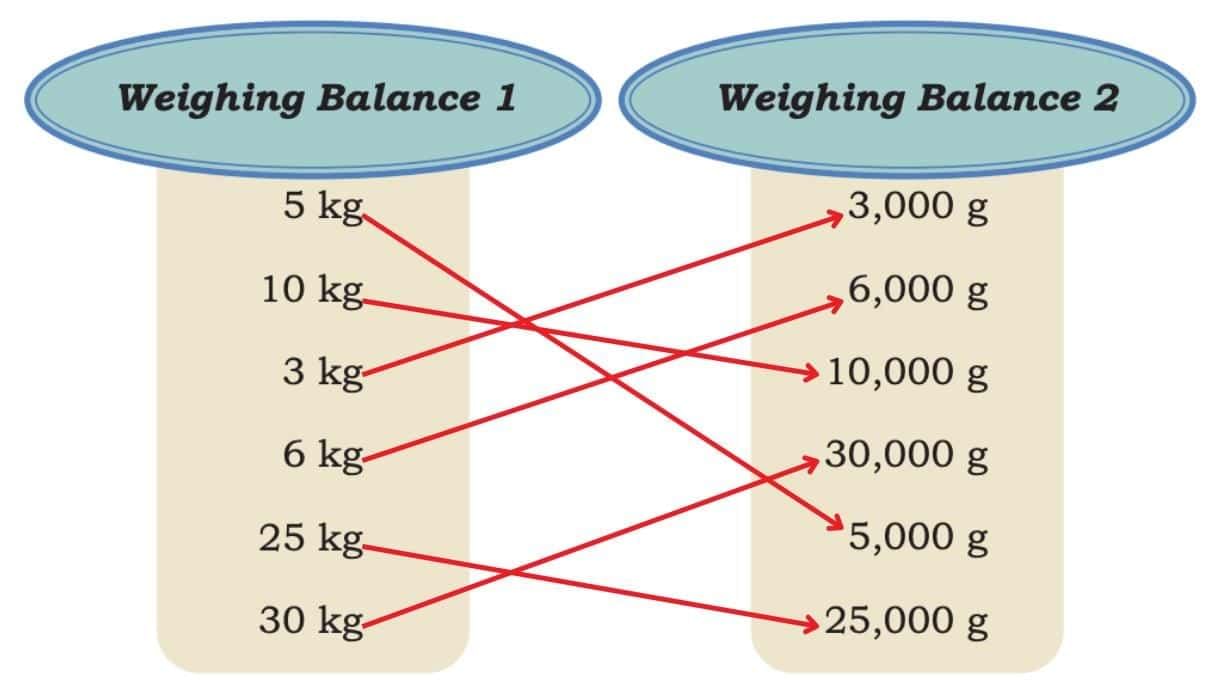
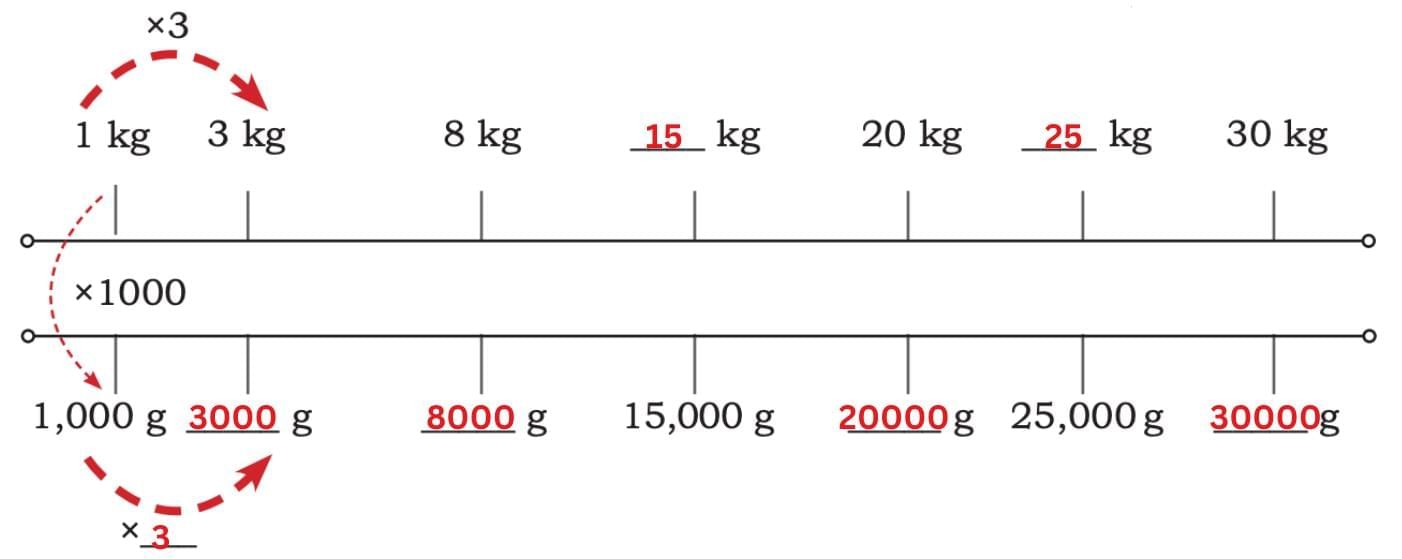
Match the bags that have the same weight. You can use the double number line given below.
Sol:
Step 1: Weighing Balance 1
It has weights in kilograms:
5 kg, 10 kg, 3 kg, 6 kg, 25 kg, 30 kg
Step 2: Convert them into grams
5 kg = 5 × 1000 = 5000 g
10 kg = 10 × 1000 = 10,000 g
3 kg = 3 × 1000 = 3000 g
6 kg = 6 × 1000 = 6000 g
25 kg = 25 × 1000 = 25,000 g
30 kg = 30 × 1000 = 30,000 g
Step 3: Match with Weighing Balance 2
5 kg ↔ 5000 g
10 kg ↔ 10,000 g
3 kg ↔ 3000 g
6 kg ↔ 6000 g
25 kg ↔ 25,000 g
30 kg ↔ 30,000 g
Step 4: Understanding the Double Number Line
Top line shows kilograms
Bottom line shows grams
To go from kilograms to grams, multiply by 1000
To go from grams to kilograms, divide by 1000
Examples from the number line:
1 kg = 1000 g
3 kg = 3000 g
8 kg = 8000 g
20 kg = 20,000 g
30 kg = 30,000 g
Weigh the Cake
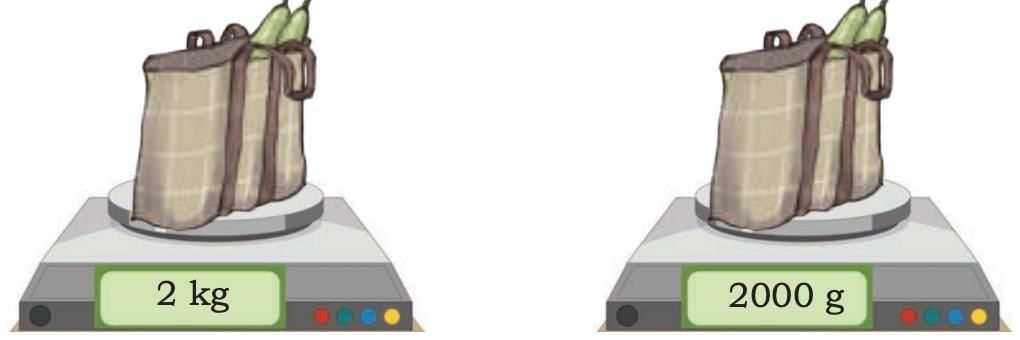
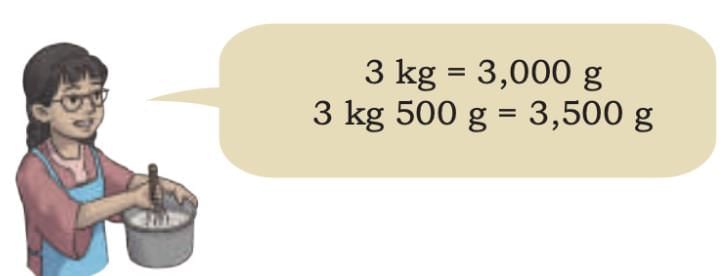
Shrenu is baking cakes for her shop. She needs 3 kg 500 g of flour. Her kitchen scale measures only in grams. What should her kitchen scale show for 3 kg 500 g of flour?
Sol:
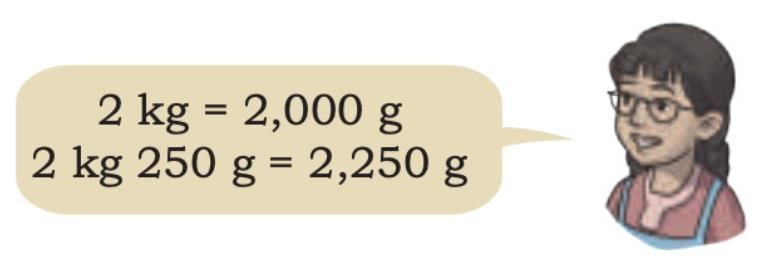
What would be 2 kg 250 g of flour in grams?
Sol:
Comparison between Different Weights
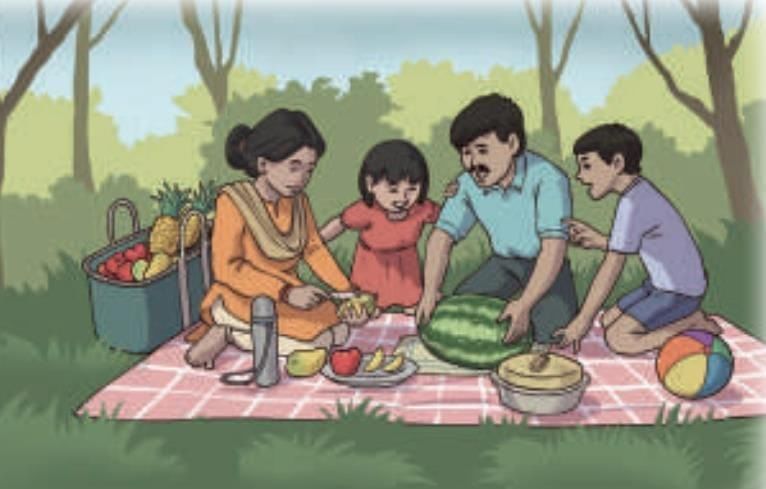
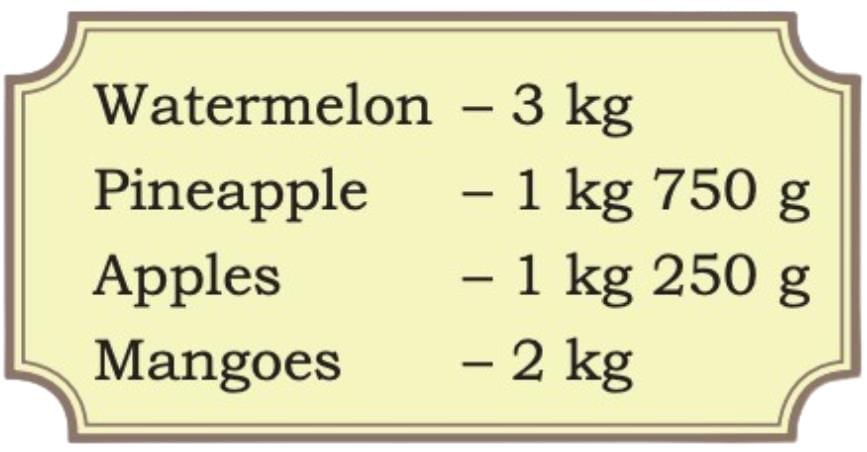
1. Harpreet’s family planned a picnic over the weekend. Her mother and father packed different food items to take along. The following is the list of fruits they carried.
Among the fruits they carried, which one has the (a) highest weight? __________ (b) least weight? __________ (c) Arrange the items in descending order of their weight.__________ __________ __________ __________
Sol: (a) Highest weight? Watermelon – 3 kg (b) least weight? Apples – 1 kg 250 g (c) Arrange the items in descending order of their weight. Watermelon, Mangoes, Pineapple, Apples
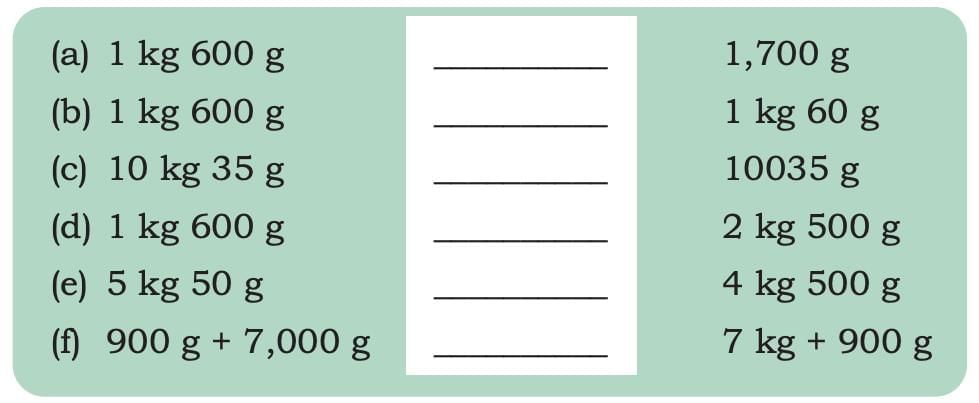
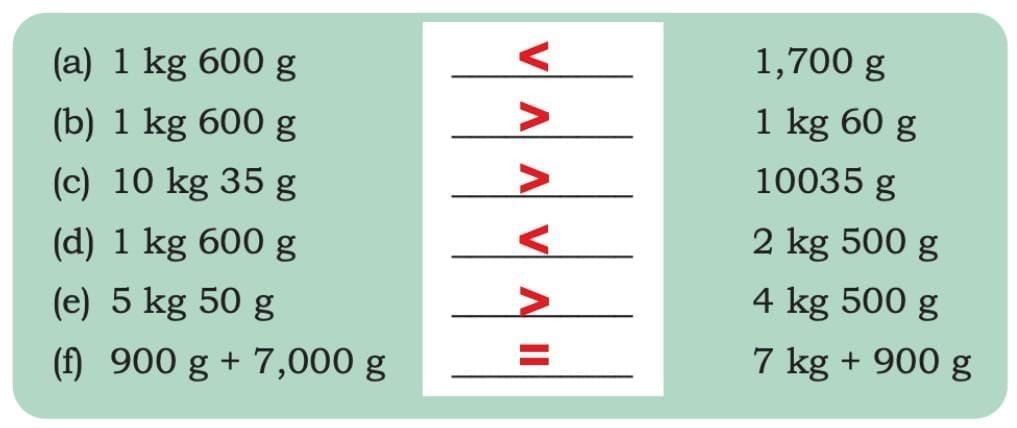
2. Compare the weights using <, =, > signs.
Sol:
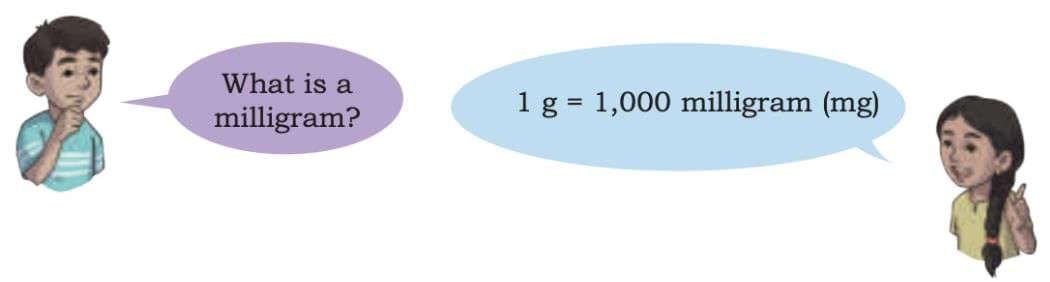
Milligram
Milligrams (mg) are tiny units for very light things like medicine or gold.
1 gram = 1,000 mg.
To change g into mg → multiply by 1,000.
To change mg into g → divide by 1,000.
It helps in precise measurements.
Solved Example:
If a sugar sachet weighs 5g, how much will it be in milligrams?
Sol: We know that 1 g = 1000 mg
Thus, 5 g = 5 x 1000 = 5000 mg
Tonnes
Tonnes (t) are big units for very heavy things like trucks, elephants, or huge containers of goods.
1 tonne = 1,000 kilograms.
To change tonnes into kilograms → multiply by 1,000.
To change kilograms into tonnes → divide by 1,000.
It helps in measuring very heavy weights.
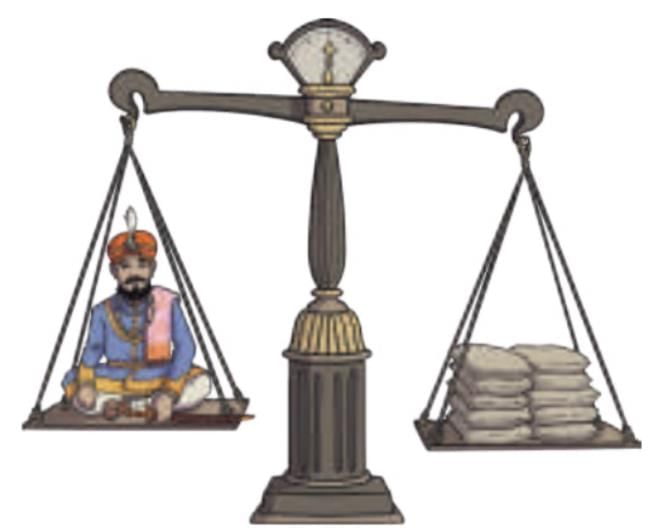
King’s Weight
In a kingdom, the king donates wheat grains equal to 10 times his weight on his birthday.
(a) If he donates 800 kg of wheat grain this birthday, what is his current weight? _______ kg. (b) If he had donated 780 kg of wheat grain on his last birthday, what was his weight last year? _______ kg. (c) How much weight did he gain in a year until this birthday?_______ kg
Sol: (a) 80 kg (b) 78 kg (c) (80 – 78) kg = 2 kg
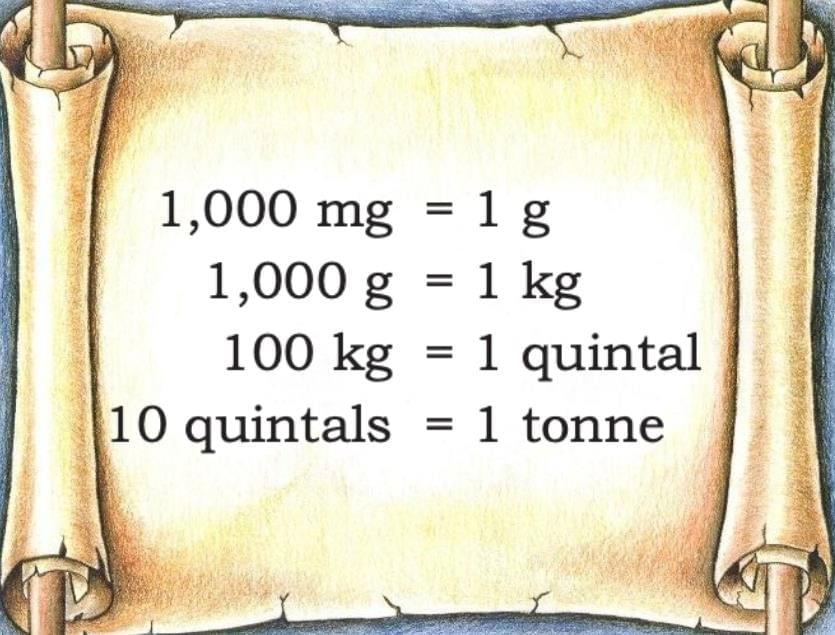
From Tiny to Big
Always remember these weight conversions – they are the key to changing between milligrams, grams, kilograms, quintals, and tonnes!
Addition and Subtraction of Weights
We measure weight in kilograms (kg) and grams (g).
1 kilogram = 1,000 grams.
When adding or subtracting weights, first look at the kilograms and grams separately.
Step 1: Add or subtract the kilograms.
Step 2: Add or subtract the grams.
If the grams are 1,000 or more, change 1,000 g into 1 kg and add it to the kilograms.
Sometimes it’s easier to change the whole weight into grams first, do the calculation, and then change the answer back to kilograms and grams.
This method is very useful in real life — for example, when adding the weight of vegetables in a market or measuring ingredients in cooking.
Example: 2 kg 500 g + 1 kg 750 g → Add kilograms: 2 + 1 = 3 kg → Add grams: 500 + 750 = 1,250 g → Change 1,000 g into 1 kg and add to kilograms → Total = 4 kg 250 g
The Grocery Store
Rathna went to the local grocery store and bought several items.
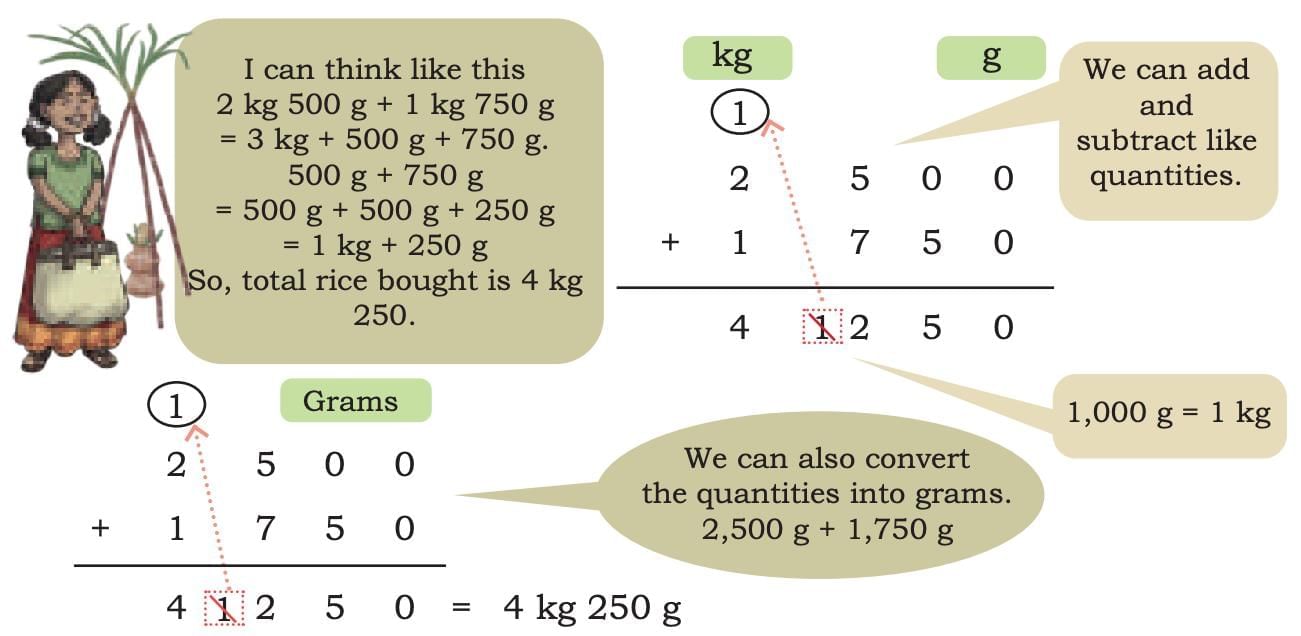
She bought 2 kg 500 g rice for daily use and 1 kg 750 g additional rice for the upcoming Pongal festival. How much total rice did she buy?
Sol: We have three different waysto add these weights:
Mental Method (breaking into parts):
Add kilograms and grams separately.
2 kg + 1 kg = 3 kg
500 g + 750 g = 1250 g = 1 kg 250 g
So, 3 kg + 1 kg 250 g = 4 kg 250 g
Column Method:
Write kg and g in columns and add them.
Carry over 1000 g as 1 kg.
Answer is 4 kg 250 g.
Convert to grams:
2 kg 500 g = 2500 g
1 kg 750 g = 1750 g
Add: 2500 g + 1750 g = 4250 g
Convert back: 4250 g = 4 kg 250 g
Multiplication and Division of Weights
Weighing is not just about adding and subtracting — sometimes we need to multiply or divide weights.
Multiplication with weights
Used when we have many items of the same weight.
We multiply the weight of one item by the number of items to get the total weight.
Example: If one packet of flour weighs 2 kg and we buy 5 packets, 2 kg × 5 = 10 kg total.
Division with weights
Used when we know the total weight and need to find the weight of one item.
We divide the total weight by the number of items.
Example: If 12 kg of rice is packed equally into 4 bags, 12 kg ÷ 4 = 3 kg per bag.
Why it’s useful:
Helps when buying in bulk or sharing food equally.
Useful for finding the cost of items (price per kg × weight) or finding weight from cost (total price ÷ price per kg).
Always remember:
You can multiply or divide kilograms and grams directly.
Or convert everything to grams first, do the calculation, then change it back to kg and g.
Solved Example
1. A farmer weighs a sack of potatoes and finds it to be 10 kg 500 g.If the farmer has 4 such potato sacks, what is the total weight of all the sacks?
Sol: 4 × 10 kg 500 g = 4 ×10 kg and 4 × 500 g = 40 kg + 2000 g = 40 kg + 2 kg = 42 kg.
2. A box of nuts weighing 4 kg 800 g is equally distributed into 4 smaller boxes. What is the weight of each small box in grams?
Sol: 4 kg ÷ 4 = 1 kg 800 g ÷ 4 = 200 g So, 4 kg 800 g ÷ 4 = 1 kg 200 g
Measuring Capacity
Capacity refers to the amount of liquid a container can hold.
We measure it using litres (l) and millilitres (ml). 1 litre = 1,000 millilitres. Bigger containers (like buckets, bottles) are measured in litres. Smaller amounts (like a spoon of medicine, a small packet) are measured in millilitres.
Example:
At home, when we prepare tea, we use water and milk.
If we want to make 2 cups of tea, we don’t need 1 litre of water because 1 litre is too much.
500 ml of water is usually enough for 2 cups.
This shows we choose the right unit (ml or l) depending on the quantity.
Big to Small, Small to Big
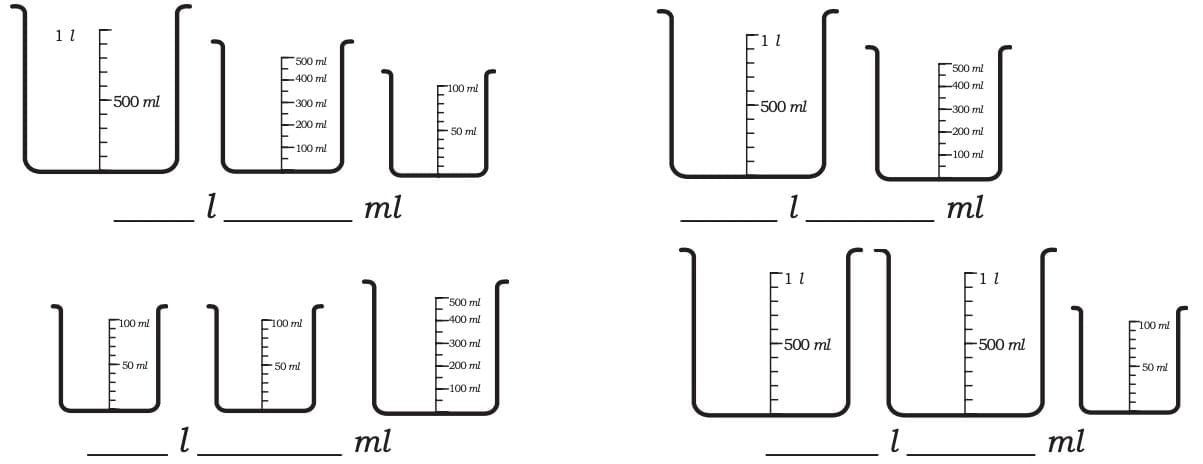
Write the total capacity of the following containers in each blank.
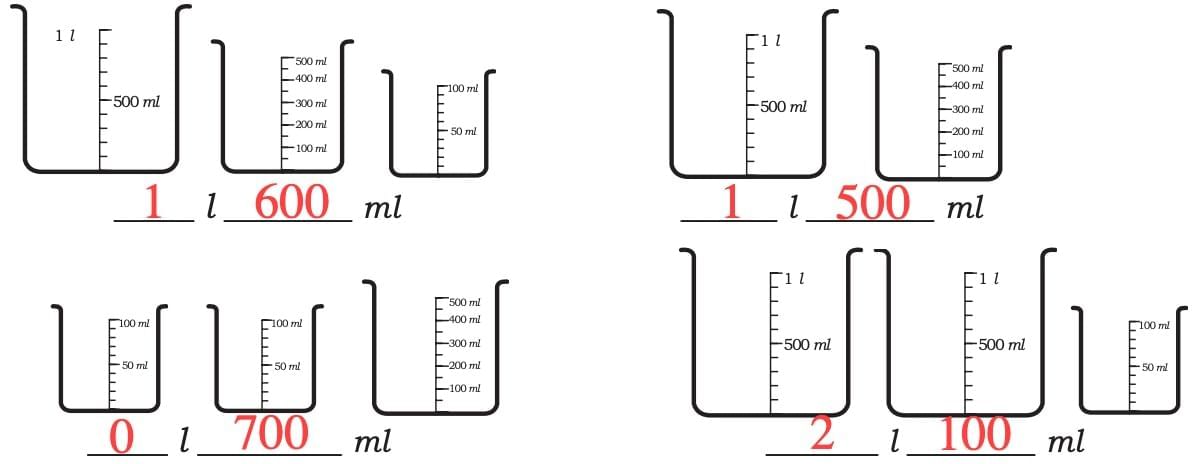
Sol: Observe the beakers:
Big beaker = 1 litre (1 l = 1000 ml)
Medium beaker = 500 ml
Small beaker = 100 ml
Add the capacities in each set.
Top-left set: 1 l + 500 ml + 100 ml = 1 l 600 ml
Top-right set: 1 l + 500 ml = 1 l 500 ml
Bottom-left set: 100 ml + 100 ml + 500 ml = 700 ml (or 0 l 700 ml)
Bottom-right set: 1 l + 1 l + 100 ml = 2 l 100 ml
Different Units but Same Measure
Litres and millilitres are connected – whenever litres feel too big, we can change them into millilitres. Example: 2 litres = 2,000 ml.
Containers are marked in ml or l – like a milk vessel or water bottle. Even if the vessel is marked in ml, you can still measure litres.
Example:
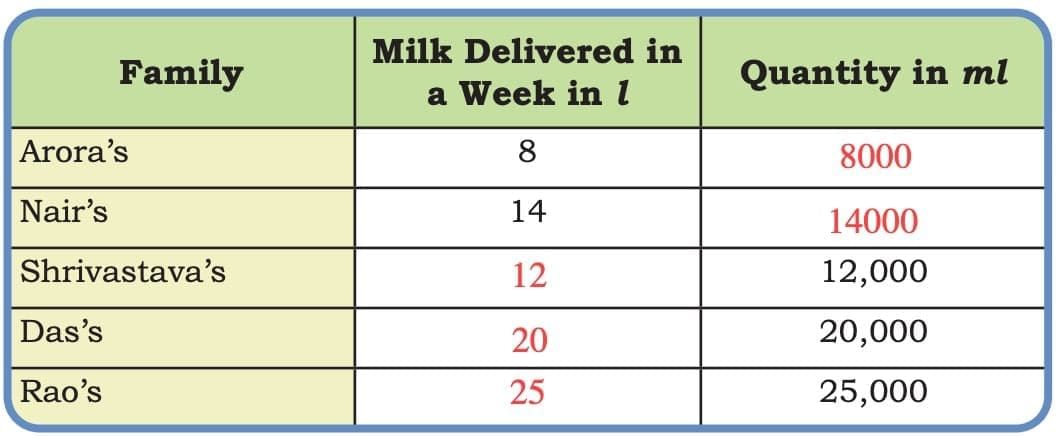
Shrivastava’s family takes 12,000 ml, which means 12 litres.
Rao’s family takes 25,000 ml, which means 25 litres.
Why we learn this – it helps us when: Buying milk, petrol, or juice. Measuring medicines in ml. Cooking recipes where exact liquid amounts matter.
Measuring Milk
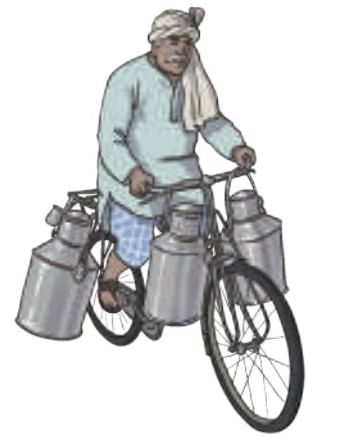
Khayal chacha delivers fresh cow milk to homes. Bhalerao’s family orders 2l of milk every day. This family has a vessel marked in ml only. What mark will you see in the vessel corresponding to 2l?
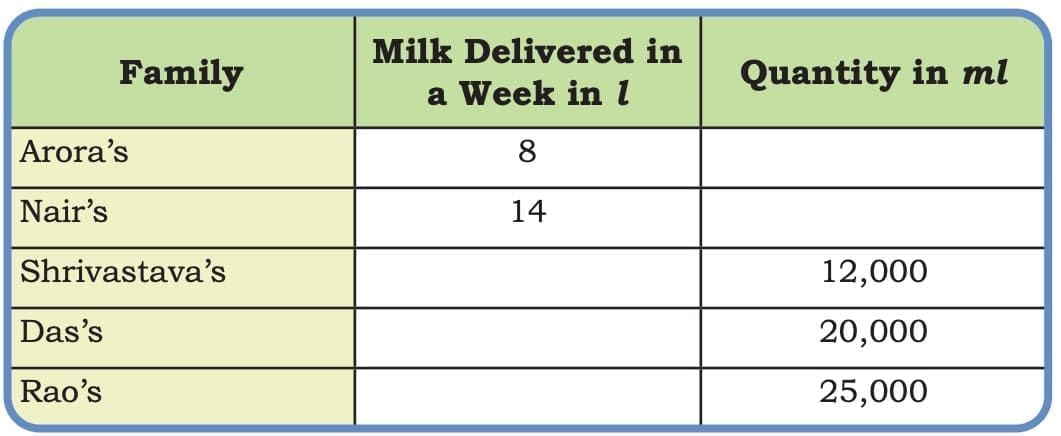
Khayal chacha delivers the following amounts of milk each week to different families.
Dev’s family needs 1 l milk every day. On Sunday, they need 500 ml more.Quantity of milk they need on Sunday = 1 l + 500 ml = 1,000 ml + 500 ml = 1,500 ml
Sol:
1. Bhalerao’s vessel mark for 2 litres Rule: 1 l = 1000 ml 2 l = 2 × 1000 = 2000 ml So the mark you will see is 2000 ml.
2. Fill the litres–millilitres blanks (Use 1 l = 1000 ml)
1 l → 1000 ml 2 l → 2000 ml 6 l → 6000 ml 8 l → 8000 ml 12 l → 12,000 ml 14 l → 14,000 ml 20 l → 20,000 ml 25 l → 25,000 ml
So the filled rows are:
3. Weekly delivery table (convert each using 1 l = 1000 ml)
4. Dev’s family Needs 1 l every day, and on Sunday, 500 ml more. 1 l + 500 ml = 1000 ml + 500 ml = 1500 ml
Comparing Capacity
It means finding out which container can hold more liquid and which one can hold less.
How do we compare? 1. If the liquids are given in the same unit (both in litres or both in millilitres), just look at the numbers. Example: 3 l vs 5 l → 5 l is more. 2. Example: 1 l vs 750 ml → change 1 l into 1,000 ml → now 1,000 ml is more than 750 ml.
Why do we convert? 1. Because it’s like comparing apples and oranges. 2. To compare properly, we need both in the same form (like both in ml or both in l).
Real-life examples: 1. A water bottle (1 l) vs a juice packet (250 ml) → bottle holds more. 2. A bucket (15 l) vs a mug (1 l) → bucket holds more. 3. Milkman gives 2 l to one family and 1,500 ml to another → convert 2 l = 2,000 ml → 2,000 ml is more.
Easy tip to remember: 1. Bigger number in the same unit = bigger capacity. 2. Always bring litres and millilitres to the same unit before deciding.
Let Us Compare
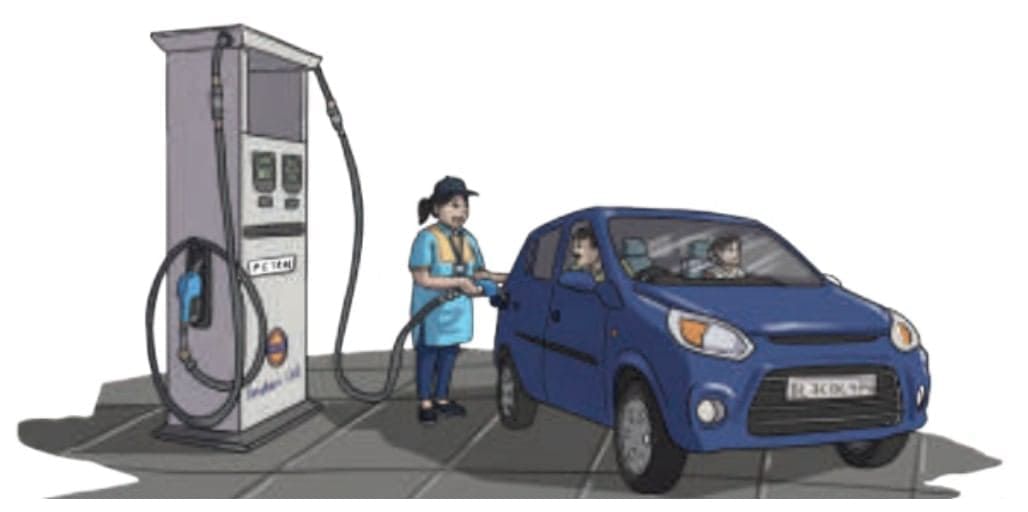
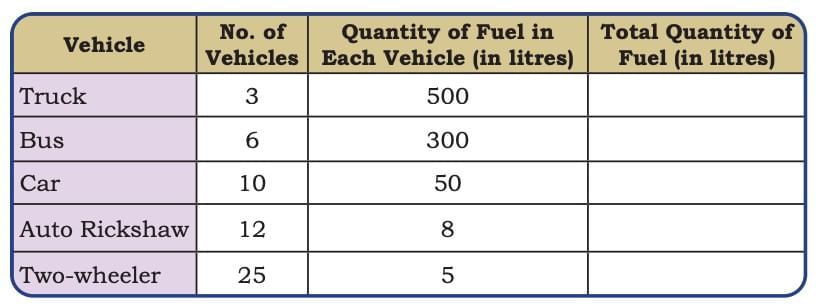
Kiran owns a petrol pump. She records the details of the sales of petrol in a day.
(a) How much more fuel is bought for buses than for trucks? (b) What is the total quantity of fuel filled from the petrol pump on that day?
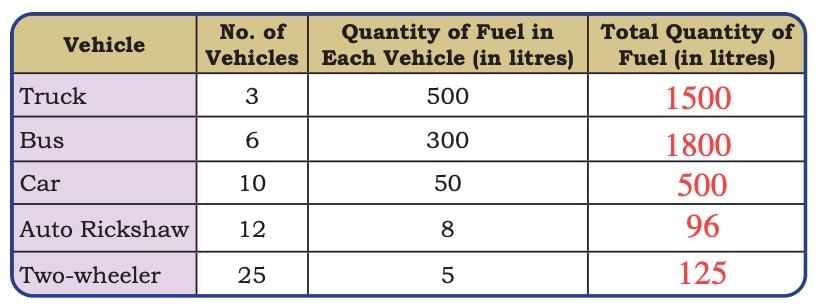
Sol: First, find the total fuel for each vehicle type (No. of vehicles × fuel in each):
(a) How much more for buses than trucks? Buses: 1,800 litres Trucks: 1,500 litres Difference: 1,800 − 1,500 = 300 litres more for buses. (b) Total fuel filled that day Add all the totals: 1,500 + 1,800 + 500 + 96 + 125 = 4,021 litres.
Addition of Capacity
Capacity means the amount of liquid a container can hold.
To add, write litres (l) and millilitres (ml) separately.
Add ml and l column-wise.
If millilitres go over 1,000, regroup them into litres (because 1,000 ml = 1 l).
Example:
2 l 500 ml + 3 l 750 ml
= (2 + 3) l and (500 + 750) ml
= 5 l and 1,250 ml
1,250 ml = 1 l 250 ml
Final = 6 l 250 ml
Subtraction of Capacity
Write litres (l) and millilitres (ml) separately.
Subtract ml and l column-wise.
If ml in the top number is smaller, borrow 1 litre = 1,000 ml.
Example:
5 l 200 ml – 3 l 750 ml
= (5 – 3) l and (200 – 750) ml
Since 200 is smaller, borrow 1 l = 1,000 ml
200 + 1,000 = 1,200 ml
Now subtract: (4 – 3) l and (1,200 – 750) ml
Final = 1 l 450 ml
Let us solve
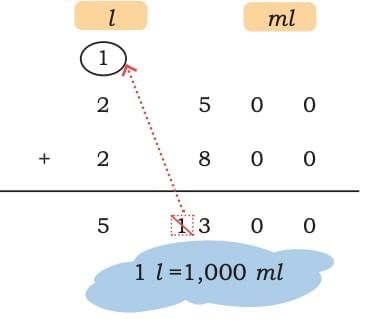
Sam and Tina fill petrol in their bikes. Tina bought 2 l 500 ml of petrol. Sam bought 2 l 800 ml more petrol than Tina. How much petrol didSam buy?
Sol: Sam found the quantity of petrol by adding like quantities.
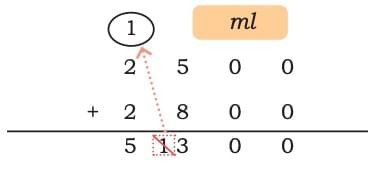
2 l 500 ml + 2 l 800 ml = 2 l + 2 l and 500 ml + 800 ml = 4 l and 1,300 ml = 4 l and 1 l and 300 ml = 5 l 300 ml
Tina converted the quantities into ml, that is, 2,500 ml and 2,800 ml.
Total quantity of petrol bought by Sam = 2,500 ml + 2,800 ml = 5,300 ml =5 l 300 ml.
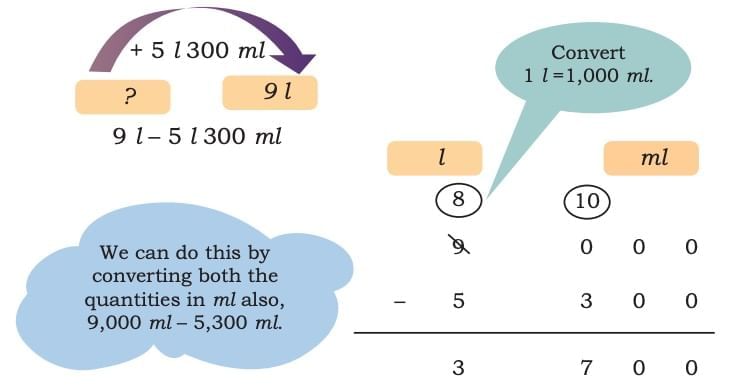
After refuelling, Sam found his fuel gauge reading 9 l.
How much fuel did his bike have before refuelling? The quantity of fuel Sam’s bike had before refuelling is–Sam’s bike had 3l 700ml of fuel before refuelling.