Multiple Choice Questions
Q1: The nucleus of an atom consists of ______.
(a) Protons
(b) Electrons and neutrons
(c) Protons and neutrons
(d) Neutrons
Q2: What is the maximum number of electrons which can be present in K and L shells in an atom?
(a) 2 and 8
(b) 2 and 18
(c) 2 and 32
(d) 8 and 18
Q3: Rutherford’s alpha-particle scattering experiment was responsible for the discovery of
(a) Atomic Nucleus
(b) Electron
(c) Proton
(d) Neutron
Q4: Isotopes of element have:
(a) The same physical properties
(b) Different chemical properties
(c) Different number of neutrons
(d) Different atomic numbers
Q5: Number of valence electrons in Cl– ion are:
(a) 16
(b) 8
(c) 17
(d) 18
Q6: An element with configuration 2,8,4 will tend to show valency
(a) 3
(b) 2
(c) 4
(d) 5
Q7: Amongst element X (2,8,6) and Y (2,8,8) which is more reactive and why ?
(a) X because it is a metal
(b) Y because it is non metal
(c) X because it has 6 valence electrons
(d) Y because it is gas
Q8: The nucleus of the hydrogen atom is called as
(a) Neutron
(b) Electron
(c) Proton
(d) Nucleons
Q9: Cathode rays get deflected in an electric field towards
(a) Positive plate
(b) Negative Plate
(c) No deflection takes place
(d) First towards negative plate and then towards positive plate
Q10: The atomic number of an element ‘y’ is 20. The electronic configuration of the ion having inert gas configuration is
(a) 2,8,10
(b) 2,18
(c) 2,10,8
(d) 2,8,8
Fill in the Blank
Q1: According to Bohr–Bury rules, the maximum number of electrons in the K-shell is ________ and in the L-shell is ________.
Q2: An atom is the smallest unit of an element which takes part in a _________.
Q3: Mass of an electron is 1/2000 times less than the mass of one atom of__________.
Q4: The K-shell of any atom cannot have more than _________ electrons.
Q5: Isotopes are the atoms of ___________ element, having same atomic number but different mass number.
| Also read: Worksheet Solutions: Structure of the Atom |
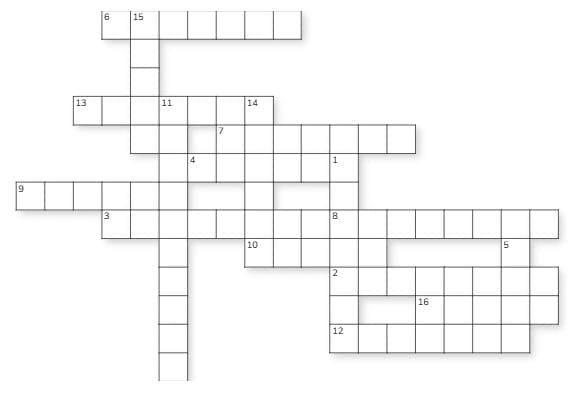
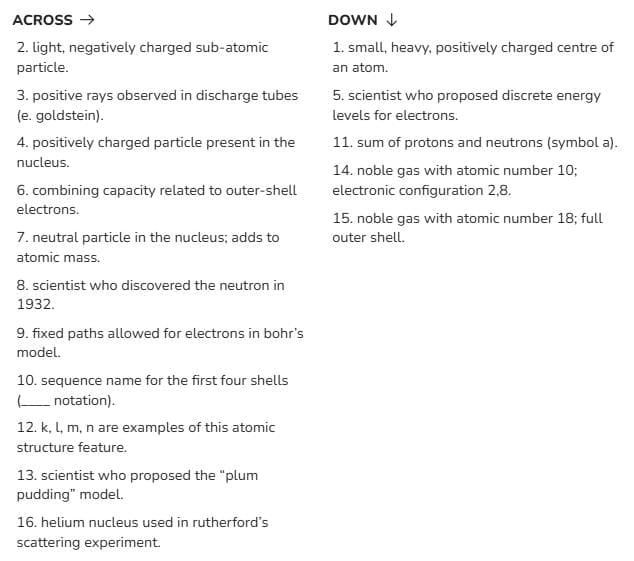
Crossword Puzzle
Very Short Answer Questions
Q1: Out of proton and neutron, which is heavier?
Q2: Were neutrons known at the time Rutherford performed the scattering experiment?
Q3: Who discovered canal rays and what do they indicate?
Q4: What is the number of electrons in the valence shell of chlorine (Z = 17)?
Q5: What is the basic difference between the isotopes of an element?
Short Answer Questions
Q1: How will you find the valency of chlorine, sulphur and magnesium?
Q2: Describe Bohr’s model of the atom.
Q3: What are the limitations of Rutherford’s model of the atom?
Q4: Write the postulates of Bohr theory?
Q5: Explain, with examples, how atoms achieve an octet by losing, gaining, or sharing electrons.