Q1: Write SI unit of G.
Ans:
We know,

or

In SI system, force F is measured in N, distance r in m and masses m1 and m2 in kg, therefore

Using G = Fr2 / (m1m2), the SI unit of G becomes N m2 kg-2.
Q2: Why should we be sent flying in space if the force of gravity somehow vanishes today?
Ans: Earth’s gravity provides the inward (centripetal) force that keeps us moving in a circular path as the Earth rotates. If gravity vanished, that centripetal force would disappear and objects on the surface would continue to move in a straight line tangent to the Earth’s surface. As a result, we would move away from the Earth and be sent off into space along that tangent.
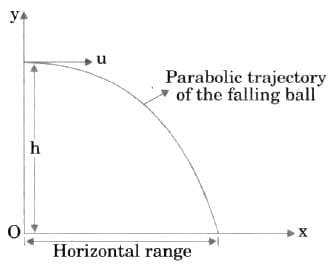
Q3: A ball moving on a table reaches the edge and falls. Sketch the path it will follow while falling.
Ans: As the ball leaves the table it has a horizontal velocity and, at the same time, a vertical downward acceleration due to gravity. The horizontal velocity remains nearly constant while the vertical speed increases. The combined motion makes the path a parabola.
Q4: Is value of “g” same at all places on the Earth? Give reason for your answer.
Ans: No. The value of g is slightly larger at the poles and slightly smaller at the equator. This is because the Earth is not a perfect sphere (it is slightly flattened at the poles) and because Earth’s rotation produces a small centrifugal effect that reduces the effective gravitational acceleration at the equator.
Q5: What is the relation between gravitational force of the Moon with the Earth.
Ans: The surface gravitational acceleration on the Moon is about one-sixth of that on the Earth. Therefore the gravitational force (weight) on an object at the Moon’s surface is roughly 1/6 of its weight on Earth.
Q6: Why does a mug full of water feel lighter inside water?
Ans: A mug immersed in water experiences an upward buoyant force from the water. This upward force opposes part of the mug’s weight, so the apparent weight (how heavy it feels) is reduced when it is inside the water.
Q7: Name the force which accelerates a body in free fall.
Ans: Gravitational force of the Earth (weight) is the force that accelerates a body in free fall.
Q8: Why value of “g” more or less constant on or near the Earth?
Ans: Because the distance from the surface to the centre of the Earth changes very little over the Earth’s surface, the value of g remains nearly the same on or near the Earth. Small variations occur due to Earth’s shape and rotation, but they are minor.
Q9: What is the unit of “g”?
Ans: The unit of g is m s-2 (metre per second squared).
Q10: What is the importance of universal law of gravitation?
or
Write four phenomenons which were successfully explained using universal law of gravitation.
Ans: The universal law of gravitation explains how masses attract each other and helps us understand many natural phenomena. Some important examples are:
(i) It explains why objects remain bound to Earth (why we stay on the ground).
(ii) It explains the Moon’s motion around the Earth.
(iii) It explains the motion of planets around the Sun (planetary orbits).
(iv) It explains tides caused by the gravitational pull of the Moon and the Sun.
Q11: Name the scientist in whose honor the SI unit of pressure is named.
Ans: The SI unit of pressure, the pascal, is named after the scientist Blaise Pascal.
Q12: Define the weight of an object on Moon.
Ans: The weight of an object on the Moon is the gravitational force with which the Moon attracts that object. It is measured in newtons and is about one-sixth of the object’s weight on Earth.
Q13: What is weightlessness?
Ans: A body is in a state of weightlessness when the normal reaction force from a supporting surface becomes zero, so its apparent weight is zero. This happens, for example, during free fall or for astronauts orbiting the Earth, where they and their spacecraft fall freely together.
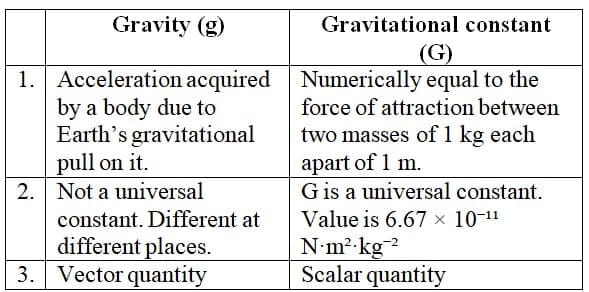
Q14: Give difference between `g’ and ‘G’ in a tabular form.
Ans:
Q15: Why is G called ‘a universal gravitational constant’?
Ans: The numerical value of G is the same for any pair of objects anywhere in the universe and does not depend on the nature of the medium between them. For these reasons G is called the universal gravitational constant.