Q1: What is a tissue?
Ans: A group of cells that are similar in structure and/or work together to achieve a particular function forms a tissue. Examples of tissues are blood, phloem and muscle .
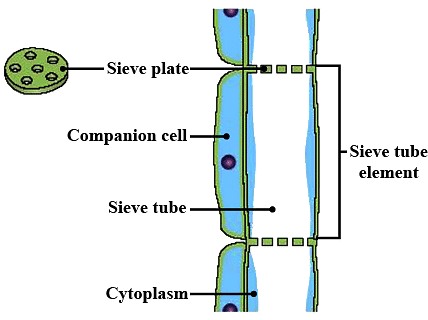
Q2: What are the constituents of phloem?
Ans: There are four types of elements are present in the phloem they are:
- Sieve tube: Helps in conduction of food material
- Companion cells: It helps sieve tube in conduction of food material
- Phloem parenchyma: storage
- Phloem fibres: It provides mechanical support.
 Q3: Name types of simple tissues.
Ans: Three types simple tissues are:
I. Parenchyma
II. Collenchyma
III. Sclerenchyma
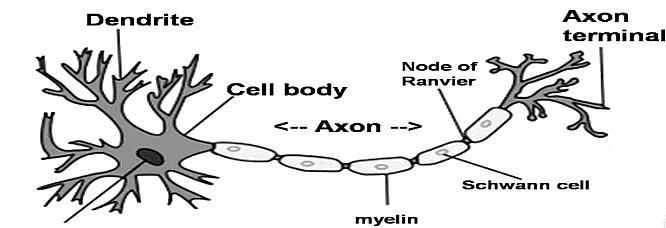
Q4: What does a neuron look like?
Ans: A neuron comprises a cell body from which long thin hair-like parts(arise). Then the neuron has a single long part(axon) and many short, branched parts(dendrites).
Q5: How many types of elements together make up the xylem tissue? Name them.
Ans: Xylem tissue consist of four types of elements:
I. Tracheids
II. vessels
III. Xylem fibres
IV. Xylem parenchyma
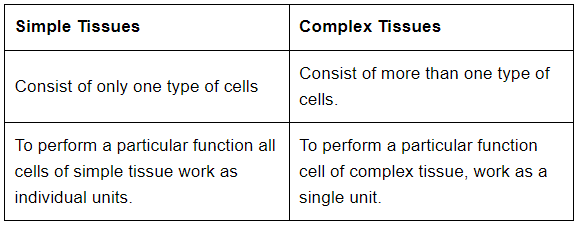
Q6: How are simple tissues different from complex tissues in plants?
Ans: Difference between simple tissues and complex tissues in plants is given below:
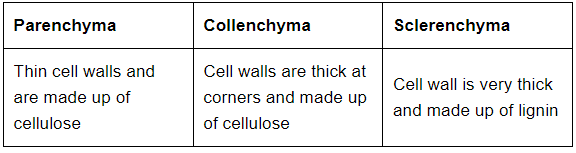
Q7: Differentiate between parenchyma, collenchyma and sclerenchyma on the basis of their cell wall.
Ans: Difference between parenchyma, collenchyma and sclerenchyma on the basis of their cell wall is given below:
Q8: What are the functions of the stomata?
Ans: The functions of stomata are:
I. Gaseous exchange with the atmosphere.
II. Transpiration (formation of water vapours for the removal of excess water)
Q9: What is the specific function of the cardiac muscle?
Ans: Cardiac muscles are the muscles of heart that pumps blood to all parts of body and it shows rhythmic contraction and relaxation throughout life without any fatigue. The cells of heart muscles are branched, cylindrical and uninucleate.
Q10: Name the following:
(a) Tissue that forms the inner lining of our mouth.
Ans: Epithelial tissue
(b) Tissue that connects muscle to bone in humans.
Ans: Tendon
(c) Tissue that transports food in plants.
Ans: Phloem
(d) Tissue that stores fat in our body.
Ans: Adipose tissue
(e) Connective tissue with a fluid matrix.
Ans: Blood
(f) Tissue presents in the brain.
Ans: Nerve tissue
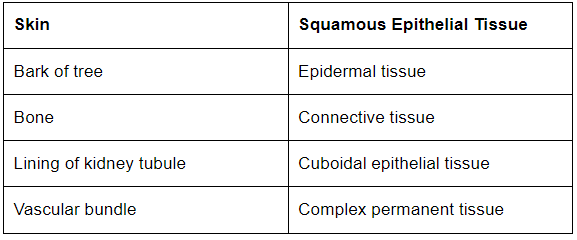
Q11: Identify the type of tissue in the following: skin, bark of tree, bone, lining of kidney tubule, vascular bundle.
Ans: The type of tissues of the given is listed below:
Q12: Name the regions in which parenchyma tissue is present.
Ans: Leaves, fruits and flowers are the regions where the parenchyma tissue is present.
Q13: What is the role of epidermis in plants?
Ans: Epidermis is a protective layer to all the plant parts. It will provide protection against water loss, Control the process of gas exchange, Epidermis secretes a waxy, water-resistant layer.
Q14: How does the cork act as a protective tissue?
Ans: In the plant a strip of secondary meristem located in the cortex forms layers of cells that are dead and arranged in a compact manner without intercellular spaces which is cork. They have deposition of suberin in their walls which is very hard and impermeable hence protects plants from unfavorable conditions and microbial attack etc.
Q15: What are the two types of tissues? Explain them.
Ans:
Plant tissues are mainly divided into two types they are:
- Meristematic Tissue: dividing tissue is the reason for growth of plants occurs only in specific regions this is also known as meristematic tissue. Apical, lateral and intercalary are the classification of the meristematic tissues.
Permanent Tissue: The cells formed by meristematic tissue later lose the ability to divide as a result permanent tissue is formed. The process of taking up a permanent shape, size, and a function is called differentiation; this also leads to the development of permanent tissues.
Q16: What is the function of Tendon and ligament?
Ans:
- Ligaments: They connect one bone to another bone and another type of connective tissue. They are strong, elastic, consisting of yellow fibers.
- Tendon: They connect muscle to bone and another type of connective tissue. They are tough, non – elastic, consisting of white fibres.
Q17: Differentiate the following activities on the basis of voluntary or involuntary:
Ans:
(a) Jumping of frog
Ans: Voluntary
(b) Pumping of the heart
Ans: Involuntary
(c) writing with hand
Ans: Voluntary
(d) Moving of chocolate in stomach
Ans: Involuntary
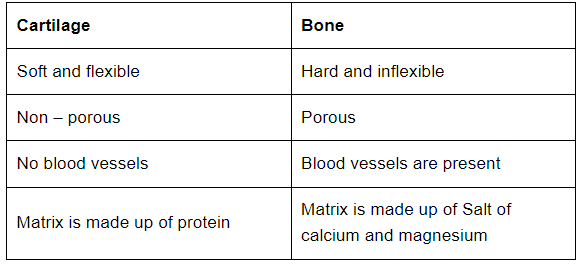
Q18: Write the difference between cartilage and bone.
Ans: Difference between cartilage and bone is listed below:
Q19: Which components of xylem are living and which ones are dead?
Ans: Xylem is composed of four elements:
- Tracheid: Dead
- Vessels: Dead
- Xylem parenchyma: Living
- Xylem fibres: Dead
Q20: Define due process of differentiation.
Ans: Dividing tissue is the reason for growth of plants occurs only in specific regions this is also known as meristematic tissue. The cells formed by meristematic tissue later lose the ability to divide as a result permanent tissue is formed. The process of taking up a permanent shape, size, and a function is called differentiation.
Q21: Mention characteristics of permanent tissues.
Ans: Characteristics of permanent tissues are:
- Cells are large, comparatively thick walls and well developed .
- Cytoplasm is present as a layer along the cell wall.
- Bigger nucleus , vacuole is present in the cell.
- There is lack of the power for the cell division in permanent tissue.
Q22: Mention the functions of nervous tissue.
Ans: Function of nervous tissues are:
- They conduct nerve impulses from one part of the body to another part.
- The nervous tissues in the body are specialised for being stimulated and then pass on the stimulus very quickly from one place to another.
Q23: How aquatic plant like Water hyacinth floats on the water surface. Explain.
Ans: Water hyacinth floats on the surface of water due to presence of aerenchyma. It is a special form of parenchyma, which contains air cavities. It provides buoyancy because of the air trapped inside which helps water hyacinth in floating because of the air trapped inside.
Q24: Name the two types of vascular tissues.
Ans: Types of vascular tissues are
- Xylem: It conduct water and minerals from roots to the parts of the plant
- Phloem: It conduct food from leaves to all parts of plant
Q25: What is the utility of tissues in multi-cellular organisms?
Ans: Millions of cells will be there in multicellular organisms. Specific functions are carried out by different groups of cells. There is a clear-cut division of labour in multicellular organisms i.e., different parts of the body of a multicellular organism perform specific functions. For example, the brain controls all other parts of the body, the heart pumps blood to all parts of the body, kidneys remove waste materials from the body, sense organs collect information from external sources and transfer to the brain etc. All these functions would never be possible without formation of tissues in multicellular organisms.
Q26: What are the functions of areolar tissue?
Ans: Areolar tissue is a connecting tissue found between skin and muscles, around our blood vessels and nerve cells and also in the bone marrow. Its functions are,
I. To fill the space inside organs.
II. To support internal organs.
III. To help in repair tissues
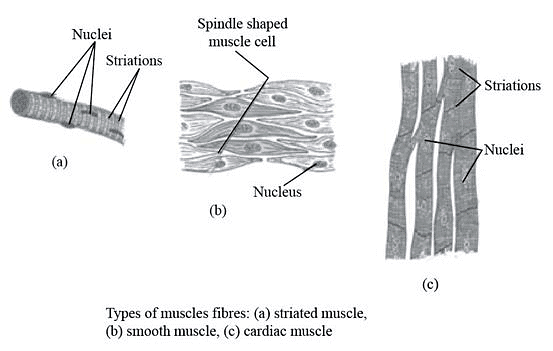
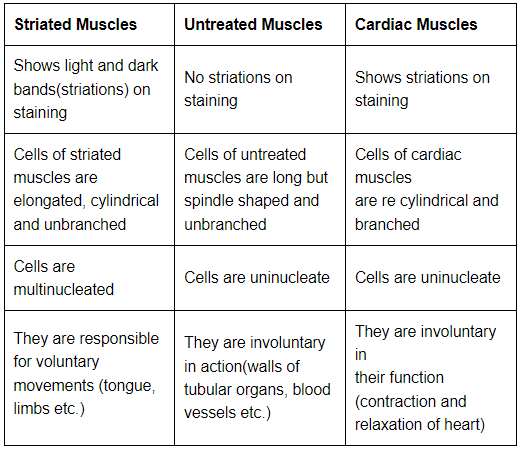
Q27: Differentiate between striated, untreated and cardiac muscles on the basis of their structure and site/location in the body.
Ans: Difference between striated, untreated and cardiac muscles on the basis of their structure and site/location in the body is given below:
Q28: Complete the table:
Ans: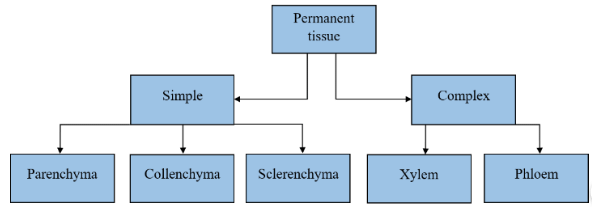
Q29: How many types of tissues are found in animals? Name the different types.
Ans: In animal four types of tissues are found:
- Epithelium or Epithelial tissue (covering tissue): It forms outer protective covering all over the body.
- Connective tissue (supporting tissue): It binds cells of other tissues in the body and give them rigidity and support.
- Muscular tissue (contractile tissue): It helps the movement of the body by contraction and relaxation.
- Nervous tissue: Its receiver stimulates and transmit the messages.
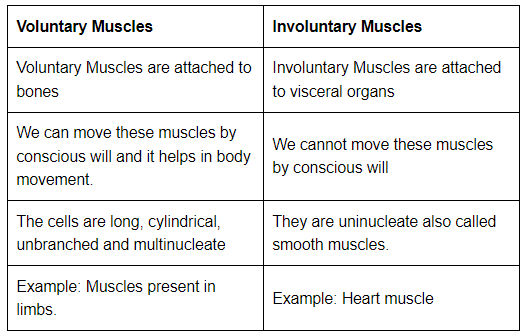
Q30: Differentiate between voluntary and involuntary muscles. Give one example of each
Ans: Difference between voluntary and involuntary muscles are given below:
Q31: What are the major functions of blood?
Ans: Blood is a type of connective tissue, and its functions are:
- Blood flow can transport oxygen, food, hormones and waste material from one part of the body to the other part of the body
- Blood carries oxygen and food to all cells. It also collects wastes from all parts of the body and carries them to the liver and kidney for disposal purposes.
- Regulates temperature by distributing heat within the body
- WBC’S protect due body from disease and helps in wound healing
- Platelets help in blood clotting
Q32: Write about the functions of,
(a) Epidermis
Ans: Epidermis, its main function is protection. It forms a waterproof coating, which reduces loss of water.
(b) Cork
Ans: Cork: It is protective in function. It prevents desiccation, by preventing loss of water from the plant body. It prevents infection and mechanical injury
(c) Stomata.
Ans: Stomata:These are the small opening which helps in exchange of gases
Q33: Differentiate between parenchyma and collenchyma
Ans: Difference between parenchyma and collenchyma is given below: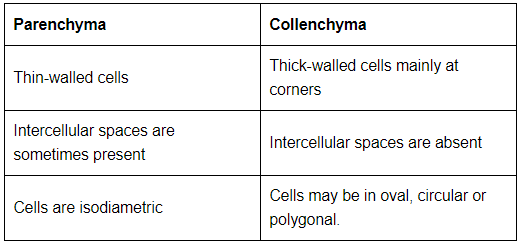
Q34: Mention the characteristics features of connective tissue.
Ans: Characteristics of connective tissue:
- The cells are loosely spaced and are embedded in a non – living intercellular matrix
- The intercellular matrix may be like jelly, fluid, dense or rigid.
- Depending on the connective tissues functions the nature of the matrix varies.
Q35: How does cardiac muscle differ from both voluntary and involuntary muscles in both structure and function?
Ans: Cardiac muscles are the muscles of the heart that pumps blood to all parts of the body and it shows rhythmic contraction and relaxation throughout life without any fatigue. The cells of heart muscles are branched, cylindrical and uninucleate.
- Cardiac Muscles are involuntary
- More akin in structure and only found in heart.
- They function throughout the life
Q36: Differentiate between meristematic and permanent tissue.
Ans: Difference between meristematic and permanent tissue is given below: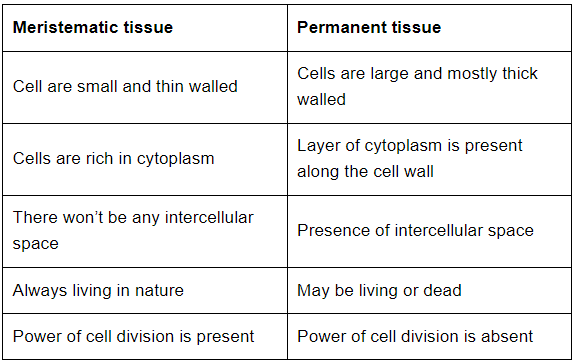 CBSE Class 9 > Class 9 Notes > Science > Short Question Answer: Tissues
Short Question Answer: Tissues
Q1: What is a tissue?
Ans: A group of cells that are similar in structure and/or work together to achieve a particular function forms a tissue. Examples of tissues are blood, phloem and muscle .
Q2: What are the constituents of phloem?
Ans: There are four types of elements are present in the phloem they are:
- Sieve tube: Helps in conduction of food material
- Companion cells: It helps sieve tube in conduction of food material
- Phloem parenchyma: storage
- Phloem fibres: It provides mechanical support.
Q3: Name types of simple tissues.
Ans: Three types simple tissues are:
I. Parenchyma
II. Collenchyma
III. Sclerenchyma
Q4: What does a neuron look like?
Ans: A neuron comprises a cell body from which long thin hair-like parts(arise). Then the neuron has a single long part(axon) and many short, branched parts(dendrites).
Q5: How many types of elements together make up the xylem tissue? Name them.
Ans: Xylem tissue consist of four types of elements:
I. Tracheids
II. vessels
III. Xylem fibres
IV. Xylem parenchyma
Q6: How are simple tissues different from complex tissues in plants?
Ans: Difference between simple tissues and complex tissues in plants is given below:
Q7: Differentiate between parenchyma, collenchyma and sclerenchyma on the basis of their cell wall.
Ans: Difference between parenchyma, collenchyma and sclerenchyma on the basis of their cell wall is given below:
Q8: What are the functions of the stomata?
Ans: The functions of stomata are:
I. Gaseous exchange with the atmosphere.
II. Transpiration (formation of water vapours for the removal of excess water)
Q9: What is the specific function of the cardiac muscle?
Ans: Cardiac muscles are the muscles of heart that pumps blood to all parts of body and it shows rhythmic contraction and relaxation throughout life without any fatigue. The cells of heart muscles are branched, cylindrical and uninucleate.
Q10: Name the following:
(a) Tissue that forms the inner lining of our mouth.
Ans: Epithelial tissue
(b) Tissue that connects muscle to bone in humans.
Ans: Tendon
(c) Tissue that transports food in plants.
Ans: Phloem
(d) Tissue that stores fat in our body.
Ans: Adipose tissue
(e) Connective tissue with a fluid matrix.
Ans: Blood
(f) Tissue presents in the brain.
Ans: Nerve tissue
Q11: Identify the type of tissue in the following: skin, bark of tree, bone, lining of kidney tubule, vascular bundle.
Ans: The type of tissues of the given is listed below:
Q12: Name the regions in which parenchyma tissue is present.
Ans: Leaves, fruits and flowers are the regions where the parenchyma tissue is present.
Q13: What is the role of epidermis in plants?
Ans: Epidermis is a protective layer to all the plant parts. It will provide protection against water loss, Control the process of gas exchange, Epidermis secretes a waxy, water-resistant layer.
Q14: How does the cork act as a protective tissue?
Ans: In the plant a strip of secondary meristem located in the cortex forms layers of cells that are dead and arranged in a compact manner without intercellular spaces which is cork. They have deposition of suberin in their walls which is very hard and impermeable hence protects plants from unfavorable conditions and microbial attack etc.
Q15: What are the two types of tissues? Explain them.
Ans:
Plant tissues are mainly divided into two types they are:
- Meristematic Tissue: dividing tissue is the reason for growth of plants occurs only in specific regions this is also known as meristematic tissue. Apical, lateral and intercalary are the classification of the meristematic tissues.
Permanent Tissue: The cells formed by meristematic tissue later lose the ability to divide as a result permanent tissue is formed. The process of taking up a permanent shape, size, and a function is called differentiation; this also leads to the development of permanent tissues.
Q16: What is the function of Tendon and ligament?
Ans:
- Ligaments: They connect one bone to another bone and another type of connective tissue. They are strong, elastic, consisting of yellow fibers.
- Tendon: They connect muscle to bone and another type of connective tissue. They are tough, non – elastic, consisting of white fibres.
Q17: Differentiate the following activities on the basis of voluntary or involuntary:
Ans:
(a) Jumping of frog
Ans: Voluntary
(b) Pumping of the heart
Ans: Involuntary
(c) writing with hand
Ans: Voluntary
(d) Moving of chocolate in stomach
Ans: Involuntary
Q18: Write the difference between cartilage and bone.
Ans: Difference between cartilage and bone is listed below:
Q19: Which components of xylem are living and which ones are dead?
Ans: Xylem is composed of four elements:
- Tracheid: Dead
- Vessels: Dead
- Xylem parenchyma: Living
- Xylem fibres: Dead
Q20: Define due process of differentiation.
Ans: Dividing tissue is the reason for growth of plants occurs only in specific regions this is also known as meristematic tissue. The cells formed by meristematic tissue later lose the ability to divide as a result permanent tissue is formed. The process of taking up a permanent shape, size, and a function is called differentiation.
Q21: Mention characteristics of permanent tissues.
Ans: Characteristics of permanent tissues are:
- Cells are large, comparatively thick walls and well developed .
- Cytoplasm is present as a layer along the cell wall.
- Bigger nucleus , vacuole is present in the cell.
- There is lack of the power for the cell division in permanent tissue.
Q22: Mention the functions of nervous tissue.
Ans: Function of nervous tissues are:
- They conduct nerve impulses from one part of the body to another part.
- The nervous tissues in the body are specialised for being stimulated and then pass on the stimulus very quickly from one place to another.
Q23: How aquatic plant like Water hyacinth floats on the water surface. Explain.
Ans: Water hyacinth floats on the surface of water due to presence of aerenchyma. It is a special form of parenchyma, which contains air cavities. It provides buoyancy because of the air trapped inside which helps water hyacinth in floating because of the air trapped inside.
Q24: Name the two types of vascular tissues.
Ans: Types of vascular tissues are
- Xylem: It conduct water and minerals from roots to the parts of the plant
- Phloem: It conduct food from leaves to all parts of plant
Q25: What is the utility of tissues in multi-cellular organisms?
Ans: Millions of cells will be there in multicellular organisms. Specific functions are carried out by different groups of cells. There is a clear-cut division of labour in multicellular organisms i.e., different parts of the body of a multicellular organism perform specific functions. For example, the brain controls all other parts of the body, the heart pumps blood to all parts of the body, kidneys remove waste materials from the body, sense organs collect information from external sources and transfer to the brain etc. All these functions would never be possible without formation of tissues in multicellular organisms.
Q26: What are the functions of areolar tissue?
Ans: Areolar tissue is a connecting tissue found between skin and muscles, around our blood vessels and nerve cells and also in the bone marrow. Its functions are,
I. To fill the space inside organs.
II. To support internal organs.
III. To help in repair tissues
Q27: Differentiate between striated, untreated and cardiac muscles on the basis of their structure and site/location in the body.
Ans: Difference between striated, untreated and cardiac muscles on the basis of their structure and site/location in the body is given below:
Q28: Complete the table:
Ans:
Q29: How many types of tissues are found in animals? Name the different types.
Ans: In animal four types of tissues are found:
- Epithelium or Epithelial tissue (covering tissue): It forms outer protective covering all over the body.
- Connective tissue (supporting tissue): It binds cells of other tissues in the body and give them rigidity and support.
- Muscular tissue (contractile tissue): It helps the movement of the body by contraction and relaxation.
- Nervous tissue: Its receiver stimulates and transmit the messages.
Q30: Differentiate between voluntary and involuntary muscles. Give one example of each
Ans: Difference between voluntary and involuntary muscles are given below:
Q31: What are the major functions of blood?
Ans: Blood is a type of connective tissue, and its functions are:
- Blood flow can transport oxygen, food, hormones and waste material from one part of the body to the other part of the body
- Blood carries oxygen and food to all cells. It also collects wastes from all parts of the body and carries them to the liver and kidney for disposal purposes.
- Regulates temperature by distributing heat within the body
- WBC’S protect due body from disease and helps in wound healing
- Platelets help in blood clotting
Q32: Write about the functions of,
(a) Epidermis
Ans: Epidermis, its main function is protection. It forms a waterproof coating, which reduces loss of water.
(b) Cork
Ans: Cork: It is protective in function. It prevents desiccation, by preventing loss of water from the plant body. It prevents infection and mechanical injury
(c) Stomata.
Ans: Stomata:These are the small opening which helps in exchange of gases
Q33: Differentiate between parenchyma and collenchyma
Ans: Difference between parenchyma and collenchyma is given below:
Q34: Mention the characteristics features of connective tissue.
Ans: Characteristics of connective tissue:
- The cells are loosely spaced and are embedded in a non – living intercellular matrix
- The intercellular matrix may be like jelly, fluid, dense or rigid.
- Depending on the connective tissues functions the nature of the matrix varies.
Q35: How does cardiac muscle differ from both voluntary and involuntary muscles in both structure and function?
Ans: Cardiac muscles are the muscles of the heart that pumps blood to all parts of the body and it shows rhythmic contraction and relaxation throughout life without any fatigue. The cells of heart muscles are branched, cylindrical and uninucleate.
- Cardiac Muscles are involuntary
- More akin in structure and only found in heart.
- They function throughout the life
Q36: Differentiate between meristematic and permanent tissue.
Ans: Difference between meristematic and permanent tissue is given below: