Very Short Answer Type Questions
Q1: Draw the atomic structure of the hydrogen atom.
Ans:
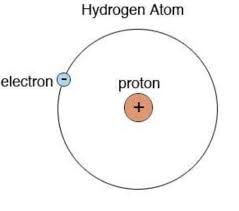
Protium (represented as 1H1) contains 1 proton, 1 electron and 0 neutrons.
Q2: Why are some elements chemically inert?
Ans: Because their outermost (valence) shell is completely filled, they have a stable electron arrangement and therefore do not readily gain, lose or share electrons.
Q3: Why is an atom electrically neutral?
Ans: An atom is electrically neutral because it contains equal numbers of protons (positive charge) and electrons (negative charge). These opposite charges balance each other, giving the atom a net charge of zero.
Q4: What is the charge and mass of alpha particles?
Ans: An alpha particle has a charge of +2 and a mass of 4 a.m.u.
Q5: What are valence electrons?
Ans: Valence electrons are the electrons present in the outermost shell of an atom.
Q6: An atom has atomic number 12, what is its valency and name the element?
Ans: Atomic number = 12 → Protons = Electrons = 12.
Electronic configuration: K, L, M = 2, 8, 2.
Valency = 2 (it tends to lose two electrons to attain a stable configuration).
Element: Magnesium.
Q7: Find the number of neutrons in 27X13.
Ans: Mass number (A) = 27, Atomic number (Z) = 13 (protons)
Number of neutrons = A – Z = 27 – 13 = 14.
Therefore, neutrons = 14.
Q8: Where is the mass of an atom concentrated?
Ans: The mass of an atom is concentrated in the nucleus because most of the atom’s protons and neutrons (which carry nearly all the mass) are located there.
Q9: Name two elements with the same number of protons and neutrons.
Ans: Carbon and Oxygen are examples where a common isotope has equal numbers of protons and neutrons:
- Carbon (for 12C): Protons = Neutrons = 6
- Oxygen (for 16O): Protons = Neutrons = 8
Q10: Draw the atomic structure of a sodium atom.
Ans:
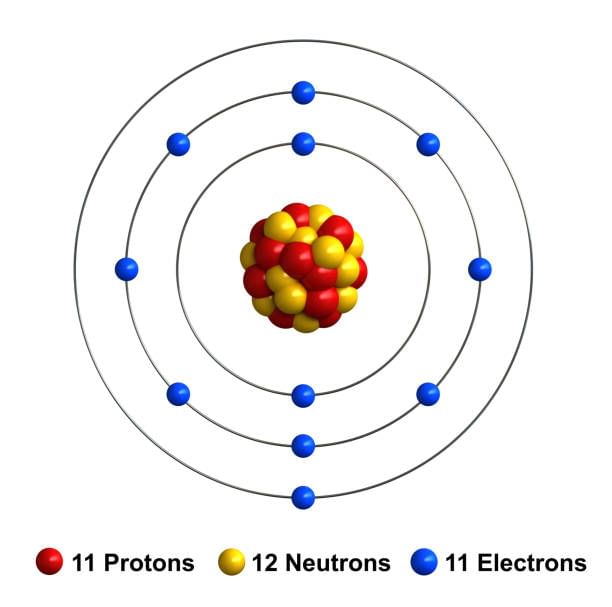
Electronic configuration of sodium: K, L, M = 2, 8, 1; valency = 1.
Q11: Name the isotope used for the treatment of cancer.
Ans: A commonly used isotope for cancer treatment is Cobalt-60 (an isotope of cobalt).
Q12: AXZ What does this symbol represent?
Ans: X → Symbol of the element.
A → Mass number (total number of protons and neutrons).
Z → Atomic number (number of protons).
Q13: Can the value of ‘Z’ be the same for two different atoms?
Ans: No. The atomic number (Z) is unique to each element; two different elements cannot have the same atomic number because Z defines the element.
Q14: Can the value of ‘A’ be the same for two different atoms?
Ans: Yes. Different elements can have the same mass number (A). For example, calcium and argon both have mass number 40 (they are isobars).
Short Answer Type Questions
Q1: Name the scientist who discovered protons and neutrons in an atom.
Ans: Protons were discovered (observed) by E. Goldstein in 1886, neutrons were discovered by J. Chadwick in 1932.
Q2: What is the contribution of Bohr and Bury together to the structure of the atom?
Ans: Bohr and Bury proposed the distribution of electrons in shells using the formula 2n2, where n is the shell number. This gives:
- First shell (K, n=1): 2 electrons
- Second shell (L, n=2): 8 electrons
- Third shell (M, n=3): 18 electrons
- Fourth shell (N, n=4): 32 electrons
Electrons fill shells beginning from the innermost shell outward.
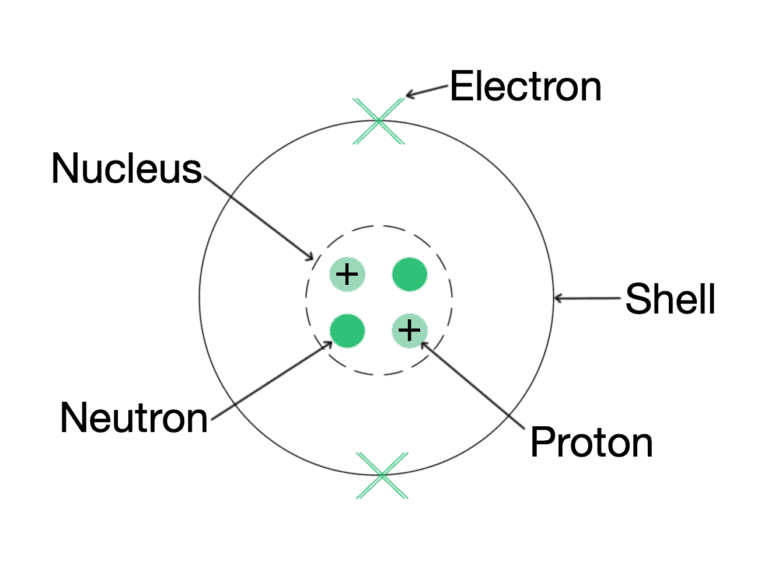
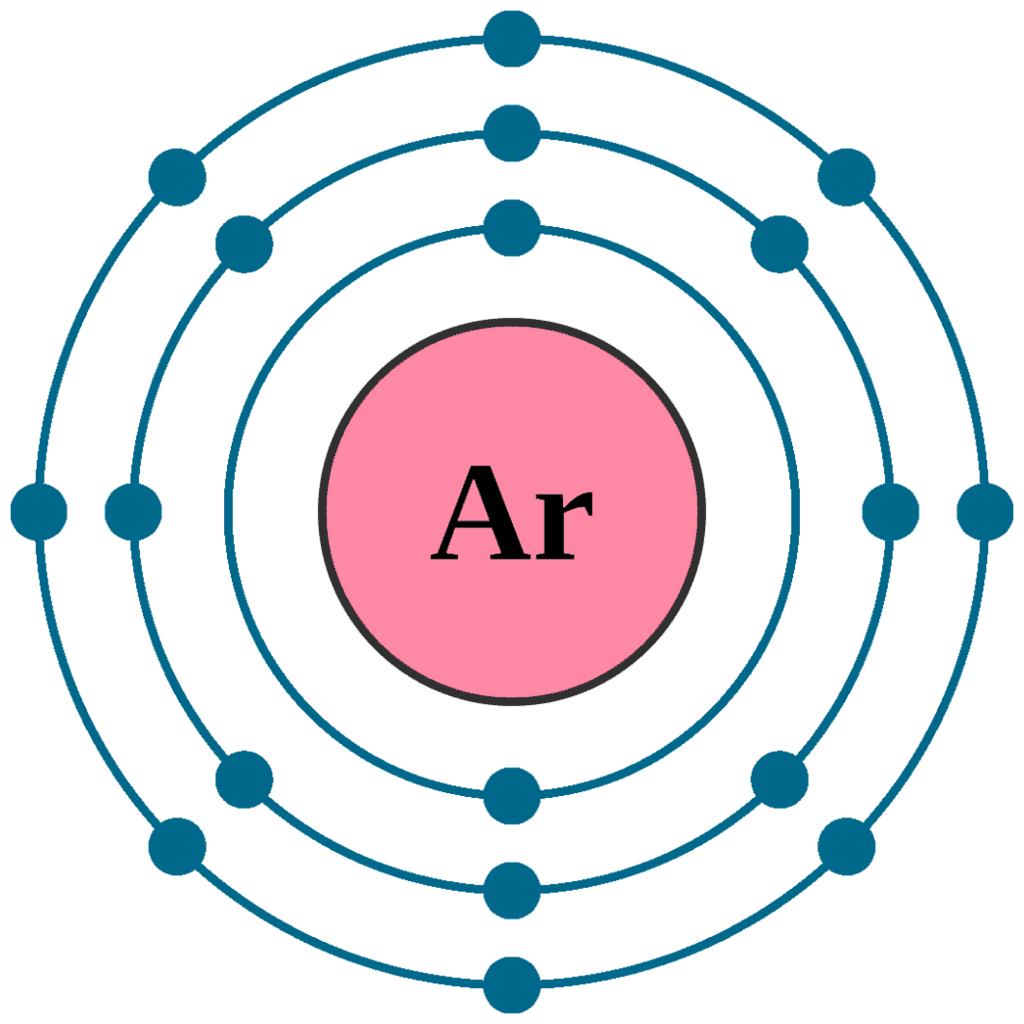
Q3: Draw the atomic structure of (i) an atom with the same number of sub-atomic particles, (ii) an atom with the same number of electrons in L and M shells.
Ans: (i) Helium ( most common isotope 4He ) has Protons = 2, Electrons = 2, Neutrons = 2.
(ii) Argon has filled L and M shells: K, L, M = 2, 8, 8.
Q4: What is an octet? Why would atoms want to complete their octet?
Ans: An octet refers to a stable arrangement of eight electrons in the outermost shell (common for many elements). Atoms tend to complete their octet because a full valence shell gives a more stable, lower-energy electronic arrangement, achieving an octet reduces the atom’s tendency to react.
Q5: Find the valency of 14N7 and 35Cl17.
Ans: The atomic number of nitrogen = 7, No. of protons = 7, No. of electrons = 7
Electronic configuration = K, L =2 ,5
Valency = 3
Because it will either gain three electrons or share 3 electrons to complete its octet.
The atomic number of chlorine = 17, p = 17, e=17
Electronic configuration = K, L ,M= 2 ,8 ,7
Valency = 1
Because it will gain 1 electron to complete its octet.
Q6: Pick up the isotopes among the following and state the reason.
Ans: The isotopes are 35X17 and 37X17, because both have the same atomic number (17) but different mass numbers (35 and 37).
Q7: Pick up atoms that have the same number of neutrons from the following:
Ans:

Q8: What are nucleons? What is the name given to those atoms which have the same number of nucleons?
Ans: Protons and neutrons present in the nucleus are called nucleons. Atoms of different elements that have the same total number of nucleons (same mass number) are called isobars.
| Element | Protons | Neutrons | (Protons + Neutrons) |
| Argon | 18 | 22 | 40 |
| Calcium | 20 | 20 | 40 |
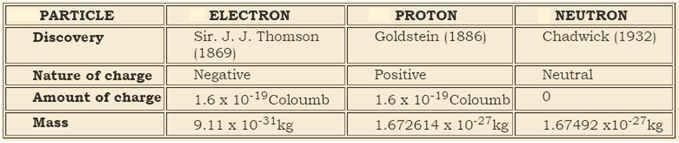
Q9: Give the difference between the three sub-atomic particles.
Ans: The three sub-atomic particles are electron, proton and neutron. Key differences:
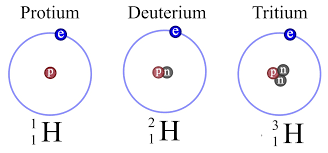
Q10. Give the names of three atomic species of hydrogen.
Ans: The three atomic species (isotopes) of hydrogen are: Protium (1H), Deuterium (2H) and Tritium (3H).
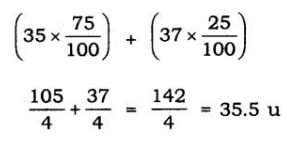
Q11: Atomic mass exists as a whole number. Why do we write the atomic mass of chlorine as 35.5 u?
Ans: Chlorine occurs naturally as a mixture of two main isotopes, approximately 75% 35Cl and 25% 37Cl. The atomic mass given (≈ 35.5 u) is the weighted average of these isotopic masses:
Q12: Give the difference between isotopes and isobars.
Ans:
| Isotopes | Isobars |
| Atoms of the same element | Atoms of different elements |
| Have the same atomic number (Z) | Have different atomic numbers (Z) |
| Have different mass numbers (A) | Have the same mass number (A) |
| Number of protons and electrons are the same in each isotope of the element | Number of protons and electrons differ because elements are different, but total nucleons are the same |
Q13: The Number of protons and electrons are same in an atom. Then why is it wrong to say that the atomic number of an atom is equal to its number of electrons?
Ans: Although in a neutral atom the number of electrons equals the number of protons, the number of electrons can change when the atom forms ions (by loss or gain of electrons). The atomic number (number of protons) remains fixed and uniquely defines the element, so atomic number should not be equated with the variable number of electrons.
Q14: An atom is electrically neutral but on loss or gain of electrons why does it become charged?
Ans: An atom is electrically neutral because it has an equal number of protons and electrons. However, when it loses or gains electrons, it becomes charged:
- If an atom loses electrons, it has more protons than electrons, resulting in a positive charge.
- If an atom gains electrons, it has more electrons than protons, leading to a negative charge.
Q15: In the structure of an atom, why are protons present in the centre and are not pulled outside by the electrons, as both are oppositely charged with the same unit of charge?
Ans: Protons are located at the centre of an atom, forming the nucleus, due to their significant mass. Here are the key reasons:
- Protons have a mass of approximately 1 unit, making them much heavier than electrons.
- Electrons have a negligible mass, roughly 1/1800 that of protons.
- Despite being oppositely charged, the mass of electrons is insufficient to pull protons away from the nucleus.
This structure ensures stability within the atom.
Q16: According to you, among the structures of an atom studied, which model is correct and why?
Ans: Bohr’s model of the atom is the most accurate because it effectively explains the arrangement of nucleons (protons and neutrons) at the centre, with electrons orbiting around them in specific, discrete paths.
- Electrons in these orbits do not lose energy.
- This stability allows them to remain in their respective shells.
Long Answer Type Questions
Q1: What are isotopes? State its characteristics, and give the uses of isotopes?
Answer: Isotopes are atoms of the same element that have the same atomic number (Z) but different mass numbers (A).
Characteristics:
(1) Physical properties (such as mass and density) of isotopes differ.
(2) Chemical properties are effectively the same because they have the same electronic configuration.
Uses:
(1) Uranium-235 is used as fuel in nuclear reactors.
(2) Cobalt-60 is used in radiotherapy for the treatment of cancer.
(3) Iodine-131 is used in diagnosis and treatment of thyroid disorders (goitre).
Q2: Explain Rutherford’s α-particle scattering experiment and give its observation and the conclusion drawn.
Ans: Rutherford’s α-particle scattering experiment: Rutherford directed fast α-particles (helium nuclei) at a very thin gold foil and observed their behaviour on a fluorescent screen placed around the foil.
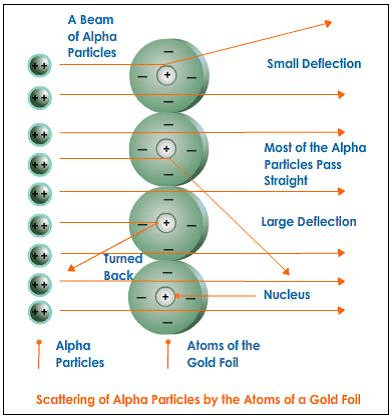
Observations:
(1) Most α-particles passed straight through the foil without deflection.
(2) Some α-particles were deflected at small angles.
(3) A very few (about 1 in 12,000) were deflected back (rebounded).
Conclusions:
(1) Most of the atom is empty space (explains why most α-particles pass through).
(2) The positive charge of the atom and most of its mass are concentrated in a very small central region – the nucleus (explains the large deflections and rare rebounds).
(3) Electrons move around this nucleus occupying the remaining space.
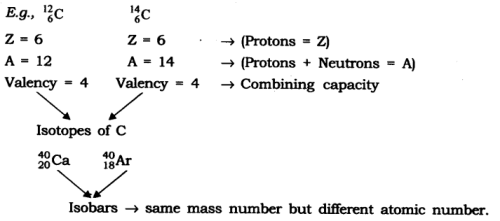
Q3: Establish the relationship between atomic number, mass number, isotopes, isobars and valency of an atom.
Ans: Atomic number — Gives the number of protons (Z)
Mass number — Gives the number of protons and neutrons (A)
Isotopes — When atoms of the same element have the same number of protons (Z) but a different number of neutrons (s) such atoms are called isotopes.
Isobars — When atoms of different elements have the same mass number (A) but different atomic number (Z) such atoms are called isobars.
Valency — It is the combining capacity of an atom.
Q4: Why do Helium, Neon and Argon have zero valency?
Ans: Helium, Neon, and Argon have a zero valency because their outermost electron shells are full, making them stable and unreactive. They don’t need to gain, lose, or share electrons to achieve a stable electron configuration.
- In Helium, the outermost orbit contains two electrons, forming a stable duplet configuration and remains inert in most reactions.
- Both Neon and Argon have eight electrons in their outermost shell, resulting in a stable octet configuration, which makes them unreactive under normal conditions.
Q5: What were the drawbacks of Rutherford’s model of an atom?
Ans: The drawbacks of Rutherford’s model of an atom are significant in understanding the limitations of his atomic theory. Rutherford conducted an experiment where he directed alpha particles at a thin gold foil and observed their deflection patterns. However, his model faced several challenges:
1. Stability of Electrons: Rutherford’s model couldn’t explain how electrons, which are charged particles, could continuously move in orbits around the nucleus without losing energy
2. Radiation Concerns: According to classical physics, any accelerating charged particle emits electromagnetic radiation. If this were the case, the electron would lose energy, spiral inward, and collapse into the nucleus, contradicting the stability of the atom.
Q6: Compare the properties of electrons, protons and neutrons.
Ans:
