Question 1. A point (other than zero) is such that [The abscissa of the point] = [The ordinate of the point] In which quadrants can the point lie?
Solution: ∵ abscissa = ordinate ⇒ x = y.
For a non-zero point x and y must have the same sign.
∴ The point lies in I (both positive) or III (both negative) quadrant.
Question 2. A line ∠M is drawn parallel to X-axis at a distance of 5 units from it. On ∠M a point P is marked at a distances of 3 units from the Y-axis. What are the coordinates of P?
Solution: The line ∠M is at a distance 5 units from the x-axis, so it may be at y = 5 or y = -5.
The point P is at a distance 3 units from the y-axis, so x = 3 or x = -3.
Therefore the possible coordinates of P are (3, 5), (-3, 5), (3, -5) or (-3, -5).
Question 3. Which of the following statements are true?
(i) The point (0, -4) lies on y-axis
(ii) The perpendicular distance of the point (5, 7) from the x-axis is 5.
(iii) Point (1, -1) and (-1, 1) lie in the same quadrant.
Solution: Only the statement (i) is true.
Explanation:
(i) (0, -4) has x = 0, so it lies on the y-axis – True.
(ii) Distance from the x-axis = |y| = |7| = 7, not 5 – False.
(iii) (1, -1) lies in IV quadrant while (-1, 1) lies in II quadrant – False.
Question 4. What are the coordinates of origin?
Solution: (0, 0) are the coordinates of the origin; it is the point of intersection of the x-axis and y-axis.
Question 5. What is the sign of y-coordinate below the x-axis?
Solution: It is always negative (y < 0).
Question 6. What is the x-coordinate of a point on y-axis?
Solution: It is always 0.
Question 7. In which quadrant the point (-2, 5) lies?
Solution: (-2, 5) lies in the II quadrant because x is negative and y is positive.
Question 8. What is the sign of the y-coordinate of a point lying in the III-quadrant?
Solution: The y-coordinate of a point in III quadrant is always negative (y < 0); both x and y are negative in III quadrant.
Question 9. If the two points are A(-2, 7) and B(-3, 4) then what is (abscissa of A) – (abscissa of B)?
Solution: ∵ abscissa of A = -2 and abscissa of B = -3
∴ (-2) – (-3) = -2 + 3 = 1
Question 10. If the y-coordinate of a point is zero, then where does this point lie?
Solution: It lies on the x-axis (because y = 0).
Question 11. What are the coordinates of a point lying on the y-axis at negative 3 units?
Solution: (0, -3)
Question 12. What are the coordinates of a point whose ordinate is 5 and lying on the y-axis.
Solution: (0, 5).
Question 13. In the following figure, which point has its abscissa as -3
Solution: The point p(-3, 3) has its abscissa as -3 because abscissa means the x-coordinate.
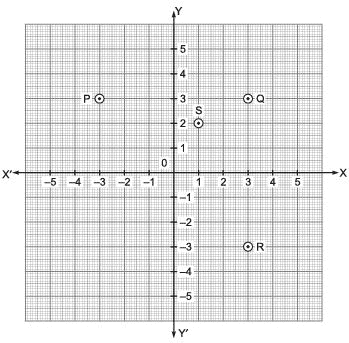
Question 14. Name the collinear points in the above figure?
Solution: The points P, O and R are collinear because they lie on the same straight line.
Question 15. What is the distance of the point (3, – 4) from x-axis?
Solution: The distance from the x-axis equals |y| = |-4| = 4 units.
Question 16. The origin lies on which of the following? x-axis only, both axis, none of the axes
Solution: The origin lies on both the axes.
Question 17. The abscissa of a point is 5 and it lies on the x-axis. What are its coordinates?
Solution: (5, 0) since y = 0 on the x-axis.
Question 18. A point lies on the x-axis as well as on the y-axis. What are its coordinates?
Solution: (0, 0)
Question 19. In which quadrants x and y coordinates have different sign
Solution: II and IV quadrants, because there x and y have opposite signs.
Question 20. In which quadrants x and y coordinate have same sign?
Solution: I and III quadrants, because there x and y have the same sign.